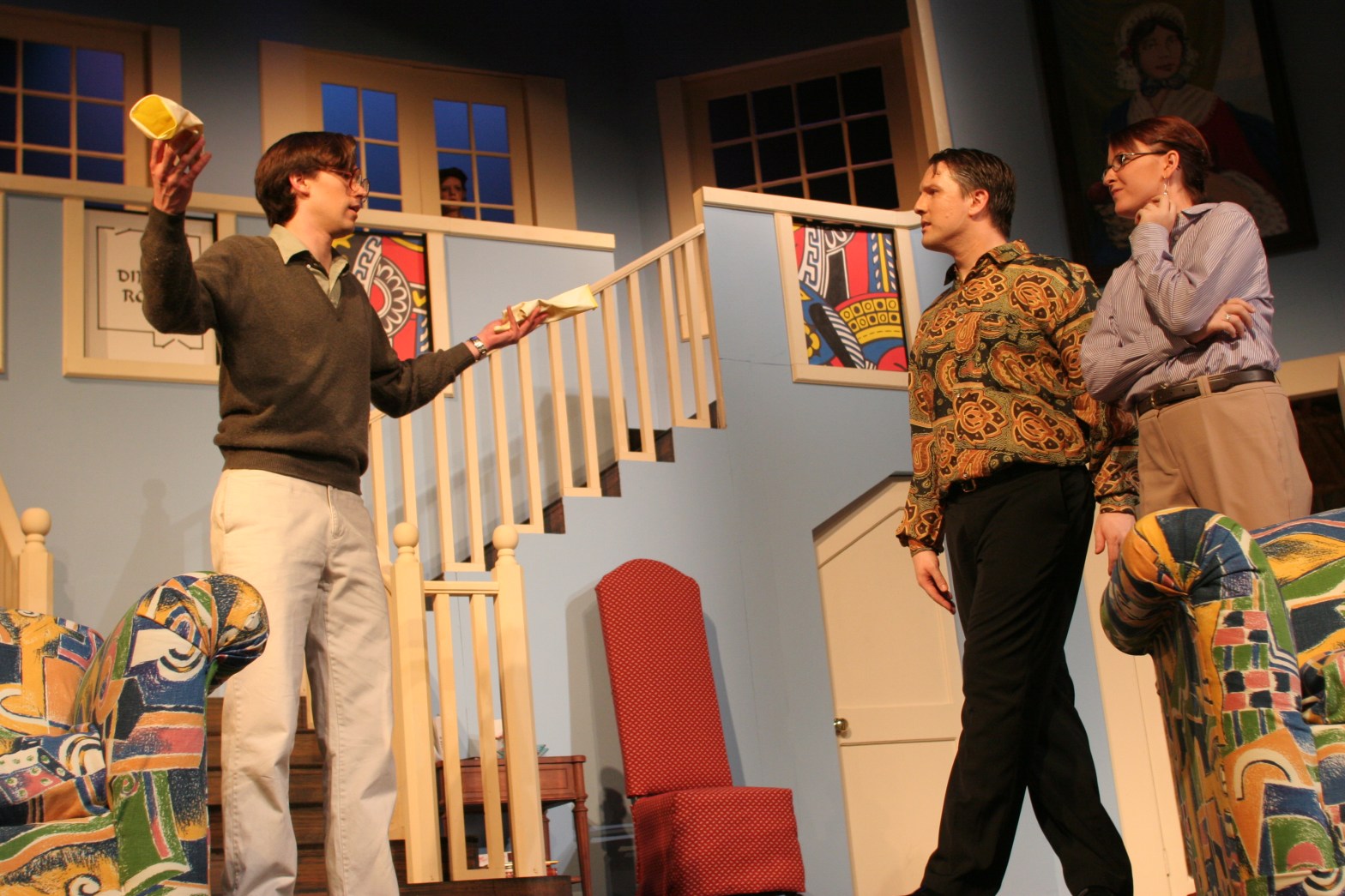
In addition to serving as a worthy language challenge, Last Letter, First Letter can also open up your dialogue in new and creative ways.
The Basics
All scenic dialogue must obey one simple (but demanding) rule: the current line must begin with the last letter of its predecessor.
Example
Two highschoolers sit on the edge of a community swimming pool, dangling their legs into the water.
Player A: “So, the prom is in two weeks.”
Player B: (obliviously) “Sure is.”
Player A: “Seems like everyone already has a date.”
Player B: “Everyone I know.”
Player A: “Well, not everyone…”
The Focus
Good give and take, active listening, and bold accepting will help fuel the engine of the game.
Traps and Tips
The techniques involved in this scenic dynamic have a lot in common with Alphabet Game, which you can review here. Most of these pointers are explicated further there.
1.) Stick your landing. Meandering sentences with unclear endings won’t help your teammates, so get out of your sentences cleanly and without unnecessary (and unspellable) utterances. Remember that your partner needs to know what letter they’re obliged to use, and they can’t do that if you don’t offer them a clear and definitive choice.
2.) Pass the ball. Especially when your scene involves more than two characters, endeavor to resolutely give focus so that the likely next speaker is clear to everyone. This prevents overtalking and the potential of multiple justifications of the same letter. The general contact of the game is that players won’t typically speak twice in a row either. (Long, multi-sentence speech acts can be confusing in this regard, too, as it will become confusing where one “sentence” ends and another begins, or if the monologuing player should essentially play the game with themselves.)
3.) Get off the bench. Here’s my perennial advice for language games: don’t make it only about the words. Our two highschoolers will likely be served by embracing some activity and action. It’s fine to start simply, and improvisers might need a few beats to settle into the rhythm and peculiarities of the language device. However, if you’re only thinking about your words, it’ll be difficult to build energy, so commit physically to the world of the play.
4.) Don’t be a jerk. A little playful shivving will likely occur, but this is markedly different that doggedly trying to end all your sentences with “box” and “fez.” I find it exponentially more delightful when players stumble accidentally into challenging letters than when you feel an improviser desperately forcing a doozy into the mix. While it’s helpful to be mindful that you’re not ending on the same word (or letter) time and again, let the scrabble tiles fall where they will and just craft your dialogue from there. Then if an “x” appears organically, the audience will love the resulting struggle.
In Performance
Language handles are popular mainstays in short-form shows. This game provides a nice (and potentially subtle) alternative to more common offerings while also allowing you to enjoy something resembling an open scene. Check out my previous Game Library entry, Last Letter Circle (here) if you’re looking for a good skills warm-up before leaping into the deep end.
Remember, you can expand your improv vocabulary with The Improv Dictionary now on sale here.
Cheers, David Charles.
www.improvdr.com
Join my Facebook group here.
Photo Credit: Tony Firriolo
© 2024 David Charles/ImprovDr
Game Library Expansion Pack I
 ImprovDr.com