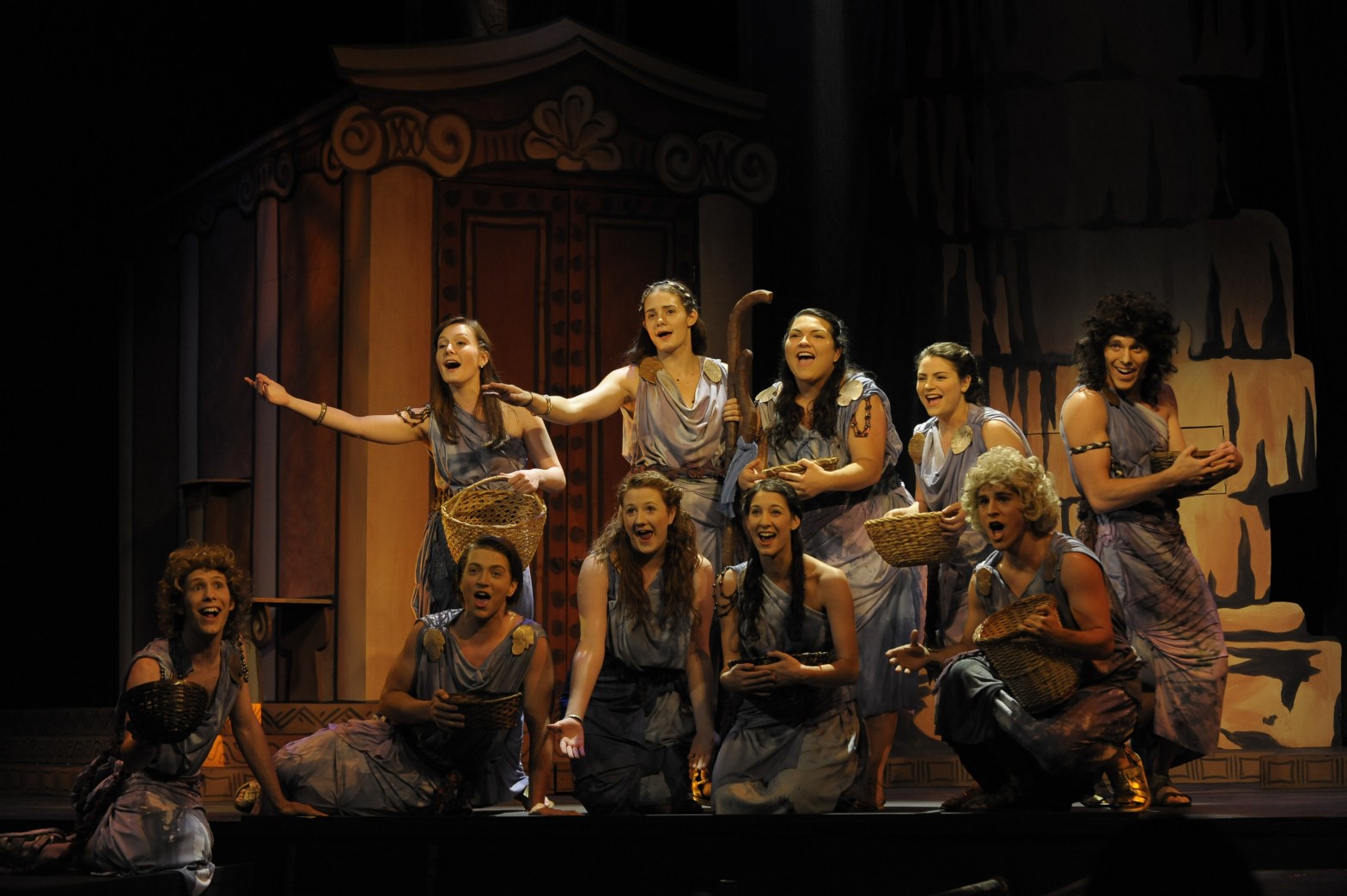
Get the proverbial improv party started with this musical jamming session.
The Basics
Players form a circle to begin.
Round one
Player A begins by creating a repeated and steady musical and rhythmic choice and “sets it” to a predictable beat. Once this has become uniform, they turn to Player B and now both players share and voice that one musical contribution. Once B understands the logic and essence of A’s choice, they then craft a new sound pattern that complements its predecessor. Both players jam until they are happy with the combination and then B offers up this sound to Player C to mirror and join. Player C now repeats B’s offer before introducing a new melodic or rhythmic choice of their own. In this manner, everyone in the circle establishes a new musical thread after mirroring that of the prior player.
Round two
Once everyone has their own musical strain going, players are instructed to break the circle and move freely around the space. Improvisers jam with other sounds in the soundscape while maintaining the initial integrity of their own choice.
Round three
After sufficient exploring has occurred, the facilitator instructs everyone to return to their original spots in the circle. The musical jam session is then deconstructed in reverse order, so if P was the last improviser in the circle to create their sound, they are the first to go quiet upon the facilitator’s prompt. Then Player O, then N, and so on, until the exercise culminates with Player A repeating the original contribution one last time.
Example
This is a little hard to model in a written medium, but the sequence would start off something like this…
Player A: (singing in tempo) “Ba cha – ba cha cha cha. Ba cha – ba cha cha cha…”
Players A and B: (singing in unison) “Ba cha – ba cha cha cha. Ba cha – ba cha cha cha…”
Player B: (while A continues with the above) “Dooooo bada. Do do do do do…”
Player B then turns to C while A continues.
Players B and C: (singing in unison) “Dooooo bada. Do do do do do…”
The Focus
This warm-up helps push musical boundaries while also reminding players that music which doesn’t strongly connect to prior choices will quickly devolve into cacophony. (How’s that as a metaphor for just improvising with each other in general?!)
Traps and Tips
1.) Mirror. It’s right there in the game title (!) but the exercise will quickly become chaotic if players don’t really take the time to sync in with their predecessor in the circle. When the group is in the zone, this overlap can become quite brief and uniform, but don’t let a prior pattern prevent you from taking a little extra time (or a lot of extra time) if you need it in order to adjust your musical offering so that it fits well with what’s already happening. Unhelpful rhythmic battles, or discordant wails that aren’t massaged early on in the process will quickly cause untold and compounding havoc further done the line.
2.) Project. For those who may be a little more anxious about musical games – and singing in general – it can prove tempting to take the smallest risk by almost whispering your addition to the soundscape. Such an approach to the game will have an odd effect on the overall experience if each added voice starts to actually diminish the overall volume – keep marching towards a group crescendo! As is the case with most big ensemble warm-ups, you’ll want to share the acoustic space, so once you’ve boldly crafted and set your vocal line, pull it back a little so that others can hear their new additions more easily. (And then, when round two hits, pump up that volume again!)
3.) Push. If you have a strong background as a musician, bring that expertise and confidence to the game. By all means play to the top of your musical intelligence, just be wary that the next person in line will need to understand and replicate what you’ve done, so perhaps leave that more advanced musical theory at home if you’re working with a lot of novices. Do, however, notice and address what might be missing from the orchestration if others will be less inclined or able to make those assessments. If everyone is doing something rhythmic, offer up a soaring melodic thread. If everyone is starting predictably on the “1,” perhaps introduce a little syncopation or contrast. When new and playful dynamics are introduced, others are more likely to learn and emulate them further down the line.
In performance
If you have some folks who are a little musically challenged, it can be an act of service to the ensemble not to start with them so that a more confident voice can offer up the baseline that the group will then use as the core of the exploration. If you’re looking for another similar warm-up, Sound Mirror can serve as a nice lead in to Musical Word (here) which explores a lot of the same dynamics and skills but in a slightly speedier and more free form fashion.
Cheers, David Charles.
www.improvdr.com
Join my Facebook group here.
Photo Credit: Tony Firriolo
© 2025 David Charles/ImprovDr
Game Library Expansion Pack I
 ImprovDr.com