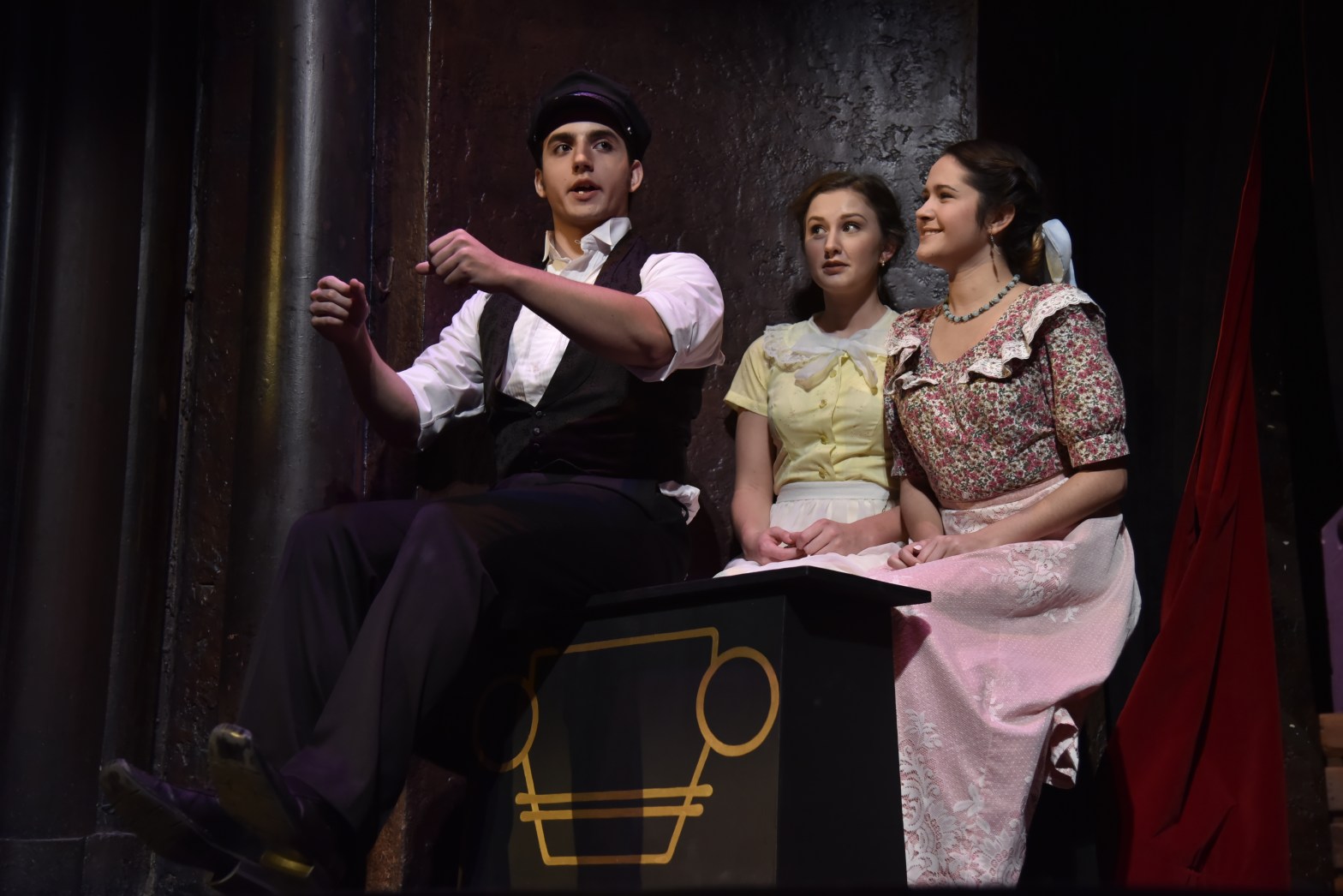
There is contagious fun to be had in this scenic dynamic that invites players to closely watch and mirror their scene partners.
The Basics
The scene takes place in a car so arrange some chairs or blocks accordingly (being aware of audience sightlines). The action usually begins with those traveling “in neutral;” that is, without providing any deliberate quirks or idiosyncrasies. Soon, the passengers pick up a hitchhiker who brings a peculiar (and generally subtle) mannerism with them. Gradually, others in the car take on (and generally heighten) this contagious behavior. The journey continues with the addition of multiple hitchhikers at strategic intervals.
Example
One player (A) begins the scene in the driver’s seat. They establish their destination (perhaps elicited from the audience as the ask-for) and happily listen to their favorite station on the radio. After a few moments, they notice a hitchhiker on the side of the road (B) and pull over to offer them a ride.
Player A: (lowering their window) “Where are you heading today?”
Player B: “I’m trying to meet up with my friends at the beach. You going that way?”
Player A: “I can get you close… Jump in!”
Player B circles the car, opens the passenger door, gets in, and fastens their seatbelt, discreetly scratching their neck as they situate themselves.
Player A: (restarting the car) “It’s a nice day for it!”
Player B: “It’d be a shame to waste this weather.” (B scratches a little more) “What are your plans for the day?”
Player A: “It’s a workday for me, alas. I’m off to a sales meeting.” (A starts to experience an itch of their own…)
The Focus
I’m including several helpful variations below, each of which tends to adjust the focus and the gift of the scene a little. Generally, this exercise is great for developing close listening and observing, gently building a curve of absurdity, and using quirks or mannerisms to create energy and character.
Traps and Tips
1.) Individual or group. The scene can begin with either an individual driver or a carload of passengers (perhaps the whole team except for one player on reserve to enter as the first hitchhiker). In the first iteration, the scene tends to naturally conclude once the car is full, and every team member has entered (usually four or five unless your stage can fit a minivan!). In the second version, players tend to cycle through the car, leaving and then returning with a new peculiar behavior. Regardless of the approach, be mindful where you seat the character offering up the new dynamic. If the audience and, more importantly, other players can’t easily see and hear them, there is little likelihood their quirk will be recognized and incorporated. To this end, it can be helpful to shuffle characters with each entrance, perhaps placing the unknown entity in the front passenger seat (or even have them drive).
2.) Consistent or changing. There is also fun to be had with how you approach characterization in the game. Players may remain as the same character for the duration of the scene (this tends to be the norm for the slower starting “individual” version described and modeled above). If you’re cycling through a larger cast of players – seven or eight – this will be the most workable option as well. However, if you’re up for a challenge, players can rotate through the car, exiting after a while, only to return as a new character with a new mannerism for their carmates to adopt. This steers the game towards a faster style of play, with characters being broader and quirks become mirrored more immediately; but, if you’re looking for an exercise to encourage players to make big character choices off the bat, this variation will fit that bill.
3.) Discrete or cumulative. A third variable consists of how players treat the introduced behaviors. A “discrete” dynamic encourages improvisers to identify and then exaggerate one quirk at a time, with previous idiosyncrasies vanishing when a new character and mannerism emerges. This style tends to privilege nuance, patience, and subtlety (remembering that players needn’t play the same quirk in the same way). Alternatively, a “cumulative” attitude keeps all prior silliness in play, so as one quirk reaches its crescendo, a different behavior gradually joins the fray with the arrival of a new hitchhiker. Exploring a variety of behaviors is important in any of these versions, but it’s particularly crucial if you’re inclined to this last technique. If Player B introduces scratching, Player C then brings in picking lint off their sweater, and then Player D offers straightening their blouse, the activity in the car will likely start to merge in unhelpful ways. To avoid this, look for contrasting categories of behavior: Player B has introduced something physical, so perhaps Player C joins with a distinct verbal tick or language game, and D adds a contrasting emotion…
In Performance
Don’t forget to pace and justify the various choices – characters needn’t be engaged in the same peculiar action for the same reason, for example. I enjoy the challenge of trying to maintain the recognizable humanity of the world as long as possible. In this manner, the game can nicely embody the curve of absurdity ethos. Sure, if you’re all simultaneously exploring five or six weird character traits, the scene is likely to be wonderfully ludicrous. But it’s even better if everyone savored the road to get there and doesn’t just rush to ridiculousness for the sake of ridiculousness!
New to ImprovDr.com or the Game Library? You can find the ever-expanding collection of games, exercises, and warm-ups here.
Cheers, David Charles.
www.improvdr.com
Join my Facebook group here.
Photo Credit: Tony Firriolo
© 2023 David Charles/ImprovDr
Game Library Expansion Pack I
 ImprovDr.com