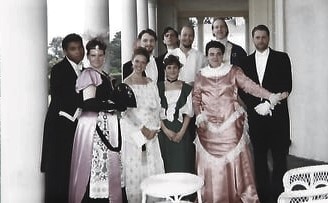
When I trained into the company of Astors’ Beechwood, part of our rehearsal process consisted of spending an uninterrupted day in the shoes of our 1890s character on the estate. I will freely confess that this was a rather different undertaking depending on whether you were an upstairs or downstairs persona. While some cast mates polished (my) shoes and prepared (my) meals, as a well-to-do newlywed summering with the Astors, much of my day consisted of just trying to keep myself busy and entertained. #upperclassproblems
I’d certainly recommend engaging in a similar intensive living history enactment, given the chance, but I assume many won’t have the time or resources for such an enterprise. Instead, I offer here a character-based exercise inspired by this experience and shaped by some of my own experiments with the work of Augusto Boal. I refer to the hour-long (or so) game as Day in the Life.
Here’s a peek inside the mechanics:
The Basics
Prior to the exercise, each participant is instructed to find a private area of the rehearsal space that will serve as their home base. Players are given a slip of paper that provides a particular occupation, such as athlete, farmer, artist, or accountant. (Actors could also just assume a scripted role of you wanted to use the same conceit to explore a company of characters and their backstories.) The following experiential exploration tracks each concocted character for one typical weekday as they engage in morning preparations, work assignments, and evening activities. A caller (the facilitator or instructor) provides frequent time updates as well as questions and prompts to gently help shape and guide the play.
The Details
This exercise allows some rather intensive empathizing and imagining as it really requires players to step into the realities of their dramatic creations. It may be unavoidable if you’re assigned an unfamiliar occupation for the exploration to begin with rather broad assumptions or stereotypical actions. The hope, however, is that as the day gradually clicks through the hours that these actions will become enriched and questioned as participants make more grounded and embodied discoveries. The exercise is designed to function largely as a coached solo experience with players only briefly interacting with imagined scene partners as needed (as opposed to other improvisers in the space) with the notable exception of the climactic gathering that finally brings everyone together.
Example
Players have scattered throughout the space and begin the exercise in a state of recline, as if asleep, while the general instructions are relayed. If possible, the lights may be dimmed or similar to provide a greater sense of privacy and isolation. Throughout, the caller provides time updates and questions to elicit activity and deeper connections.
Caller: “It’s 6am. Are you still asleep? What are your surroundings? When do you usually get up? Is anyone else sharing your space…?”
A minute or so passes with (probably) the majority of the participants still asleep…
Caller: “It’s 6:15. Do you generally sleep well? Are there any stresses from your day or job that followed you to bed last night? What can you hear or see outside your bedroom window…?”
The exercise continues as players experience the events of an imagined typical day…
Traps and Tips
As this is a rather epic coached exploration, my observations largely pertain to the role of the facilitator…
1.) Question rather than mandate. Part of the premise of this game is that a character’s occupation can have profound influences on their given circumstances and how they live their lives. While it’s foreseeable that our farmer or athlete might rise at the crack of dawn to tend to their obligations or training regiment, our artist or accountant might sleep in considerably longer (unless they have young children!) If the sidecoach mandates action – “It’s time to get up!” – as opposed to proffers questions – “Do you have time for breakfast?” – then much of this variety and nuance might quickly become lost. To this end, I like to provide rather broad occupation categories that also allow for individualization: the farmer might be employed on an industrial-level scale megafarm, or work on a family plot of land or more boutique scale; an athlete might be at the top of their game and competing on an Olympic or professional level complete with a full support team, or working feverishly but alone just to break into the minors…
2.) Embrace specific ambiguity. As each individual will experience their day on a different timeline and at a different pace, pursue broad questions – albeit provocative ones – as the coach. I like that the randomness of the occupation assignments can invite players to step wildly out of their comfort zones and knowledge bases. A reasonably benign activity such as consuming breakfast can look quite different for each emerging character. Do they have time to prepare and sit down to enjoy a proper meal? Do they need this level of sustenance for the day ahead? Or does their workflow demand that they grab something on the run if they have time for anything at all? It’s helpful to pepper the experiment with such questions to encourage players to consciously interrogate their choices and assumptions. Complicating factors such as family circumstances, age, and health status – which have little to do with many occupations – are also fruitful areas to question and examine.
3.) Don’t be afraid of the silence. I’ve experienced that participants find a gentle narrative of the timeline and day as helpful, but also don’t be afraid of deliberate silence. If you’re new to the dynamic, it can prove tempting as the sidecoach to want to fill most moments with language, but it’s okay to primarily announce the time markers and then just offer a few sparse questions to guide the play (especially if improvisers are clearly immersed and engaged in the process). It’s also helpful to establish that characters should relish the silence, too. Many occupations require some level of prolonged interaction with co-workers, but for the purpose of the exercise, it’s helpful to lean into more solitary tasks. Most players will tend to use much of the greater space as they explore different components of their paradigmatic day, but it’s generally advisable for them to politely ignore other bodies they might bump into as characters will generally occupy conflicting realities that will only implode the requisite concentration: one player’s law office won’t easily coexist with another’s farmland.
4.) Encourage movement and activity. If you’re not careful, the tone of the exercise can take on a less-than-helpful cerebral energy, with players largely contemplating what their day might feel like rather than actually putting the reality into their bodies. Whenever possible, as the coach, use your questions to gently spur on action. How do the various personae get to and from work – their own vehicle, public transportation, walking…? What is their grooming or clothing regiment in the morning? Do they tend to eat lunch in their workspace, or do they have another preferred location? While I also like to ask questions that invite players to investigate their emotional journey and truth – “What are you looking forward to today,” “Who do you see in your day that gives you joy…?” – sometimes it’s equally vital to prod activity with the likes of “There is a task you need to complete before your workday is through…”
5.) Consider the climax. As the day moves into the early evening, I’ll place an important social gathering on everyone’s calendar. (I generally allude to this gently at least a little earlier in the exercise just to plant the seeds.) Depending on the space you’re occupying, I might stealthily move a few furniture pieces around to approximate an art gallery, reception hall, or similar as the evening calls draw close. Around 8pm I’ll start nudging characters to make their way to this occasion that has some special significance to them: perhaps they are showing their artwork, or networking to find an investor, or accompanying a loved one or spouse out of obligation, or working the evening to make some extra cash. For the last phase of the game, I’ll now encourage players to gently interact with each other (although my strong preference is for this to remain largely silent, perhaps with utterances or the like so that characters don’t wander around just announcing their jobs and prior choices).
Final Thoughts
It’s important to allow sufficient time for a debrief so that players can share their feelings, discoveries, and experiences. It can be quite striking to truly embody a character through the lens of occupation that is different than your own lived or projected life choices. I like to end the journey at an all-play party and usually ask characters after they’ve had some time to wander to finally settle on a fellow partygoer with whom they feel a connection or rapport. If you’re a current student of mine, stop reading now! I like the small finesse of actually creating a stock of papers that have each occupation listed twice, and it’s striking how often these compadres find each other in the final mull. Regardless of whether or not this particular outcome materializes, it’s fascinating to see which characters group together and what assumptions – both similar and different – players made when provided with a simple but common prompt and starting point.
While this particular exercise isn’t a carbon copy of my training experience at Astors’ Beechwood in the mid ’90s (all those years ago!) it certainly gives you a small peek into the ethos and rigor of the process. It was a true pleasure to spend a summer of my life as Alfred Gordon Forster and I’m saddened that this unique Newport entertainment opportunity has closed.
You can read a little more about this venue and experience in my companion blog post here.
Cheers, David Charles.
www.improvdr.com
Join my Facebook group here.
© 2023 David Charles/ImprovDr
 ImprovDr.com