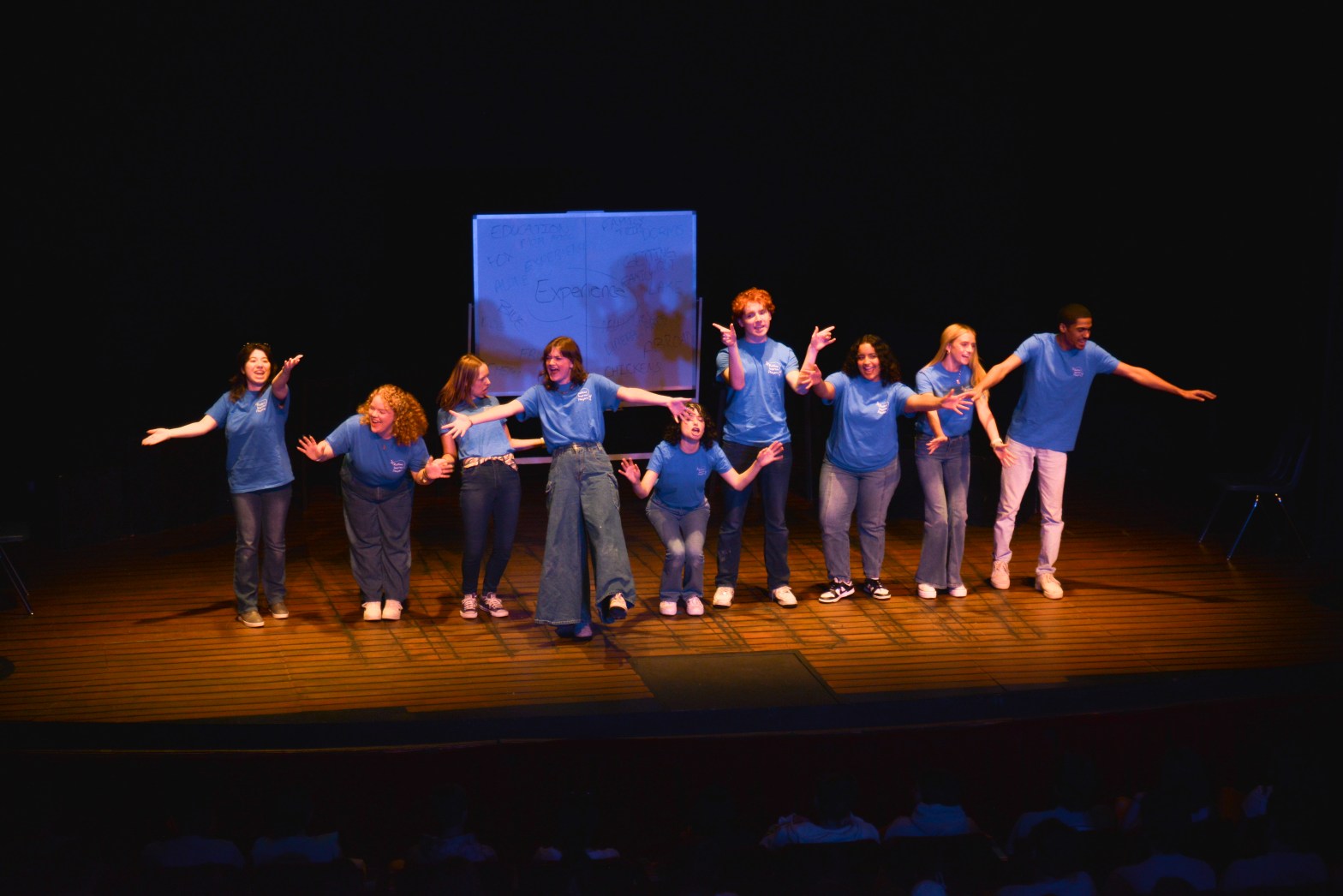
I formulated this warm-up for my university musical improv class (although I imagine others have created a similar device before me). Musical Word serves as a joyful and quick all-play that gets everyone into the collective groove.
The Basics
Players begin in a circle. (Surprise!) One participant offers up a favorite (ideally multisyllabic) word. Players deconstruct the word in the following rounds taught by the group facilitator or coach.
Round one
The player who offered the word, perhaps “syncopation,” begins by naturally repeating the word in a set cadence that their teammates echo and emulate. While everyone should strive to establish a clear and predictable rhythm, when the word is first spoken, it’s important that improvisers just allow the intrinsic musicality of the word to emerge without imposing creative embellishments.
Led by the initial volunteer, the ensemble intones “syncopation” together until they have found a common sound and rhythm.
Round two
On the leader’s signal, players now begin to slowly break the word into its constituent sounds and elements (while maintaining the original cadence and tempo as the unifying force). Although sounds should be drawn from the given word, players can play with unique rhythms, combinations, and melodies. Throughout, participants should keep an eye (or ear) on the whole and seek to work with (rather than despite) the choices of their fellow jammers.
Player A explores sustaining a snake-like “ssss” hiss underneath the chanting group. Player B offers an almost beat box series of percussive “p” hits, while C starts to sing the word in its entirety but with a soaring melody in half-time, all while others in the circle begin to add their own unique finesses.
Round three
Players are now encouraged to wander through the space at will, jamming with classmates as they come into contact. Improvisers needn’t settle into one choice and should continue to explore the different potentials of the word. However, it’s still important for each singer to maintain an awareness of the greater soundscape and their individual place within it.
Players break the circle and continue to challenge themselves as they connect with different singers and fragments of the chosen word.
Round four
Once again, the leader provides a signal – this time for participants to re-form the original circle and return to their starting positions. As the circle coalesces, so too does the word until everyone is speaking in unison again. When the ensemble feels done, everyone stops speaking, and the warm-up is over.
The circle is re-established, and the players recite “syncopation” several more times until the group falls silent.
The Focus
Pushing the boundaries of your individual and collective musicality.
Traps and Tips
1.) Play with the sounds. Look for hidden possibilities in the inspiring word and its constituent elements (in addition to using the more obvious syllables, consonants, and vowels). Elongate short vowels, contract long ones; explore how the different consonants feel when you separate them from the base word.
2.) Play with the rhythms. Set the different elements of the word to varied tempos and rhythms. It’s helpful to make sure the initial cadence serves as a unifying foundation so that the exploration doesn’t devolve into true chaos; however, don’t shy away from bravely introducing novel patterns. If your choice proves wildly incompatible, you can always return to the original word to reset your bearings.
3.) Play with your voice. Similarly, sing out fully. Try contrasting melodies and harmonies that use different parts of your voice – your chest voice, head voice, falsetto, mix… As no one is really listening exclusively to one specific singer, it’s a great chance to just try things that you might be reluctant to try as a soloist in front of an audience. Expect that there will be a little joyful failure and cacophony and embrace that reality.
4.) Play with your teammates. Finally, don’t be afraid to be a musical thief. Boldly mirror and morph the sounds and melodies and dynamics that are being offered by your teammates. The spirit of improv, after all, constantly reminds us that the most creative choice comes from the intersection of our own instincts with those of our collaborators. Just make sure that you’re offering up as much as you’re borrowing so that others can also steal from you!
In Performance
Once your group understands the various rounds, this is a great and efficient way to get folks vocally warmed up (while also offering a chance to gradually learn everyone’s favorite words)!
Cheers, David Charles.
www.improvdr.com
Join my Facebook group here.
Photo Credit: Olivia Skvarenina
© 2024 David Charles/ImprovDr
Game Library Expansion Pack I
 ImprovDr.com