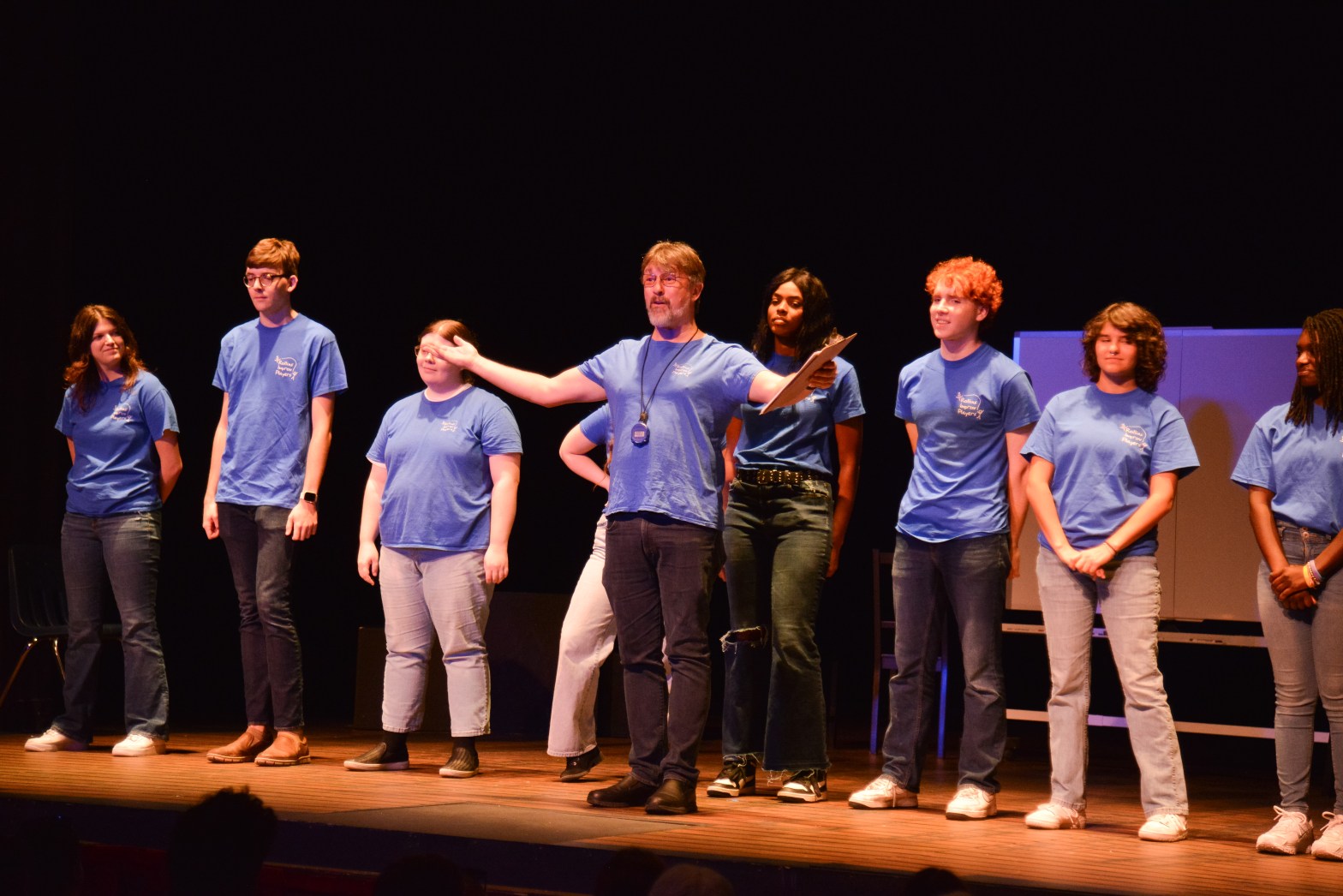
Played energetically, this warm-up will have everyone exercising their bodies and voices in a matter of minutes.
The Basics
Players form a circle. The first participant, A, introduces a unique noise and accompanying action. Starting with the player to their immediate right, this offer quickly ricochets around the circle in a counterclockwise direction (with each subsequent player not waiting for the prior player to fully complete the action before mirroring it and passing it along). When the choice makes it back to its creator – Player A initially – they repeat their own contribution. The next improviser, Player B, now introduces a brand-new motion and sound that passes around the circle with similar rapidity. The pattern continues until C, then D, and so on, add their own playful creations. When the last player’s noise and action make it back to them, the exercise is complete.
Example
Player A introduces the gesture of clasping they hands above their head while making a little jump, which moves swiftly around the circle.
After A repeats their movement, B now lunges into the circle with a whooshing sound. C mirrors this idea, as do the remaining players in sequence.
When it’s C’s turn to initiate, they perform a little “cha cha” step while whistling. D approximates this as best they can, and the noises and accompanying actions continue apace.
The Focus
It’s a simple little physical warm-up, so that’s the primary focus. However, it can also be used to build your movement vocabulary and develop bravery and reactivity.
Traps and Tips
1.) Move boldly. Avoid making wimpy choices in the initiating position. When introduced to new exercises, performers can become surprisingly reluctant to make a large or revealing offer, but the game will fall flat if every movement and sound utilizes the bare minimum of energy and attack. A particular pet peeve – that often occurs when the game has developed some momentum – is when a player unhelpfully and anticlimactically introduces an unenergized gesture (often some iteration of a “boop” with a small finger point) thus bringing the joyful wave of attack to an abrupt halt. Don’t be that person!
2.) React swiftly. I’ve used the term ricochet above as the game benefits from this approach rather than a more stop and start dynamic of each player waiting for their predecessor to finish each action in its entirety before adding their own voice and body. You want to make sure you’re honoring all the details of each new element, and so the first few participants are likely going to need a second to process the specifics, but as you get a few places around the circle, players should start to anticipate the wave of energy and diminish any pause between echoes until, ideally, the motions actually start to overlap.
3.) Build gradually. While I caution against fear-based little offers, there is a value in letting the overall size and volume of the initiations increase slowly with each new addition. To this end, perhaps don’t start the game with the biggest or most extreme move in your repertoire so that there is somewhere to go. In a related sense, it can also be fun to let each new movement build just a little with each echo around the circle so that the owner of any given noise and action finds that it returns to them in a slightly elevated or exaggerated state. In this way, each suggestion grows a little while it moves around the circle, and then each new suggestion continues to build a little from where the prior idea left off (remembering that choices ate not literally cumulative so much as responding to the earlier dynamics).
4.) Participate graciously. And just as an annoyingly under energized “boop” can put a damper on the fun, so too can players who provide impossible physical feats of strength that will only thwart their fellow ensemble members. Unless you’re workshopping in a group of trained (and well stretched) dancers, challenging the group to mirror your gymnastic splits or high kick will likely cause consternation and possibly injury. Keep in mind what will give your teammates joy rather than strive to show off a unique and perhaps unrepeatable skill.
In Performance
There’s also a version of this game called Noise and Action Backs, which exploits the same basic premise. Here, players form a line all facing forward. The player at the back of the line, A, taps the improviser standing directly in front of them, B, causing them to quickly turn around. A then introduces the inspirational first sound and action before running to join the front of the line and turning their back away from the activity. B now taps C on the back or shoulder and models the provided combination before joining the front of the line. C then does the same for D, and so on, with the movement and sound being passed through the line at an ever-increasing speed. In this warm-up, the same choice now slowly grows and morphs and heightens (in a “telephone game” style) as waiting players can’t see the exact movements of those who came before them. If you like the original and have a reasonably robust space to play in, this provides a useful variation on the central theme.
Cheers, David Charles.
www.improvdr.com
Join my Facebook group here.
Photo Credit: Olivia Skavarenina
© 2024 David Charles/ImprovDr
Game Library Expansion Pack I
 ImprovDr.com