I encountered the general conceit of this exercise in Keith Johnstone’s Impro, although I’ve tweaked the specifics to suit my own pedagogic needs and now often use this gentle variant in my introductory “Nuts and Bolts” master classes and workshops.
The Basics
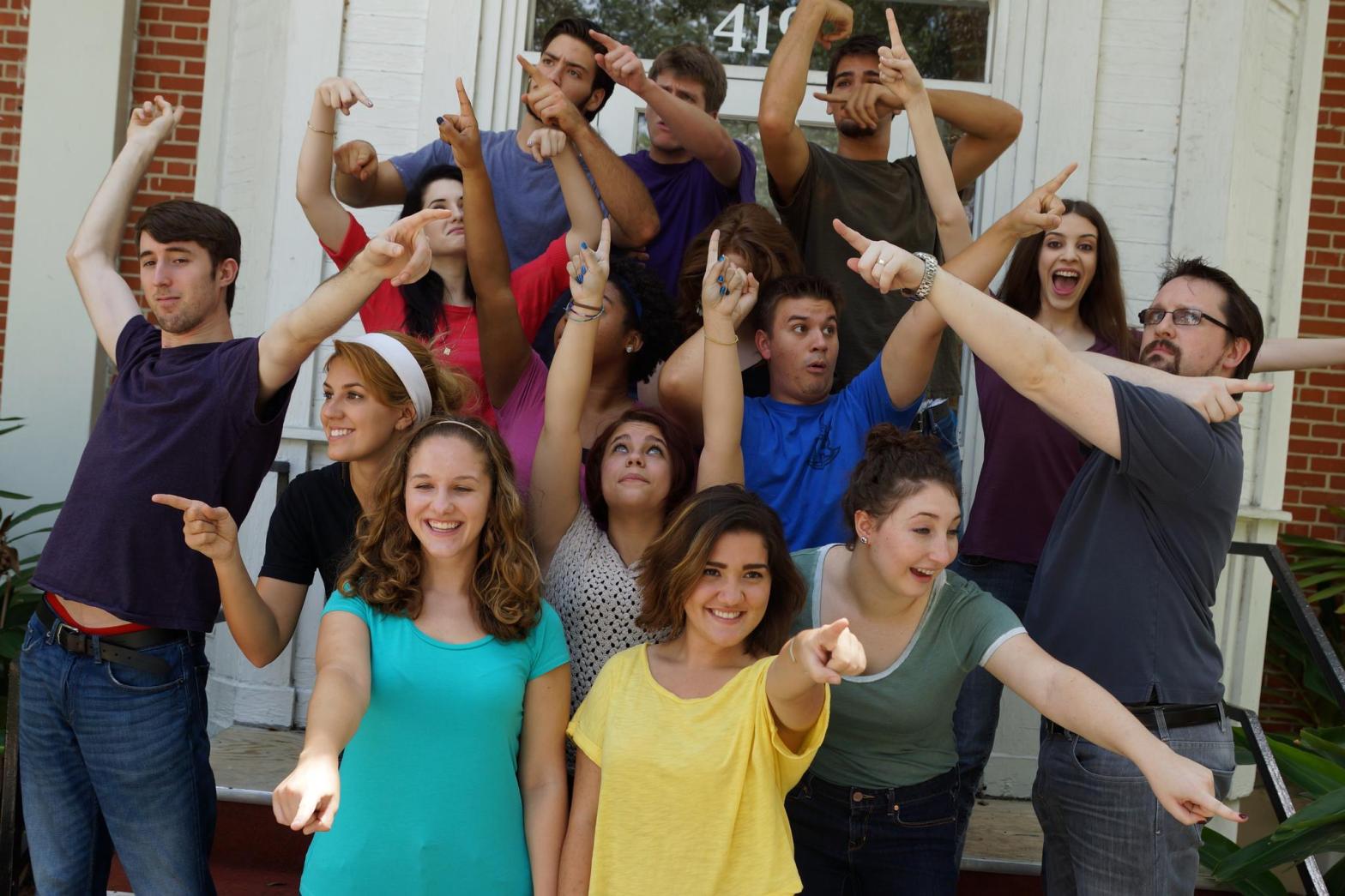
Players work individually and are instructed to walk through the space. With each new step taken, participants should pause and clearly point at a different object while exploring the following rounds of play.
Round one
Players name each selected object by its correct name in their given language. This iteration is largely about setting the rhythm and pattern of the exercise and, consequently, serves as the bedrock for the more challenging dynamics below: step, point clearly, name the given object, and repeat
Player A takes a step as their classmates do the same. They point at a window and say “window,” before taking another step – possibly in a new direction – and gesturing towards a chair…
Round two
Players continue the physical pattern above but are now required to name each object aa something that it is not. These new names shouldn’t be synonyms of the selected item, nor merely the correct name in a second or third known language if players are multilingual. Improvisers should endeavor to retain the same jaunty pace of the first round.
Player A takes a step and points at a window and says “portrait,” before taking another step – possibly in a new direction – and gesturing towards a chair which they rename as a “blanket…”
Round three
The logistics of this round remain largely the same as its predecessor; however, players are coached to avoid certain spontaneity “cheats” that might have inadvertently infused their prior process. Participants are encouraged not to repeat words they’ve heard others utter in the space or use others’ ideas (or their own, for that matter) as prompts with which to word associate – someone else said “dog,” so now I point at a random object and announce that it is a “cat” or similar. Players should also avoid merely listing a series of items in a category – “shoe,” “baseball cap,” “cardigan…” Or utilizing other methods for defusing the innate challenge of being truly spontaneous, such as using words that all begin with the same letter or sound, or scrolling through the alphabet in order – “alligator,” “beach ball,” “charisma…”
Player A repeats the exercise while now taking care not to use shortcuts or “solutions…”
The Focus
Being in the moment, reacting instinctually and without judgment or overthinking, and rediscovering the potential boundlessness of creativity all serve as powerful takeaways.
Traps and Tips
The mechanics of this game are quite straightforward; the lessons it affords, on the other hand, are more nuanced and complex, so here are a few of my common questions that I use to debrief the experience after the completion of all three rounds…
1.) Which of the rounds did you find most difficult? There will always be outliers or participants prone to contrary stances, but generally, students experience unexpected difficulties in the second and then third versions. Unless your space is woefully limited in terms of objects (this can be somewhat the case in my current acting classroom, which primarily houses chairs, blocks, white boards, schoolbags, and little else), round one doesn’t usually pose significant problems. The later rounds, which theoretically offer a great deal more freedom, often stump players. I’ll note that young children will typically find endless imaginative possibilities in a relatively empty sandbox (sandpit) and that adults can lose this effortless ability to create if they don’t continue to exercise that muscle – which this game modestly strives to do.
2.) How many words are there in our language? In English, there are over 150,000 words (many more when you include archaic and scientific terms, notably less in terms of how many words must people commonly use). Regardless of the precise number, it’s telling that when you take one word out of the mix (in round two), the newfound freedom of choice can become debilitating. And yet, to truly revel in the world of spontaneity, we need to joyfully embrace this potential for discovery. It’s also notable that players will often create limiting rules for themselves – there is no explicit expectation that original names should be exclusively nouns, for example, and yet this will often become a presumptive limitation. When we’re seeking a culture of play, we need to be wary of imposing unhelpful boundaries beyond those needed for a game or scene to find its course.
3.) How did the instructions prior to round three affect your play? This is one of those delightful accidents that I stumbled into when I added the above well-intended parameters to the routine. Yes, it’s important to earnestly face each new object and not rely on other external impetuses to solve the riddle. (I use the image of “empty slating” as you approach each item; that is, doing your best to have a visceral reaction to that source of inspiration as if you were facing a new, blank piece of paper without any other influences on it.) However, noting “traps” invariably puts judges on the improvisers’ shoulders which only further hampers their efforts. While I believe it’s important not to actively seek “cheats,” it’s noteworthy that this awareness comes at a cost as well.
4.) And a word of caution. As you move into the “name things as they aren’t” territory, some cheeky players will usually discover the potentially divisive side game of pointing to fellow students and offering whimsical critique – “talented,” “smart,” “handsome…” It doesn’t take much for this misplaced joviality to eclipse the stated intent, in part because it’s another way to avoid the innate discomfort of the exercise. It can prove helpful to forewarn players of this “gag” just to reduce the likelihood of its unwanted appearance.
In Performance
I’ll end the exercise with some observation to the effect of how it’s an improviser’s job to reconnect with effortless creativity, freed from self-imposed strictures, and the shadow of internal and external judges. That’s not a small feat, as I’m reminded every time I engage in this exercise alongside my students after more than thirty years of playing it!
You can also revisit these rounds as a launching pad into adjacent skills. For example, if I’m looking at rhyme, I might add a replacement or fourth round so that participants now name an object (as it is or isn’t) and then must immediately offer up three unique rhyming words. So, if they were to point at a wall, they might then say, “Wall, ball, cattle call, enthrall…” before moving into the next random object in the room.
I’m continuing to edit the Game Library as i move into the Os. Keep up with my progress here.
Cheers, David Charles.
www.improvdr.com
Join my Facebook group here.
© 2024 David Charles/ImprovDr
Game Library Expansion Pack I
 ImprovDr.com