You’ll need a flashlight for this warm-up that can accommodate a larger than usual number of players. And the facilitator needs to have their running shoes on, too!
The Basics
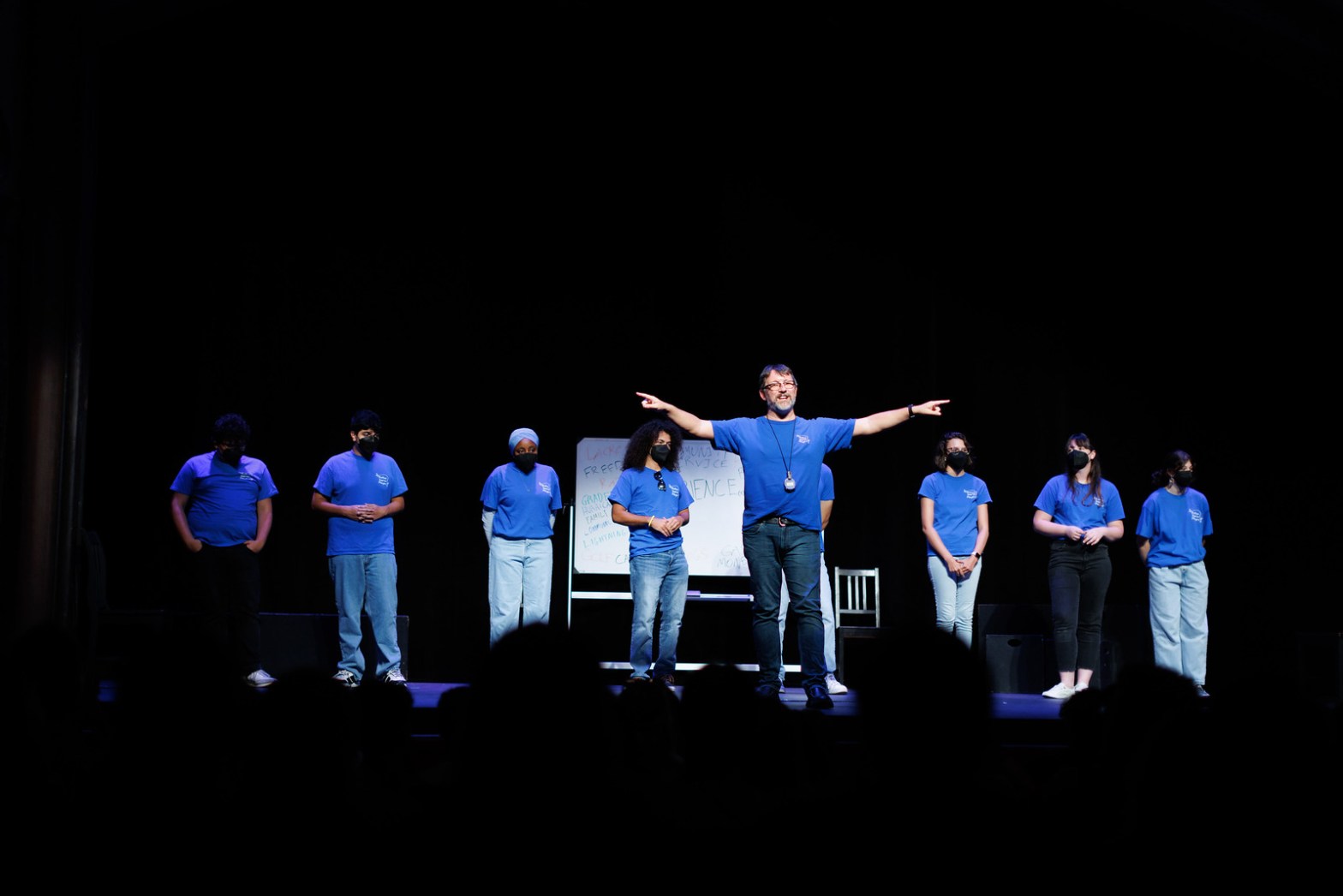
Players form a line in the lip of the stage or preformed space, thus forming an embodiment of a Radio Dial. Each improviser is given a unique type of radio station or program, such as “golden oldies,” “weather report,” or “current events.” If you play under theatrical lighting, these can be dimmed before the game begins. The host (with their flashlight) then scans up and down the radio dial, activating each actor (and their assigned style) whenever the light bathes their face. In this manner, each radio station is visited multiple times and offers a wide variety of playful content.
Example
The facilitator quickly moves up and down the dial with their light, creating a pleasing jumble of white noise as each station briefly comes to life for just a second. Eventually, the dial settles on Player A...
Player A: (golden oldies) “… and wasn’t that a stroll down memory lane? We’re going to keep those sentimental hits coming that transport us all back in time with this next fan favorite, ‘Don’t go under the stone tree…'”
The host’s light moves quickly over the line of faces (that briefly spring to life) until resting again on a new subject…
Player B: (weather report) “…squalls and driving train through the evening. If you haven’t taken a raincoat to work today, you might want to hunker down in place…”
The conducting flashlight moves again, cuing more white noise until settling…
Player C: (current events) “… you can’t mean to say that you believe the current misinformation circulating and being crafted by the…”
The Focus
Look for smooth and brave transitions – it’s worth rehearsing the white noise dynamic in particular as it’s a cool and peculiar feature of the game that builds energy and playfulness when executed well. Embracing a “starting” or “caught in the middle” attitude further heightens the risk and surprises; that is, try to avoid joining each new station “at the beginning” of its beat, whether that’s a song, intro, or sentence. There are many different types of games that can also be featured (or that can just organically emerge), and these are the subject of my tips below.
Traps and Tips
1.) Embrace randomness. I can’t overstate how much fun can be mined from simply hearing the stark and competing styles of stations weaving and jamming, and even if you decide to lean into one of the strategies below, I’d still recommend that, particularly in this first wave of the game when you’re hearing and establishing each station, seeking disparate material initially will open up richer and more complex games for later. To this end, endeavor to provide as much variety as you can in the ask-fors. If you’re working with a larger ensemble – more than six or so – it might prove wise to elicit or determine the stations prior to the performance as it can be daunting to quickly gather a dozen offers that feel promising and different. There can be a tendency to lean heavily on dialogue as players primarily have little more than their voices to create the channels, but it can be fun to include singing, music, and Foley elements as well.
2.) Embrace connections. If you’re looking for a longer offering, leaning more heavily and deliberately into connections and callbacks can level up the entertainment. (I’d still recommend a first wave of more disjointed material just to give you more shades of paint to add to your final mural.) In the above example, when we wind our way back to the weather channel, we might learn of some trees being uprooted in a local tornado, or our events might start including apple-inspired commentary, with words such as juicy, tart, or crisp (while our golden oldies channel similarly looks to weave in details stolen from their teammates). If you clumsily force other offers into your shtick, the exercise will take on a tone of desperation, so still maintain your own deal and incorporate and justify others’ ideas judiciously. The host can also help in this regard by moving the focus to well-suited next channels to facilitate ongoing runs and bits. (If you have a lot of channels to remember, it’s helpful for players to have their inspiration printed on paper stock held below their chins for everyone’s reference as well.)
3.) Embrace story. And this is another joyful dynamic to explore. You’re probably not setting yourself up for success if you strive to make every shift between stations a linear story progression – this is more the comedic terrain of Conducted Story and Story, Story Die anyway. However, teasing out common themes, reincorporating (and, more importantly, justifying) prior elements in new contexts, and weaving recurring characters across multiple genres opens up rich and new fertile creative soil. Does the weather report now serve as a grand metaphor for the political landscape being described in the current events program? Or perhaps one of the guests references Newton’s experience with the falling apple. Or the golden oldies channel provides a series of songs (or song lead-ins) that add commentary to other tensions and dynamics currently in the mix. It might be unlikely (and ultimately unhelpful) to seek a unified story arc across all the stations on the dial, but a few glorious whimsical throughlines are frequently possible. As are some well-situated continuations of thought where one channel “finishes” the incomplete thought of its predecessor.
In performance
For larger groups, pre-preparing a nice variety of channel options beforehand (that represent suitable targets and aspects of your local demographics) can help set the stage for abandon. If these are then shuffled (and, for the benefit of the host, displayed) then you’ve enabled a quick entry into the action.
New to ImprovDr.com or the Game Library? You can find the ever-expanding collection of games, exercises, and warm-ups here.
Cheers, David Charles.
www.improvdr.com
Join my Facebook group here.
Photo Credit: Scott Cook
© 2025 David Charles/ImprovDr
Game Library Expansion Pack I
 ImprovDr.com