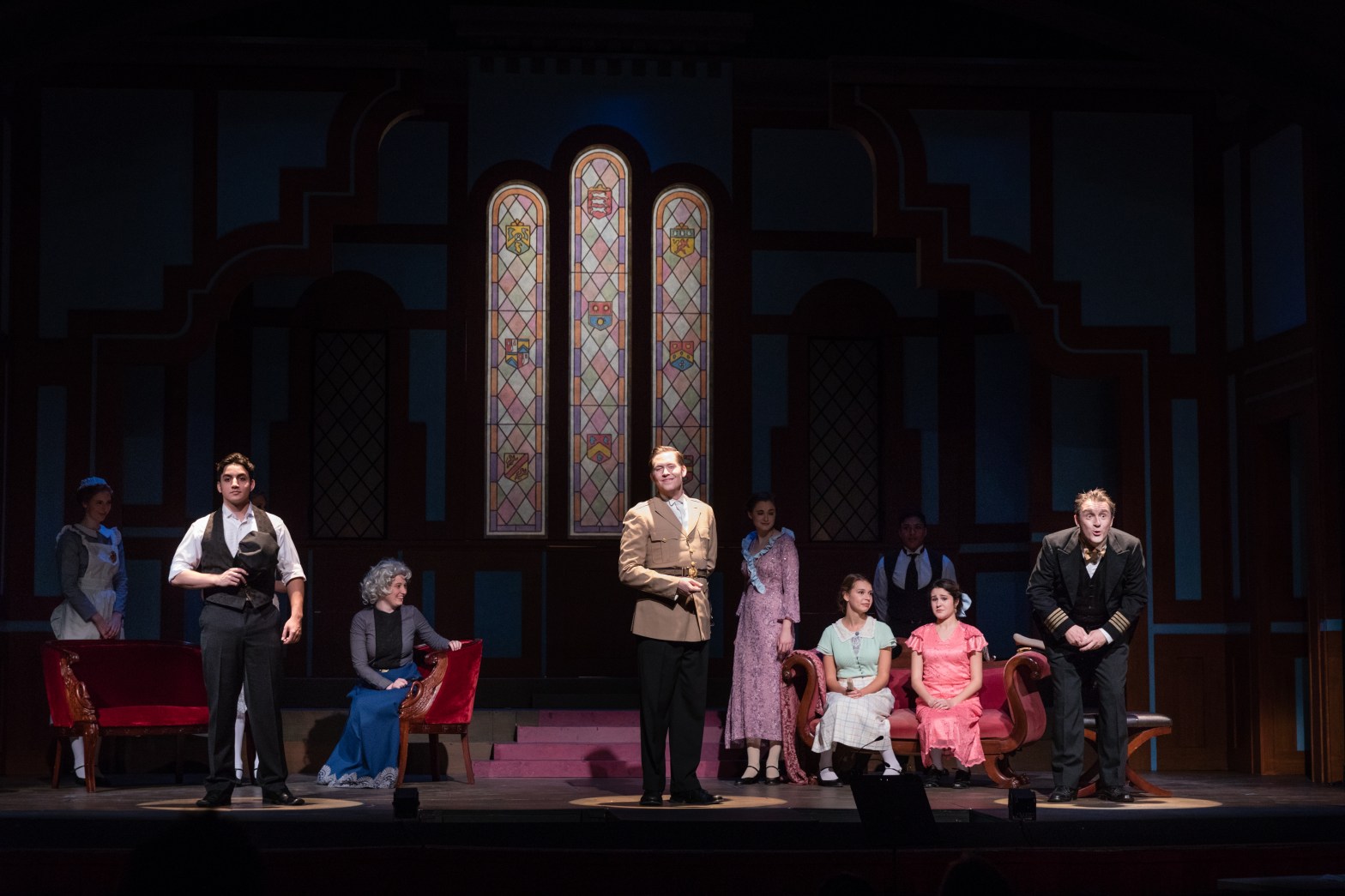
Get ready to move for this fast-paced game that’s three scenes in one.
The Basics
You’ll need an attentive technical improviser and three distinct pools of light to make this game work. A team (of ideally two or three improvisers) obtains three different scenic prompts, and each one is assigned to a specific area of the stage (left, center, or right) that corresponds to your particular lighting abilities. For the duration of the action, the technical improviser randomly shuffles between the three zones, causing the team members to leap from space to space and scene to scene.
Example
Players A, B, and C acquire the suggestions of coal mine, travel guide, and embarrassment for the stage left, center, and right areas, respectively. The host facilitates a countdown, and the lighting improviser offers up the stage left area to begin, causing Players A and B to rush into the light while Player C waits offstage to see if they’re needed.
Player A: (crawling on their stomach) “And you’re sure this is where you heard the sound?”
Player B: (wiping the sweat from their eyes) “Yes. Just a little further up ahead. It was the unmistakable sound of the wind. “
Player A: “Then that means…”
Player B: (excited and shuffling forward) “I know. We might have finally found our way out of here..”
The lights move swiftly to the stage right area, prompting Player C to step into focus while Player A drops their prior character and rushes over to join them. Player B retreats into the darkness.
Player C: (apologetically) “I’m so sorry, Clark. I should have knocked.”
Player A: (covering himself with an imaginary towel) “You really should have. I was just getting ready to go swimming…”
Player C: (avoiding eye contact) “There is a lock on the guest bathroom…”
Player A: (awkwardly) “I thought you’d gone shopping…”
The lighting improviser shifts focus to the center region of the stage, causing B and C to dash into the light…
Player B: (with a dramatic gesture) “…And this painting is of King Louis the fourteenth’s prized blood hound…”
Player C looks suitably impressed…
The Focus
Agility, reactivity, and leaping head first into each scene as it grows and morphs.
Traps and Tips
1.) Leap. If you’re playing this as a traditional short-form game, you’re not going to get a great deal of time in any one scenario, so it’s important that each premise hits the ground running with clear and brave specifics. I particularly like playing the game with three actors as this configuration allows each improviser to field and then take initial responsibility for one premise and area. (Using just two players ups the challenge of the game even further, but there’s also something aesthetically pleasing about the different combinations enabled by three bodies.) If you take too long looking for the “deal” of the scene, the lighting improviser might have already edited you, so make bold choices.
2.) Leap. There is undeniably a torture dynamic at the core of the exercise, and the lighting improviser should be empowered to challenge and surprise the players. If one storyline is proving itself to be especially entertaining, by all means, return to it a disproportionate number of times! And vary the length of each episode to further add to the fun. (Scenes needn’t pick up exactly where they left off but can rather move forward through time at whim.) Throughout, the team should avoid needlessly slowing down the frequent transitions and should literally leap from one scene to the next (bodies permitting). Lethargically moseying from one vignette to the next does little for the performance.
3.) Leap. Also, pay heed to the “collage” designation in the title. Strive to craft wildly different scenes with clearly different moods and energies. (Eliciting markedly disparate initial offers from the audience can go a long way to assist in this regard.) Give each scene sufficient time (albeit condensed sufficient time due to the fast-paced structure) to find its own deal and footing so that the greater game benefits from variety. (I enjoy throwing in one style-based scene into the mix to keep the stories from quickly feeling too same-y.) Then, when the machinery of the game is up and running, look for possible connections and threads that might further enrich the current tapestry. The further apart the vignettes begin, the more satisfying any later ties will become.
In performance
More recently, I’ve explored adding a “last line, first line” overlay where each new scene must begin with the repeated tag line of its predecessor, breathing new context into the line of dialogue. This adds an avowedly Pan Left, Pan Right vibe to the whole affair. (You can access that game in the library here.) This isn’t necessarily a good or bad adjustment, although it does tend to overshadow the more subtle connections that, for me at least, tend to feel like the signature element of Scene Collage.
We’re off to the races with new and reviewed “S” improv games and exercises. As always, you can search prior posts here.
Cheers, David Charles.
www.improvdr.com
Join my Facebook group here.
Photo Credit: Scott Cook
© 2025 David Charles/ImprovDr
Game Library Expansion Pack I
 ImprovDr.com