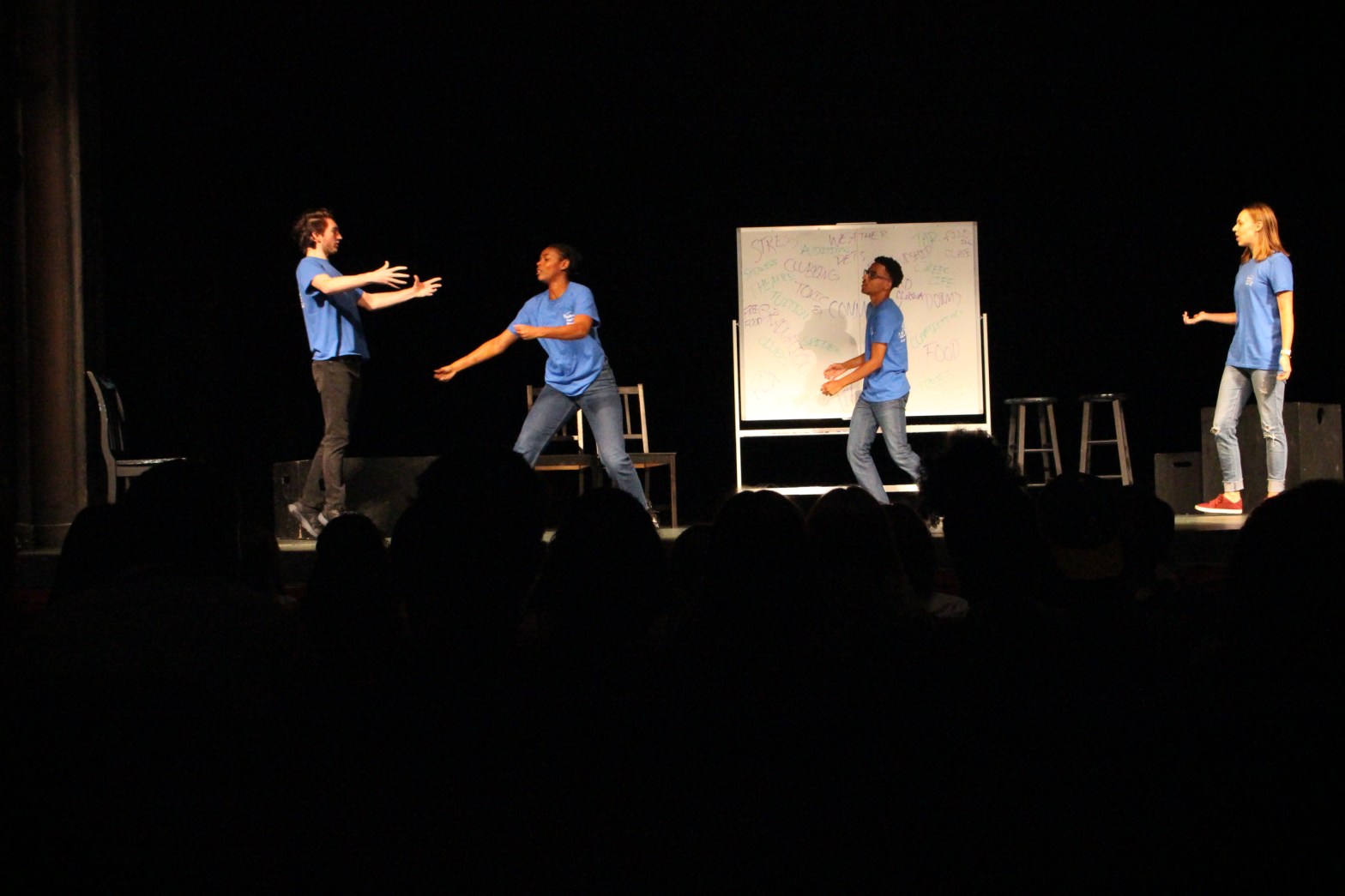
Explore the dynamic relationship between what we say and how we say it with the game Shadows.
The Basics
Two players (typically members of the cast) serve as the actors, while two volunteers (typically folks drawn from the audience) serve as playwriting “shadows” who lurk one behind each assigned actor. During the scene, shadows audibly “whisper” each improvised line of dialogue for their partner, who must then repeat it verbatim while imbuing the provided words with subtext, emotion, and meaning. This dynamic continues with a series of freshly interpreted sentences until the scene draws to a close.
Example
After the game has been explained and the audience members coached, volunteers A and B take their positions behind players C and D respectively to begin a scene about working at a pet store. Player D mimes kenneling a frisky dog while C supervises.
Volunteer A: (audibly stage whispering) “I think you’ve done really well today.”
Player C: (with an unsure and slightly judging demeanor as they review their notes) “I think you’ve done really well today.”
Volunteer B: (audibly stage whispering from over D’s shoulder) “I really love working with animals. “
Player D: (standing up nervously after locking the kennel and with an air of desperation) “I really love working with animals. “
Volunteer A: (whispering) “I can see that.”
Player C: (mentally preparing to share the bad news) “I can… see that.”
The Focus
Enjoy the division of labor and exploit the rare opportunity to really consider each provided line before you act it.
Traps and Tips
1.) Speak up. There can be a tendency for audience volunteers to genuinely whisper their ideas so quietly that only the receiving players can hear them, but these scenes thrive from each line also being heard by the audience before they become fully embodied and performed. It’s worth modeling this preferred dynamic before launching into the game (or sidecoaching volunteers to increase their volume within the scene itself) to avoid this trap. The guest playwrights should also aim to give bite-sized and rather bland readings of their text offerings to show the actors sufficient room to make the dialogue their own as well.
2.) Polish dialogue. In the actor roles, make sure you are earning each speech act and not just parroting lines as soon as they’re offered. These contributors are responsible for selling the scene and making each phrase fully their own. Pay particular attention to inflection, subtext, and operatives (or the most important or juicy word in each line). Every effort should be made to honor the improvised text in terms of the language, but that doesn’t mean phrases shouldn’t be pulled apart and reassembled in interesting or unexpected ways. Don’t just rattle through each offering in the hopes that the next line might be better.
3.) Savor silences. And don’t neglect or underestimate the power and playfulness of your staging, movement, and silences between and within the provided dialogue. Just because a shadow has created the next line, this doesn’t mean that the line must be uttered immediately or quickly. Taking a breath or creating unexpected blocking or stage pictures that reframe your words or intentions can become a delightful way to surprise your partners, shadows, and audience. If your shadows are particularly aggressive, this is also a great way to show down and deepen your scene as well – new lines, after all, shouldn’t be offered until the prior line has been fully utilized.
4.) Dig deep. There are a lot of surface-y and likely gaggy games that can easily take over the scene, such as making every suggested line sarcastic or an inversion of the audience volunteer’s intention. A little of this can be fun but be cautious of making the shadows the butt of the joke rather than the heroes who have enabled a spellbinding story. When the actors really work to find the weight of the scene, rather than skip carelessly in the shallows, the game will start to feel notably different than other trivial chuckle fests and that can be quite exhilarating. Erring on the side of a more complex relationship or fraught scenario can go a long way to help in this regard.
In performance
I stumbled back into this format as I searched for a new audience game for my R&D Show at Sak Comedy Lab and was struck by its simple elegance and ability to house a host of different energies, genres, and discovered games. I hope you’ll have similar luck if you add it to your performance repertoire.
Cheers, David Charles.
www.improvdr.com
Join my Facebook group here.
Photo Credit: Olivia Skvarenina
© 2025 David Charles/ImprovDr
Game Library Expansion Pack I
 ImprovDr.com