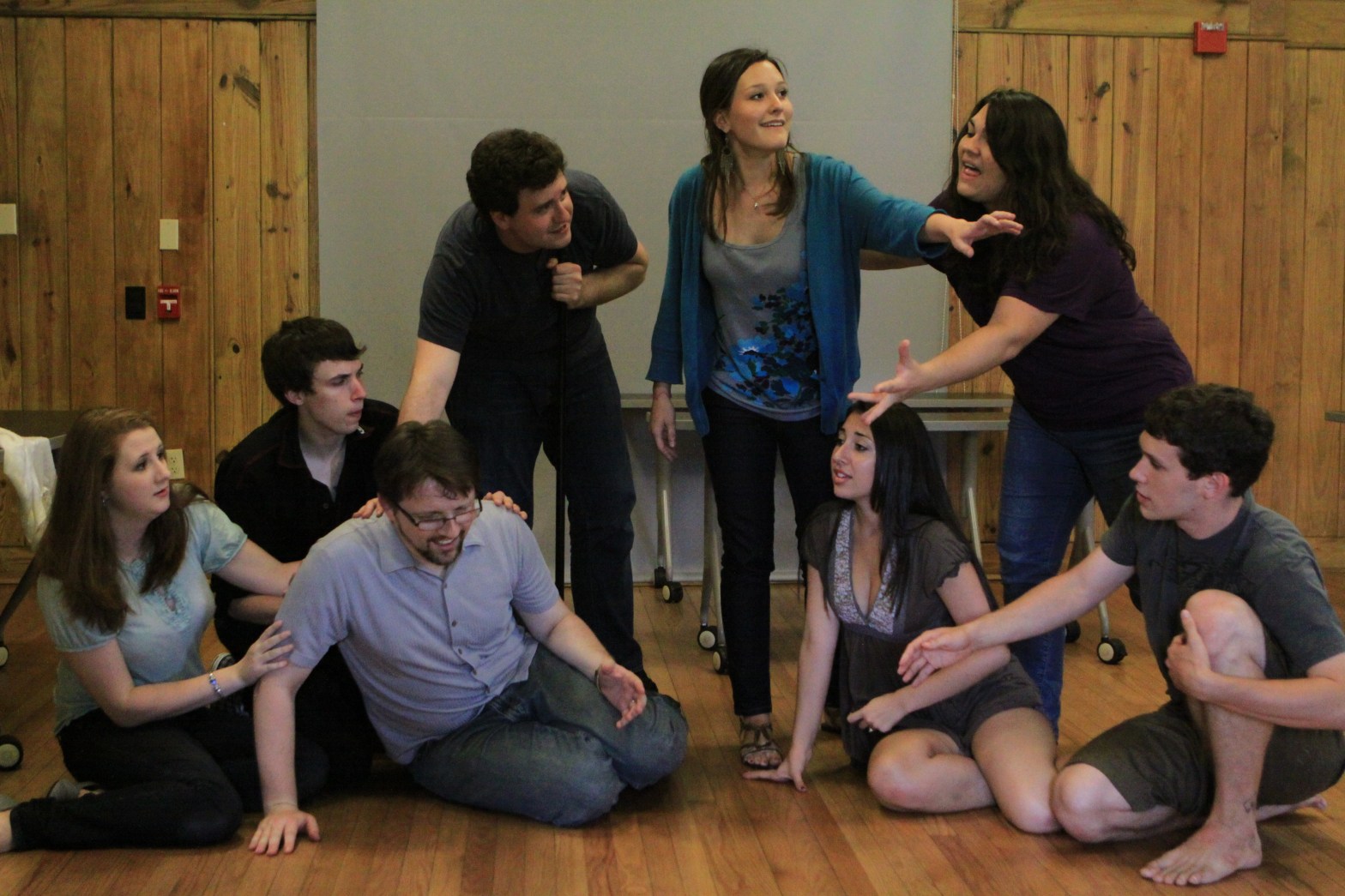
This game provides a rate opportunity for team members to stretch their monologue creating skills while revisiting the potential horrors of taking a high school Yearbook Photo!
The Basics
A real or invented high school club serves as the launching point and players take the stage and assume strong character poses before freezing for their group photo (perhaps with an accompanying “smile” and camera flash from the booth). While their fellow players remain frozen, characters take turns stepping out of the tableau to narrate their story to the audience. After each monologue, the narrator returns to their original frozen position before a teammate repeats the process until every club member has had the chance to share.
Example
“Chess Club” inspires the action and the team of four players assume an odd selection of poses before the photographer’s camera flashes, the students freeze, and Player A makes their way to the forestage…
Player A: (straightening their club jacket, and with a big smile) “I’ll never forget this day. My parents, and all of my friends, were surprised when I signed up for the chess club and, in fairness, I have never been very good at board games, or much of anything for that matter. But I knew this was the club for me when I saw his name – Emmanuel – on the sign-up sheet.”
Player A looks longingly back at the frozen image of Player D.
Player A: “Sometimes you just know what the universe has in store for you, even if your parents and friends think you’ve lost your mind. But it wasn’t my mind I lost that day, it was my heart…”
The Focus
Snap into a strong point of view so that you can quickly find and exploit your character’s unique energy and spark.
Traps and Tips
1.) Use your body. There isn’t a lot of time for thinking as this game begins, and so it’s important – if not crucial – to literally jump into a deal right as the audience sees the assortment of characters assembling for the photo. Make a bold and definitive choice of some variety – an emotional energy, way of holding yourself, orientation to the space or another actor, a peculiarity or quirk… It’s unlikely that this first choice will make much sense initially to you or the audience, but as context begins to emerge, you’ll now have a deal from which to build and respond. And be sure to take these physical choices into your monologue as well. Just walking with that seemingly random energy into the limelight can be enough to jumpstart your inspiration. Also, be aware of other’s physical realities, especially during the moments of transition, so that you can pick up on cues as to who might be ready to narrate next. (If in doubt, it can be helpful to assume you’ll move down the line in order from stage right to stage left.)
2.) Use your patience. There can be a tendency to rant to do too much when it’s your turn to narrate, but keep in mind that you have a whole team of players whose collective contributions will craft the greater narrative together. Early stories should feel a little incomplete as they’re laying the groundwork for those that will follow. While I wouldn’t necessarily advocate a strict Four Sentence Story approach (you can read about this exercise here), it can be helpful to strive to spread around the various story functions. Our initial speaker, A, for example, probably shouldn’t offer up the climax for the entire group but rather provide some of the raw material for others to weave and reincorporate. Endowing D as Emmanuel, their crush, offers a promising future connection. It will likely prove less helpful to then endow everyone else as well and spell out exactly what they did.
3.) Use your partners. There is generally a delightful cumulative effect to the narratives, with each character building off the details and energies introduced by their peers. So, while I caution against detail dumping on your teammates and constraining their own agency, players should be sure they are adding helpful and interesting flavors and spices to the emerging buffet. If early characters create and shelve rich specifics, it’s exciting to see later improvisers reclaim them and justify these gifts in their own way. Some ripening helps in this regard, so don’t grab at the thing that was just said if it might become more dynamically helpful further down the line. In this manner, A’s choice to endow D as their love interest allows B and C (assuming we’re narrating in that order) to offer up new or complicating story threads that can further heighten the payoff of D’s eventual climactic account.
In performance
In my experience, the final narrator does inherit somewhat of a “piece it all together” function in this game and so they can be at the mercy of their teammates. Yes, a little playful mischief and endowing can certainly add to the fun, but if earlier players are doing little else than shivving and placing incongruent details, the burden of the final position will become daunting and possibly even a little icky. (No one wants to be put into the position of coming up with the “punchline” for a joke without any punchline.) Instead, lean into character and relationships, and enjoy how the oddball group of club members construct a unified story together.
This format features a string of individual completed monologues. If you’re looking for a structure that breaks up these speeches into smaller portions, consider exploring the related game, Perspectives, here.
Cheers, David Charles.
www.improvdr.com
Join my Facebook group here.
© 2025 David Charles/ImprovDr
Game Library Expansion Pack I
 ImprovDr.com