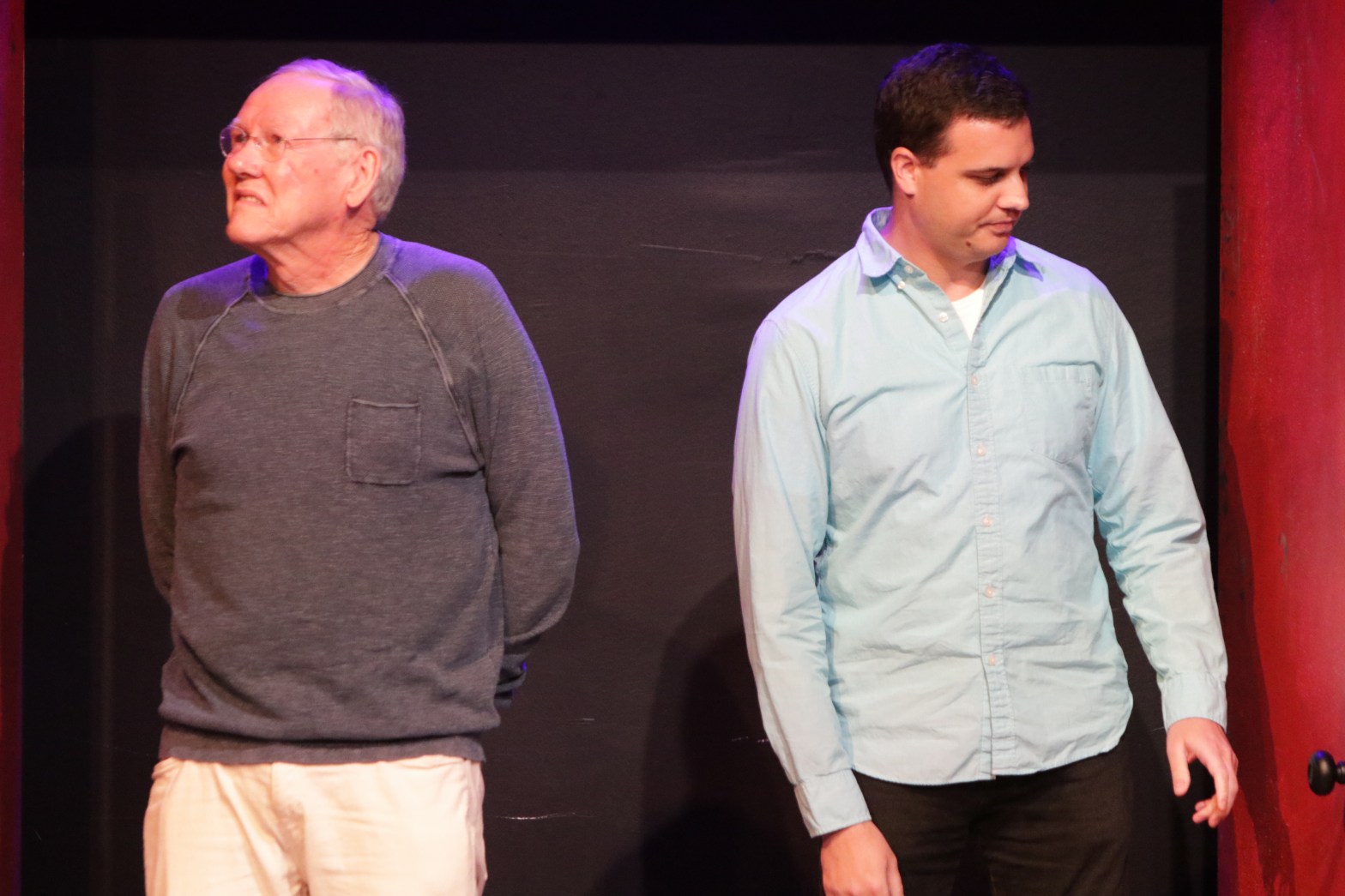
This is a performance-ready retooling of a concept that I enjoy exploring in my improv classes, as embodying a specific (or playfully unexpected) age can cast new light on old, stale scenarios. I’m describing the ensemble warm-up version here birthed with the R&D Show, but it could be easily tweaked to create a workshop experience or team-style game.
The Basics
Players work in pre-assigned pairs. A situation or premise (and possibly a relationship) is obtained that can be experienced at various times in your life. All the pairs leave the performance space except for the first two improvisers, who take strong (frozen) positions from which to begin their exploration. The emcee assigns a specific age (generally beginning with an elder designation), and the pair creates a brief scene (6-8 lines of dialogue) in the given circumstances as characters of the given age. When the scene reaches its conclusion, the actors return to their initial poses, and the next pair is ushered into the theatre. They “tag out” their teammates, take on the exact positions, and receive the “first line” of the scene, before the emcee offers up a new age demographic to inspire the action. The scene is then replayed with ever-decreasing ages until all the absent pairs have participated.
Example
The ensemble is given “taking an international flight” and “best friends” as their premise, and everyone except for Players A and B exit the space. Two chairs are place side-by-side, with A assuming a seated pose looking out the window while B places their luggage in an overhead bin. The emcee assigns “70-year-olds,” and the scene begins.
Player B: (struggling a little) “I believe this should fit…”
Player A: (trying to unlock their belt, nervously) “If you need a hand…?”
Player B: “Don’t you move a muscle, Orlando. I’m not giving you an excuse to bale on me!”
The scene continues until both characters are clinging to each other’s hands for the takeoff. After the blackout, the host instructs A and B to return to their first poses, and C and D enter from the lobby.
Emcee: “You first line is ‘I believe this should fit,’ and you are now best friends in your fifties.”
The stage resets with the new actors.
Player D: (proudly) “I believe this should fit…”
The Focus
This game pulls a little from Tag traditions and a little from formats like Actor Switch, Replay, and Replay Scene. It’s fun to embrace the overarching concept of the experiment of only adjusting the age and seeing what happens, so look to really honor the common poses and line of dialogue while being open to where the scene might want to go afterwards.
Traps and Tips
1.) Start boldly. Choose clear, ripe, and emblematic poses if you’re playing in the first position. As the warm-up is designed to move quickly, it’s helpful for characters to start at least somewhere vaguely in the middle of the action (as opposed to waiting at the boarding gate lounge, for example, although the above scene could probably benefit from an even more dynamic start in that regard as well). Similarly, strive to compose a strong opening line. Ideally, later players will imbue the offer with new emotions, subtexts, and possibilities, so make it pithy and a little open-ended or, at least, open to reinterpretation.
2.) Proceed sharply. If you’re aiming for 8ish lines of dialogue for each iteration (which is particularly important if you have several couples to rotate through), you should make every word count. (Offering a foundational relationship can help in this regard as it hands the players most of their CROW information right up front so they can concentrate more on the how than the what of their foundational choices.) That being said, it’s probably even more important to make every moment (or silence) count so that you’re not just idly chatting. The scene is less likely to arrive anywhere of note if the stakes and energy aren’t expertly constructed to facilitate a dynamic payoff.
3.) Create smartly. This warm-up invites unnuanced stereotypes in its very construction so be wary of just playing a loose-fitting cliché as opposed to a more cleverly composed and balanced character (admittedly no small task given the brevity of each vignette). Elderly characters needn’t be doddering. Younger characters needn’t be obnoxiously oblivious or carefree. Casting can do a lot to help in this regard. We debuted the game with a wonderfully diverse array of actor ages, spanning nearly 50 years. Frankly, this reality, alone, heightened everyone’s awareness. Look for playful “if this is true, what else is true” connections. If our seventy-year-olds are taking their first flight, for example, that immediately raises the stakes and begs the question of why are they finally pursuing this experience now?
4.) Play obviously. The “blind” aspect of the game can offer some unexpected joys as well, with players perhaps inadvertently echoing or inverting the dialogue, staging, or choices of their forebears. If improvisers grab at the insanely whacky right from the gate, the likelihood of these appealing connections will dramatically decrease. Which isn’t to say explore tepid or static moves, but if our first scene eschews the simpler premise and makes our passengers inexplicably passengers on a flight to the moon, it’s unhelpfully unlikely that subsequent scenes will mine any entertainment from tilling old soil in new ways which, for me at least, is a large part of the charm with this game.
The R&D Twist
We played this warm-up with 10-12 improvisers, which involves some attack and focused facilitation between each vignette if you don’t want it to sag. Make sure players are able to spryly get back into the space to minimize the transitions. If you’re inclined toward steep curves of absurdity, ending on characters that are sooo young they have to engage in some sort of Baby Talk will likely get you to your intended destination! As we had a scene with this handle schedule later in the show, I opted to use teenagers for the final replay instead.
New to ImprovDr.com or the Game Library? You can find the ever-expanding collection of games, exercises, and warm-ups here.
Cheers, David Charles.
www.improvdr.com
Join my Facebook group here.
Photo Credit: James Berkley
© 2026 David Charles/ImprovDr
The R&D Show Expansion Pack
 ImprovDr.com