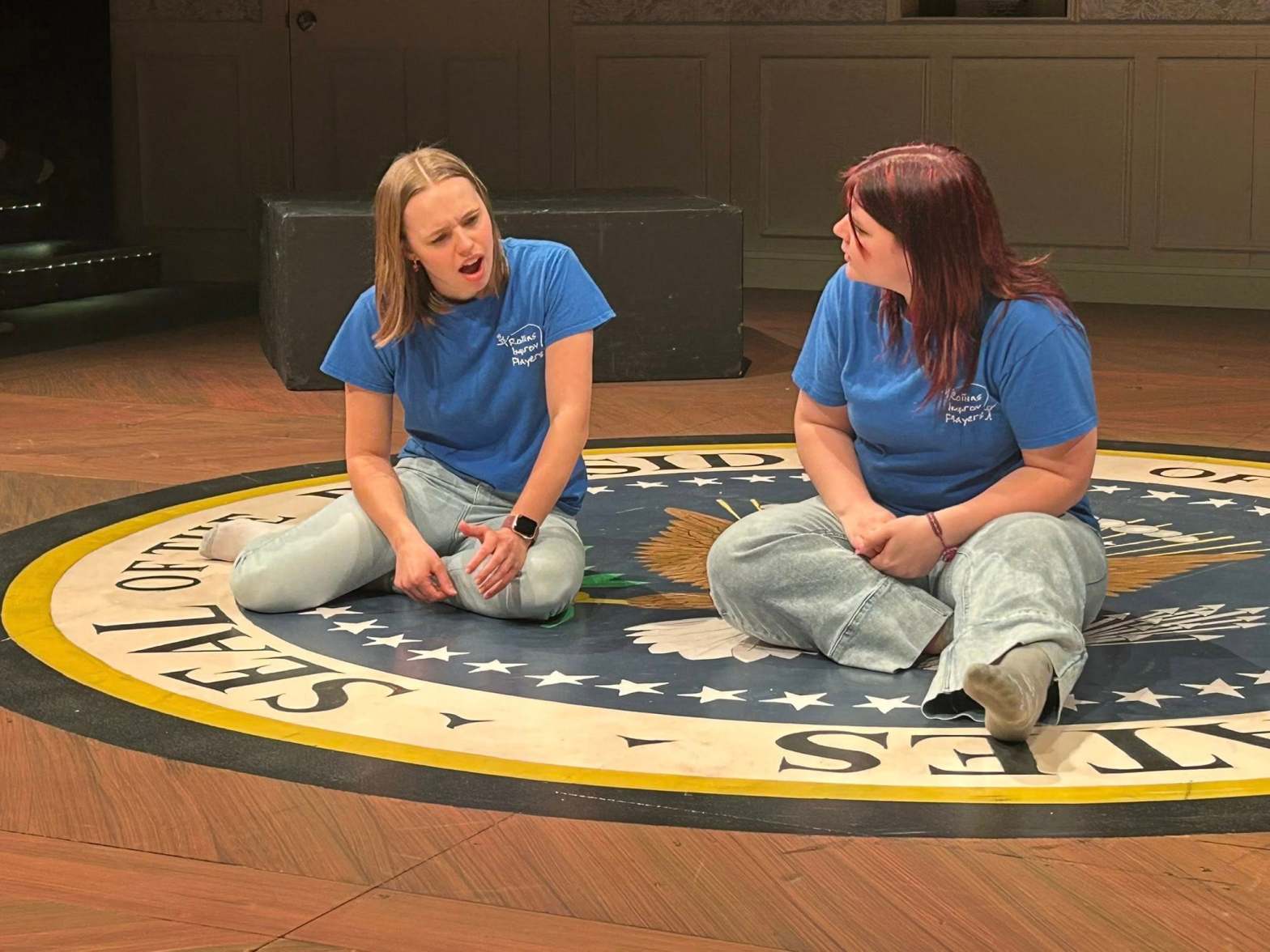
Perhaps more of a handle than a game in its own right, Baby Talk nonetheless provides a surefire way of upending a run-of-the-mill scenario.
The Basics
A premise is obtained. Players perform a scene in which all their dialogue is now performed with the cadence and timbre of adorable babies. That’s it!
Example
An employer calls a wayward employee into their office for an end-of-year review.
Player A: (gesturing) “Pwease, have a swheat…”
Player B: (sitting nervously) “I have to wadmit, Wi’m pwetty nervwous…”
And so on…
The Focus
Committing to the absurdity that invariably ensues.
Traps and Tips
1.) Explore baby sounds. I’ll willingly confess that I don’t feel that I have a great “baby talk” in my back pocket as a player, and most actors will likely have slightly different ways of approaching this. But whatever “sounding like a baby” means to you, you’ll want to grab at your choice with both hands and not let go. Be it a joyful lisp, different placement, higher pitch, slower cadence, or some unexpected alliterative fun (as I’ve tried to model with my unexpected “W” placements above), the scene is served by strong attack. And even if your first efforts feel a little clumsy, if everyone is similarly bold, the scene will have energy (and you can steal dynamics from others that you might not have thought to use yourself).
2.) Explore baby language. There are various approaches in this domain as well, but the scene benefits from players mirroring a dominant attitude. Whether you’re using very adult and educated words (but mispronouncing them terribly, or slowly, or deliberately…), or replacing adult concepts and vocabulary with juvenile equivalents, seek to build the language reality and games in a similar direction as your teammates. This is a “rules of the world” approach where there isn’t really a wrong technique so much as a clear and unified understanding as to how the baby talk will infuse the action.
3.) Explore baby movement. Again, look for physical choices that will delightfully increase the comedic juxtapositions and commentary. There’s fun to be had from only making the language component of the scene childlike, with movement qualities remaining typical and expected. In this manner, the satiric distance between the adult behavior and the baby speak increases: Players A and B are still wearing suits and engaging in all the normative behaviors of office workers. Or there’s similar but equally rich joy to be had from fully embracing baby movement as well, thereby unlocking physical schtick and opportunities for discovery. Now, Players A and B struggle to even get into their adult-sized chairs without considerable effort.
4.) Explore baby logic. As you piece together your preferred mechanics for the game, strive to deploy “how a baby might view this world or scenario” throughout. Does B throw a temper tantrum when their job review doesn’t go particularly well? Does their boss offer them a juice box to calm them down? Does someone have to come and hold their hand to lead them safely out of the office, or does a bell indicate that it’s now recess or nap time? The more you can apply the “if this is true, what else is true” mentality, the more the scene can become more than a simple gag (though it’s also a fun simple gag!)
The R&D Twist
We used this game in the R&D Show XI where we were exploring youthfulness and how considering age alone can create new improvisational pathways. It’d be fair to say that it appeals to some performers more than others, as it’s a bit of an acquired skill to have a brave baby talk voice ready to go. Nonetheless, I find both the struggle and success of the resulting effort absolutely endearing, especially when the characters assume the naiveté of a young child regardless of their given circumstances.
New to ImprovDr.com or the Game Library? You can find the ever-expanding collection of games, exercises, and warm-ups here.
Cheers, David Charles.
www.improvdr.com
Join my Facebook group here.
© 2026 David Charles/ImprovDr
The R&D Show Expansion Pack
 ImprovDr.com