Here’s a fun icebreaker warm-up that requires players to work together quickly and quietly.
The Basics
Step One:
Invite the ensemble to work through the rehearsal area, striving to fill in any empty spaces and while walking an unpredictable pattern. Once the group is sufficiently shuffled, the instructor or facilitator calls out a number, and players are instructed to quickly shuffle into groups of the designated size (or as close approximations as mathematically feasible).
Step Two:
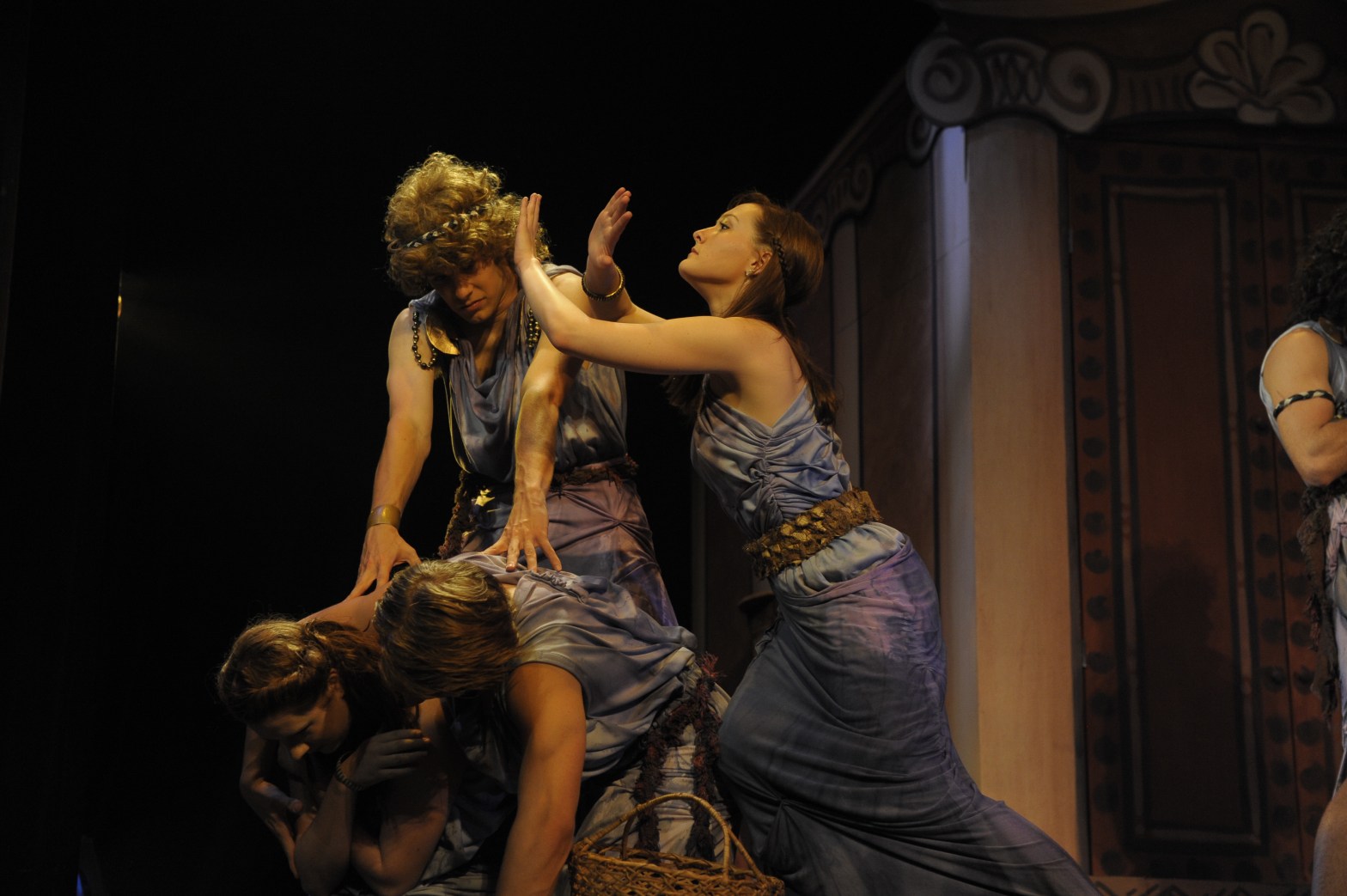
Groups are assigned an object that they must collectively sculpt with their combined bodies while working in silence. In this manner, players might be instructed to quickly “Be a… washing machine,” or “great oak,” or “table place setting…” The group facilitator might also provide a clear time restriction to further heighten the stakes.
Step Three:
Each tableau is briefly viewed by the remainder of the group (perhaps with a little lighthearted feedback to acknowledge finesses or refocus the intent of the exercise). Once all the images have been briefly celebrated, players are instructed to break their groups and walk randomly through the space again, and the process repeats.
The Focus
Keep your attention on the process of creation rather than the results. A finely etched image that was essentially dictated by one over-eager participant is less laudable than a clumsier tableau forged by brave individuals all contributing a connected idea.
Traps and Tips
1.) Look out for cliques. Especially (but not exclusively) if you’re working with younger players, the wandering phase can devolve into friend groups clumping and moving together to make sure they won’t become separated – especially once everyone learns the basics of the exercise. Encourage independent and varied movement patterns. Similarly, it’s important that no one feels excluded when numbers are announced, and groups are formed. If you’re not blessed with an easily divisible number, remind players that groups need only be approximate and to actively seek out new player combinations. If you’re able to do the math and offer “groups of five, and one group of six…,” that can help too.
2.) Look out for individuals. Players should actively work together to form the various elements of the named object. So, if a washing machine is offered as inspiration for groups of four, each group shouldn’t consist of four unique and independent renditions but rather one (likely imperfect) conglomeration. In some instances, such as the place setting, players might create isolated elements – one player is a spoon, another is a knife…. As a caller, I prefer using items that require a more robust sense of connected collaboration as it tends to invite players to get a little more into their bodies and out of their heads.
3.) Look out for (well-intended) directors. It’s useful to remind participants that the construction process should occur in silence. Ideally, this will discourage particularly excited players from accidentally dominating the process by telling their peers what to do (although this can still certainly happen in silence as well). Players should confidently make and adjust their own bold choices, but this should not be at the expense of other’s agency as well. If you know the short-form game Machines, this exercise offers a helpful template in that each player builds onto a first choice gradually one at a time until the final image is completed.
4.) Look out for too much feedback. I really enjoy the third step of viewing everyone’s creations, but be wary that this doesn’t needlessly bog down the momentum or introduce an overly critical energy that scrutinizes minutiae. I tend to use this moment to acknowledge particularly playful or unexpected choices, or to increase the boundaries or potentials of the game. For example, if everything defaults to a flat, almost 2D, portrayal on the floor, I might nudge that different staging planes or configurations can be used as well. Regardless, this stage should generally be filled with laughter and joy.
In Performance
If you’re using this exercise as an early warmup, I’ve found four or five creations will usually suffice before the novelty stays to wear off a little or players start becoming needlessly clever in an effort to keep the exercise engaging. This desire to reinvent the game works against its rather simple but elegant goals a little.
Cheers, David Charles.
www.improvdr.com
Join my Facebook group here.
Photo Credit: Tony Firriolo
© 2023 David Charles/ImprovDr
Game Library Expansion Pack I
 ImprovDr.com