This form can inspire a short-form scene, a longer vignette (I’m not a fan of mid-form as a designation!), or a full-fledged long-form one act. You’ll need an able musician or band for the fun, and possibly a willing and responsive audience member too.
The Basics
A historian figure (or figures) recalls the basic premise and story elements of a Lost Musical that is then reenacted by awaiting singers who perform the cued musical numbers.
Variation One
In the short-form version, a fellow player offers two of three musical moments from the concocted musical that is generally inspired by an audience title or topic. This narrator may edit each number boldly so as to keep the scene moving forward at a jaunty pace. “And in this next number, we see the stirring ballad of our protagonist as they finally come to terms with their mortality…”
Variation Two
For the longer iteration, an audience member volunteers who is either a fellow historian or expert on the chosen topic/musical, or their life becomes the inspiration for the action, with a guiding improviser asking leading questions to move them from one important moment of their life to another. These (generally “true”) story snippets inspire brief songs that portray and embellish upon the provided biographical information or field of expertise. “That’s a really moving story about your first love on the baseball mound in grade school. It’s not surprising that it became such a rousing opening song entitled ‘Out of My League.’ Let’s watch that now.”
Variation Three
In a more leisurely long-form setting, much of the Lost Musical may now be performed, with the narrator(s) or historians(s) providing contextualizing information that moves the action from one song to the next. Here, variety becomes key, as does an eye to crafting a more robust story arc or homage to musical traditions. You may have a team of four or five singing improvisers at your disposal, or an entire cast of a dozen or more (in which case, improvisers might need to work in smaller sub-groups to help manage the fun). “After that memorable opening number, the musical radically shifts gears. We see a distraught mother and her child, huddled on a street corner as the Christmas shoppers disappear back to their warm and decorated homes. This is perhaps the most touching number of the piece, ‘A Cold Holiday…'”
The Focus
Tell the story. Sing the song. Follow the fun.
Traps and Tips
1.) Narration pointers. If you’re narrating without an audience volunteer, strive for rich conciseness and clear gifts. Ideally, your narrative will set the singing improvisers up for a clear starting point that is energized and ripe with musical potential. When you have a lot of players on your bench, you might want to go so far as to name different improviser combinations to move the work and fun around (a lot of the singing can fall on the shoulders of a singular protagonist, for example, if you’re not mindful). Don’t overlook or under-estimate the performance value of this role, but keep in mind you’re primarily serving your teammates by helping them leap over the often-chunky transitions. If you’re ambiguous or unclear, you might add to rather than reduce hesitance and confusion. If you’re narrating with an audience member, know that non-improvisers, in particular, benefit from explicit and loaded prompts and expectations. It’s easy to have the energy dissipate if your “chat times” become meandering or effusive. (This is why I’d tend to say that including a non-player in the mix will automatically increase the length of your scene to the 8–10-minute range at least, whether that’s your intention or not.) If your audience partner is struggling, get simple elements from them – “Remind me where you first met your spouse” – and then springboard that quickly into a song premise.
2.) Scenic pointers. Although most of the scenic work will usually occur in song, and each transition might be accompanied by your improvising musician right off the bat, don’t forget the value of the spoken and acted transitions. If your narrator and/or audience volunteer are pitching unfinished starting points, there’s a lot you can do with two or three well-chosen and confidently delivered lines of dialogue as the musical play-in begins. Whether this is quickly getting that CROW out in a helpful way, establishing a song-worthy point of view, crafting a new and interesting stage picture or activity, or clearly identifying the first singer and giving them strong focus, these albeit brief scenic vignettes can work wonders for setting everyone up for success. Even if you’re playing in a really long-form setting, you should probably avoid making these truly fleshed out scenes as the premise is that the narrator or historian is “skipping over the boring parts” so you can get to the songs.
3.) Song pointers. It’s definitely an art crafting a tight and building song, and this game demands that you have some improvisers (if not many) with this skill set securely in their pocket. Make sure you’re positioning your players for success. If you have non-singers with great narrative skills, make sure you’re exploiting them in the historian position while those with powerhouse voices should probably be featured in your solos and showstoppers. Play to strength. The narrator offers a helpful mechanism to rescue or edit songs that might be careening off the tracks or starting to outlive their entertainment value. If you’re striving for a longer performance event, it’s worth your time to workshop some various structures (solos, duets, group numbers…), genres (blues, Broadway, soul…), and functions (“I want song,” up-tempo or patter pieces, finale…) just so that every number doesn’t start to feel the same.
In Performance
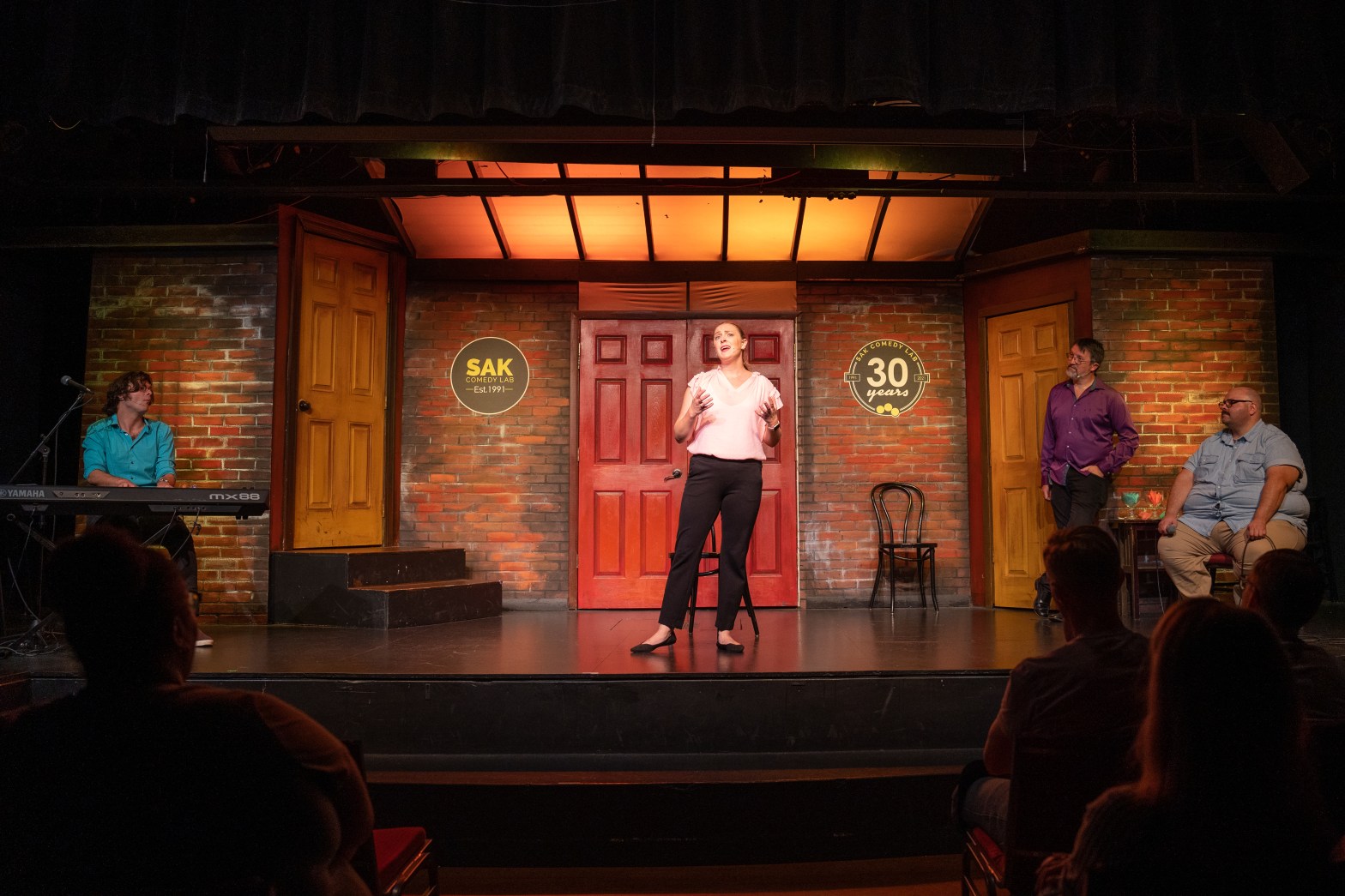
I’ve played Lost Musical in short-form shows, as the culmination of a one-day workshop, for the final of a semester-long musical improvisation class, and as the inspiration of a professional festival offering (as pictured above). In each case, the results have been joyful and bracing. I wish you similar success with your rediscovered musical masterpieces!
Cheers, David Charles.
www.improvdr.com
Join my Facebook group here.
Photo Credit: Mariah Clinkscales
© 2024 David Charles/ImprovDr
Game Library Expansion Pack I
 ImprovDr.com