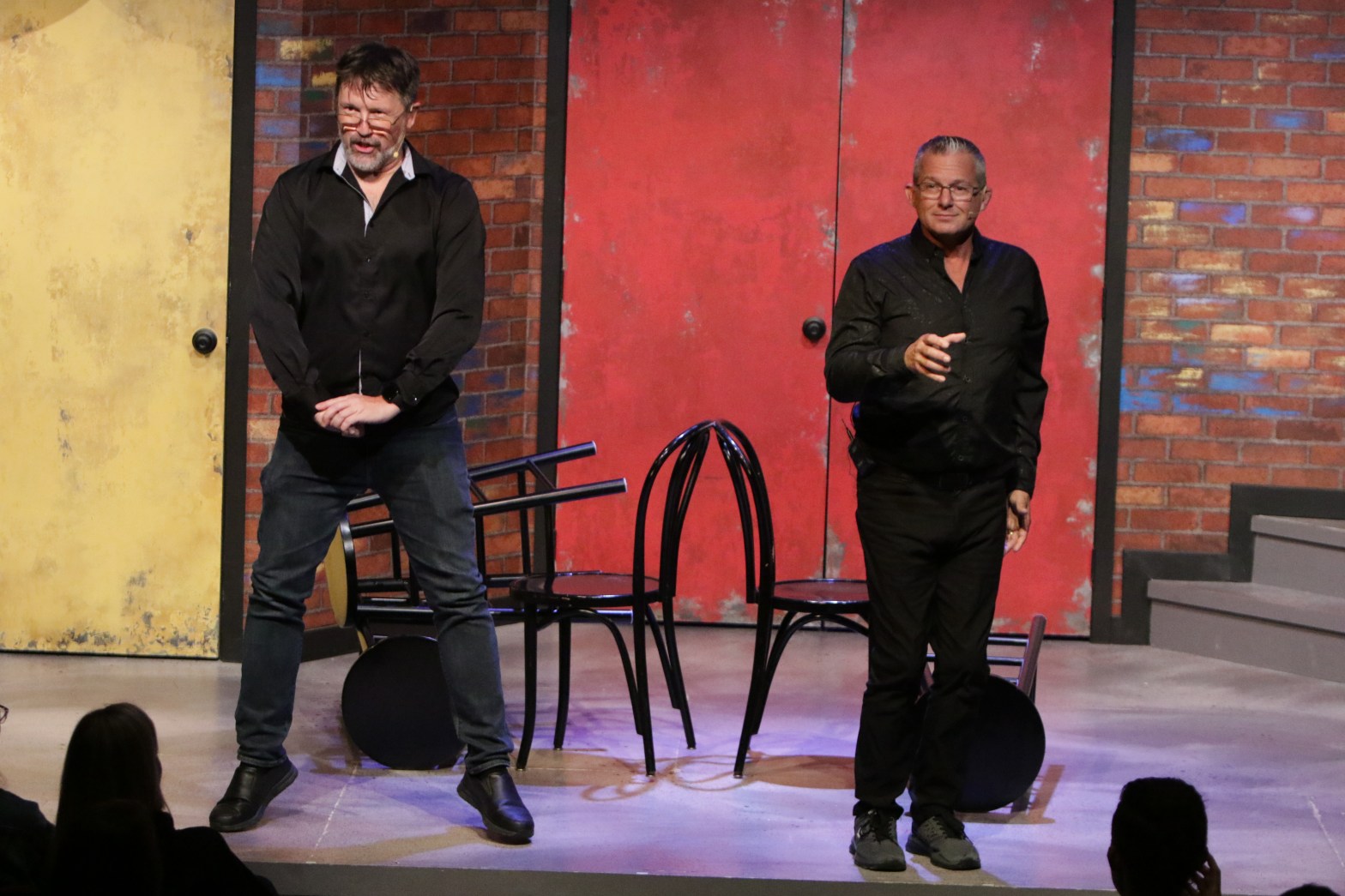
Obviously, virtually any performance style can easily become the source material for a long-form homage, and this is certainly the case with classical opera with its larger-than-life characters, scenarios, and voices. This deliberately shorter offering takes all of that size and condenses it into a bite-sized musical scene. I call the resulting fun Opera Minutiae.
The Basics
I usually introduce this scenic device by playfully declaring that the world of opera can make any seemingly mundane action or chore truly epic. To prove that point, a simple activity is obtained – such as changing a coffee filter or cutting a hang nail – and the improvisers craft a soaring operatic treatment.
Example
Two improvisers stand beside a hastily assembled approximation of a car with its concerning flat tire as the musician begins playing.
Player A: (gravely, singing)
“The tire. The tire. Our poor, deflating tire…”
Player B approaches their partner slowly and grandly, softly echoing their sung cry.
Player B:
“Oh tire, dear tire. Do we have a spare tire?”
Their voices continue to weave and build as they hopelessly and musically consider their plight…
The Focus
Similar to Ritual Scene, mine the inspirational suggestion for its smaller constituent elements. If you gloss over the individual steps, you’ll quickly run out of material!
Traps and Tips
1.) Think extending. The “story” of an Opera Minutiae is usually rather simple and obvious and largely dictated by the audience’s premise (although there should always be room for some delightful surprises even if they are subtle). If you jauntily advance, there won’t be much of a scene at all, so endeavor to explore the details and imbue them with energy, emotion, and finesse. Loitering in the land of description and extending provides the majority of the fun and playfulness.
2.) Think small steps. When you view the small event or activity as essentially the entirety of your play, you’re more likely to build something of lasting value and interest. The flat tire (or dirty coffee filter or painful hang nail) should take on tragic proportions for the characters. As such, each interconnected action should be the cause for musical and physical luxuriating. Just seeing or discovering the problem should be significant enough to warrant a prolonged emotional exchange.
3.) Think (musical) movements. For the singers and musician alike, it’s helpful to think of the scene as comprising of a series of distinct (and building) movements each with its own equally unique soundtrack (as opposed to one consistent mood or “song” underscoring the entirety). I find it helpful to think of the game as an entire opera rather than merely one moment – a dynamic I explore in my next Game Library entry. Our characters discovering the flat tire might be fast-paced and overlapping. If Player B learns that they never replaced their spare, this might become a soaring solo aria. If Player C arrives as a tow truck driver, the scene might take on a recitative feeling before morphing into a multilayered fugue…
4.) Think (physical) movements. And don’t forget to explore the physical conceits of opera, too. Acknowledging that there are many varied styles of modern opera (and that they don’t all involve singers somewhat stoically “parking and barking” on the forestage), the taxing vocal demands of the form do tend to encourage more reserved and formal movement choices. Embracing this seriousness and simplicity will only create more comedic opportunities. Make your gestures and physical choices as deliberate, expansive, and indulgent as your vocalizations!
In Performance
At the time of this writing, I’ve been working on a new hybrid long-form/short-form experiment called The R&D Show (with Robby Pigott and Ashley Evans providing the R and A to my D). While our first act re-envisions a different stock short-form game each show as a full offering in its own right, our second act brings improv students to the stage to look at classic games through the lens of a specific theme or skill. We’ve taken to closing that act and show with this game as we love musical improv, and it provides a high energy ending in which we can likely get the more willing sections of the audience singing along. (You can find out when this show is next running on my homepage here.)
Come back and check out my next entry for another operatic potential, or explore the Game Library here for a wider assortment of possibilities.
Cheers, David Charles.
www.improvdr.com
Join my Facebook group here.
Photo Credit: James Berkley
© 2024 David Charles/ImprovDr
Game Library Expansion Pack I
 ImprovDr.com