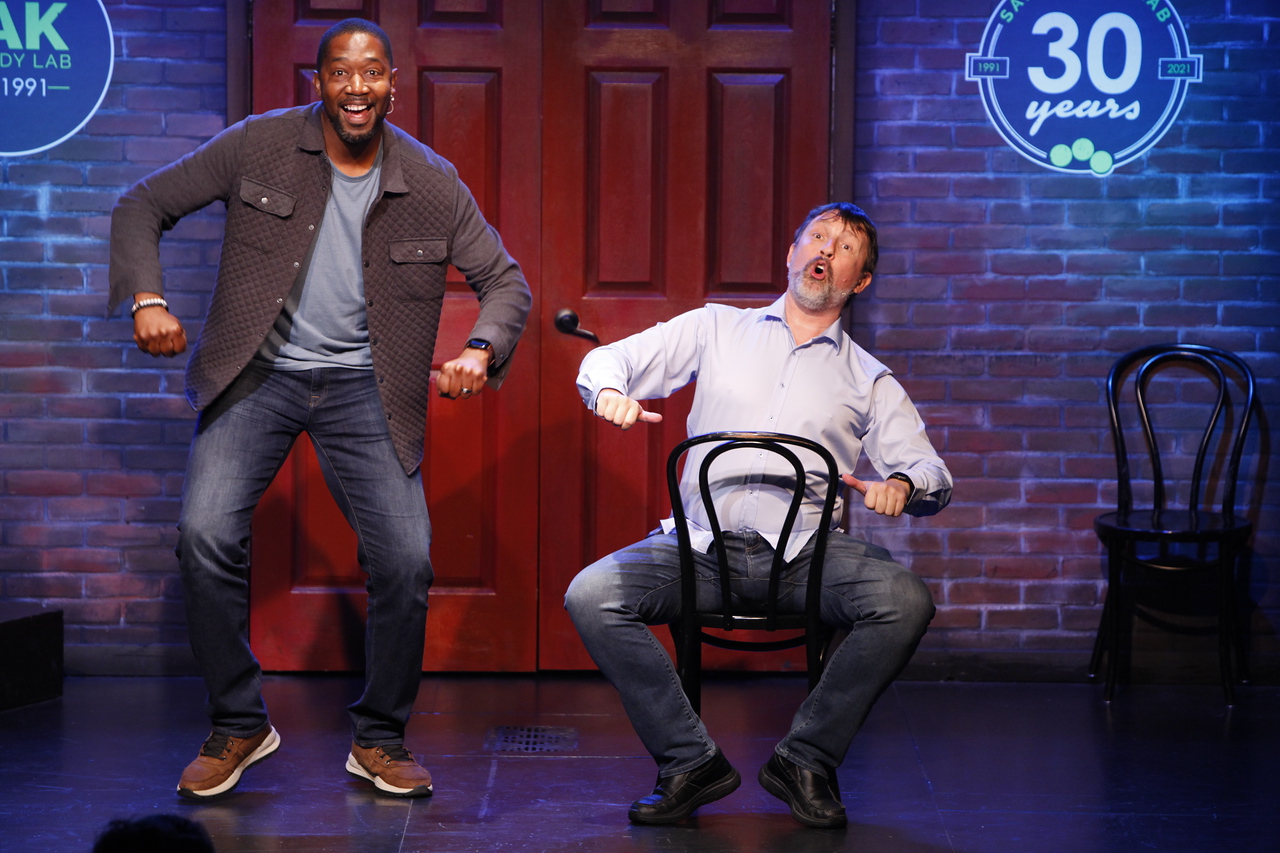
At its core, Parallel Universe is really a Freeze Tag variation (albeit on steroids) with a more substantial scenic arc. It works particularly well with a smaller cast or team and is actually quite exciting and effective even with just a duo, although expect a bit of a workout!
The Basics
Two contrasting and unrelated scenarios (or universes) are obtained that will house two equally different scenes. To begin, a caller nominates which universe will be seen first, and the game begins. At a suitably dynamic moment, the caller rings a bell (or perhaps announces “switch”). All onstage players must freeze in their current positions before then justifying their poses in the context of the second scenario. This new scene develops until the caller repeats the signal, thereby freezing and returning the improvisers to the original premise. Multiple bells then move the players back and forth between the two universes, with each transition being led by the prior frozen tableau.
Example
“Classroom” and “Deep Sea Oil Rig” serve as the inspiring suggestions. The caller selects the classroom to begin, and Players A and B take the stage.
Player A: (assuming the role of a struggling teacher) “Alright, Audrey, why don’t you join me at the whiteboard, and we’ll work through the steps together.”
Player B: (with equal parts reluctance and petulance) “I’m a lost cause. My mind just doesn’t work this way. I’m never going to pass calculus.”
Player A: (handing Audrey a marker) “Attitude is half the battle. Now, let’s start at the beginning.”
Player B reaches to take the marker, only to be interrupted by the caller’s bell. The improvisers now find themselves in their parallel universe, perhaps with a lighting and underscoring change to help sell the transition. Shortly thereafter, B transforms the marker into a length of breathing tube.
Player B: “Something hit one of our support pylons, and I’d feel a lot better knowing how much damage it caused.”
Player A: (accepting the piping before checking their heavy driving suit) “And I’d feel a lot better if you were joining me down there.”
Player B: “I’ll be watching your every move up here on the short circuit camera.”
A is suitably unimpressed but begins to inch backwards just as the bell sounds again, returning the action to the classroom. Their movement takes on an astonished quality as they examine the whiteboard.
Player A: “I’ve never seen anything quite like it. Audrey. You’ve discovered a whole new way to solve the equation…”
The Focus
Endeavor to fully accept and embrace offers coming from all quarters but most specifically from the poses that carry over with each belled transition.
Traps and Tips
1.) Plant. The model above moves quickly to illustrate the mechanics, but you’ll generally want to allow a reasonable amount of time in each world before jumping back and forth and complicating matters. Without a clear CROW for each scene, it’ll be difficult to develop a story of any consequence. If you’re playing with a larger team, this is particularly important as it’s no fun to watch players move from one scene to another without knowing who anyone is or what they’re doing.
2.) Move. This is standard advice for most Freeze Tag games as there’s little risk or interest if players are just shifting from one talking heads premise to another. My preference is to find the movement organically rather than engaging in clearly unmotivated gymnastics! Usually, remaining open to the types of activities that might occur in the two worlds is enough to nudge players into dynamic actions. If you’re serving as the caller, try to reward brave physicality with your bells as strong poses will invite stronger actions and stories, too. Except perhaps when both premises are robustly established and up and running near the culmination of the game, you’ll also want to see every character justify their stance before shifting back.
3.) Support. When players exclusively concentrate on their own deals and justifications, the game can take on an unhelpfully competitive tone, especially if the scenes contain multiple excited players vying for space. Make sure everyone gets a window to make sense of their changing world (usually starting with the improviser currently in focus or in the most delightfully awkward or difficult to maintain pose). It’s odd to switch universes if someone still hasn’t clearly joined the new reality. It can be generous to assist other players with their justifications, but make sure this doesn’t inadvertently become a means for bulldozing as it’s more fun for everyone to see how each performer uniquely puts the disparate pieces together than to just have one overeager improviser announce a solution. And remember that every justification needn’t be verbal in nature – clear physical, emotional, or psychological adjustments add great variety to the mix.
4.) Leap. The first couple of transitions may tend to be stumpers as everyone tries to identify the foundational elements of each scene, but as the game finds its footing, be sure to confidently leap from one world to the next as the structure almost demands an increased tempo of calls. If every transition becomes tepid or apologetic, it’ll be hard to gather steam to reach dual (and perhaps dueling) scenic climaxes. To utilize a second meaning of “leap,” it’s also fine and often helpful to let scenes move forward in time between each reappearance. Our oil rig diver might be deep underwater when we see them next (possibly with their partner becoming the pylon), or resurfacing after their dive, or recovering in the medical bay… While players should retain their original roles – it’ll be confusing if Player B suddenly embodies the math teacher and A takes on the student – you might find yourself needing to take on a new character or function as the stories advance, especially if you’re playing in a duo.
In performance
The more contrast you frontload with your audience suggestions the more challenge and fun awaits. (Even something as simple as asking for an indoor and then outdoor location can be enough to make sure the worlds aren’t unhelpfully similar in tone or activity.) As you become more comfortable with the conceit, you can also look for gentle connections or thoughtful contrasts between the two vignettes. In this way, you can unlock a greater uniting theme or topic that sheds additional light on both premises in a pleasing fashion.
The Game Library contains numerous Freeze Tag structures that can serve as great training resources for this current undertaking. You can find them by using the search engine here.
Cheers, David Charles.
www.improvdr.com
Join my Facebook group here.
Photo Credit: James Berkley
© 2024 David Charles/ImprovDr
Game Library Expansion Pack I
 ImprovDr.com