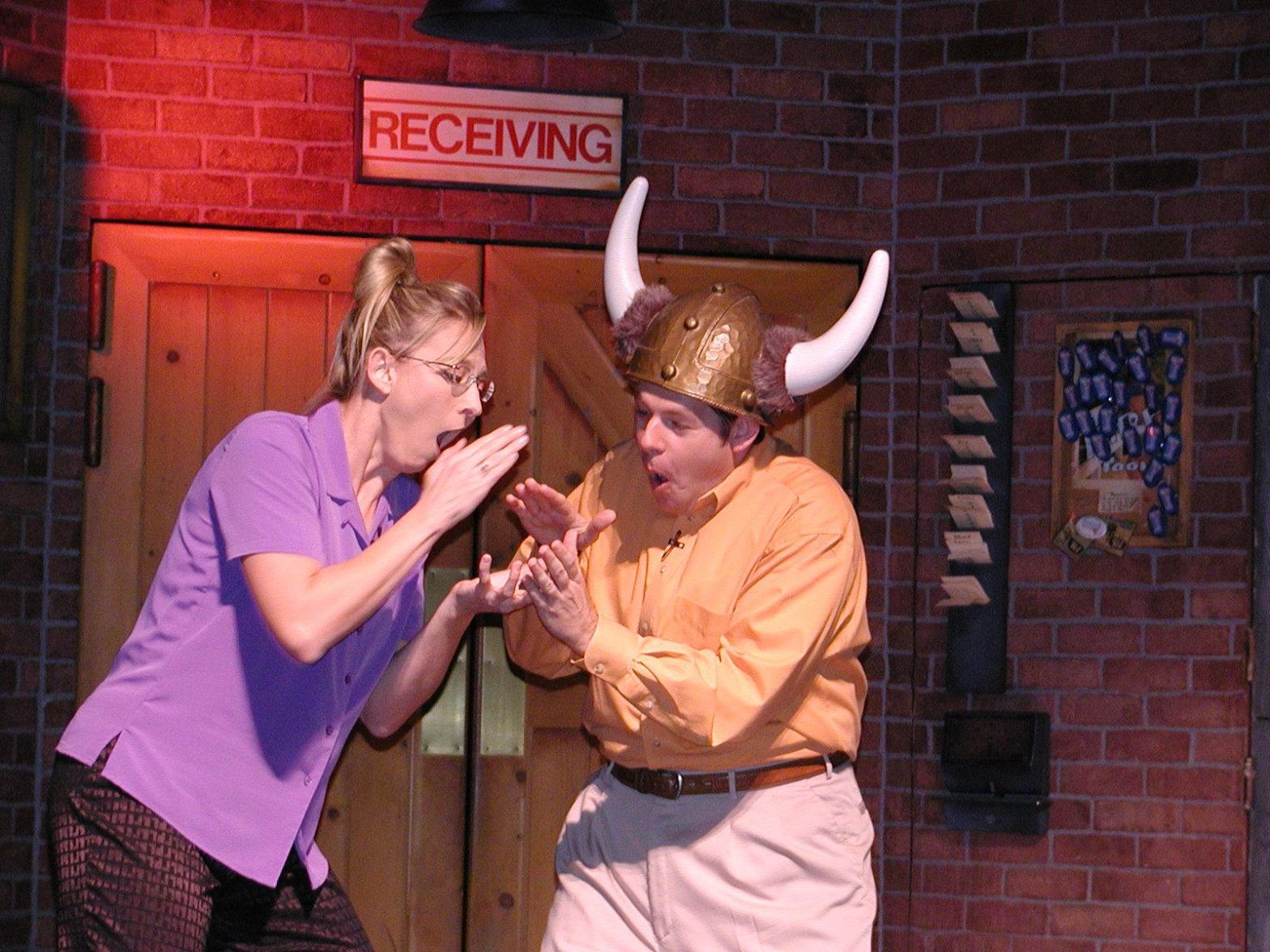
While most endowment games walk on the sillier side of the improv path, Party Quirks dances merrily down this road with unabashedly absurd characters and unfiltered foolishness.
The Basics
A host of a party is joined by (usually) three guests who each embody a quirk, trait, or persona that was solicited from the audience while the host was absent. During the resulting party, each guest engages with the previously absent character in the hopes that they will eventually recognize and be able to explicitly name their peculiar foibles.
Example
Player A volunteers to serve as the host and during their absence, B, C, and D acquire “leopard on the prowl,” “painfully shy teenager,” and “panicked soccer mom who’s lost her kid at the game” respectively. A returns and starts their party prep as B is the first to arrive.
Player A: “So glad you could make it, Brenton. I wasn’t sure you would when you responded, ‘maybe…'”
Player B: (salaciously examining the snack table) “I like to keep my options open.” (With disappointment) “You’ve put out a lot of… vegetables.”
Player A: “I’ve got chicken wings in the oven. You’re actually a little early, which is fine…”
Player B: “Well, that’s a start, and as they say, the early bird catches the…”
Player A: “Worm?”
Player B: “Or something like that. Oh dear, I seem to have spilled a little something on myself…”
A few beats later, the pair realizes that Player C has quietly entered the living room and is hiding against the wall…
The Focus
I tend to view this game as fundamentally an exercise in large, brave characterization as the bizarre prompts demand equally bold physical, emotional, and verbal manifestations.
Traps and Tips
1.) Focus on your deal. For the guests, strive to break down your ask-for into bite-sized pieces. If you’re given an animal or other non-human source of inspiration (or perhaps even the identity of a celebrity), it’s standard practice for your character to believe they are the named identity rather than embodying the actual thing itself. (So, Player B doesn’t drop to all fours to be a leopard but rather takes on the animal’s essence and intensity.) Unless time is no longer on your side, avoid monologuing or becoming a soloist as the traditional give and take of the scene remains crucial for watchability. (Entrances are, perhaps, an exception to this rule and invite strong and owned moments of arrival to get your individual game going.) For the host, it’s helpful to have a strong scenic deal too (other than merely correctly guessing your guests’ peculiarities). This can be as simple and obvious as wanting to host the best party of the season, or a little more guarded such as finally confessing your love to that one special coworker.
2.) Focus on your host. Endowments more commonly seek to change the qualities of a designated scene partner who isn’t in the know. This game plays and feels a little differently in that guests will often (at least initially) focus on layering attributes onto themselves. Player B is the leopard, after all, not Player A, so B will likely move with a predatory and disturbing gait. Subsequently, it can be easy to neglect or forget the host, who is structurally the key to the scene. Make sure each big choice or move is seen and processed by the host and that they, in turn, have a chance to respond and share what they’re receiving. Strong and playful choices that the host can’t see won’t push the scene forward; Player C lurking on the back wall will likely be joyful for the audience, for example, who will eventually decipher the choice, but A will eventually need to experience that energy in order to be able to successfully incorporate it. In general, then, avoid prolonged side-games and scenes in which the host isn’t directly involved and engaged.
3.) Focus on your fellow guests. Paced entrances are predictably a must in a game ripe with split focus potentials. This also allows the host some uninterrupted one-on-one time with each arrival to truly savor their choices. Generally, the host should name the deal of each guest when they’re somewhat certain of the underlying ask-for. (The audience should be cued to “oooh” and “ahhh” and “applaud” throughout to let the party host know when they’re close or on the money.) Correctly identified players can then leave the party or fade into the background until needed. Especially if the scene is running out of steam or time, players shouldn’t forget that they can also help create the conditions for their teammates to more clearly portray and explore their quirks. Subsequently, if Player A isn’t picking up on B’s feline hunger, they might more ably recognize the behavior if B menacingly starts to follow C across the room.
4.) Focus on your prompts. For first-time players, it’s smart for everyone to have some sense of what types or categories of quirks might be gathered from the audience. If the host is looking for a celebrity, they’re unlikely to understand that they have a great cat in their living room. To this end, players might need to deploy leading language to guide the investigation if the ask-fors deliberately or accidentally strayed from any venue expectations: “This party is really wild,” “It’s a real zoo in here….” As with all endowment games, avoid explicitly saying any of the key elements as these should first be heard from the endowee. Once your company becomes comfortable with the premise (and routinely finds “success”), it can add to the fun to include at least one unexpected ingredient into the mix to keep everyone on their toes. Such a choice also usually necessitates that everyone lends a hand in identifying the final guest, which provides a nice energy boost and climax.
In Performance
The short-form game Psychiatrist explores this same conceit only relocated to a therapist’s office where patients are “cured” when the doctor successfully names their delusion (who or what they believe themselves to be). If you’re put off by the potential vibe of making light of mental illness, Party Quirks explores the same dynamic without that ick.
You can explore other endowment games by using the Game Library search engine found here. And check out The Improv Dictionary here for helpful pointers on endowing and building bold characterizations.
Cheers, David Charles.
www.improvdr.com
Join my Facebook group here.
Photo Credit: Leesa Brown
© 2024 David Charles/ImprovDr
Game Library Expansion Pack I
 ImprovDr.com