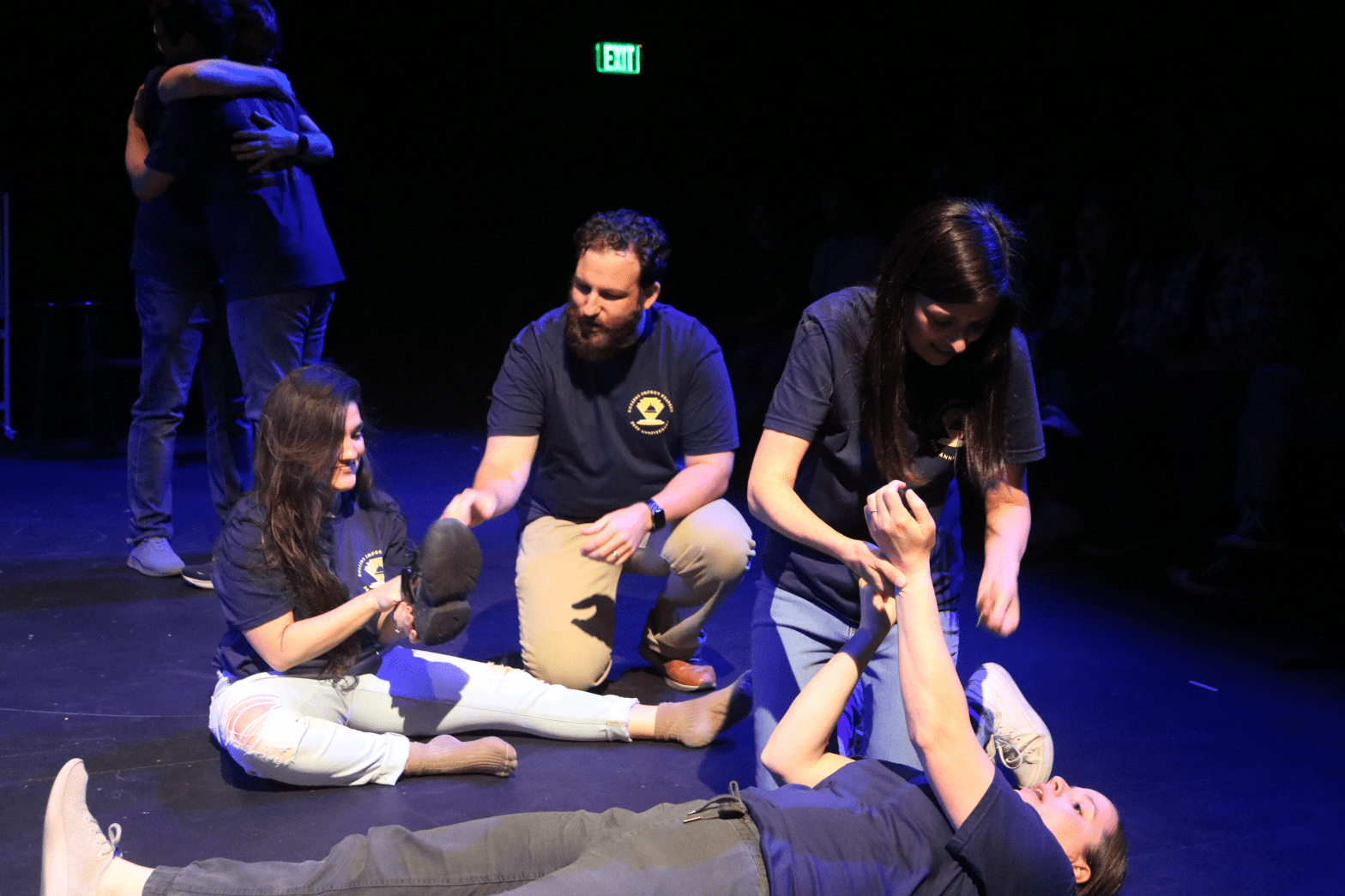
Get the party (scene) started with this jamming game.
The Basics
A team of improvisers scatters across the stage to begin. When the booth begins to play a suitably energetic song, the players dance with abandon. The music then stops abruptly (perhaps on the signal of a host), and the actors must freeze in their current random positions. An unrelated premise or location is then obtained from the audience. During the scene that follows, the team members must all eventually unfreeze and justify their poses in the spirit of the current circumstances and story.
Example
The music blasts, and four players take the stage to dance wildly, only to be stopped by an emcee’s whistle. They are caught in four truly varied poses scattered across the space. Player A is hunched over with their hands resting on their head…
Host: “What’s an outdoor location that you wouldn’t expect to see these positions?”
The audience provides a mountain trail as the starting point. A brief countdown ensues as the lights transition.
Player A: (swiping at their head) “Someone get these bees off of me. I’m terribly allergic!”
Player D considers how their peculiar pose might assist and eventually unfreezes as their teammates remain at the ready in their dancing stances…
Player D: (wagging their finger with disapproval) “I told you, son, not to mess with that nest…”
The Focus
Find inspiration from the unexpected tableau.
Traps and Tips
1.) Dance. When attacked fearlessly, the dancing preamble to the game can nearly be as entertaining as the scene itself. So, dance joyfully and to the top of your ability. Explore different physical levels, movement styles, rhythms, and partner combinations. If the opening movements feel safe or apathetic, the risk of the game will plummet. When the music stops, the audience should feel that the players have been caught off guard in truly challenging poses (as this should, in fact, be the case).
2.) Prioritize. When I host this game, I’ll always take a moment before the scene starts to instruct the team to have a quick look at each other. This adds a little playful heat to the event as they see the impossible positions they need to utilize – just watching them really see each other can add greatly to the fun! However, there’s also a pragmatic reason for this coaching moment: it’s useful for the players to recognize if a fellow teammate is in a particularly extreme or challenging pose so that this player can be given an opportunity to begin the scene if necessary. To avoid a cluttered start with multiple players talking over each other, default to the most uncomfortable position and/or those who are downstage of you as they’ll be less likely to be able to see you initiate if you’re out of their line of sight.
3.) Incorporate. Standard Freeze Tag techniques and strategies apply. (See here.) Be particularly careful that fun physicalities don’t become instantly dropped, needlessly fudged, or unhelpfully thrown away with blasé quips – “Well, I’m glad my stretching is over…” I like donning an attitude of making these starting positions important for the whole duration of the scene, so actors may take on elements of the opening tableau as parts of their characterization or keep returning to key activities or orientations. This strikes me as a more rewarding approach than just seeing a series of panicked justifications and a resultingly under-energized talking heads scene.
4.) Pace. In my current campus troupe, we tend to play this game as a quick hit that lasts approximately a minute or so. Even (or perhaps, especially) under these tightened parameters, it’s crucial to patiently and generously time the unfreezes. (The accepted concept is that players who have remained frozen aren’t in the world of the scene until they elect to come to life.) Avoid a mass blob of indistinguishable characters all trying to justify their existence in one chaotic improv avalanche. If you’re playing on a four-person team – which works well for this game – it’s helpful to assume that at least one player will remain frozen until the last twenty seconds or so of the action. Often, the first player will need a responsive partner reasonably quickly, but this shouldn’t necessitate remaining team members carelessly jumping on board the improv train as well.
5.) Share. And a last cautionary tale. Oftentimes, a well-intentioned improviser will inelegantly assign a list of roles or functions to their frozen teammates in an effort to quickly define everyone. Unfortunately, this type of move typically deflates the game and robs the audience of seeing the escalating difficulty of one player after another having to weave themselves into the emerging story. Instead, assume that each player will accept the responsibility of defining their own deal when they see the best moment to do so. Sure, there will be occasions when you might be able to see what another improviser can’t and therefore offer a much-needed helping justifying hand. But don’t make this your default setting.
In performance
If the thought of dancing doesn’t inspire confidence or your cast includes members who might not be served by such an energetic opening ritual, consider exploring the similar upcoming game, Statues, as an alternative.
Cheers, David Charles.
www.improvdr.com
Join my Facebook group here.
Photo Credit: Kalani Senior
© 2025 David Charles/ImprovDr
Game Library Expansion Pack I

