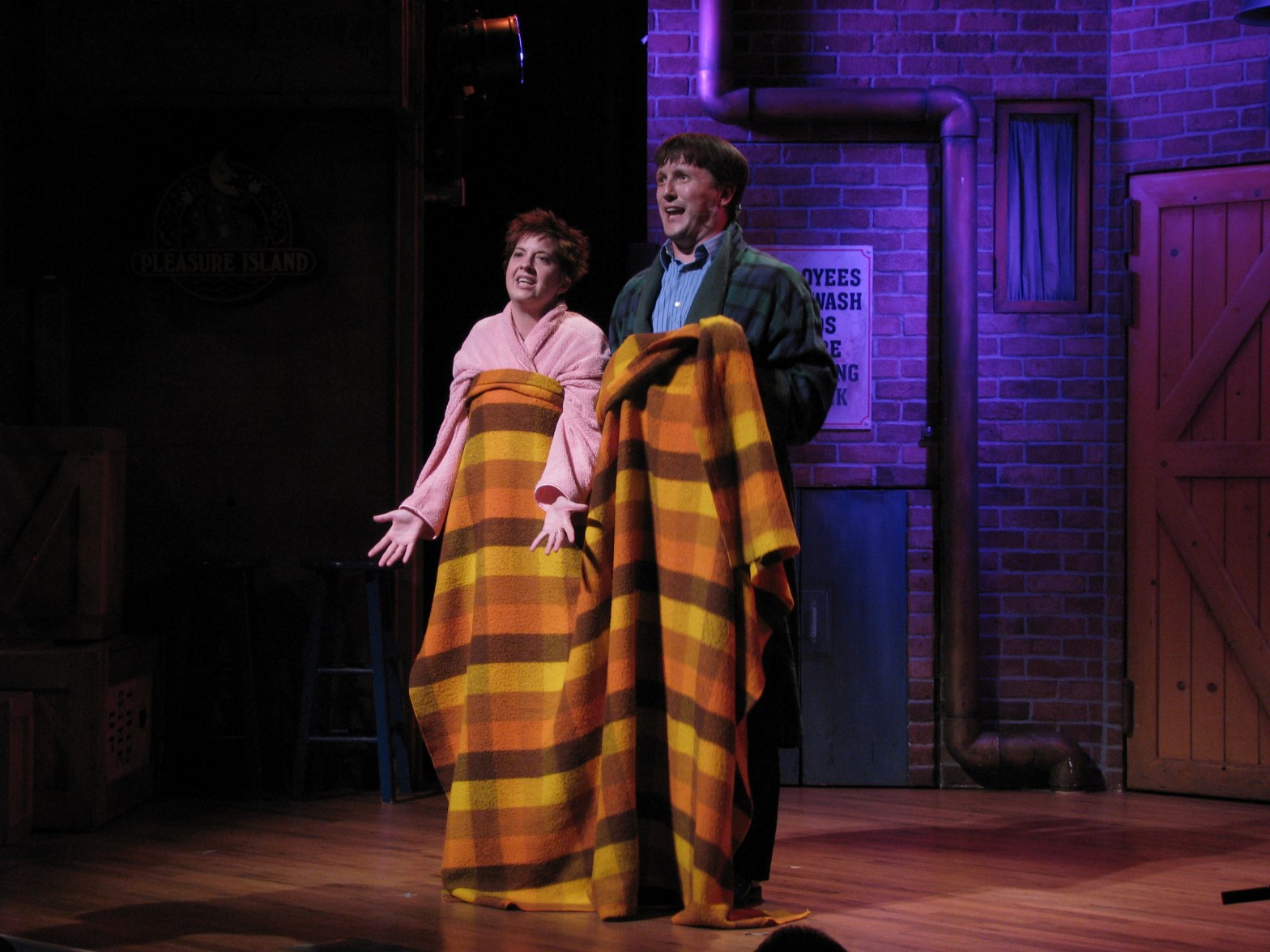
I first came across this structure at Disney’s Comedy Warehouse where we were fortunate to improvise alongside some truly world class musicians (and technicians, for that matter). More recently, it inspired the first act of an R&D Show at Sak Comedy Lab, where we take a short-form premise and expand it to make a 40–50-minute set. It plays with devices similar to those found in Song Cue (here) but allows the players a little more wiggle room between the musical moments which invites a wider array of styles and encourages patience in story building.
The Basics
For the short-form version, three random, original song titles are elicited from the audience. Generally, these are written on large sheets of paper and placed on the lip of the stage (or on an accessible clipboard to the side) as it’s a longstanding challenge to remember the later titles once the scene is up and running (!) so it’s smart to have the prompts visibly available. (The musician will want to note the song offers so that they don’t miss the pitches from the stage either). An additional scenic location or inspiration might also be obtained, and the team then begins an impromptu scene. At opportune moments – often marking the beginning, middle, and end of the action – players work their way to an unused song title which then initiates the creation of an accompanying musical number. The scene ends when all the generated titles have been used in this fashion.
Example
The offered song titles include, “It’s never too hot for coffee,” and the scene begins at a water park. Players A and B set the stage by resting out on deck chairs before an imagined wave pool.
Player A: (wiping the perspiration from their forehead with a beach towel) “These temperatures are unbelievable. I’m regretting our choice to summer in Florida…”
Player B: (smiling while looking out at the pool) “But the kids are loving it, darling. This is a memory they won’t soon forget.”
Player A: (rolling closer) “Will you re-apply my sunscreen? I can feel myself cooking…”
Player B: (it’s the third time) “I suppose you can’t be too careful.”
Player B reaches to take one last sip from their stowed cup.
Player A: (astonished) “Coffee? On a day like this?”
The music starts playing…
Player B: “You know what I always say…”
“If the moon is out, or the sun is up,
You know what I’m gonna need in my cup!
You might laugh or get all scoff-y,
But it’s never too hot for some steaming coffee…”
The Focus
Create the need for the various songs and work to make the titles significant and meaningful to the dramatic (or comedic) arc.
Traps and Tips
1.) Build. As is often the case with these written examples, I’ve had to jump to the relevant material quickly to model the core dynamic. If you’re playing the original 4-5-minute version, you do need to establish details quickly to leave room for the songs but, nonetheless, invest in scenic and relationship details to give yourself something of note to serve as your launching pad. Your songs are less likely to pow if they are just throwaway gimmicks that don’t further the world and lives of the characters.
2.) Risk. Again, the above example starts about 2 steps away from the known song title, and there will certainly be times when you need this kind of simple conciseness. But generally, it’s more fun for the players and the audience not to just plod from one inelegant song setup to another. Instead, let the scene go where the scene organically wants to go, and then, when the time feels ripe for a musical embellishment, look to pivot towards the next viable title. Even if you end up miles away from the intended targets, there is great fun to be had from seeing the sudden scramble to line up the next known cue that isn’t easily and obviously in front of the cast already.
3.) Contextualize. To balance the above fearlessness, also take full advantage of the fact that the three (or more) song titles are known before even the first improv choice has been made. This allows players to display greater finesse with what the lyrics might mean within the context of the scene. Above, coffee has been used to just mean the drink, but it could also become the name of the couple’s dog, or the flirty waitstaff bringing refreshments, or the vacation spot’s name… You’ll want to be careful of driving the scene mercilessly towards such a left-field choice regardless of the story needs (or just retreating into your head to plan something overly original in general), but a few earned surprises can go a long way to breathing new life into potentially mundane justifications.
4.) Strategize. Lastly, strive to set yourself and your fellow collaborators up for joy and success. It’s less fun if the same actor ends up justifying, starting, and serving as the lead singer for every title – aim to share this wealth around. If B has taken the first song as a solo, then perhaps A takes the lion’s share of the next number, and their currently unseen children might join for a rousing ensemble piece to close. Make sure you’re getting into each musical number clearly and cleanly: don’t leave your musician guessing if an oddly phrased line was intended as their cue. And if you’re mentally able, give a little thought as to the sequencing of the songs – they needn’t just appear in the order they were gathered. Sometimes there’s a clear choice for the “out” – perhaps a particularly pithy phrase, or silly word, or challenging lyric. Or if you’re stumbling a little, it can be kind to use that “impossible” title as the middle number so that the finale has a better chance of selling.
In performance
For good or evil, this musical game can tend to run a little longer as the onstage team has more control over when (and if) they want to move onto the next musical moment. (This internal calling also invites a much wider array of stylistic energies, which I love as a player.) If you’re committed to slating this in a fast-moving short-form competition, songs will need to be pithy – no longer than probably a verse and chorus. If you’re fortunate enough to have some room to let the scene grow, you might find yourself with something considerably more robust on your hands.
New to ImprovDr.com or the Game Library? You can find the ever-expanding collection of games, exercises, and warm-ups here.
Cheers, David Charles.
www.improvdr.com
Join my Facebook group here.
Photo Credit: Leesa Brown
© 2025 David Charles/ImprovDr
Game Library Expansion Pack I

