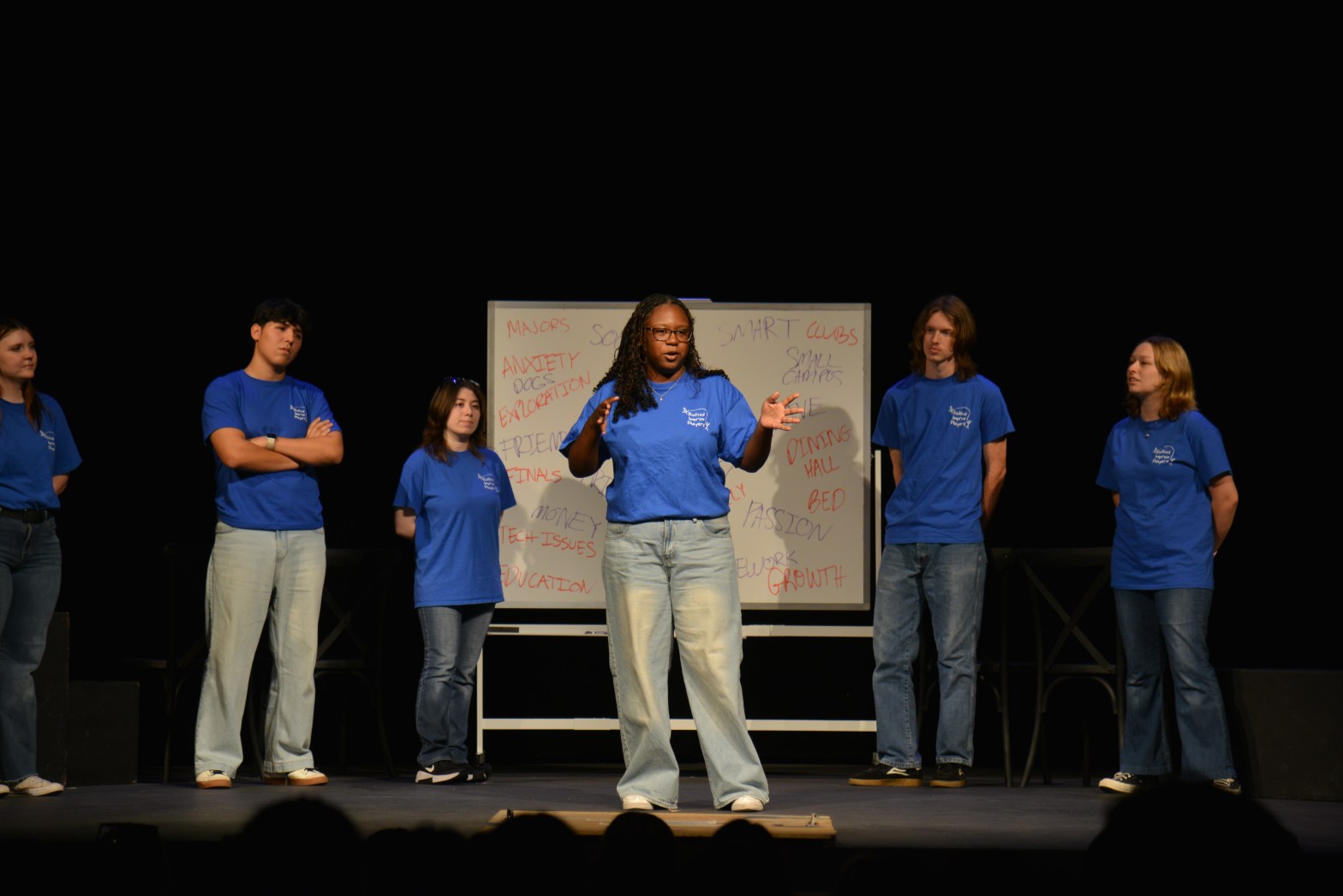
I first learned this game as a fast-paced decider, but since have also played it as a frame for an entire set with each “death” becoming the inspiration for a lengthier scene. Either way, Story, Story Die suitably flexes your story and listening muscles.
The Basics
Players form a line. The host or emcee typically serves as the facilitator and positions themselves in front of the improvising storytellers. A title is obtained and when players are pointed to by the emcee they must continue the story narrative. As the lead moves from player to player, new narrators should pick up exactly where the prior speaker left off. If a narrator falters, repeats, stumbles, or otherwise impedes the progress of the story in an unpleasing way, the audience calls “Die” (or makes a game show buzzer sound) to eliminate the offending player. The exiting player might perform a brief death ritual or scene. Generally, the story then resets (I tend to begin a new chapter) and the process continues until only one remains victorious.
Example
The story is inspired by the title “Lost in the Forest.”
Player A: “It was an unseasonably hot day in the woods behind Fatima’s house. She’d wandered aimlessly into the…”
The caller shifts the focus to Player B.
Player B: “…dense trees, oblivious to the time, and without bothering to look for landmarks that could led her back to the fam…”
The caller shifts the focus to Player C.
Player C: “…ily home. She was in the mood to explore and couldn’t be bothered with such things. A pleasant stream caught her at…”
The Focus
Endeavor to tell a good story. Allow the eliminations to come when they will by playing bravely and with grounded presence.
Traps and Tips
1.) Thoughts about the storytelling. Yes, this game generally needs players to go out, but it is so much more impressive if you also get a good story along the way. Don’t start with a manic energy or let the fear get the better of you. Establish strong specifics and a unifying voice and tone. It’s helpful to tell the story in the third person, create a clear protagonist, and take small steps. A strong introduction, platform, or balance (depending on your preferred terminology) will set everyone up for success. Especially if you’re playing with more than a handful of players, the story will likely last a while and move through multiple chapters. If nothing is clearly established or built upon, it can quickly just become a clutter.
2.) Thoughts about the transitions. Make sure you’re paying close attention to the caller or facilitator. When their hand or focus moves away from you, immediately stop talking. Much of the fun comes from players finishing each other’s sentences or words in unique or unexpected ways and if you quickly try to cram in that last idea or phrase that you really wanted to say, you’re actually robbing the game of much of its delight. Similarly, when you are the new designated speaker, grab the narrative thread right away, avoid repeating the last word or two (this is a legitimate reason for being called out) and aim to continue developing the narrative arc. Each death also provides a natural reset moment when the conductor can move the story to a new chapter so as to provide a clean (but connected) start. It can serve to offer a brief story recap here too if the action is becoming unwieldly and needs a little help.
3.) Thoughts about the conducting. Look to pace the challenge from round to round. I like to start rather leisurely, allowing players to get a full sentence or two out as the story first takes shape. This stops the narrators from becoming needlessly jittery and tends to give you richer material that grounds the later chaos. Once the story has some bones, then ramp up the speed and unpredictability of the shifts. If the players are truly excelling – which is a wonderful problem to have – you can then deploy other challenges and “fouls” to increase the likelihood of an out, such as forbidding “and,” “or,” and “so,” as transitional words on the passes (or just altogether), or banning words that start with or feature a particular letter of the alphabet suggested by a random audience member. I tend to scale back my aggressiveness if the story is faltering too much as no one really wants to hear minutes of panicked nonsense, so strive to balance the needs of the story and the desire to find an eventual winner.
4.) Thoughts about the deaths. I’ve seen (and enjoyed) a wide variety of approaches to the eliminations. On the simplest level, players can just accept the call and leave the stage. Sometimes when we play this for Halloween-themed shows on my home campus we might just add the simple choice of having the person slump in place to the ground so that the final narrators are now talking amidst a pile of their former teammates. Depending on your audience, time restraints, and personal sensibilities, some companies have departing players get an ask-for to inspire a quick pantomimed death. And as noted above, you could also lean the format into long-form territory by having the deaths expand into full-blown scenes that culminate in the demise of the losing player. At Disney’s Comedy Warehouse the “award” for winning the whole shebang when it was used for an entire set was then completing the story in a style or manner of your choosing, which gave a lovely climax to the story and show.
5.) Thoughts about the style. It’s a simple matter to theme the story to your particular event needs or audience demographic. In addition to embracing one overarching style to steer the narrative, once you’ve mastered the central dynamics it can also prove fun to have each narrator tell the story through their own unique lens. In this manner, one player might be telling the story as a detective novel, another in the style of science fiction, and yet another as a young adult fantasy. Particularly fearless improvisers can have the audience assign these styles before the story begins, but it also works well for players just to select a genre with which they are familiar, announcing their choice beforehand. If you’ve played this game a lot, this little adjustment will breathe new life into the stories, just make sure you’re still really listening to each other and picking up the narrative where you partner left off. There can be a tendency to retreat into your mind in search of the next useful trope and then just shoehorning it into the mix when it’s your turn regardless of whether or not it serves the story – avoid that whenever possible!
In Performance
Especially if you’re hoping to tell a good story (and why wouldn’t this be your goal?) be mindful that this decider can take a little while so perhaps limit the number of players in the mix. If you’re playing with more than four or five, you might end up burning more time than you intended.
Or you can also just remove the elimination feature entirely, which moves the warm-up into Conducted Story territory!
Cheers, David Charles.
www.improvdr.com
Join my Facebook group here.
Photo Credit: Olivia Skvarenina
© 2025 David Charles/ImprovDr
Connected Concept: Story Series for Improv I
 ImprovDr.com