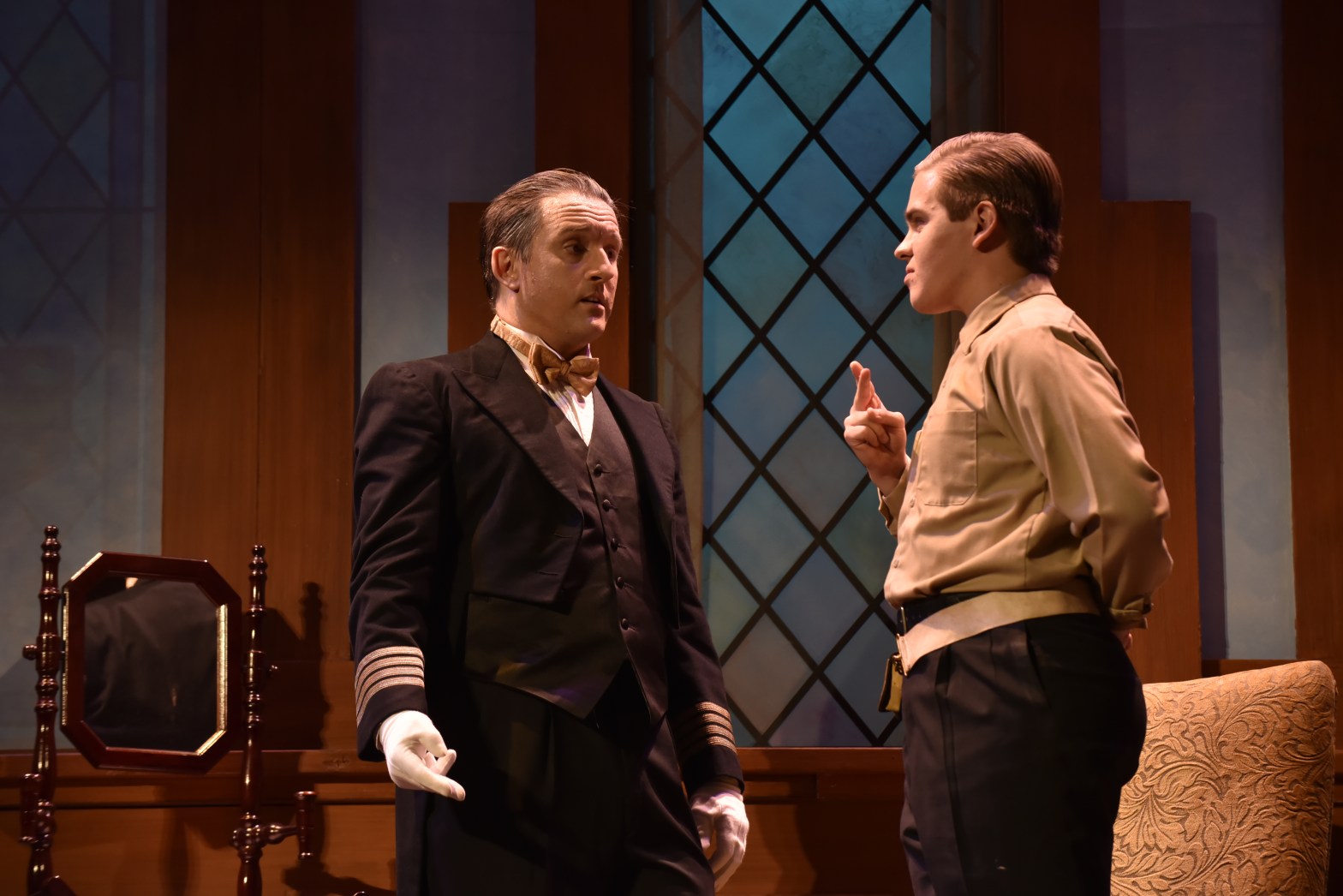
Perhaps more of a skills-building exercise than a commonly played game in its own right, Two by Four challenges improvisers to craft multiple characters in the same scene.
The Basics
Two players perform a scene in which they each embody two distinct characters each. At some point – usually during the story’s climax – all four characters should be onstage at once, with the two improvisers leaping between their creations as deemed necessary and helpful. (It’s always struck me that this is actually a Four by Two, but I’m maintaining the title under which I encountered the game many years ago at Players Workshop in Chicago!)
Example
It’s game day, and Player A begins the scene sitting on the family couch with a large bowl of potato chips in their lap.
Player A: (calling offstage, in a gruff and midwestern dialect) “Clara! You’re going to miss kick off!”
Player B: (appearing a few moments later, with a tray of goodies) “We’ve been waiting for this game all season. I wouldn’t miss it for the world, John.”
Clara sits beside John on the couch and they get comfortable.
Player A: “The perfect day, the perfect partner, and the perfect team…”
Player B: (turning to the offstage window upon hearing a sound) “Is that car pulling into our driveway?”
Player A: (distracted) “Just ignore whoever it is and they’ll go away.”
Player B moves to the window.
Player B: (with anxiousness) “It’s your parents, John. And they have a lot of luggage.”
Player A: “I can’t have got the dates wrong…”
While A’s “John” remains on the couch, improviser A dashes to the other side of the door established by B and knocks. B does not watch as A moves from the body of one character to the other.
Player B: (looking at the ghost character “John” on the couch) “That’s definitely your mother.”
Player A: (assuming a new gait and tone, from behind the door) “John, darling, don’t keep your mother waiting. That was a long drive, and I need to use the restroom…”
Player B (Clara) opens the door to welcome her mother-in-law (A)…
The Focus
Strong characters with defining and recognizable traits are the key to success, as are sharp transitions between the various personae. Moving between embodied (seen) and ghost (imagined) characters is both the gift and the curse of the enterprise, and it can take many attempts to find any finesse with this element of the format.
Traps and Tips
1.) Seek variety. If you have a cast of largely homogeneous characters – four teenagers at a party, for example – it can prove difficult to clearly craft useful distinctions which can create difficulties further down the line. When the story allows, look for a diversified cast with contrasting ages, genders, physical and vocal energies, and the like. How you distribute these roles initially can also assist. Player A taking on “John” and then John’s mother, for example, increases the likely distance between the actor’s two home personae, which in turn encourages boldly different choices.
2.) Lock in. My examples are always a little truncated for flow, but you’ll want to make sure you give each character a chance to find their voice (literally and metaphorically) before putting them in a sea of new entrances. Now that we’ve met the first couple, it might be helpful to focus on B’s Clara and A’s mother before throwing in the fourth character (probably A’s father who might be busy unpacking the car in the driveway to facilitate that choice). Strategic exits are key as any characters who remain onstage and in the scene need to be carefully tracked and kept “alive”. In this way, if Clara and the mother have a mini scene at the door, they should keep looking to “John” even if he isn’t speaking, and Player A might want to leap back into that body to give the occasional reaction or two as well. (Don’t feel the need to always offer a verbal gift as you move between your characters.)
3.) Retain focus. Be careful where you look! As the fourth player enters, in particular, there will be a lot of movement as embodied characters engage in traditional stage movement and blocking, and improvisers need to dart between their creations in order to inhabit formerly ghost personae. Strong eye contact should be maintained for the former (when a character is looking at another character whether or not they are actually there) and rigorously avoided for the latter (when an actor needs to dash from one role to the other and not have their partner’s eyes follow this technical business). Interacting with ghost characters as if they were there is a huge part of the fun and entertainment value, so work to clearly know who is sitting or standing where and refer frequently and often to these resting places and people.
4.) Move deliberately. Related to the above, make sure your movement quality is radically different when a character moves as opposed to when an actor leaps from one persona to the next. If everything feels a little sluggish or same-ish, then it’s easy to become confused. When characters have unique movement qualities, and fazing dashes feel notably different, players (and the audience) will generally have a better time discerning between the two. While a little confusion is probably unavoidable and, frankly, part of the fun, lethargic jumps between characters tend to rob the scene of its natural flow and will decrease rather than increase the overall energy.
5.) Pursue balance. This is more of a consideration in the training hall but work to give each character their due. If we only see a glimpse of A’s Dad as he spends the rest of the scene in the driveway, the audience can feel a little cheated. Part of the contract of the game as described in the (possibly backwards) title, is that we’ll see four characters crafted by two actors, and it’s exciting for this moment to feel significant and sizable.
In performance
The skills honed through this exercise enable the construction of larger pieces that may often require single improvisers to don multiple hats. This bite-sized version allows players to explore the key dynamics and techniques in a concentrated environment. In this iteration, players don’t typically take on each other’s roles, but this is certainly a tradition with ghost characters in derivative pieces, especially if the performance would be better served by that configuration (rather than have the one actor portray a lengthy scene leaping clumsily back and forth between their two creations while their scene partner watches helplessly on).
Cheers, David Charles.
www.improvdr.com
Join my Facebook group here.
Photo Credit: Tony Firriolo
© 2025 David Charles/ImprovDr
Game Library Expansion Pack I
 ImprovDr.com