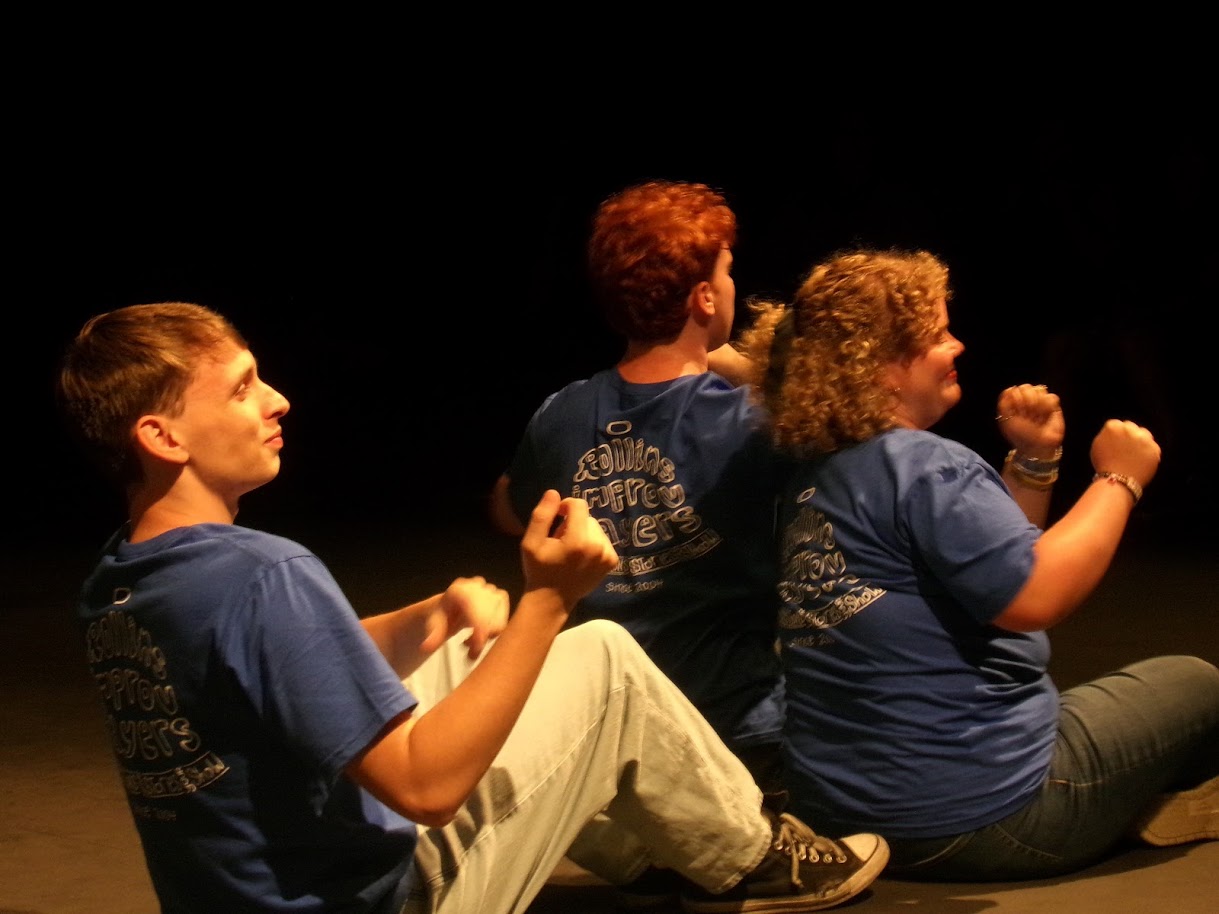
This format provides a delightful variation on the endowment subset of improv games. I’d forgotten all about it, to be honest, until I went on the hunt for an off-the-beaten-track game for my R&D Show at Sak Comedy Lab.
The Basics
An environment or location is obtained and then the entire team leaves the space so they cannot hear the remaining set up. While they’re gone, two words related to the setting (often objects) and one activity likely to be performed in the space are obtained by the emcee or facilitator. When the players return, they create an improv scene in which they attempt to say the two hidden words and partake in the given action. The audience should “ooh” and “aah” appropriately to help improvisers know when they are getting close. The scene concludes when all the given elements have been successfully identified or a preset time limit has been reached.
Example
The team is assigned a desert as their location, and while they’re out of the space the audience assigns “oasis,” “cactus,” and “riding a camel” as the three ask-fors. The team is summoned back into the theatre, and the scene begins…
Player A: (crawling painfully on the ground) “I don’t think we’re ever going to be found in all these sand dunes. I don’t know how much longer I can go on.”
Player B: (assuming a similar position while playing with a compass) “If you’d checked the airplane’s fuel when I asked you to… I can’t seem to get any reading at all on this compass, or at least nothing that I can understand.”
Player A: “Does the sun set in the east or the west? Have we just been walking around in circles?”
Player B: “I don’t know what to tell you, Drea. All I know is that if we don’t find some water and shade soon…”
The audience “oohs” at the mention of water…
The Focus
Putting the endowment part of the exercise aside, this premise provides strong motivation to build nuanced and detailed worlds with lots of great objects and characteristics.
Traps and Tips
1.) During the host’s set-up. This scene requires a little more finagling than you might be accustomed to in terms of eliciting helpful audience suggestions. Most base locations will work as long as they have multiple features and components. (Being stuck in an elevator might be a little too limiting, for example.) When it comes to the hidden elements, consider your performance parameters. If you’re playing within a tight time limit, you might want a couple of the items to be at least a little obvious. If you’re looking for a longer offering, then leaning into related but slightly obscure choices will likely serve better. In either case, it’s typically wise to rule out the really obvious candidates, such as “sand” or “dune” for our desert location, as it will make the scene pace odd if the first move in the scene ticks off one or more of the missing components. I tend to lean toward nouns or objects for the first two words just as this tends to encourage players to create props in their world which is more fun and can also lead them toward the generally more difficult activity as well.
2.) During the players’ absence. When the improvisers are released from the theatre as the host brainstorms the endowment pieces, it’s incredibly helpful for them to engage in some quick brainstorming as to possible elements. (This is why it’s important to get the base environment before the team leaves the space.) You don’t want the scene to devolve into nothing more than a loose list of references and guesses, but it can open up improv doorways if everyone quickly considers fruitful possibilities. What kinds of people or occupations might be found within the world? Is there jargon or lingo that might commonly be used, or props that tend to define the location? Perhaps even exploring a “third thought” attitude to the scenic prompt might help. Deserts tend to be devoid of water, so what are some related strategies or ways of solving that as a character?
3.) During the scene itself. Take risks. Pursue active choices. Fill the stage with objects and potentials. Above all, however, listen to each other and the audience. If players act as individual detectives hunting for the right answers, you won’t get much of a scene. So, you’ll want to make extra sure you’re building off each other’s ideas and seeing what doorways organically emerge as a result. A dynamic story will more likely lead you into fruitful territory than a random series of buckshot announcements. That being said, if you haven’t heard any response from the audience for a while, that’s their way of telling you that you are barking up the wrong tree (or cactus) and so you’ll want to look for ways to evolve the direction of the exploration. Repeating the same “wrong” choices again and again won’t ultimately get you any closer to the endowment finish line, so let the story expand.
4.) During the scene’s culmination. As is the case with all endowment games, it’s more than fine if you don’t end up finding all the clues especially if you’ve given the audience a joyful and brave journey along the way. Time reminders from the emcee can help shape an incomplete picture by strategically ramping up the stakes. Similarly, the host can (should) encourage the audience to offer feedback if the players are feeling a little rudderless or abandoned. Often, the activity provides the most challenging element to find, so I find it helpful to try to first focus on the two objects just so everyone tastes a little victory early on in the action. As the activity might require several elements, it tends to be a little more impressive as the scenic climax or button (especially when the players fully commit to performing the given activity). As is the case with Crime Endowment (see here) and other related games, bringing back all the discovered puzzle pieces at the end of the scene provides a lovely out as well.
The R&D Twist
This game rewards pursuing the obvious in our scene work and is worth a look for that reason alone. Initially, I resuscitated the concept as an offering for the R&D lab assistants but I’m considering expanding it into our first act down the road as well. Simpler ask-fors were needed for the former; expanding the number and difficulty of the hidden elements will certainly be needed for the latter.
New to ImprovDr.com or the Game Library? You can find the ever-expanding collection of games, exercises, and warm-ups here.
Cheers, David Charles.
www.improvdr.com
Join my Facebook group here.
© 2026 David Charles/ImprovDr
The R&D Show Expansion Pack

