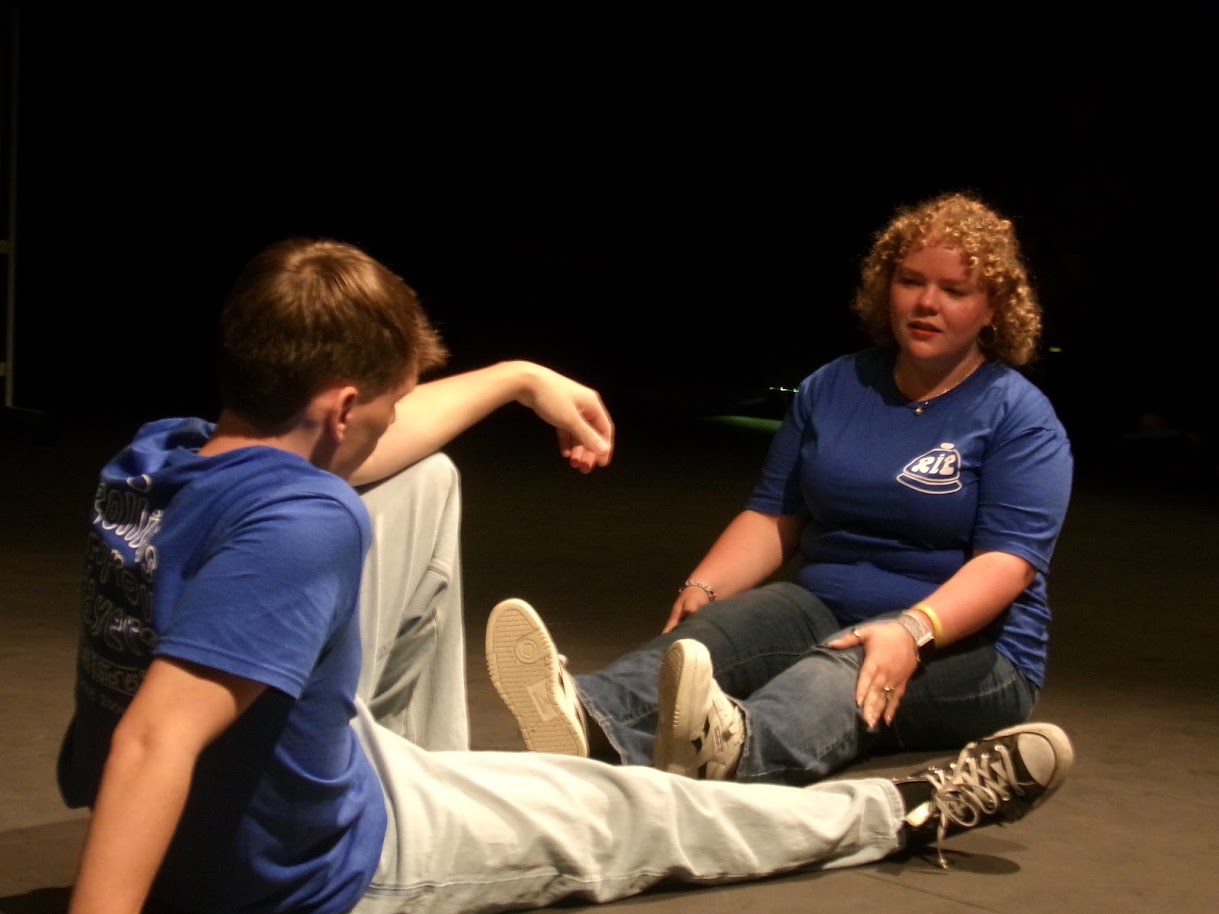
As the R&D Show continues its run and promise of all-new games, I increasingly find myself in search of new formats, particularly larger cast warm-ups as we usually have 12 lab assistants joining the fun for the second act. I devised this fun replay variation to meet this recurring need.
The Basics
Members of the ensemble work in (perhaps predetermined) pairs. A brief initial scene is created based on a prompt that only features Four Lines (hence the title). Different players are then shuffled onto the stage, and the host offers a small (or not-so-small) adjustment to the given circumstances. The new pair now repeats the scene, using the exact same dialogue, while embracing the altered conditions. The brief scene replays with new adjustments until everyone has played at least once, possibly with the original pair returning to provide the last variation.
Example
“Biting your fingernails” is offered as a small interpersonal pet peeve to inspire the action. The first pair take the stage and improvise a “neutral” iteration of the action.
Player A: (seeing Player B sitting on the couch and biting their nails – with annoyance) “I see you’re home early…”
Player B: (while chewing away) “Yeh, my morning class got canceled.”
Player A: (tempted to slap B’s hand out of their mouth but remaining reserved) “We’ve talked about you not doing that.”
Player B: (unruffled) “I didn’t think you were serious, Sophia.”
Blackout. The emcee obtains a new framing ask-for or adjustment and Players C and D tag out the first players from their starting poses. The action is now a first date in a movie theatre…
Player C: (seeing Player D sitting in the movie seats and biting their nails – with affection) “I see you’re here early…”
The scene and replays continue…
The Focus
This is truly a slimmed down version of Replay or Most Scenes in a Minute (see here and here) with a rotating rather than consistent cast, so those game pointers largely apply as well. If you mine the subtext of the lines, you can really find vast new possibilities for the scene and relationship.
Traps and Tips
1.) For the first scene. Don’t think of the scene as just the four lines or you’ll have a base model with very few details to model. Focus on setting up stage geography, mood, and relationship (or all the key CROW ingredients, for that matter). To this end, assume strong physical starting positions so the scene has a “starting in the middle” vibe. I’ve perhaps clumsily described the first performance as “neutral” – by that I mean, don’t lean into a broad style or overlay as this is the terrain that will follow. Consider the first crack at the story as grounded and set in the here and now. You only get four lines, so make them important. That being said, keep the dialogue succinct and memorable. I’m also a fan of a little specific ambiguity as this also gives room for surprising twists and development.
2.) For the first replay. The second pair to the stage model the flow of the game so it’s important that this initial transition is precise and clean. If you’re using this to warmup a larger group, it can be helpful to have everyone repeat the lines of dialogue aloud before the first switch just to maximize the likelihood dialogue will be remembered. (Pre-assigning who will be replacing Players A and B respectively will help with this, too). Incoming players should assume the exact positions of the outgoing characters who should snap back into their starting or “one” positions to facilitate. (If the emcee plans to radically change the environment or context each time, you might want to omit this Freeze Tag overlay.) It’s helpful for those who will follow to pace this first reenactment. If the first replay significantly ups the energy, resets the norms, or changes every line of text (deliberately or by accident) there’s not really much room for the greater exercise to expand. On the other hand, if the first replay excels in subtle shifts of tone and intention, the playing field will remain wide and open for future improvisers.
3.) For the subsequent replays. Building on the above note, the curve of absurdity should be your friend especially when viewed across the game as a whole (rather than one small individual step or replay). Look to satisfy the pitch from the emcee while also honoring discovered games and trends that unite the vignettes. As best you can, keep the opening poses and the original dialogue intact. (In my book, it’s okay to shift a word here or there to honor the new given context – so “home” becomes “here” in the above example to recognize the shift in location.) Subtext and stage directions, however, are ripe locations for mischievous play and reimagining. I’ve tried to nod to this potential with the first player’s disgust morphing into affection, although that large a move will probably serve better a few replays into the action. If you have a set number of pairs playing, I think an attitude of “leaving room for those who follow” becomes especially important as you don’t want the series of scene to climax before half the ensemble has even hit the stage.
4.) For the facilitating emcee. Know what you want to get out of the game as this will also set your focus and inspire your adjustments. When we first played it, my stated thesis was that small changes could have a big influence, so each new premise tried to tweak a seemingly minor (though ripe) ingredient. If you’re going to the audience for new inspirations, make sure you’re guiding them a little into the fruitful terrain you’d like to investigate. It’s great to simply explore genres or styles, but I’ve found it’s equally fun to make the focus a little something more out of the ordinary. So, each replay could try to just gently increase the amount of love being felt, or decrease the amount of physical space available, or adjust the ages of the characters… (See Age Replay here for how I added a blind component to this concept as well.) In this way you can keep the frame of the exercise while pursuing markedly different scenic or comedic results.
The R&D Twist
This fast-paced series of scenes provides a nice way to get the whole ensemble up and playing together. It requires a little advanced sorting as you can lose a lot of time and energy if there isn’t a clear sense of who’s playing next and in what positions. I also strongly recommend the device of having the whole company repeat the lines before leaping into the action – the fun of watching characters butcher the dialogue will quickly evaporate if following scenes now have little to nothing to mirror and explore!
New to ImprovDr.com or the Game Library? You can find the ever-expanding collection of games, exercises, and warm-ups here.
Cheers, David Charles.
www.improvdr.com
Join my Facebook group here.
Photo Credit: Tony Firriolo
© 2026 David Charles/ImprovDr
The R&D Show Expansion Pack

