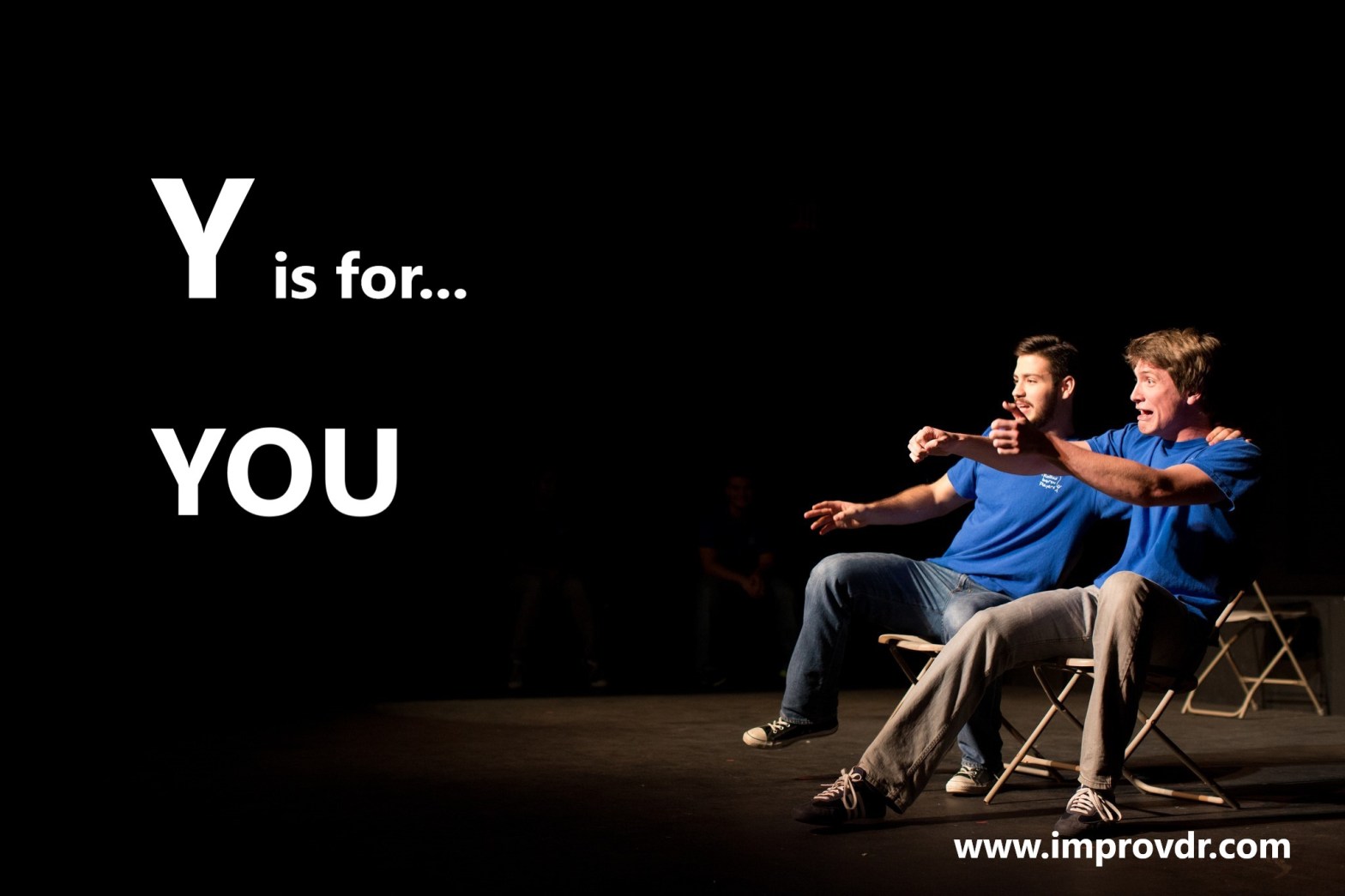
Game Library: “Yes Party”

Part demonstration, part exercise, Yes Party aptly models the destructive results of negativity and Wimping.

The Basics

It’s helpful to have a white board and markers (or similar) for this participatory brainstorming exercise. A facilitator leads the discussion, perhaps with a helper or two writing the offered suggestions on the whiteboard.

Round One

The facilitator invites the participants to offer up a theme for a party which is then written on the white board. Those in attendance are then asked for a reason why this party theme can’t happen or is a bad idea – a block or wimping “Yes, but…,” if you will. The theme is then crossed out. A series of new party ideas are then elicited with each receiving the same treatment. Continue in this fashion until there is a small collection of rejected themes.

Round Two

The facilitator now elicits one more possible party theme. This time, rather than seeking a reason to nix the idea, participants are now invited to brainstorm ways to realize and expand upon this particular party concept. What types of food might be served? Will there be decorations or costumes? Who might serve as the entertainment? These additions are recorded without judgement on the whiteboard around the theme in question.

Example

Facilitator: “What’s a fun theme for a party?”

Player: “A Halloween party.”

Halloween is written boldly on the white board.

Facilitator: “OK, what’s a reason for not having a Halloween party?”

Another Player: “It’s February.”

Halloween is crossed out on the white board.

Facilitator: “Fair enough. What’s another theme then?”

Another Player: “Pirates of the Caribbean.”

This new idea is recorded.

Facilitator: “Great! But what might be a reason we can’t do that?”

Another Player: “I don’t like pirates…”

Several more themes are obtained only to be rejected…

THEN

Facilitator: “Let’s try our planning session again. I need another possible theme…”

Player: “How about a villains theme?”

Facilitator: “I love it. So what would we need for such a party?”

Villains and the resulting additions are all recorded…

Player: “We could have black light to make it eerie.”

Another Player: “And a smoke machine…”

Another Player: “We’ll need a DJ with a customized playlist.”

Another Player: “And definitely themed costumes – everyone dressed up as their favorite villain…”

Facilitator: “Any refreshments…?”

The Focus

This experience typically culminates in an extremely provocative visual: one section of the board covered in crossed out suggestions and another full of uncensored potential. As this exercise is more often tailored for improv novices, my tips focus on proven ways to debrief the experience.

Traps and Tips

1.) How did each planning session feel? There are no guarantees in improv – and both models can certainly prove joyous for different reasons – but generally participants will feel thwarted by the first model and at least comparatively encouraged by the second. There can be a joy in creatively shooting down others’ ideas, but ultimately this leaves very little of value on the brainstorming white board.

2.) Were you equally as likely to contribute to both seasons? Often the first round will peter out on its own accord. Once the dynamic becomes crystal clear with no idea surviving the group gauntlet, there is little motivation for folks to offer up anything new. In the second iteration, while there can be momentary stalls as everyone contemplates what might be missing, the mood tends to quickly become playful and less guarded. Every idea, after all, gets written down without judgement.

3.) Which approach was more likely to result in a fun party? This is when the visual representations of the two rounds are worth a thousand words. Little survives the carnage of blocking and wimping on the first board, while the second likely displays a delightful array of brilliant and off-kilter ideas (many of which are probably brilliant in their unique off-kilter way too). By joyously embracing all ideas, players are now likely to find inspiration for exciting offers that might not have been immediately apparent.

4.) Is there a place for assessment in the second model too? On the improv stage when we’re dealing with fictitious characters and journeys there are rarely damaging real world consequences. If we were to actually hold our brainstormed party, there are some parameters that would need to be honored. There are probably budgetary limitations, and important interpersonal social contracts to uphold, such as making sure everyone feels welcome and included. This exercise doesn’t seek to deny these realities but rather reveals that when critique enters the creative equation too quickly it tends to serve a destructive rather than constructive role. Sometimes the most lauded idea is actually a response to an earlier “out of left field” notion.

In Performance

In life and art, it’s very easy to poke holes in the ideas of others and come up with wimping reasons that allow you to avoid action or momentum. Yes Party hopefully provides a glimpse into an alternative pathway where ideas – and the people behind them – are given some room to explore and muse without the pressure of always presenting polished finished product.

Cheers, David Charles.
www.improvdr.com
Join my Facebook group here.
Photo Credit: Tony Firriolo
© 2023 David Charles/ImprovDr

Connected Concept: Wimping

“W” is for “Wimping”

Wimping is a fear-based response characterized by the phrase “Yes, but…” that ultimately withholds energy and reduces all-important momentum that allows scenes to climb to new unexplored heights.

When the Fear Strikes…

This is just a taste of this entry/concept. Go here for more information.

Related Entries: Commandment #8, Conflict, Waffling Antonyms: Accepting Synonyms: Blocking, Negating, Postponing

Cheers, David Charles.
www.improvdr.com
Join my Facebook group here.
© 2023 David Charles/ImprovDr

Connected Game: Yes Party

Game Library: “Zones”

The central conceit of Zones encourages players to construct a detailed Where that, in turn, necessitates skillful justifications and imaginative stage movement.

The Basics

There are several variations of this basic premise that all involve dividing the available playing space into distinct areas. I’m assuming for this description a reasonably robust proscenium floorplan that could accommodate four clear square “zones” upstage left and right and downstage left and right, respectively. In a smaller space, you might want to opt for three columns or strips that face the audience stage left, center stage, and stage right. Whatever your preferred orientation, be sure that the zones are clearly marked – placing cones or small blocks as boundary markers should suffice. The audience then provides four random contrasting emotions (or one for each area). Each emotion is clearly assigned to one particular zone. For the scene that follows, players must experience and express the emotion that corresponds to their current stage position. All movement and emotional shifts must be justified.

Example

The four emotions “fear,” “joy,” “infatuation” and “frustration” are assigned to the upstage right, upstage left, downstage right and downstage left zones, and “apartment” serves as the basic premise. Company members ready the stage in the countdown transition, placing a couch downstage center (half in the infatuation and half in the frustration zones) and a couple of stools by a kitchen counter upstage left (in the land of joy). As the scene begins, Player A is discovered behind the kitchen counter, preparing some bread and cheese. A playful tune plays on their speaker system, and they bob along to the rhythm. They are in their happy place.

Player B arrives outside the apartment door positioned upstage right. It quickly becomes apparent they have forgotten or lost their keys… again. They don’t want a confrontation. They timidly call out from behind the door.

Player B: “Can you let me in, Amanda?”

Player A: (without skipping a beat or changing their tone) “I left it open for you!”

Player B doesn’t really like the sound of this – how long has their door been left unlocked? They enter and cautiously stow their bag upstage right.

Player A: “I’m making us a snack!”

Player B: (on edge) “What is it?

Player B moves now to the stage right edge of the couch as A responds.

Player A: “Fondue… it’s your favorite.”

Now in the land of infatuation on the couch, Player B smiles.

Player B: (kicking off their shoes with delight) “I thought I could smell it in the hallway.”

Player A has assembled some nibbles on a platter and happily carries it to the couch, although as she enters the frustrating zone, she notices B’s discarded shoes on the floor…

The Focus

The more you invest in shaping the location, the more your characters will have motivations to move around the space, and the more likely this staging will trigger dramatic emotional changes.

Traps and Tips

1.) Draw your boundaries. Make your areas as distinct and clear as possible. If players and the audience are unable to easily discern which characters are in which areas, then the game will become muddied. If you’re so inclined, marking the boundaries with twine or chalk proves particularly effective, although be careful you’re not creating a tripping hazard in the process. There’s also an art to eliciting and assigning the various emotions. Avoid placing moods that are too similar in adjoining zones (or largely synonymous emotions in general) as much of the entertainment comes from the sudden and stark emotional shifts.

2.) Set the scene. You can lay a lot of helpful groundwork by giving thought as to your location and how to arrange your playground pieces. (A location serves as my preferred scenic prompt for this reason.) Heed Spolin’s advice and quickly establish several paradigmatic set pieces – whether these have real stand-ins or are purely conjured. Placing the couch, for example, over two emotional zones, provides the backdrop for a promising game later. Doorways or points of entrance should be thoughtfully placed as well and clearly in the territory of a particular energy.

3.) Justify the emotions. Obviously, characters need to justify each sudden shift in their emotional climate. Emotions needn’t all be played at their most extreme level immediately, and justifications shouldn’t be purely verbal in nature either. Player A’s dancing while cooking is likely as effective an embodiment of joy as anything they might just proclaim. Especially if you find yourself inhabiting one zone for a lengthier period of time, make sure you explore different facets or shades of the required feeling.

4.) Justify the staging. It can be tempting just to wander to the area of the stage that allows you to take on the emotion that you most want to play in the moment – and a little of this strategy played aptly will serve you and the scene – but aimless strolling or just leaping inexplicably into new areas without any pertinent motivation soon becomes tiring to watch. Hence, the import of a well-designed set. Use the various set pieces to provide rationales for your movement. Without the door, couch, and counter, our roommates would start in a nowhere land. As new furnishings and props are added – A’s snack platter, B’s bag at the door and shoes on the floor – new opportunities will arise to playfully move the characters through the space.

In Performance

Be on the lookout for insidious wimps: stubbornly staying put in the same spot even when the action would naturally have you move, or, on the other extreme, casually passing through all the zones repeatedly so you don’t have to really dig into any emotional truth or intensity. Take the risk of just using the stage as you would in any other scene, crafting interesting stage pictures while engaging in relevant actions or activities. Then, when you find yourself in a new zone, the audience can revel alongside you in your struggle to figure out why your mood has now changed. If you always engineer these moves, the danger and payoff of the scene unfortunately declines markedly.

I first encountered Zones as an emotional game, and this provides the foundation for the version I’ve described above. The conceit can also readily house other playful categories such as styles, time periods, animal essences, and status configurations. The mechanics remain largely the same, as does the usefulness of a well-etched location.

Cheers, David Charles.
www.improvdr.com
Join my Facebook group here.
Photo Credit: Tony Firriolo
© 2023 David Charles/ImprovDr

Connected Concept: Where

“W” is for “Where”

The last ingredient of CROW, a scene’s Where includes all of the perceivable elements of the location.

Where It’s At

This is just a taste of this entry/concept. Go here for more information.

Related Entries: Character, CROW, Environment, Levels, Objective, Space Objects, Stage Picture Antonyms: Talking Heads Synonyms: Location, Locale

Cheers, David Charles.
www.improvdr.com
Join my Facebook group here.
© 2023 David Charles/ImprovDr

Connected Game: Zones

Game Library: “Four Square Relationships”

Players explore one persona from four different relationship perspectives in this character-building exercise.

The Basics

A team of five is used with one player serving as the central protagonist and the remaining four waiting “offstage” at the primary compass points (north, south, east, and west). Each area and its corresponding player is assigned a specific type of bond: I tend to use familial, love, work, and spatial. Familial consists of blood bonds or similar such as a parent, sibling, or child; love refers to meaningful relationships that are chosen like a significant other, best friend, or crush; work refers to connections forged through employment or educational settings and includes fellow co-workers, classmates, or supervisors; and spatial bonds reflect those that are created through proximity, activities, and shared locations, such as a neighbor, fitness instructor, or supermarket clerk. Four vignettes are then performed, in no particular order, where the compass performers initiate and endow connections on the central protagonist.

Example

Player A serves as the protagonist. Player B (familial) begins a scene as A’s grandparent, welcoming A into their home for their monthly dinner and a game or two of cards. Player C (love) initiates the second vignette as A’s former significant other, returning one last box of discovered property at a favorite restaurant. Player D (work) continues as a struggling colleague who A has been instructed to mentor on the factory floor. Lastly, Player E (spatial) assumes the role of A’s hair stylist – and unofficial counselor – during a regular session. Each scene lasts several minutes before finding a natural button that is then accepted and edited by the new entering player.

The Focus

The featured player (A) should explore the contrasting facets of their character as revealed through four starkly different relationship energies. If participants are accustomed to Wearing Your (Their) Character Lightly, the experience should encourage a more grounded and multidimensional creation.

Traps and Tips

1.) Logistics. Taking on the role of the protagonist provides a powerful opportunity for growth. Whenever possible, I’ll publicly model the dynamic once in front of the group and then have smaller teams all privately explore the premise, ideally rotating everyone into the hot seat position. Watching too many iterations tends to put players in their heads and can introduce the pitfall of comparison: how can I make my choice even more original than my peers? Such a mindset can inadvertently encourage improvisers to dismiss obvious and grounded choices in lieu of needlessly original ones. Frankly, there are only so many options that belong in each category – spatial can particularly prove to be a stumper – and players shouldn’t think twice about exploring a previously seen relationship in a new and honest way. Unobserved rotations helpfully decrease these pressures.

2.) Tone. Beware of the bulletproof protagonist. If each new vignette merely facilitates another opportunity for cerebral commentary, then old habits will just remain firmly entrenched. It’s in the spirit of the exercise for the “compass” player to make the first few moves in order to establish their endowment intent. The protagonist should give a little generous space to accommodate this process, responding honestly and emotionally rather than immediately assigning buckshot “facts.” Once the most basic foundation has been laid, however, the scene should quickly settle into a more even-handed give and take. Compass players should enter with a rich gift to jumpstart this process but not feel the need to micromanage the outcome. Protagonists should embrace pitched chances to change or reveal heretofore unseen shades and energies.

3.) Material. The basics of this game can obviously be retooled to serve a variety of ends, but I find it useful to think of the resulting scenes as parts of one introductory act rather than an improvised play in totality. When approached with this later mentality, players will often rush to make connections and deploy callbacks. This, in turn, can overly and unintentionally favor the first vignette with subsequent characters feeling the need to keep that initial story building. When all four compass players view their offers as equal starting points, removing any pressure to construct one unified arc, the protagonist becomes much more well-rounded and diverse. By all means, incorporate or reference shelved ideas when they are pertinent but relieve yourself of the responsibility to connect all the dots in one linear narrative.

In Performance

Endowment Circle (here) provides a fast-paced and larger scale exercise that similarly invites character complexity. Subsequently, this earlier entry offers helpful workshopping tips and techniques for the current offering, too. Both exercises powerfully investigate the notion that people are not one thing but rather shift in subtle and not-so-subtle ways based on their current situations. Characters tend to feel and appear lightly worn when they lack this situational complexity.

While I’ve provided one grouping of relationship types, these bonds or energies can change to suit other training needs. If you’re struggling with caustic conflict, for example, each compass point could be assigned a contrasting positive energy to infuse into the relationship, such as pride, passion, loyalty, and tenderness. Or each scene could incorporate a distinct mantra, essence, or staging challenge…

Cheers, David Charles.
www.improvdr.com
Join my Facebook group here.
Photo Credit: Tony Firriolo
© 2023 David Charles/ImprovDr

Connected Concept: Wearing Your Character Lightly

“W” is for “Wearing Your Character Lightly”

If someone observes that you are Wearing Your Character Lightly, they are encouraging you to dig deeper and find more grounded truths in your work.

In Search of Snugger-Fitting Clothes

This is just a taste of this entry/concept. Go here for more information.

Related Entries: Drama, Love, Material, Vulnerability Antonyms: Culpability, Emotional Truth, Subtext Synonyms: Cartooning, Commenting

Cheers, David Charles.
www.improvdr.com
Join my Facebook group here.
© 2023 David Charles/ImprovDr

Connected Game: Four Square Relationships

Game Library: “Chatterbox”

I briefly mention this character-based game in my earlier Commandment #6 entry on Waffling here, which also looks at ways to restrain vocal effusiveness. If you’re working on taming this particular improv inner demon, consider exploring games such as Sentences and Speaking in Turn that actively restrict verbal offers. Chatterbox, on the other hand, provides a rare exception where carefully embracing your verbosity actually aids the scene.

The Basics

One player volunteers to play the “chatterbox” for the scene. While other characters engage in “normal” dialogue and action, the chatterbox’s speech acts are deliberately, inappropriately (and generally, comedically) voluminous.

Example

Two young children, Player A and B, begin the scene in a daycare sandbox. Their imaginative game is well underway as we join the action, each with an improvised stick in their hand to serve as their fictional character…

Player A: “I will rescue you from your castle prison!”

Player B: “Don’t get caught! The king is a meanie…”

Player A: “Fear not, I am brave…”

A teacher, Player C, enters with a new addition to the daycare center, Player D (the predetermined chatterbox).

Player C: “Can Emily join you both in the sandbox? She’s new.”

Player B: “Sure! Grab a stick. We’re playing castles.”

Player C: (warmly, as they leave) “Thank you, children. Play nicely now.”

Player B: “Have you played castles before?”

Player A: “It’s my turn to be the prince…”

Player D: “Ah, I see. I wasn’t aware that this sandbox was really a portal in time, sliding us all back into tired gender tropes and stereotypes. I am familiar with this general oeuvre, and the harm such narratives have imposed upon generations of the world’s youth, suggesting that we have no agency ourselves but must wait, instead, for a theoretical prince to save us from the very system he represents and from which he gains his power… I would like to be the horsey, please.”

Player B: (handing D a suitably horsey stick) “Here you go…”

Player A: “I’m outside the castle, by the moat.”

Player D: “Ah yes, the moat – that medieval castle fortification system that trapped its occupants as much as protected them. Much like the modern education system that we find ourselves unwittingly engaging in currently…”

Player A: “What kind of horse are you?”

Player D: “A wild stallion…”

Player A: “Will you help me rescue the king’s prisoner?”

Player B: “I’ll send down my long hair, like Rapunzel…”

The Focus

Be cautious of coding the chatterbox as crazy or unpleasantly inappropriate as such a move will usually shut down instead of heightening the game. Similarly, doggedly challenging the overtalker’s facts or content tends to ground their flights of fancy rather than empowering them to reach for new levels of ludicrousness. A lot of the appeal of this game is experiencing in real time what rambling content the uninterrupted stream of consciousness ultimately creates.

Traps and Tips

1.) Leave room. The chatterbox, by design, tends to vocally dominate the scene, especially if the tool isn’t used sparingly. It’s a helpful strategy to have this character enter the scene a little later for this reason as this gives the other players some stage time to establish the CROW and their own character deals. Such an introduction provides the scenic norm that the chatterbox can then disrupt and overturn. Once the chatterbox has been established, concentrate on the scenic give and take. Players should strive to pitch focus and fun launches to the chatterbox who should return the favor by not completely driving the scene without a sense of their scene partners’ needs, too. Not every response needs to be a paragraph, even if it is frequently so.

2.) Avoid blocking. Each chatterbox diatribe serves essentially as a built-in stalling device with their innate function as an unbridled and expansive musing. As is true of any waffling or wimping choice, you’re just a short walk from outright blocking territory. While it’s the chatterbox’s stated function to verbosely comment upon or overly contextualize the topics at hand, strive to also enable continued play and discovery. Player D could easily shut down the castle game completely with their societal critique, but by also then agreeing to join the activity they are serving the greater goal of the scene. This can be a hard balance to strike, but if you’re the chatterbox and you find your teammates scrambling to find one new scenic avenue after another, then explore a less overtly blocking tack.

3.) Find the POV. This character device can provide an overlay for almost any improv scene or serve as an impetus to craft a unique characterization. Often, the basic language and technique has much in common with an expert persona with their love of specificity, jargon, and historicity (whether or not any of it is even remotely truthful!) If you’re playing with this device for the first time, such an expert approach serves well, but also look for points of view or character qualities that can maximize comedic juxtapositions and support playful surprises. I thoroughly enjoy having a young child as the mouthpiece for this reason as it tends to add to the curve of absurdity in helpful ways. A meandering professor, for example, is probably a little more realistic in an unhelpful way than a student, staff member, or classroom visitor taking on the disrupter role.

In Performance

If all of your characters are versions of a chatterbox without even trying, you might want to reevaluate your ingrained verbal habits. But as a scenic novelty played with precision and a healthy dose of irony or satire, this characterization technique can provide a great deal of delight. And unlike accidental waffling that will stifle the contributions of your teammates, here its deliberate application invites the whole team to work together towards a common end.

Cheers, David Charles.
www.improvdr.com
Join my Facebook group here.
© 2023 David Charles/ImprovDr

Connected Concept: Waffling

“W” is for “Waffling”

To Waffle is to exert the might of your words clumsily and without finesse.

Types of Wafflers That Might Show Up In Your Scene Work If You’re Not Particularly Careful About Using Your Words Deliberately and Concisely…

This is just a taste of this entry/concept. Go here for more information.

Related Entries: Bulldozing, Commandment #6, Over-Originality, Postponing, Wimping Antonyms: Action, Physicality Synonyms: Commenting, Talking Heads

Cheers, David Charles.
www.improvdr.com
Join my Facebook group here.
© 2023 David Charles/ImprovDr

Connected Game: Chatterbox

Game Library: “Neighbors”

Depending on the age and comfort level of your players, Neighbors can provide a lighthearted “ice breaker” or function as an opportunity for more Vulnerable sharing and ensemble building alongside the fun. This exercise requires moving quickly across the circle so may not be suitable if troupe members have mobility issues or the thought of bumping into each other a little causes stress. Identity Circle provides an alternate in such cases, although this option (you can read about here) tends to get more intense in terms of its time and content.

The Basics

Players form a circle with one volunteer (A) starting in the center. If you’re playing in a larger group, it’s often helpful for everyone to place a shoe or similar as a clear indicator of each spot on the outer rim. Player A’s goal is to gain a spot on the outside of the circle. To achieve this end, they ask other random players, “Do you like your neighbors?” The recipient of this question has two possible responses. If they answer “No,” then the players to their immediate left and right must quickly exchange places, thus leaving a brief opening for the center player to occupy a spot on the perimeter. If the questioned player replies “Yes…,” then they must complete the phrase “…but I don’t like people who…” The end of the sentence should provide a category that the speaker does not embody themselves. Examples might include: “… but I don’t like people who… have traveled overseas” or “… have siblings” or “… are good at mathematics.” Once the category has been announced, anyone who satisfies this condition (has traveled internationally, includes siblings in their family, or considers themselves to be good at math…) must now quickly leave their current spot and find a new vacated home. If players have an option, this new spot shouldn’t be immediately to their left or right but rather across the circle. The central player similarly tries to occupy a new home before the circle is reformed. If they are successful, the new player without a spot becomes “in.” Regardless of the outcome, this center player now continues asking fellow teammates, “Do you like your neighbors?”

The Focus

As players become more comfortable with each other, they may become inclined to share more personal facts and feelings. With younger improvisers, remaining on the level of “…I don’t like people wearing blue” might actually prove advisable. Ether way, the game shouldn’t be used to reify cliques or potentially ostracize or isolate company members, and if in doubt, players needn’t disclose (or be pressured to disclose) anything that makes them uncomfortable on any level whatsoever, so discourage any answer “policing.”

Traps and Tips

1.) Why mark the various spots in the circle with shoes or similar? Every now and then, a response will prove so universal that the vast majority of the circle will need to change spots. The pertinent speaker should never move (as they shouldn’t belong to the category they provide) but if essentially everyone else is moving, it quickly becomes impossible to ascertain what was and what wasn’t a legitimate spot on the periphery. If you’re outdoors, a cone or similar could serve this function, and if removing shoes doesn’t sound like your jam, I’ve also just marked each spot with a piece of paper or book bag.

2.) What happens if just one player (or no one at all) belongs to the named category? These are both reasonably rare occurrences, but it’s good to have a clear strategy in place. If only one player moves, you can use this as an opportunity for them to quickly “tell the story” behind this factoid or feeling. You can use this same device for the initial respondent if no one moves as this means they have stumbled into a rare fact that unifies the entire ensemble. I’ll typically have the player who offered the category become “in” now, largely so that the exercise doesn’t become skewed by friends trying to come up with such specific responses that will only apply to one teammate: “Yes, but I don’t like anyone whose middle name is Alfred…” To maintain the playful spirit of the game, these moments to share the story behind the fact should be completely optional and free from coercion.

3.) How do you balance competitiveness with ensemble building? Some player demographics are more prone to lean into the “winning” aspect of the game than others. When played with too much gusto, the exercise can devolve into a full-contact sport as players almost wrestle to secure a new home. This energy can quickly discourage full participation, especially from those more inclined to introversion or with larger personal bubbles. Promote playfulness but stress that everyone should feel safe and welcome to participate on all levels. The exercise will wilt if it really becomes about beating others rather than learning about and connecting to your fellow players. And there’s something powerful about modeling and embracing “losing” with good cheer and generosity as well.

4.) What does wimping generally look like in this exercise? There’s unquestionably a risk in answering the repeated question with a “Yes, but…” as this now requires the speaker to make a specific choice that will probably reveal something a little personal. While the launching phrase is in the form of the paradigmatic wimp, “Yes, but…” responses are the strongest acceptances in this particular exercise as they facilitate action and connections. On the contrary, a long string of “Nos” that just trigger movement from your immediately adjacent teammates quickly becomes a wimping choice. When this answer becomes the norm rather than an unexpected twist, it relieves the speaker from contributing in a more meaningful way.

In Performance

I particularly enjoy the combination of physical play and more earnest sharing that this exercise affords. Unlike Identity Circle – that can easily expand into a more significant event – Neighbors also retains its usefulness when deployed as a shorter warm-up.

Cheers, David Charles.
www.improvdr.com
Join my Facebook group here.
© 2023 David Charles/ImprovDr

Connected Concept: Vulnerability

“V” is for “Vulnerability”

The opposite of bulletproof armor onstage (and perhaps its antidote) consists of nurtured Vulnerability.

The Glorious Risks of Vulnerability…

This is just a taste of this entry/concept. Go here for more information.

Related Entries: Change, Culpability, Emotional Truth, Postmortem Antonyms: Bulletproof, Winning Synonyms: Losing

Cheers, David Charles.
www.improvdr.com
Join my Facebook group here.
© 2023 David Charles/ImprovDr

Connected Game: Neighbors