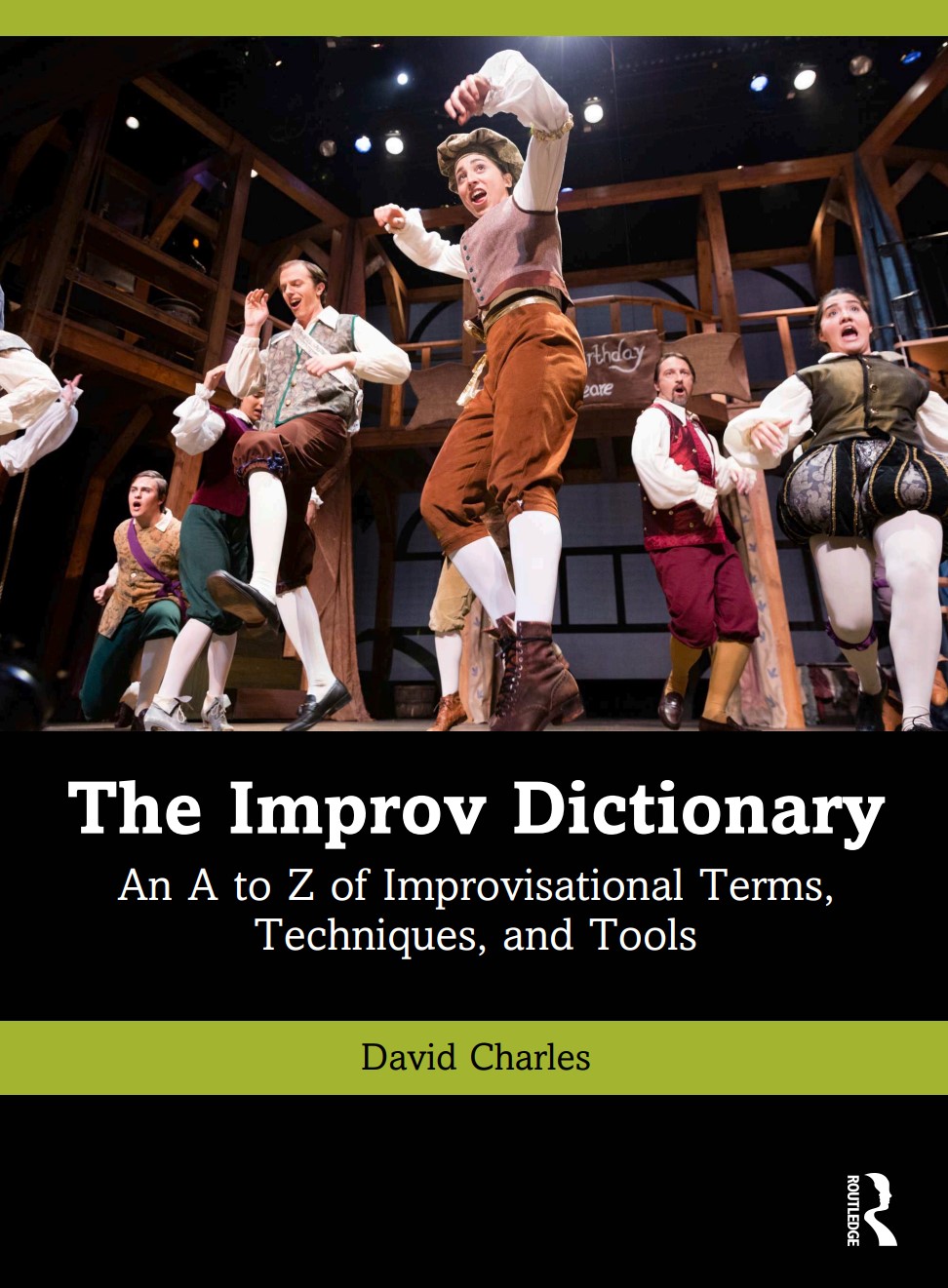
The Improv Dictionary

An A to Z of Improvisational Terms, Techniques, and Tools

UPDATED ORDERING OPTIONS BELOW!!!

Where has the online archive of “A to Z” entries gone, you may wonder? I’m excited to announce that this extensive series of definitions and performance tips is now available in PRINT with Routledge!

In addition to 150 deeper dives into core improv techniques that you’ve come to love, with helpful strategies and curated games (found here on ImprovDr.com), this new edited and expanded edition includes over 100 new sleeker short definitions and cross references to help build your improv vocabulary, and 40 or so beautiful improv production shots. In pre-orders. the book routinely featured on Amazon’s #1 New Releases and Best Seller lists (see below)! Check out this lovely feature (here) in Winter Park Magazine that digs into the writing process and goals.

Currently, the paperback is 33% off with Amazon, and 25% off on the Routledge website.

If you take your improv fun seriously, then this is the book for you…

Here are some options for getting your hands on a digital or print copy of this labor of love… All prices are in US dollars. (Publishers set list prices in case you were wondering!) The email link might not work if you have a popup blocker: you can email me at David@improvdr.com if that happens.

IF YOU WANT A SIGNED COPY…

If you’re local (as in Orlando, USA local) and we see each other with some frequency, I’m offering a limited number of autographed/personalized paperback copies for a limited time at list price ($46). Email me here to reserve yours ASAP with your request (and any specific dedication language), and I’ll send you payment details. I have a small stock of copies and in most cases can get it to you in about a week. If you’ve opted for hand delivery, it’s incumbent upon you to find me and not vice versa 🙂 You can generally find my performance schedule at Sak Comedy lab on my homepage here.

If you’re stateside (as in the contiguous USA) and want an autographed/personalized paperback copy, it’ll cost me about $7 to pack and mail it via USPS media rate ($5.61 postage, $1.69 packaging), so that’d bring the price point up to $53. Email me here if you like the sound of that with your request (and any specific dedication language), and I’ll send you payment details.

If you live outside the USA there really aren’t cost effective ways for me to sign and get a copy to you without really upping the price (the USPS doesn’t have an international media rate so, depending on the country, it’d be around $32 to get a copy from me to you). If that’s something you REALLY want, email me here, and we’ll figure it out, but that’d bring the price to somewhere in the ballpark of $75. I get it if that’s too rich for your blood. It’s MUCH cheaper to use one of the methods below, and I’ll happily sign your copy for a drink when I next see you at an improv conference or festival!!

IF YOU JUST WANT A WAY TO GET A PRINT OR EBOOK COPY EASILY…

If you have access to Amazon.com for your book orders, then you can order a Kindle or Paperback copy here. The hardcover version is archival quality intended for libraries, hence the much steeper price, but the other two versions are currently at or below the list price of $46. You can also access a sample of the first 8 or so pages if you click on the icon to the left below the cover image. That’s mainly my intro comments, alas, but it gives you a sense of the look and feel. (In the first month of sales The Improv Dictionary was listed – on and off – as the #1 Best Seller in TheaterPaperback, the #1 New Release in Theater Direction & Production – Kindle and Paperback, the #1 New Release in Theatre History and Criticism – Kindle, the #1 New Release in Acting & AuditioningPaperback and Top New Release in Performing Arts History and Criticism – Kindle and Paperback)

For international readers in particular, your most cost-effective choice (if not Amazon) will likely be buying through Routledge directly as they offer “free standard shipping on every order across the globe.” They sell the paperback and hardback versions and offer both eBook purchases and rentals. You can find The Improv Dictionary listed here. This site offers a preview as well (although it’s formatted for a digital reader), so look at the one on the Amazon site above if you want a better sense of the final printed product. If you’re affiliated with a theatre, university, training center, or festival and are interested in a larger order, I might be able to get a bulk discount for you through the publisher. Just reach out here. (Due to the weight of the book, it’s not really feasible for me to travel with any substantial number of copies.)

If you are still reading, thank you! I imagine you’ll also find this in bookstores and libraries with decent theatre selections eventually, too!

Regardless of your interest in The Improv Dictionary, continue enjoying the extensive ImprovDr Game Library (with approximately 200 improv games and exercises) that you can access here.

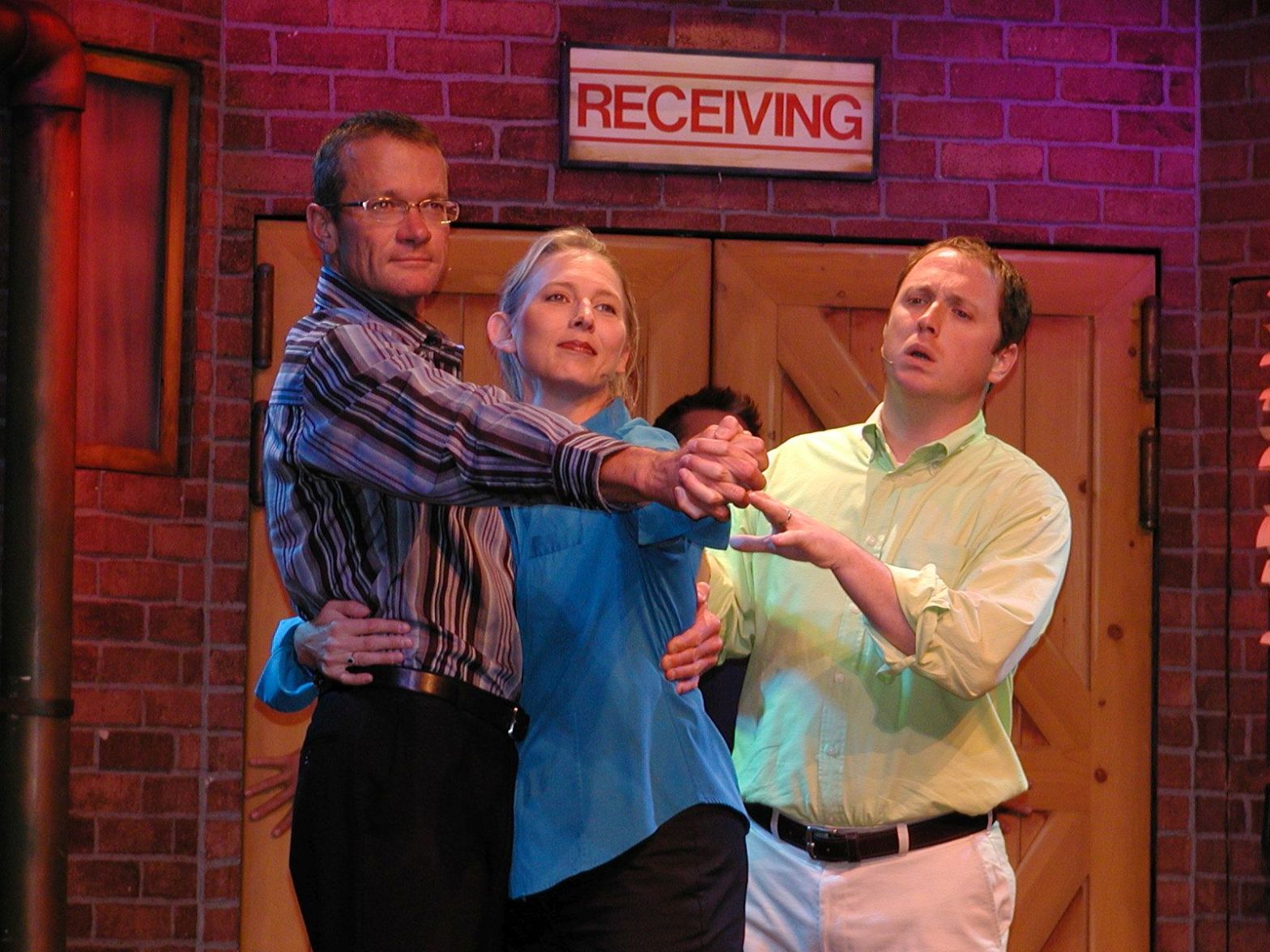
Game Library: “Contagious Hitchhiker”

There is contagious fun to be had in this scenic dynamic that invites players to closely watch and mirror their scene partners.

The Basics

The scene takes place in a car so arrange some chairs or blocks accordingly (being aware of audience sightlines). The action usually begins with those traveling “in neutral,” that is, without providing any deliberate quirks or idiosyncrasies. Soon, the passengers pick up a hitchhiker who brings a peculiar (and generally subtle) mannerism with them. Gradually, others in the car take on (and generally heighten) this contagious behavior. The journey continues with the addition of multiple hitchhikers at strategic intervals.

Example

One player (A) begins the scene in the driver’s seat. They establish their destination (perhaps elicited from the audience as the ask-for) and happily listen to their favorite station on the radio. After a few moments, they notice a hitchhiker on the side of the road (B) and pull over to offer them a ride.

Player A: (lowering their window) “Where are you heading today?”

Player B: “I’m trying to meet up with my friends at the beach. You going that way?”

Player A: “I can get you close… Jump in!”

Player B circles the car, opens the passenger door, gets in, and fastens their seatbelt, discreetly scratching their neck as they situate themselves.

Player A: (restarting the car) “It’s a nice day for it!”

Player B: “It’d be a shame to waste this weather.” (B scratches a little more) “What are your plans for the day?”

Player A: “It’s a workday for me, alas. I’m off to a sales meeting.” (A starts to experience an itch of their own…)

The Focus

I’m including several helpful variations below, each of which tends to adjust the focus and the gift of the scene a little. Generally, this exercise is great for developing close listening and observing, gently building a curve of absurdity, and using quirks or mannerisms to create energy and character.

Traps and Tips

1.) Individual or group. The scene can begin with either an individual driver or a carload of passengers (perhaps the whole team except for one player on reserve to enter as the first hitchhiker). In the first iteration, the scene tends to naturally conclude once the car is full, and every team member has entered (usually four or five unless your stage can fit a minivan!). In the second version, players tend to cycle through the car, leaving and then returning with a new peculiar behavior. Regardless of the approach, be mindful where you seat the character offering up the new dynamic. If the audience and, more importantly, other players can’t easily see and hear them, there is little likelihood their quirk will be recognized and incorporated. To this end, it can be helpful to shuffle characters with each entrance, perhaps placing the unknown entity in the front passenger seat (or even have them drive).

2.) Consistent or changing. There is also fun to be had with how you approach characterization in the game. Players may remain as the same character for the duration of the scene (this tends to be the norm for the slower starting “individual” version described and modeled above). If you’re cycling through a larger cast of players – seven or eight – this will be the most workable option as well. However, if you’re up for a challenge, players can rotate through the car, exiting after a while, only to return as a new character with a new mannerism for their carmates to adopt. This steers the game towards a faster style of play, with characters being broader and quirks become mirrored more immediately; but, if you’re looking for an exercise to encourage players to make big character choices off the bat, this variation will fit that bill.

3.) Discrete or cumulative. A third variable consists of how players treat the introduced behaviors. A “discrete” dynamic encourages improvisers to identify and then exaggerate one quirk at a time, with previous idiosyncrasies vanishing when a new character and mannerism emerge. This style tends to privilege nuance, patience, and subtlety (remembering that players needn’t play the same quirk in the same way). Alternatively, a “cumulative” attitude keeps all prior silliness in play, so as one quirk reaches its crescendo, a different behavior gradually joins the fray with the arrival of a new hitchhiker. Exploring a variety of behaviors is important in any of these versions, but it’s particularly crucial if you’re inclined to this last technique. If Player B introduces scratching, Player C then brings in picking lint off their sweater, and then Player D offers straightening their blouse, the activity in the car will likely start to merge in unhelpful ways. To avoid this, look for contrasting categories of behavior: Player B has introduced something physical, so perhaps Player C joins with a distinct verbal tick or language game, and D adds a contrasting emotion…

In Performance

Don’t forget to pace and justify the various choices – characters needn’t be engaged in the same peculiar action for the same reason, for example. I enjoy the challenge of trying to maintain the recognizable humanity of the world as long as possible. In this manner, the game can nicely embody the curve of absurdity ethos. Sure, if you’re all simultaneously exploring five or six weird character traits, the scene is likely to be wonderfully ludicrous. But it’s even better if everyone savored the road to get there and doesn’t just rush to ridiculousness for the sake of ridiculousness!

New to ImprovDr.com or the Game Library? You can find the ever-expanding collection of games, exercises, and warm-ups here.

Cheers, David Charles.
www.improvdr.com
Join my Facebook group here.
Photo Credit: Tony Firriolo
© 2023 David Charles/ImprovDr

Game Library Expansion Pack I

Game Library: “Compulsive Liars”

I love the central premise of this game but will freely confess it’s a seldom played offering in my own repertoire. The conceit is delightfully elegant but tends to become a bit of a stumper. Compulsive Liars, nonetheless, offers great lessons for the training lab even if you also find yourself a little reluctant to bring it to the public stage.

The Basics

For the duration of a scene, every major offer is assumed to be a lie by the other players (and characters) and is immediately called out as such.

Example

Characters sit around a table and prepare for their weekly poker game.

Player A: (shuffling the cards) “It’s so nice that we can have the escape of this friendly Wednesday night game…”

Teammates amp up the intensity of their preparations, assuming that the “friendliness” offer was a lie. 

Player B: (miming that their arm is in a sling) “You still owe me for my hospital bill from our last game when I caught you cheating…”

Teammates assume the source of the injury is a lie.

Player C: “I saw you at the tennis club yesterday. You weren’t injured then….”

Players assume that C was not at the tennis club.

Player A: (as they start dealing cards out) “So that wasn’t you I saw doing community service on the side of the highway when I was delivering meals on wheels?”

The Focus

Bold choices, rich specifics, and active listening are all a must.

Traps and Tips

1.) Do something. As the featured dynamic tends towards the verbal, it’s incredibly helpful to establish and explore a rich physical world. It’s likely that you’ll find moments when the current thread of conversation runs dry, so a detailed action or activity can readily inspire a new angle: “I always love the snacks when we play at your house…” However, be cautious of exclusively talking about the activity itself as this will quickly pose content challenges. There are only so many lies our poker plays will likely be able to conjure about the cards…

2.) Pick something. There will often be multiple possibilities when it comes to identifying the lie in each offer. Don’t waste your time trying to decipher the “best” option – just trust your instinct and quickly pick one fact or facet and run with it. For example, in the opening line above, fellow players could also assume that it isn’t Wednesday, or nighttime… It can work to have various players reveal these different lies in the same offer in a pile on fashion, and this can certainly give an energy boost. However, I’ve found that such an approach can make finding the next move or lie problematic, so regardless of whether you tend towards a chain (as I’ve illustrated above), or a series of clumps (as I’ve described here), be mindful that you also…

3.) Offer something. The first obligation of the dynamic is to discover, call out, and then heighten the false claims of your scene partners. The second – equally crucial – component consists of then offering up your own detailed choices that others can similarly shape and endow. When Player A states that they were delivering meals on wheels while exploding their teammate’s untruth, they have given the poker table something new and rich with potential. It’s certainly fun to uncover unexpected angles and fabrications in unlikely elements of a choice, but if accusations don’t include previously untilled material, players will probably struggle to continue the game. So, whether or not you’re mindfully revealing your own trap for someone else to spring, bravely offer specifics.

In Performance

While it can be tricky to find and maintain a jaunty and stage worthy tempo, the central requirements of this game all lean into critical improv competencies; namely, building detailed worlds, quickly embracing and heightening the choices of your partners and explicitly using them to craft you own, and bringing colorful details to your scene work. Not to mention that this game also unlocks the delightful power of lies!

Cheers, David Charles.
www.improvdr.com
Join my Facebook group here.
Photo Credit: Leesa Brown
© 2023 David Charles/ImprovDr

Game Library Expansion Pack I

Game Library: “Circular Scene”

Perhaps more of a scenic structure than a short-form game per se, Circular Scene provides a pleasing way of shaping the narrative arc.

The Basics

I tend to teach this format through a Spolin lens, with players having a brief planning session to come up with a common who, what, and where. The hope is that once they understand the logistics involved, they can recognize and apply the technique to other improv scenes when the potential organically emerges. Players prepare by quickly determining the basic components of a scene that will eventually loop back around on itself so that the story essentially ends where it began. This may take the form of one large loop (think in terms of a conclusion that neatly replicates the opening beats), or it can feel more like a tightly wound coil (think in terms of a slinky with many smaller circles that is finally connected at both ends). In either case, the scene is improvised and culminates when the audience has a sense that the pattern is about to repeat itself (again).

Examples

A college student who has sworn off dating reluctantly prepares themselves for one last attempt. We see them go out on a blind date, which quickly reveals itself to be yet another disaster. As the thwarted student leaves, they recommit to never date again, only to check a notification from a dating app and then agree to go out with a new contender the next night...

OR

A goldfish – a species renowned for its short memory span – awakes in a vast ocean, unsure who they are or their purpose in life. They approach various marine life, asking if they can help solve the riddle of their identity, but no one can seem to help, until the fish finally approaches a friendly barracuda who, kindly, answers their question. The goldfish happily swims away, content in their newfound knowledge, only to have their memory suddenly reset seconds later. The fish, once again, finds itself swimming in an unfamiliar ocean and is filled with the insatiable need to know who they are...

The Focus

Lean into the structure, as the satisfaction of the scene largely derives from the audience’s sense of déjà-vu when the scene turns back in on itself.

Traps and Tips

1.) Remain flexible. I always give this advice when working with the Spolin “preplanning” model but avoid considering the “how” of the scene when you’re brainstorming. When you’re exploring the dynamic for the first time, it’s helpful to have a general sense that your scenario has an innate potential for circularity but allow the specifics to emerge as you play, or the scene can start to feel “approximated.”

2.) Remain diligent. As is the case with almost every improv scene, the most interesting dynamic often bubbles up on the way to the thing that you thought the scene was going to be about. If you’re using a brief template, also remember that the audience isn’t privy to your planning session, so you won’t want to leap over the foundational elements of the story. Give every moment its due.

3.) Remain united. Be wary of working at cross purposes with your teammates when it comes to the central dynamic. If one improviser is exploring the goldfish short memory angle, and another pursues the circuitous nature of the seasons, and yet another wants to examine the oceanic food chain, it’s likely that none of these dynamics will land for the audience in a pleasing manner. Build on the choice of another and amplify their game rather than clinging doggedly and unhelpfully to your own.

4.) Repeat. These scenes benefit from a clear overlap, so look to repeat at least a few of the initial steps in order to sell the ending. In this way, our dating scene might benefit from continuing on to the beginning of the next night so that we see that the doomed student is about to suffer the exact same fate all over again. If you’re playing with the “slinky” variation, this can go even further, with the student going on a second, and third date that all end up the same (therefore, deploying the comedy of threes as well…)

In Performance

If you’re inclined towards a more linear style of story construction, this simple variation offers a nice way to mix things up.

Cheers, David Charles.
www.improvdr.com
Join my Facebook group here.
Photo Credit: Leesa Brown
© 2023 David Charles/ImprovDr

Game Library Expansion Pack I

Game Library: “Circle of Knots”

I’m not always able to track where I’ve learnt a game with any certainty, but this ensemble-building warm-up comes from Augusto Boal’s treasure trove of improv exercises, Games for Actors and Non-actors.

The Basics

The conceit of the game remains the same even if the details shift a little in the variations listed below: players stand in a circle and hold hands, then messily rearrange themselves to form a large knot cluster. The group must then work together to untangle the tumult and return to their original positions in the circle without letting go of their partners’ hands (or talking).

Variation One:

After players have formed the initial circle and held hands, Boal offers a beginning ritual in which they then expand into the space as far as they can until only their fingertips are touching, and then contract the circle as tightly as they can so that they’re occupying the least amount of space as possible. I tend to omit this step, but it’s a good way to start building some comfort amongst the group, especially if they’re playing together for the first time. Play then continues with one of the following…

Variation Two:

While still holding hands, one self-selecting player begins the entanglement process by moving across or into the circle and then traveling over or under the hands of another pair (while taking care not to loosen their grips with their own partners on each side). New players then perform the same process, randomly creating a denser clump of knots, until no more such moves can be made. The ensemble then attempts to collaboratively return to the original circle slowly, safely, and in silence (and without breaking any of the links).

Variation Three:

Rather than beginning the process with players already holding hands in one large circle, participants create the tangle by randomly reaching across the circle and holding hands with two other random players. (You can coach the process with “everyone take your right hand, reach out and take someone else’s excluding those players on either side; now do the same with your left…”) After everyone has forged two connections in this manner, the group seeks to untangle through the same careful process. It’s possible in this iteration that an untangled group might actually form several smaller circles!

The Focus

Players must work together closely (literally and figuratively) in order to declutter the group.

Traps and Tips

1.) Know your group. As is the case with most warm-ups designed to build ensemble, there is a certain element of trust that already needs to be present for the game to feel safe and inclusive. Players should be aware of mobility issues and limitations, and comfort levels in general. For those who need a wide personal sphere, this exercise might prove wildly uncomfortable or just completely inappropriate, so don’t assume every ensemble will enjoy this highly physical game without having built some rapport beforehand. It’s also nice to warn players that they’ll be exploring a game that involves such close proximity so that they can dress appropriately.

2.) Pace the untangling. If everyone starts twisting and pulling and seeking their own extraction all at the same time, you’ll increase the likelihood of strain or injury, so make sure the desire to solve the riddle of the knots doesn’t eclipse the more important goal of keeping everyone safe. This can become a particular concern if you’re using the warm-up with younger players who can have a tendency to inadvertently introduce a level of competitiveness that can work against the greater good of the group. Especially in the third iteration, there may be moments when players need to briefly break and reconnect their grips so that they’re not bending each other’s wrists in dubious ways.

3.) Consider a leader. This is another variation on the variations, but I’ve also seen the game utilize a designated leader (perhaps standing part from the circle) who assumes the job of conducting the disentanglement (with or without the use of speech). This changes the central dynamic of the exercise a little, but if you’re stuck, or your group includes a player that would prefer not to be in the thick of the knots, this allows a different form of involvement. It can also provide a chance to positively single out a (willing) participant for a leadership position who might not normally step into such a role.

In Performance

If your ensemble is hesitant to play (appropriately) in each other’s space, this game can help to break the ice a little!

Cheers, David Charles.
www.improvdr.com
Join my Facebook group here.
Photo Credit: Tony Firriolo
© 2023 David Charles/ImprovDr

Game Library Expansion Pack I

Game Library: “The Chair”

As a decider or skills drill, The Chair offers an opportunity to polish your justifying and accepting.

The Basics

Players are divided into two teams and stand on either side of the stage or workshop space. One volunteer sits in a chair placed in the middle of the playing field, and a time limit is set (usually a couple of minutes, but definitely sufficient for everyone to get at least one turn each). One at a time, members of the opposing team try to provide offers that will result in the sitting player revoking their position in the seat. (No overt physical moves are allowed such as shoving or lifting the chair itself.) While all offers must be accepted in terms of the premise and details, the seated player may artfully justify their ongoing position when they’re able. If the challenger ultimately proves successful, they occupy the chair and the other team becomes activated. If the challenger is skillfully and appropriately foiled, they return to their side, and a fellow teammate enters the gauntlet. Whichever team occupies the chair when the countdown ends wins the game.

Example

Player A sits in the central chair as the countdown begins.

Player B: (entering in a frenzy) “Your house is on fire. We need to put it out!”

Player A: (not budging) “I know. I’m the one who set it on fire…”

Player B: (after a moment’s thought) “But the flames are spreading to your neighbors’ houses…”

Player A: “Just as I hoped…”

Player B returns to their “side,” perhaps prompted by a caller or instructor. A fellow team member, D, steps forward, miming that they are an octogenarian looking for a seat on a public bus…

Player D: “Would you mind terribly if I sat there? I have been on my legs all day.”

Player A: “Then maybe you should have gotten to the bus stop sooner, grandpa…”

The Focus

The seated player should earnestly cling to their objective of remaining seated but also vigorously accept the endowments and scenarios of their fellow players. If participants become lackluster or uninvested, the game will quickly sag.

Traps and Tips

1.) Use a caller. There are likely to be many close calls in the game, so it’s helpful to have a designated judge who’s empowered to quickly and resolutely determine ownership of the chair and provide time warnings. If in doubt, I tend to defer to the incoming challenger just to keep both teams engaged in the action.

2.) Accept each premise. It’s incumbent upon Player A to accept that their house is on fire and then that they are occupying the last seat on a bus. That being said, it’s up to them to frame those choices however they see fit, so it’s in the spirit of the game for them to become an arsonist or a disrespectful youth. The game becomes more exciting when these justifications are nuanced and strongly connected to the initiations rather than just some tepid or generic attitude of “I don’t care.” Eliminating players for reusing exact tactics or phrases can help in this regard, too.

3.) Limit the exchanges. The power to win can be strong in many, so it’s helpful to set some agreed upon limits to each improv parlay. I’ve found that giving the challenger one right of response (and their opponent a second counter) generally provides a nice balance and flow. Challengers need to accept and justify the seated player’s stated reality too, so it’s not in the spirit of the game to insist that Player A is not an arsonist or that they are a very well brought up teenager who loves their grandparents.

4.) Play to play. Don’t play to win. Explore the unformed idea, accept the inexplicable judge’s call, and embrace each elimination with good cheer (pun intended). No one really wants to watch a group of angry improvisers care too much about a silly warm-up.

In Performance

Keep the flow of entrances strong and energized. It can become tempting to recycle old motivations and premises, but this will do little to sharpen and enhance your spontaneity.

Cheers, David Charles.
www.improvdr.com
Join my Facebook group here.
Photo Credit: Kalani Senior
© 2023 David Charles/ImprovDr

Game Library Expansion Pack I

Game Library: “Chain Murder Endowment”

This short-form classic embodies the central device of the childhood game of telephone, but here information potentially becomes warped and misunderstood as it passes from one improviser to another in front of an audience that is all delightfully in the know.

The Basics

I prefer this game with four players (so that you get a total of three discrete vignettes). If time is too tight, a cast of three can prove workable as well. One player (A) remains in the theatre while their teammates leave the space so they can’t hear. Player A gathers three random and unconnected elements – a location, occupation, and prop. These suggestions combine to form the features of a crime, with the prop now becoming an unlikely weapon of sorts. Player B returns to the stage, and a scene is played in which Player A must endow the obtained elements, while both players only use gibberish and body language. When the incoming player believes they know the selected components, they perform the crime in the pertinent location, against their scene partner (who represents the occupation), and with the peculiar choice of weapon. The victim dies dramatically and then strikes silently to the side of the stage, as the next potential criminal enters the theatre with Player B now serving as the gibberish clue-giving partner for Player C. When four players are used, the process then repeats one last time for Player C and D.

Example

Player A obtains “pyramids of Giza,’ “phlebotomist,” and “slinky,” as the elements before the absent Player B returns.

Player A: (welcoming their teammate while wiping away the sweat from their brow) “Shiminy popo!”

Player B, intuiting that they might be in a dense jungle or similar, starts slashing through imaginary scrub.

Player B: “Fashega taneeka jay.”

Player A nods in agreement that it has been hard going before kindly removing the machete from their partner’s hand and gesturing towards their new mode of transportation while offering them a leg up.

Player B: (with excitement) “Kaneep sha a nay-nay!”

Player A: (gently correcting the horse assumption while miming fastening the cumbersome saddle over a gigantic hump) “Gah, nay-nay! Shalee paplincha gavine!”

The scene continues with Player B ascending the unspecified creature. After the location becomes clear, Player A suddenly feels the urge to donate blood and starts to communicate as much to their scene partner…

The Focus

Enjoy the party game element but also strive to construct a (probably) simple story that justifies the need and appearance of each component. Avoid devolving into outright charades, or taking on any of the critical of the crime yourself when you are in the endower position (or essentially showing or demonstrating rather than creating the conditions under which the pertinent item would be needed).

Traps and Tips

1.) Know your order. The game will get off to a rocky start if the endower and endowee are on different pages and working at cross purposes. I advise working through the elements in the order they were obtained above – we use the acronym LOW in my current home venue, which stands for location, occupation, and weapon. This also allows you to accumulate the needed pieces of the puzzle in a helpful way onstage, beginning with the largest immovable item and ending with the typically most portable.

2.) Give clear feedback. All endowment games have to walk the tenuous path of accepting ideas the endowee offers up and sending unequivocal signals when a choice is wildly off base. Whenever possible, the endower (Player A) should acknowledge the endowee’s intent even if they then quickly move on – putting aside the machete or laughing that their friend has mistaken a camel for a horse! Inversely, don’t be needlessly opaque when the guesser is on the right track, or they might accidentally throw out the good with the bad. Similarly, if the endowee has all the needed information (or is as close as they’ll get in the time limit), joyfully invite the playful murderous climax of the vignette.

3.) Exploit your gibberish. While most would consider it poor form for the improviser who is in possession of the missing informative to fudge their gibberish to include known words or sounds, it’s a common tactic for the endowee to judiciously utilize creative signs to confirm their suspicions. In this way, “nay-nay” is a reasonably transparent approximation of a horse sounding gibberish word (at least for English speakers). If Player A used such a device first (or early in the scene), it would likely feel like a cheat. When such a move comes from the endowee, it can help narrow the focus a little. I wouldn’t advocate using this carelessly or as a default, but it’s a helpful tool if players are becoming unhelpfully stuck.

4.) Reinvent the wheel. Much of the fun of this game, in my opinion, is the chain element that places three scenic attempts in quick succession. While the elements of the crime (as best as they were communicated and understood) should remain the same, players shouldn’t mindlessly repeat their former partner’s tactics. If Player A uses a camel as an entry point to the pyramids, Player B should ideally begin somewhere else. In the worst-case scenario, players can recycle earlier clues when they find themselves at a dead end, but the audience enjoys the challenge of seeing new takes on a common problem.

5.) Sell the ending. Enjoy the silly deaths that punctuate each round (this also reduces the potential for ickiness, especially when the elements are wonderfully ludicrous). The game usually culminates with the players forming a line on the lip of the stage and the host beginning with the final criminal (our as yet unseen Player D in my example) and reviewing the understood facts of the crime. (It can be fun to coach the audience to provide loud “noes” or similar for each incorrect assumption). The host can then travel back through the line as needed until the desired answer emerges – even if this might mean returning all the way to the source, Player A! If you’re playing in a competitive show, this recap can occur before or after the scores are obtained. I like getting scores prior to the review as the overall enjoyment and quality of the scene often have little to do with its success, and there can be a nice bump in audience energy immediately after the last murder which can serve as a helpful throw to the scores.

In Performance

It’s admittedly a risk, but I’ve enjoyed weaving an audience volunteer into the chain. Typically, Player C (the second endowee) provides a strong position as this requires the volunteer to both receive and then give clues. Such a position also grants them a little time offstage with a (hopefully) confident improviser who can walk the guest through the basics, such as using the LOW acronym described above.

Cheers, David Charles.
www.improvdr.com
Join my Facebook group here.
Photo Credit: James Berkley
© 2023 David Charles/ImprovDr

Game Library Expansion Pack I

Game Library: “Can I Talk to You for a Second?”

A delightful modern twist on the classic tradition of asides, Can I Talk to You for a Second offers characters a playful and highly theatrical device for creating mischief.

The Basics

During the course of a suggestion-inspired improv scene, players may self-select to pull another to the side of the action for a private “talking to” by using the titular phrase in a typically high-pitched cadence. Once the unsolicited advice has been proffered, players return to the scene in progress.

Example

Players explore the scenic promise of a 20th wedding anniversary. Player A assumes the role of one of the celebrants as the lights rise and is in the middle of an impassioned speech.

Player A: “… and I didn’t believe the poets when they said that you could grow to love someone even more with each passing day. But as I look now at my amazing spouse of 20 years, I will happily admit that the pessimist of my youth was wrong.” (Raising a glass) “So, I’d like you all to join me in a toast to…”

Player B: (who has been standing beside the speaker all this time, and in a quiet but high intoned voice) “Can I talk to you for a second?”

Player A: “Of course, sweetie. If you’ll all hold that thought for a moment…”

Players A and B step to the side for their private exchange.

Player B: (in hushed tones) “You promised me you weren’t going to drink tonight. You know how you get with a few wines in you…”

Player A: “And that’s why I explicitly told the bartender to serve me sparkling grape juice for the whole evening, darling.”

Player B: “I’m so sorry. I shouldn’t have doubted you…”

Player A: “I know you only want the best for me, for us… May I continue with my speech?”

Player B: “Of course. Forgive me.”

Player A returns to their prior position and raises their glass.

Player A: “So, I’d like to toast my better half who always has my back!” (They raise their glass and drink as the guests do the same.)

A nervous looking member of the wait staff, Player C, approaches the jubilant speaker.

Player C: “I’m terribly sorry to interrupt, but…” (Their pitch rises) “…can I talk to you for a second?”

The new pairing crosses to the edge of the performance space.

Player A: (confidentially) “How can I help you?”

Player C: “Well, I just learnt from my manager that all those refills I’ve been giving you tonight should have been…”

The Focus

Capitalize on the fun shifts in tone and staging and keep an eye (and ear) out for games lurking in the secretive asides.

Traps and Tips

1.) Build your world. It’s easier and more effective to introduce the novel device after the audience understands the basic premise of the scene, so put your energy there first. Once strong and grounded relationships have been established, you’ll have more to playfully upend and tilt. (I’ve needed to leap ahead in my example a little to showcase the unique dynamic in play.)

2.) Pace your ruptures. The frequency of the asides tends to escalate on its own, so exert patience initially as you familiarize the audience with the conceit. It’s not unusual for the scene to end in a volley of sidebars, so avoid the temptation to start with this level of aggressiveness.

3.) Give big gifts. There is a revelatory function to the private chats, so be cautious of entering into these moments without the intent or energy needed to shake up the apple cart a little. If the asides become too mundane or momentum sapping, they’ll do the scene more harm than good. If in doubt, explore the possibility of a good old-fashioned CAD.

4.) Listen to everything. As is the case with most improv games that involve some element of secrecy, it’s critical that players hear everything even as each whispered aside goes unnoticed by their characters. In this way, games can be discovered and built upon, as I’ve endeavored to model with the wait staff member adding to Player A’s revelation about the sparkling grape juice (although I’d recommend exerting more patience than my example allowed).

In Performance

I love the stylistic silliness of the almost whining phrase and veneer of politeness leading into increasingly searing or blunt adjustments and critiques. Don’t feel the need to mask or hide the launching phrase as it becomes such a joyful and predictable catchphrase for the scene.

Most of my tips for Asides (found here) also apply to this variant.

Cheers, David Charles.
www.improvdr.com
Join my Facebook group here.
Photo Credit: Mariah Clinkscales
© 2023 David Charles/ImprovDr

Game Library Expansion Pack I

Game Library: “Blind Freeze Tag”

A simple but helpful variation on a short-form improv classic…

The Basics

Players form a line at the back or side of the stage – the first person (stage right typically) stands so that they are facing away from the playing space. Two improvisers begin a scene based on an audience prompt. When they have established a clear scene and find themselves in a suitably dynamic pose, a fellow observing player (or perhaps the host or instructor) calls out “Freeze,” and the players do so. The improviser who was unable to see the scene turns around and enters the playing field, tagging out one of the current characters so they can assume that exact position which they use to inspire a brand-new scene. The back line shuffles with the newly released improviser joining one end (usually stage left), and the player on the other turning around so they can’t see the new action.

Example

Player A and B volunteer to play first while Player C faces away in the back line. The first scene finds inspiration from “boating.”

Player A: (holding out their hand to assist Player B) “The river is a little choppier than I expected.”

Player B: (carefully stepping into the raft) “I’m sure it’s nothing, sweetie. I can’t wait to check ‘white water rafting’ off our bucket list! Hand me my paddle…”

Player A turns to do so as B mimes the raft slowly drifting into the rising river. They raise their hands in a panic.

Player A: “Um, honey…”

Player D: “Freeze.”

Player A and B hold their poses as C spins around and quickly tags A out so they can assume that exact position with their hands nervously raised. Player A strikes to the back line while B holds onto their own position facing towards the floor.

Player C: (after a moment of squirming) “I’ve told you I don’t know the combination to the safe.”

Player B: (their intended oar transforms into a floor panel) “I know where you keep your money – I’ve been scouting out this video game store for months…”

Player C: “Then you should know only the owner opens the safe. She doesn’t trust me with the combination.”

Player C slowly lowers their hand to trigger a panic switch as Player B fumbles uselessly with the safe dial.

Player E: “Freeze.”

The Focus

Committing to clear specifics and quickly justifying peculiar poses provide the lifeblood of all freeze tag games.

Traps and Tips

1.) Enter quickly. Players on deck should move to the stage as swiftly as they’re able when the “freeze” is announced. The game will quickly lose steam and playfulness if each transition becomes needlessly laborious. Usually, one pose will immediately feel richer or more dynamic than the other, so trust your first instinct and don’t waste time assessing your options as this will grind everything to a halt.

2.) Freeze bravely. Players who are able to see the playing field should actively look for promising new stage pictures and relationships and grab these moments for each new “freeze” call. My example errs on the side of shorter vignettes, and it’s good form to allow the first few scenes some space to develop. But as you construct your fourth, fifth, and sixth scenes, the game should become jauntier. Be wary of lethargic calls deflating the momentum.

3.) Pose resolutely. When you are caught by a “freeze,” strive to maintain all the physical, facial, and emotional details of your position. If you inadvertently relax into a more generic pose, you’re robbing the incoming player of vital and inspiring information. Similarly, as you assume a previous position, pay attention to the minutiae as much as you can during such a quick transition. Smudging gestures or ignoring notable choices, such as the line of sight or an emotional quality, will lower the stakes in an unhelpful way.

4.) Justify specifically. Similarly, the more nuanced you can make your justifications, the better. These details are often cumulative and represent the concerted efforts of both players, so don’t feel the need to just voluminously spew a disconnected diatribe. But when our robbery becomes located in a video game store, with an in-the-floor safe and an absent owner, the scene transcends the initial germ of an idea of a generic hold up. It’s good form for the new (entering) player to get the first crack at defining the altered reality, but when both players then polish that initial idea through the lens of their current physicality, the scenes quickly take on a glossier sheen.

See Conducted Freeze Tag here for additional pointers.

In Performance

As an improv mainstay, freeze games can feel trite or overdone when they become safe or a mechanism for recycling old bits and jokes. Challenge yourself to play every scene (and the game as a whole) with the joyful attack and abandon of a neophyte.

Cheers, David Charles.
www.improvdr.com
Join my Facebook group here.
Photo Credit: James Berkley
© 2023 David Charles/ImprovDr

Game Library Expansion Pack I

Game Library: “Big Game”

This exercise pushes players to the limits of their physical abilities.

The Basics

Players scatter through the available space and claim an area as their individual stage. If you’re workshopping in a smaller room or theatre, improvisers can work in pairs with one person performing the activity for the other. (There is also an inherent value in everyone having a little audience to enjoy the process and offer up some feedback at its conclusion.) Improvisers self-select an everyday activity – such as washing the dishes, brushing their teeth, or wrapping a present – and, upon the facilitator’s signal, patiently mime their action for a minute or so. The facilitator then gradually increases the size of the objects involved, and the task is repeated until the objects have become absurdly unwieldy.

Example

Player A (partnered with Player B) mimes brushing their teeth with a typical-sized toothbrush, tube of toothpaste, sink, and faucet.

The caller increases the object size by 100%, so now the toothbrush more closely resembles a hairbrush, and the toothpaste a rolling pin. Player A endeavors to brush their teeth again.

Objects grow again. Now the toothbrush is approximately the size of a cricket bat… the activity is repeated.

The objects expand once more so that Player A must manipulate an oar-sized brush and tube that evokes a rolled up carpet…

When the objects have become truly enormous, Player A and B exchange roles, and B undergoes a similar process with their own action.

The Focus

Commit to the escalatingly absurd conditions. In the above example, it’s foreseeable that Player A will need to brush their teeth across the huge brush when it becomes too heavy to lift or move.

Traps and Tips

1.) Explore weight. As each object grows, make sure you are appropriately increasing its weight and adjusting your efforts accordingly. A hairbrush doesn’t weigh that much more than a toothbrush, but a cricket bat certainly does.

2.) Explore mass. Similarly, consider how each object’s inflating size necessitates your own physical choices and approaches. Keep the features of each item specific and nuanced. How do you need to grab and operate an oversized faucet? Does this require an entirely new strategy than a mere flip of the wrist?

3.) Explore energy. Exertion should increase alongside the size of the objects, so be wary of meandering through each reenactment without a proportionate change in your attack and energy. Squeezing a toothpaste tube is a rather simple affair for most of us under normal conditions; when the tube becomes the length and thickness of a rolled up carpet, a gentle push won’t do the trick and needs to become a full-bodied action.

4.) Explore creativity. While I tend to teach this game in classes with a physical focus, I’m always reminded that the results can unlock delightful playfulness, imaginative problem-solving, and engaging silent stories. When you add character, point of view, and emotion, the scene can become something surprisingly pleasing.

In Performance

Although I love the idea of crafting scenes in almost alien landscapes with enormous, mimed props, you probably won’t stumble into this opportunity often. However, most scenes can benefit handsomely from the increased attention to prop construction that this big little game fosters.

Cheers, David Charles.
www.improvdr.com
Join my Facebook group here.
Photo Credit: Scott Cook
© 2023 David Charles/ImprovDr

Game Library Expansion Pack I