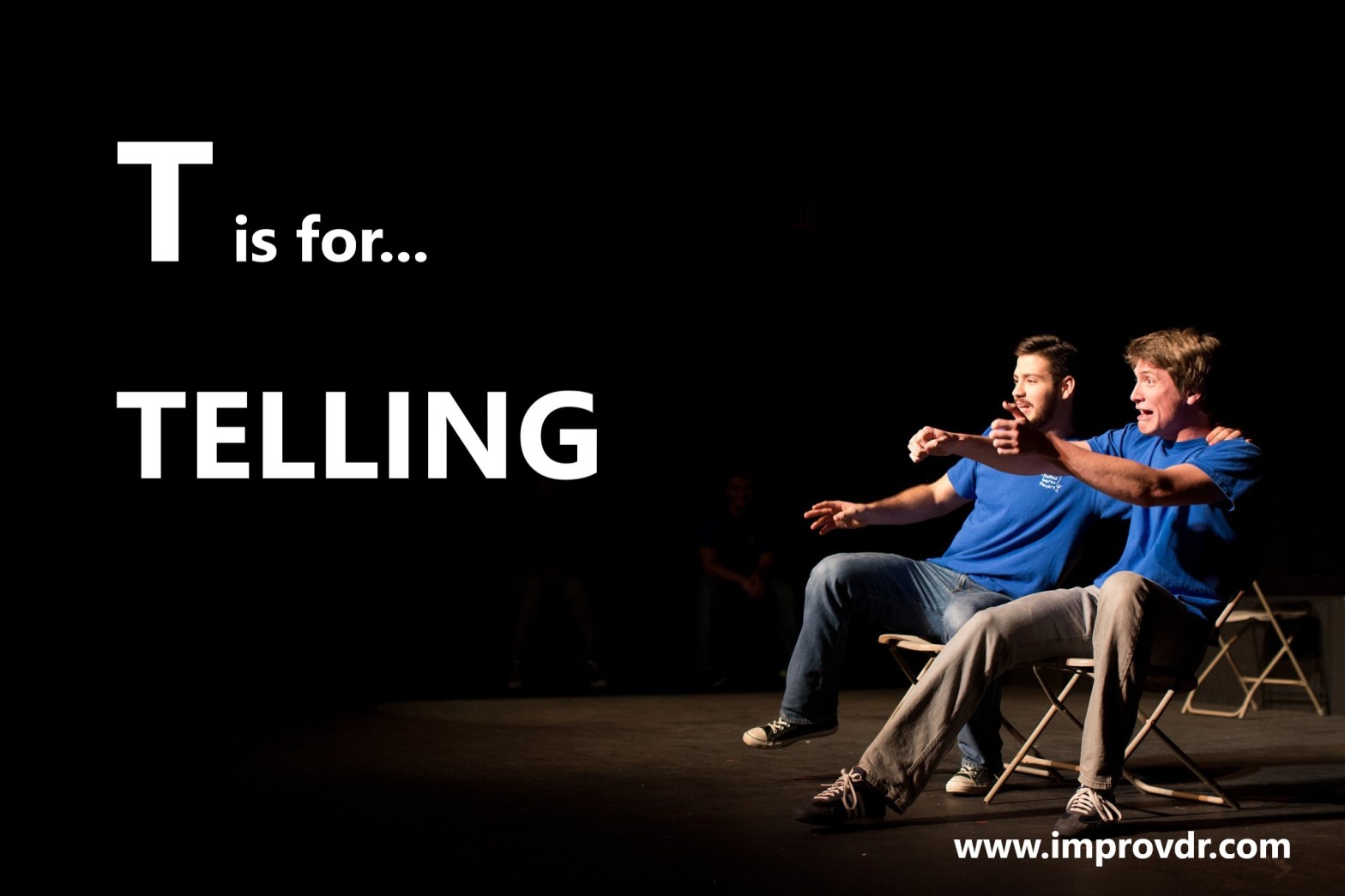
Game Library: “Expert Double Figures”

If you’re going to find yourself in a typically-to-be-avoided Teaching Scene, Expert Double Figures at least comedically reframes the whole affair.

The Basics

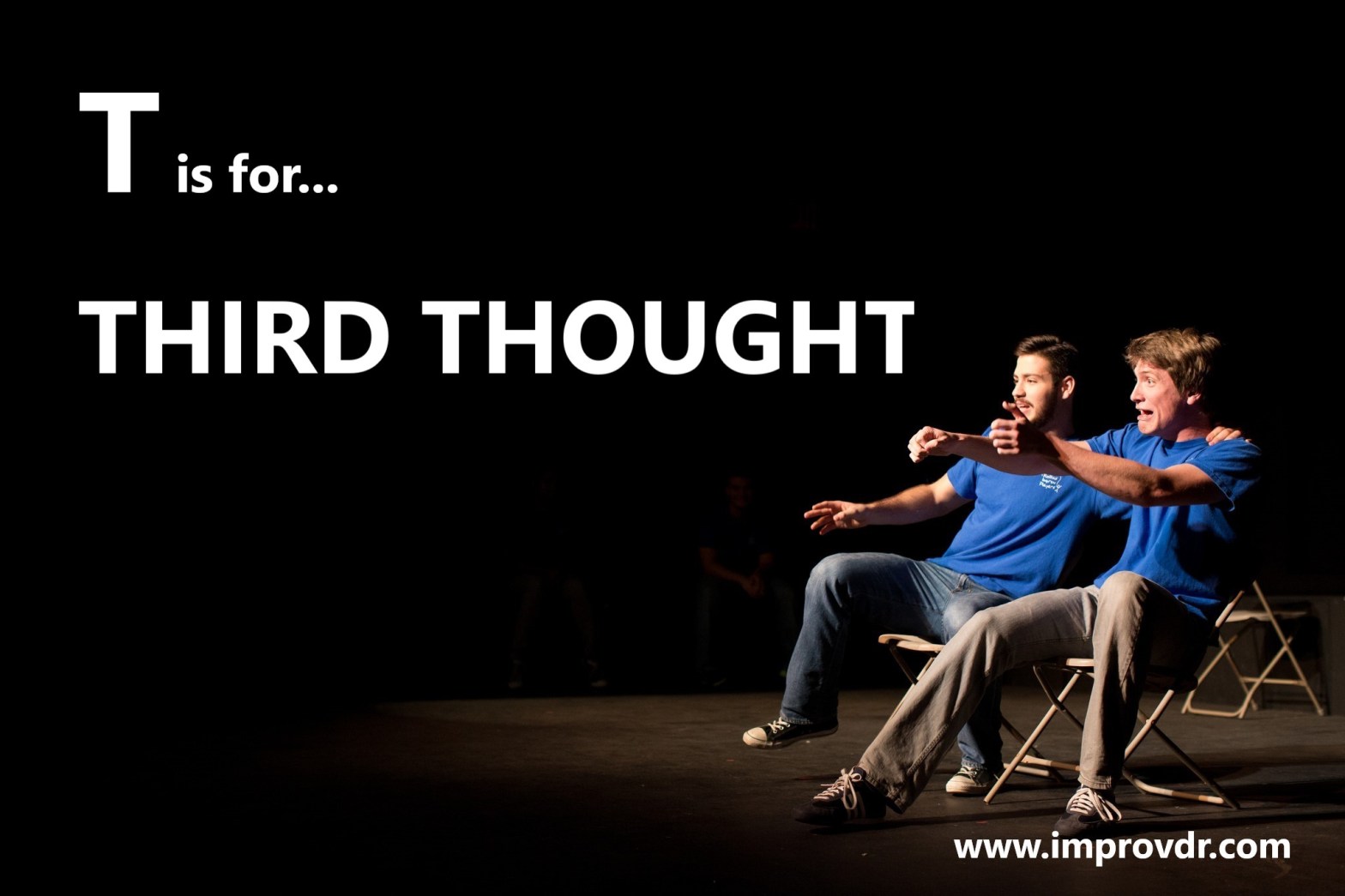
An interviewer conducts a session with an expert whose field of study has been elicited beforehand from the audience. While both characters provide their own voices, their gestures are supplied by fellow teammates (or possibly audience volunteers). Non-talking players stand closely behind their assigned fellow performer and insert their arms under the armpits of their talking counterparts whose own arms are tucked away out of sight behind their backs. In this manner, it “appears” as if both players are now forming one character each. Gestures – welcome or otherwise – should be incorporated and justified by the interviewer and expert throughout the scene.

Example

Player A performs as the interviewer, Player B takes on the role of an expert on the subject of railways, and Players C and D assume the arms functions, sliding themselves into the positions described above as the lights transition...

Player A: “And welcome back to On the Right Track! I’m your host, Greg, and let’s get this interview moving…”

Throughout the above, Player C provides peppy gestures culminating in a sweeping outstretched arm towards the guest. Player D, as the expert’s hands, waves to the audience.

Player B: “It’s an honor to share the stage with you again, Greg.”

Player D offers up an extended hand…

Player B: “…and I’ve brought you a little gift. Have you been a good boy this year?”

Player C reaches over to take the proffered object with one hand while dabbing A’s forehead with the other.

Player A: “Well, apparently not, as you seem to have brought me a lump of coal!”

As Player D pats their hands clean…

Player B: “Actually, that’s a sign you’ve been a very good boy as you have nearly unlimited power in your hands right now…”

The Focus

There are pluses and minuses in terms of whether to use fellow players as the arms or one or more audience volunteers. Teammates can often more expertly pace the gestural curve of absurdity, and there’s usually a greater sense of immediate trust. Volunteers are a little more hit or miss and may turn the game unabashedly into a torture scene through an excess or complete absence of movement. The latter of these dynamics can quickly scuttle even the most patient and proficient improvisers. But as is the case with most games that include audience involvement, a volunteer increases the charm factor tenfold and may win over an otherwise tepid auditorium. Whichever approach you prefer, the game requires active, full-bodied listening and skillful justifications.

Traps and Tips

1.) Warm up. Especially if you’re performing with unfamiliar arms, it’s important to take a few beats to determine your rhythm and preferred form of attack. If you’re using a volunteer, the first few lines of dialogue will normally involve teaching them some of the basic rules and techniques, as well as empowering them to take some physical risks. With a fellow teammate, the requisite rapport will (hopefully) come more naturally. In either situation, I’m an advocate for starting with natural and smaller choices that help establish the characters and relationship. This makes the absurdity that’s likely to follow all the sweeter.

2.) For the talkers. Pay attention. It’s surprisingly easy to almost forget that your alien arms are making choices alongside your dialogue. If you inadvertently ignore or overlook early physical offers, you’re not taking full advantage of all your scene partners. It’s particularly impressive when the small gestures (or lack thereof) are suddenly woven into the fabric of the character, so don’t just wait for that big move as such a mindset will disincline you from catching the stream of smaller subtler offers. It’s helpful to occasionally set up your arms for a strong moment, especially if they are being provided by a reluctant or overwhelmed audience member, but make sure this doesn’t become a one-way street (track?) or you’re actually placing the bulk of the justification burden on your obscured scene partner.

3.) For the gesturers. There’s only so much coaching you can do in the moment with an audience member, so these notes are primarily targeted towards improviser arms. Make sure you give yourself room to grow. If you start with the biggest and wackiest thing you can conjure, then you’re starting on shaky terrain; hence, my preference for leaning into more casually “normal” gestures at first (if not exclusively). There’s also something quite wonderful about selling the illusion so well that when larger choices appear, they become truly surprising for everyone. I’d also strongly advise against pre-setting “bits” – a pair of glasses suddenly appears in the expert’s shirt pocket for you to grab – as cramming such a move into the narrative will nearly always be at the expense of the more organic choice you’ve extinguished in the rush to get to the funny.

4.) For the whole team. Yes, you could just stand and have a relatively static and regular interview or teaching scene. But why would you just stand and have a relatively static and regular interview or teaching scene? The challenging teamwork required to embody the two characters invites action and mischief. Once you’ve warmed up and found your stride, playfully create activities to perform. This game configuration invites the use of demonstrations, ideally that require both characters (and all four performers) to closely collaborate. If you allow the scene to devolve into another talking heads diatribe, you’ve probably missed the boat (train?) a little in terms of really fully exploiting the game’s unique features.

In Performance

A related version of this game is Arms Expert where only the expert has their gestures provided by another person, usually an audience member. The mechanics are obviously the same, although now the focus squarely resides with the expert persona and their unexpected behavior. There are advantages to this slimmed down approach: with one audience member unpredictably pitching moves to two talking improvisers, you now have twice the brain power engaged in the tricky task of justification. With four arms that have their own minds, the challenge unmistakably increases, but so too does the creative potential, which is why I find myself returning in my own work to this four-player iteration.

Cheers, David Charles.
www.improvdr.com
Join my Facebook group here.
© 2023 David Charles/ImprovDr

Connected Concept: Teaching Scene

“T” is for “Teaching Scene”

Teaching Scenes (much like transactional and stranger exchanges) are widely discouraged in most improv circles. The basic dynamic – that one character has all the knowledge and agency and must tell the other what to do – is rife with pitfalls while also inviting players to wander into other problematic habits, such as asking questions, conflating text and subtext, and becoming reduced to talking heads where you ponderously discuss action rather than engage in it.

Lessons Designed for Teaching Scenes

This is just a taste of this entry/concept. Go here for more information.

Related Entries: CAD, CROW, Game of the Scene, Strangers, Talking Heads, Transaction Scene Antonyms: Subtext

Cheers, David Charles.
www.improvdr.com
Join my Facebook group here.
© 2023 David Charles/ImprovDr

Connected Game: Expert Double Figures

Game Library: “Contact”

Also known as Touch to Talk, Contact demands creative staging choices to satisfy the central game premise. If you find yourself in a passive Talking Heads scene, this device will get you back into your whole body.

The Basics

Every line of dialogue must be accompanied by the speaking player appropriately making physical contact with another on stage. When a physical connection becomes severed, the dialogue must immediately stop as well until a new form of contact becomes established.

Example

Two dental office coworkers are at a work function, standing patiently at the lunch buffet line. They are awkwardly silent. A moment later, when they have finally made it to the front of the line, they both reach for the same plate and their hands touch.

Player A: “I’m sorry – after you of course!”

Player A hands B the plate and they both assess the meager remains of the lunch buffet before them. Player B leans back with exhaustion, momentarily resting their head on their co-worker’s shoulder.

Player B: “I knew I shouldn’t have taken that call from home. Shall we split the last piece of bacon?”

With surgical precision, Player A cuts the bacon in two, placing one half on each of their plates. In a flurry of overwhelming energy, Player C arrives, draping their arms over the shoulders of the two hungry workers.

Player C: ‘Back for seconds already? Leave some for the rest of us! But seriously, I’m excited for your demonstration…”

Player A and B shoot each other a panicked look while C absent-mindedly takes the half-piece of bacon off B’s plate and munches it. A second later, C has disappeared back into the hotel event room. Player A surreptitiously elbows B…

Player A: “I completely forgot all about that…”

The Focus

Perhaps it’s somewhat unavoidable that players will tend to quickly break any silences with “panic” connections. As best you can, though, embrace energetic lulls and allow them to build tension and interest. Earn each moment of unique contact and use this need for human connection to forge more dynamic staging and relationship choices. Rushed or half-hearted touches won’t do much for the scene or game.

Traps and Tips

Pedestrian physical justifications drain the scene of its playful creativity, so look out for these “solutions” that are essentially wimping ways to reduce the stakes by “cleverly” dismantling the primary obstacle.

1.) Unjustified contact. Without insightful justifications the scene quickly devolves into an odd and inexplicable dance of peculiar gestures. You don’t want every line to simply become a spoken rationale for the previous strange physical choice or there will be little room to actually generate fulfilling content. Don’t overlook emotional, subtextual, and situational details that helpfully frame and incorporate your contact moves – show rather than tell your reasoning. This strategy allows justifications to coexist alongside more traditional scenic choices and endowments, such as Player C’s smarmy supervisor’s arrival. It’s also fair game to create a point of contact with one player in order to facilitate talking to another: or put another way, your contact point and the intended recipient of your dialogue don’t have to be one and the same.

2.) Handsy contact. If you’re not careful the vast majority of contact initiations will become hand centric as such moves are socially safer, less vulnerable, and more accessible. Such an approach is likely appropriate when you’re playing the game with younger improvisers where personal boundaries are particularly important. In well-established and high-functioning ensembles, on the other hand, a steady stream of handshakes, back pats, and finger prods will quickly sap the scene of its risk and charm (although issues of consent and decency should still clearly apply). In these cases, consider applying the following rule or, if you’re feeling extra adventurous, veto any forms of hand contact altogether!

3.) Repeated contacts. A surefire strategy to encourage bolder physical choices consists of adding a “no repeats” rule. It’s tempting to parallel moves made by your teammates: they place their hands on yours, so now you place your hand on theirs. If you apply a “no repeats” condition, all previously used forms of contact are now burned and can’t be used again by anyone onstage. If I’m directing in Gorilla Theatre, I’ll often introduce this rule once the scene is up and running as it’s a guaranteed way to ramp up the challenge, but it’s also possible and fun to just make this feature part of the setup and premise right from the get-go. Much of the true fun begins when the most obvious and “normal” forms of physical connection have all been used!

4.) Passive contact. Another helpful best practice is to exclude passive contact as a way of enabling a player’s dialogue. In order to speak, the pertinent player must initiate their own form of contact and cannot merely piggyback on a touch established by a teammate. In this way, C placing their arms over A and B’s shoulders only releases C to speak. If A wants to respond in the moment, they can’t use C’s connection to do so but must rather create their own move, perhaps by bluntly lifting and removing C’s hand (or, even better, trying to just use their own shoulder to execute this particular extraction).

5.) Sustained contact. Casually existing in the same prolonged state of physical connection serves as a final cheat worthy of discouraging and avoiding. Used sparingly, a loitering handshake or epic hug provides a delightful opportunity for a character to complete a more significant speech act. If players spend the majority of the scene holding hands just so they can talk, however, then the spirit of the challenge has been discarded. Once a physical move has been made and utilized as a means to talk, it’s generally helpful to now consider this physicality spent even if it continues as part of the scenic given circumstances. After all, not every physical choice needs to be prompted by a desire to speak.

In Performance

This game can inspire really imaginative and unique staging, elevating a mundane relationship or premise into something quite new and wonderful (and, frankly, probably just a little odd too). Be sure to enjoy both the opportunities for novel physical connections and the power and dramatic potential of the silences when such connections are impractical or unnecessary.

Cheers, David Charles.
www.improvdr.com
Join my Facebook group here.
Photo Credit: Tony Firriolo
© 2022 David Charles/ImprovDr

Connected Concept: Talking Heads

“T” is for “Talking Heads”

Talking Heads refers to the improvisational plague of performers essentially only acting from the neck up (not the highly physical 1970s rock band of the same name). Whether sitting or standing, these players – and the scenes they populate – are largely intellectual affairs devoid of dynamic staging, physicality, and subtext-infused body language.

Escaping the Road to Nowhere

This is just a taste of this entry/concept. Go here for more information.

Related Entries: Environment, Stakes, Sticky Feet, Telling Antonyms: Physicality, Stage Picture Synonyms: Waffling

Cheers, David Charles.
www.improvdr.com
Join my Facebook group here.
© 2022 David Charles/ImprovDr

Connected Game: Contact

Game Library: “Tag-Team Monologue”

Part wresting, part dramatic storytelling, Tag-Team Monologue combines the excitement of competitive sports with the esteemed theatrical tradition of standing onstage alone and speaking to an imaginary scene partner.

The Basics

The team performs a monologue from the unique perspective of an original character. One improviser begins the narrative and stands center stage, with their remaining teammates waiting behind them in a line. At opportune moments, a waiting player tags the current speaker out (usually with a gentle tap on the shoulder or back) and picks up the story exactly where it left off. The team continues to tag each other out until the monologue finds an organic button.

Example

The monologue gains inspiration from the audience suggestion “Thanksgiving.” Player A steps into the spotlight to begin with their fellow teammates standing closely behind.

Player A: “It was my first holiday season in my own apartment, and I was determined to prove to the rest of my family that I could succeed at adulting. I’d spent most of…”

Player B: (tagging in as A returns to the back line) “… November researching just how to cook the perfect turkey and fixings. Two weeks earlier, I pre-ordered everything from the local…”

Player C: (tagging B out) “… farmer’s market. Needless to say, I was over the moon when the day before Thanksgiving several overflowing biodegradable grocery bags arrived on my new apartment’s doorstep. I rushed to get it all inside, and im…”

Player D: (replacing C) “…mediately started to lay it all out on my kitchen counter…”

The Focus

Although the nature of the tags in this game are rarely the primary performance consideration, the narrative will struggle without strong and generous Takes as the speaking improviser is largely at the mercy of the teammates standing behind them.

Traps and Tips

1.) Find the character. Observe and listen closely when the first player establishes the character and launch as an ability to mimic and maintain these early offers provides the game with a solid foundation. The story should be told in first-person, so assuming facets of the same characterization greatly enhances this narrative style and voice. Mirroring verbal cadences, adopting a similar physical stance, and weaving memorable words or phrases back into the mix all give the game the aura of design. Be cautious of careless character inconsistencies as opposed to those that are offered knowingly to create tension or opportunities for growth.

2.) Find the moment. Stories that get lost in generalities and a nowhere time and place tend to struggle and result in less enticing narratives. As I’ve demonstrated in my example, a little preamble or contextualizing is common and perhaps even helpful for unifying the team in terms of a basic theme or focus. Player C is the first improviser to leap the story into a particular “now” – in this case, the day before Thanksgiving. Strive to get to this pivotal moment as soon as you can, and be wary of then slipping back jnto more generic timeless action or jumping quickly forward to other events that could also be fleshed out to craft an entire tale in their own right. When the story focuses on a smaller story arc of a few minutes or hours (rather than spanning multiple days or weeks), you’re more likely to chart an exciting journey.

3.) Find the rhythm. The tag feature of the game provides abandon and risk, and it’s great to build to some unpredictability and even a little narrative danger by tagging when the timing feels right instead of when you know the next contribution you’d like to personally make. Give the story and initial tellers sufficient space to creatively build a firm foundation. As I’ve noted numerous times throughout this library of games, story should take precedence over the game, especially initially. Once the team and audience have a strong sense of the narrative north star, then ramping up the pace of the tags will feel exciting. In case it doesn’t go without saying, players shouldn’t tag in a set order either but should also change this up as the story builds.

4.) Find the trust. There is something innately a little scary about standing center stage and performing a monologue with only the sparsest sense of your teammates’ presence behind you. The current speaker is completely at the whim of their fellow players in terms of the edits as there is no (gracious) way to give. The speaker may telescope to everyone in the theatre that they have nothing left to offer the story – a feeling that quickly becomes excruciating for all involved – but ultimately the responsibility and power to rescue such improvisers solely resides in the hands of the back line. Subsequently, focus takes should be timely, brave, and generous. Don’t fall into the well-worn shivving “bit” of letting a speaker appear to squirm a little in the hot seat if the player is truly uncomfortable and in need of a lifeline.

In Performance

Audiences uniformly enjoy a simple and playful story told with energy and conviction. The tagging dynamic provides additional risk and whimsical staging possibilities, but don’t rely on this gimmick as an evasive tactic to reduce the preeminence of the storytelling challenge.

See my related Game Library entry on Tag-Team Song here for some additional pointers on specifically when and how to deploy the tagging device.

Cheers, David Charles.
www.improvdr.com
Join my Facebook group here.
Photo Credit: James Berkley
© 2022 David Charles/ImprovDr

Connected Concept: Take

“T” is for “Take”

When it comes to moving focus around on the improv stage you really only have iterations of two choices: you can Give focus by directing it to another or Take focus by personally owning the next dramatic moment or step.

Ways to Take

This is just a taste of this entry/concept. Go here for more information.

Cheers, David Charles.
www.improvdr.com
Join my Facebook group here.
© 2022 David Charles/ImprovDr

Related Entries: Bulldozing, Commandment #2, Edits, Give, Stage Picture Antonyms: Passenger, Split Focus Synonyms: Entrances, Sharing Focus

Connected Game: Tag-Team Monologue

Game Library: “Text/Subtext”

Characters shifting quickly from Text to Subtext at a caller’s whim describes the essence of this game that invites players to unabashedly explore what lurks under their dialogue.

The Basics

An offstage caller facilitates the action variously announcing “text” and “subtext.” When text is the governing dynamic, characters engage in typical improvised dialogue. However, when “subtext” is cued, characters start to speak their previously unvoiced motives, desires, and thoughts. While characters speak subtext, their partners should hear and react as if everyday text was still being uttered. The caller continues to move the players and characters between these two communicative states for the duration of the scene.

Example

Player A (the parent) and Player B (their teenage child) sit outside the high school counselor’s office awaiting their not-so-pleasant appointment. B exudes nervousness, while A struggles to maintain the appearance of calm.

Caller: “Begin with text.”

Player A: “… And you’ve told me everything I need to know? I don’t want to be surprised when we’re in there with the high school counselor.”

Player B: “How many times do I need to tell you that I’m not sure what this is about myself?”

Player A: “They don’t ask to meet parents – in the middle of a work day, no less – if it isn’t serious, Megan.”

Player B: “I know this feels like a big deal. You’ve told me that enough since you got the email.”

Caller: “Subtext”

Player A: (retaining an irritable vibe even though the content is now more vulnerable) “I just had high hopes for you. You’re not like your siblings. You could make something of yourself – if you tried.”

Player B: (responding with the previously slightly snarky tone) “I hate that look in your eye like I’ve disappointed you. Whatever’s waiting for me behind that door can’t be worse than that look.”

Player A: “I feel like I’ve failed you somehow…”

Caller: “Text”

Player A: “… he always gives me a hard time when I have to take a half shift.”

Player B: “I know, okay. I’m sorry having me is such a hassle…”

The Focus

There’s a rare opportunity in this dynamic to explore rich subtext in such a way that it goes from a subtle undercurrent one moment to your overt utterances the next. Fully exploit the emotional journey such shifts enable.

Traps and Tips

1.) Honor the basics. The general rules of onstage secrets apply in this scenario. Improvisers should listen closely to the revelations of their teammates but not unduly comment upon or carelessly explode these discoveries as their characters. It can be tempting to grab at that cool dynamic your partner just introduced but give all the ingredients sufficient time to boil in the scenic pot before serving them up otherwise you’ll end up presenting something half-baked rather than patiently matured. It’s also extremely gaggy to just parrot back something you heard voiced privately. You’ll get a laugh, but it’ll likely prevent the scene from building to anything riveting.

2.) Explore the nuances. This particular game dynamic poses the worthy challenge of maintaining the façade of any established relationships while also potentially speaking subtext that has a starkly contrasting energy. To aid in this mind-numbing endeavor, strive to introduce and set your base moods quickly. If Player A hits the ground running with a frustrated petulance, it’ll be markedly easier to maintain this tone even as the subtext reveals something notably different. Exploring the distance between this primary textual mood and the ever-changing colors of the subtext provides much of the richness of the game. On a simpler technical note, take your time introducing new characters. If the stage is crowded, it’s less likely that clear POVs will be effectively established before you hit the first “switch.”

3.) Complicate the dialogue. The sojourns into subtextual musings clearly offer the chance to skillfully develop contrasts and contradictions. But don’t lose sight of the fact that the dialogue portions of the scene are now informed by this material as well. Keep your subtext active during the regular dialogue (just as you need to keep the dialogue tonality active during the subtextual sections). As the audience now has the context to read into your words and gestures, use this knowledge to your advantage. Both characters at our school office have revealed vulnerability as part of their inner monologues, for example, so it would be a shame not to see some subtle evidence of this in the scene proper.

In Performance

If you tend to gravitate towards more angry or argumentative hues, Text/Subtext offers a great vehicle for finding love and more culpability in your work. The same holds true for improvisers who default into commenting or cartooning patterns where text and Subtext are essentially one and the same. The physical mechanics of the game can take a little time to effectively incorporate, but the experience quickly reveals if you typically have little of interest operating under the surface of your dialogue.

Other games that explore similar subtextual terrain include Angel and Devil, Conscience, Inner Monosong (Monologue), and Stop! Think! (Find then in the Game Library here.) These formats can serve as helpful skill building steps on the road to the current game in question. You can also apply your calls to one character at a time – rather than the onstage cast as a whole – which can provide an interesting variation as you now can see text and subtext directly playing against each other.

Cheers, David Charles.
www.improvdr.com
Join my Facebook group here.
© 2022 David Charles/ImprovDr

Connected Concept: Subtext

“S” is for “Subtext”

The meaning beneath the line of dialogue. Dialogue without Subtext is like pizza without toppings.

Getting to the Bottom of Subtext

This is just a taste of this entry/concept. Go here for more information.

Related Entries: Ambiguity, Objective, Secrets, Specificity Antonyms: Cartooning Synonyms: Meaning

Cheers, David Charles.
www.improvdr.com
Join my Facebook group here.
© 2022 David Charles/ImprovDr

Connected Game: Text/Subtext

Game Library: “Pan Left, Pan Right”

With its “four scenes in one” structure, crisp and quick details are a must in Pan Left, Pan Right.

The Basics

Each member of a four-person team obtains a different suggestion to inspire their work, such as an occupation, location, relationship, or theme. Players form a square (if this configuration wasn’t used for the ask-for elicitation) with two players clearly assuming the downstage positions. These players are considered “onstage” with the two players behind them waiting “offstage.” The downstage right position (typically) is considered the pole position, and the premise assigned to the improviser in this spot governs the current action. Throughout the game, a caller rotates the players around one spot by announcing “Pan left,” which moves the players one clockwise position, or “Pan right,” which turns the action counterclockwise. (Directions are from the audience’s perspective.) After each shift, the new scene in the pole position begins (or resumes) with the two corresponding players now in the downstage positions. Each vignette continues its own arc – potentially with small or significant leaps in time – until the next shift is announced.

Example

Players A through D receive the following offers, respectively: a sailor, operating theatre, aunties, and paranoia. After the suggestions have been repeated, Players A and B are randomly selected to go first with A standing in the downstage right position and B stationed to their left.

Player A: “Look at that amazing view! No one as far as the eye can see!”

Player B: (a little the worse for wear) “I didn’t realize we were going so far out to sea…”

Player A: “You’ll find your sea legs soon enough. Now hand me the compass…”

Player B: “I think I dropped it…”

Caller: (with a clear directorial point) “Pan left”

The team rotates one position in a clockwise direction so that now B and C are downstage, and B’s “operating theatre” premise activates.

Player C: (stepping back from the table) “Would you like to close?”

Player B: “I’ve been waiting a year for you to ask me that very question!”

Player C: “And I’ve been waiting a year for you to be ready. Is that a yes?”

Player B: “Yes! Sutures. I won’t let you down.”

Player C: “I have faith in you…”

Caller: “Pan left…”

The Focus

Strong choices, actively listening, and landing your gifts quickly and resolutely are all a must for this fast-moving scenic collage.

Traps and Tips

1.) The preparation. The setup for this four-faced game is more complex than many but also offers opportunities to model the playfulness that is to come. I strongly prefer establishing the player square prior to the game so that each player can stand in the pole position when they get their own ask-for. This helps to hard wire the conceit of when each scene goes live for the audience and players alike. The caller can also model the panning instructions to scroll through the players one spot each time. I find it’s helpful to use the audience’s right (counterclockwise) and left (clockwise) when determining your directions. If your company prefers, there’s no reason not to use the downstage left position as the pivotal scene-defining spot; my current venues just tend to default to the right. What is important is consistency as there’s enough going on in the game without everyone becoming unsure whose scene is currently in play. I like getting a four-letter word and then having each player using the next letter to inspire their ask-for: I used “soap” to help direct my own example above. It’s also smart to review the four suggestions, with accompanying gestures and player shifts cued from the caller. If your caller then gets a small random number to click through to get to a starting combination, you’ve had ample chances for everyone to get the mechanics straight.

2.) The conducting. There are many improv games where the caller is a rather decorative embellishment. This is not one of those games! Much of the success and build of the scene rests on the caller’s creative shoulders. If you’re assuming this responsibility, make sure you’re actively involved in the set-up phase of the game if this isn’t already your venue norm. Large sweeping arm gestures alongside the various “Pan left” and “Pan right” calls are crucial for setting and maintaining the requisite traffic patterns. (A little playful confusion can add to the joy but if the players are consistently unsure where to go, the scenes won’t amount to much.) If the company is really struggling or as a courtesy when the vignettes are being established, the caller can also add gentle content reminders to the calls: “Pan left to the aunties.” The caller also serves as the editor-in-chief, nudging the struggling scene to the wings or giving the crackling scene that extra few seconds to build. Especially if you apply the twist (below), it’s crucial to identify strong phrases or buttons that can facilitate quick segues, exchanges, or runs. Make sure one scene doesn’t accidentally get short shrift: this is more likely to occur if you frequently interchange lefts and rights without being conscious as to the missing combination stuck in the upstage position.

3.) The scene work. My examples for this game library are typically on the briefer side, but it’s not uncommon for a vignette to only get four or five lines before it’s edited, particularly when the tempo of the game increases which it has a tendency to do during its climactic closing run. Strangers, ill-defined locations, and passive tactics all problematically sap energy and time from the format. With four scenes competing on some level for stage time, vague-prov generally doesn’t fare well, especially if other vignettes quickly land their deal. Context provides so much of the challenge and entertainment, so you’ll want to establish your basic CROW as soon as feasibly possible, while also being mindful that your choices and energy aren’t too unhelpfully similar to others already seen. Adopting a “starting in the middle” strategy serves well: you might only get three or four appearances in any given character combination, so you don’t want all this time to be spent setting up or alluding to an exciting action that never has time to actually materialize. It’s also considerate to remember that the caller is actively seeking dynamic moments to edit, and you can generously assist in this pursuit, especially if you have added…

4.) The twist. You can take the risk of the transitions up a notch by adding a verbal freeze tag dynamic to the base form. This iteration requires each new scene to launch with a repetition of the last spoken line from the prior vignette. To use the scenario above, the first exchange was edited on the phrase “I think I dropped it,” so this would now need to be the first line of the subsequent operating theatre scene, and “I have faith in you…” would be repeated to start the aunties premise. Once you’ve played the game a few times with this device it can feel a bit sparse or rudimentary without it. There is so much delight to be had from seeing the same line recontextualized in back-to-back scenes or even pass through several in a well-executed fast-paced run. A little specific ambiguity can help a lot in facilitating these dynamics: if every line in the surgery scene has the word “scalpel” in it, you’re probably making it needlessly tough on the caller and the next scene. Justifying the occasional extremely scene-specific word or term in a radically different context certainly adds an element of impressiveness but will bog down new scenes that haven’t yet found their footing. Subsequently, I’d recommend at least initially offering up some editing options from the stage that are more user-friendly so that the next scene can quickly pick up some steam.

In Performance

There’s a certain improv magic when all four scenes build and riff off each other with effortless finesse. Trust the caller whose outside eye can recognize and shape games that may not be as easily recognized from within the heat of the action. And avoid languishing in the transitions: literally the act of leaping from one premise to another fuels the spontaneous fire. (On this point, I’ve seen some troupes add – frequently large – numbers to the calls, such as “Pan Right 12 times.” I’m not a fan of this gimmick as it degrades the snappy transitions between scenes, which is one of my favorite aspects of the format.)

While I’ve seen and played this game with just three improvisers and corresponding vignettes in the mix, the fourth player really adds exponential joy and challenge, in my opinion. Playing with more can also work, although it can prove difficult to remember everyone’s premise if the cast gets too large.

Cheers, David Charles.
www.improvdr.com
Join my Facebook group here.
Photo Credit: Tony Firriolo
© 2022 David Charles/ImprovDr

Connected Concept: Strangers

“S” is for “Strangers”

The conventional wisdom when it comes to Strangers is to avoid them whenever you can (on the improv stage just as in real life). By definition, strangers don’t tend to bring vital backstory or relationship details to the story.

When Is a Stranger Not a Stranger…?

This is just a taste of this entry/concept. Go here for more information.

Related Entries: Character, CROW, Curve Ball, Endowing, Relationship, Secrets Antonyms: Specificity Synonyms: Vagueness, Wimping

Cheers, David Charles.
www.improvdr.com
Join my Facebook group here.
© 2022 David Charles/ImprovDr

Connected Game: Pan Left, Pan Right