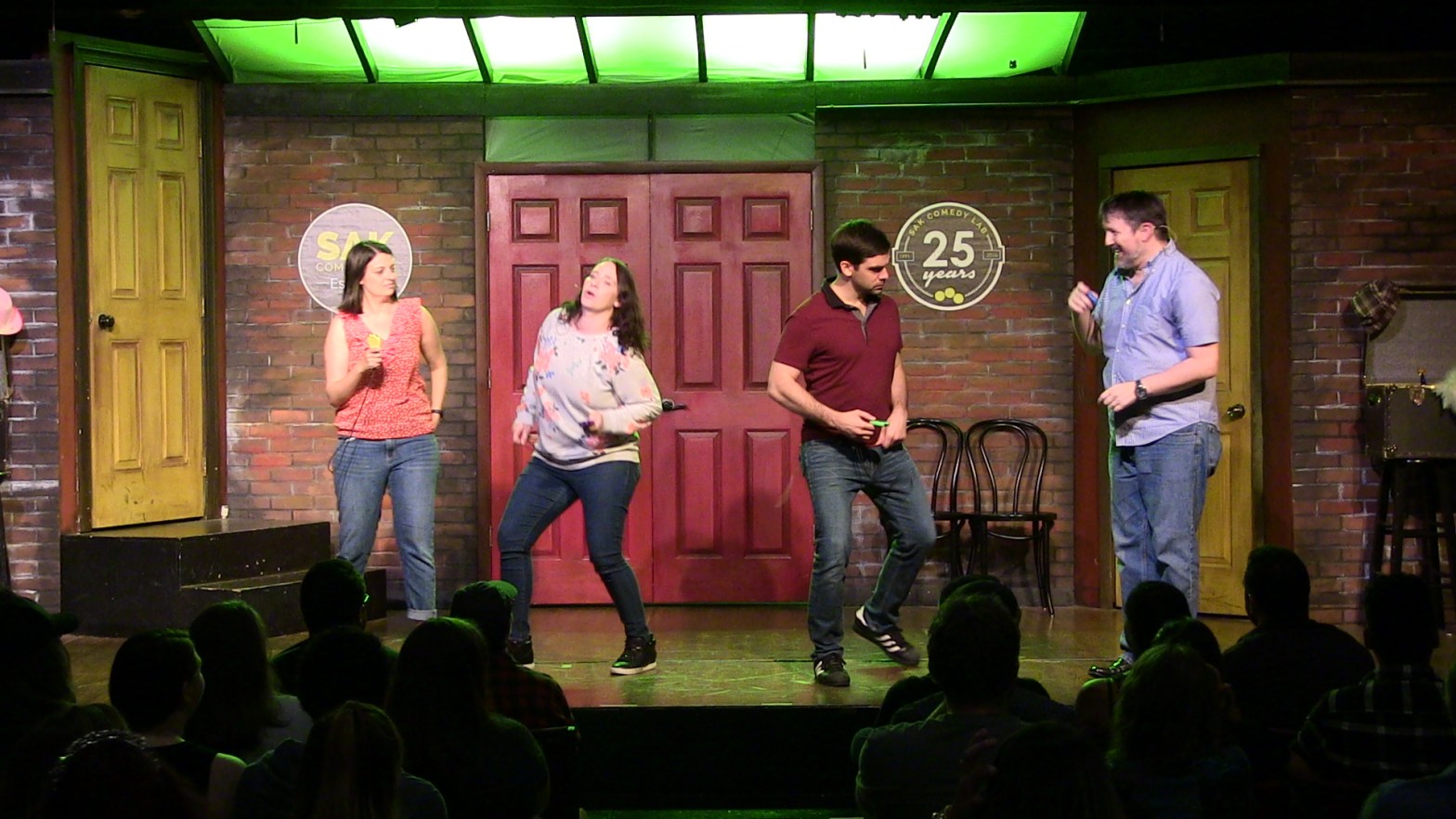
Game Library: “Lines From Texts”

This is a “nice” twist on a classic improv short-form game. I’ve put nice in quotation marks as the results can often tend more towards the “naughty” depending on your source material!

The Basics

One brave audience member volunteers their cell phone, unlocks it, and opens up a text thread before giving it to a predetermined improviser (“A”). For the resulting scene, this player may only use lines pulled from that text thread as their dialogue, which their teammates must work to incorporate and justify.

Example

Player A waits offstage with their volunteered phone (likely looking for a promising first line) while two teammates (B and C) begin a scene based on the suggestion of “messy roommate.”

Player B: (vacuuming the floor) “It’s a clear violation of our roommate agreement. You can’t persuade me otherwise…”

Player C: (picking up some carelessly discarded trash) “I’m just saying that if this feels like a trap… we should give him a chance to explain his behavior.”

Player B: (with a loaded look) “He’s never going to date you, you know that, don’t you?”

Player C: “You can be an awful friend, you know that? This has nothing to do with my feelings for…”

The door rattles heralding A’s entrance.

Player B: “I’m not living like this anymore.”

Player A: (reading from the chat thread verbatim) “The next round is on me!”

Player B: (under their breath) “it’s not even lunchtime…”

Player C: “You seem to be in a good mood this morning.”

Player A: (reading) “You’re only young and beautiful once, am I right…?”

The Focus

Guide and savor the madness while trying to add the reader’s peanut butter to the other players’ jelly.

Traps and Tips

1.) For the setup. Make sure the audience member fully understands the ask before giving up their phone. The scene will feel icky if the volunteer isn’t in on the joke. Depending on your venue and content guidelines, you might need to work to get a “suitable for work” text thread. If in doubt, be explicit with the audience in terms of the game and its needs. I’ve seen players find it useful to ask for a specific group message thread or similar (rather than freely moving between any and all conversations) as this gives the volunteer a little say in what they are willing to divulge. Group threads can also have the benefit of offering multiple voices to choose from, which often proves advantageous.

2.) For the scene start. The current wisdom in my improv circles is to have (generally) two players begin the scene without their phone-bound teammate. By doing so, you can provide some unobstructed CROW and given circumstances, setting the “norm” or platform before Player A enters with likely mayhem. In addition to getting the scene rolling and building the world, you can also establish the missing player’s general deal or energy as they’ll have a difficult time concisely doing this while only using text dialogue. As noted above, giving the reader 10 or 20 seconds to scan the potentials of their borrowed phone can also set them up for greater playfulness and success.

3.) For the non-readers. The heavy lifting of this scene really rests on these improvisers’ shoulders (even though it might look otherwise to the audience). Share focus with great deliberateness. This game is a relative of Columns, Hesitation Speech, and Papers where random offers are strategically woven into the action (usually with the express intention of disrupting it or adding surprise). While the phone reader might thrive and easily add their voice at will, they’ll usually benefit from some good old-fashioned focus gives and lead ins. Narrow questions can become needlessly cumbersome if overused: “What should we have for dinner?” Consider more open-ended handoffs instead: “What do you have to say for yourself?” The game loses steam if you repeatedly make Player A scroll endlessly for a phrase that is vaguely appropriate. And avoid the cop out of coding the trader as “crazy.”

4.) For the reader. You’ll want to be generous with your fellow players as well. Bombarding them with a string of non sequiturs without leaving sufficient room for nuanced justifications will likely suffocate the story (and tempt your teammates to just dismiss you as “crazy”). You’ll rarely find the perfect response so happily settle for the first thing you find that’s vaguely in the ballpark. As you don’t have much flexibility with your language, make sure you are also making strong staging, emotional, and subtextual offers. I’ve standardized my spelling in the above example, but fewer and fewer of us text with the same attention to detail that we’d give a more formal piece of writing. Shorthand and misspellings can add another level of fun.

In Performance

Actor’s Nightmare provides an old-world iteration of this dynamic with one significant distinction (other than the level of technology). In the current updated version under consideration, the reading player will generally scroll around and randomly choose helpful (or not so helpful) dialogue as it presents itself. In Nightmare, the conceit is that the reading player is providing the “correct” dialogue; for this reason, they should stick to providing one character’s dialogue in its original written sequence.

Cheers, David Charles.
www.improvdr.com
Join my Facebook group here.
© 2024 David Charles/ImprovDr

Game Library Expansion Pack I

Game Library: “Last Word, First Word”

This short-form game tills similar terrain as Reiterate/Repeat in that players cannot make their own offers without first utilizing the choices of their stage partners.

The Basics

Every line of dialogue in a scene must begin with the last word of the prior line of dialogue.

Example

Two circus clowns have just returned to their trailer after a grueling performance.

Player A: (as they remove their nose) “That was a difficult show.”

Player B: (as they slip off their oversized hoop pants) “Show me one good reason to come back tomorrow.”

Player A: (taking off their curly wig) “Tomorrow is another day, with a different audience.”

Player B: (hanging up their pants) “Audiences, Twinkles, just aren’t the same anymore.”

Player A: (sitting at the makeup table and reaching for a wipe) “More and more kids would rather just be sitting in front of their screens…”

The Focus

While this game looks very similar on paper to Last Letter, First Letter, it can exercise surprisingly different improv muscles. Unlike its variant which requires some spelling and language finessing, Last Word, First Word invites players to more closely scrutinize how they use their dialogue.

Traps and Tips

1.) Think essence. Don’t get too caught up in the absolute minutiae of the prior, inspiring word. (I think it’s a mistake to set the game up with this expectation for the audience, too.) In my example above, I’ve deliberately used homonyms (“show”), pluralized a word (“audiences”), and taken the second half of a compound word (“more”) to demonstrate that these all feel like appropriate repetitions to our ear. Honor the spirit of the launch word, rather than get bogged down in wrestling your sentences to obey precise grammar rules and idiosyncrasies. You’ll want to be careful of sloppily including preambles or utterances before you use the word in question, but taking artistic liberties to keep the story and action engaging and interesting are more than okay in my book.

2.) Think variety. I’d advise generally allowing sentences to form as they will, and end on the word that just happens to come out. That being said, there is some value in being a little strategic. If you always end your dialogue with your scene partner’s name, for example (or any other word, for that matter), that can become a little unhelpful once the initial joy of the challenge wears off. Having a philosophy of striving to offer up different final words (a least more times than not) expands the content of the game in fun and interesting ways, especially if you allow yourself to apply the above tip and use those words freely as jumping off points. If you’re heading accidentally to that same word again and it’s already been amply used, that would be a good moment to add a little postscript to your line, “you know,” “isn’t it,” “I’ve been told…” just to keep things interesting.

3.) Think subtext. Avoid the temptation to just parrot back the last word of your scene partner’s sentence to them. In my experience, this default approach often introduces a needlessly confrontational, questioning, or sarcastic tone that can loop content in less-than compelling ways: “Show? What do you mean show?” A little of that interplay can certainly add some fun and energy, but the scene will deepen if you really act your lines rather than just repeat words without clear intention. There’s no prize for speaking immediately, and a little earned silence will build suspense and interest. When you filter the required word through your established and evolving character’s point of view, you’re likely to create a more enticing and engaging relationship and story arc.

4.) Think brevity. And speaking of subtext, if you embrace shorter lines (so as to keep the improv ping pong game flowing), that will also encourage using your words in richer and more loaded ways. There are always exceptions to the “rules,” but as is the case with other iterations, there’s an expectation that no one player will hold onto the focus for too long. Long, winding passages decrease the challenge and effectiveness of the central device, especially when they are used as a way of evading the expected give and take. Concise dialogue, on the other hand, keeps the collaborative high wire act exciting as any final word might tilt the power balance or send the scene lurching in a completely unanticipated direction.

In Performance

This game seems much easier than its closely related kin Last Letter, First Letter. While their names and rules are similar, I find this variant surprisingly more difficult, especially if you’re committed to crafting a patient and nuanced scene.

Cheers, David Charles.
www.improvdr.com
Join my Facebook group here.
Photo Credit: Tony Firriolo
© 2024 David Charles/ImprovDr

Game Library Expansion Pack I

Game Library: “Last Letter, First Letter”

In addition to serving as a worthy language challenge, Last Letter, First Letter can also open up your dialogue in new and creative ways.

The Basics

All scenic dialogue must obey one simple (but demanding) rule: the current line must begin with the last letter of its predecessor.

Example

Two highschoolers sit on the edge of a community swimming pool, dangling their legs into the water.

Player A: “So, the prom is in two weeks.”

Player B: (obliviously) “Sure is.”

Player A: “Seems like everyone already has a date.”

Player B: “Everyone I know.”

Player A: “Well, not everyone…”

The Focus

Good give and take, active listening, and bold accepting will help fuel the engine of the game.

Traps and Tips

The techniques involved in this scenic dynamic have a lot in common with Alphabet Game, which you can review here. Most of these pointers are explicated further there.

1.) Stick your landing. Meandering sentences with unclear endings won’t help your teammates, so get out of your sentences cleanly and without unnecessary (and unspellable) utterances. Remember that your partner needs to know what letter they’re obliged to use, and they can’t do that if you don’t offer them a clear and definitive choice.

2.) Pass the ball. Especially when your scene involves more than two characters, endeavor to resolutely give focus so that the likely next speaker is clear to everyone. This prevents overtalking and the potential of multiple justifications of the same letter. The general contact of the game is that players won’t typically speak twice in a row either. (Long, multi-sentence speech acts can be confusing in this regard, too, as it will become confusing where one “sentence” ends and another begins, or if the monologuing player should essentially play the game with themselves.)

3.) Get off the bench. Here’s my perennial advice for language games: don’t make it only about the words. Our two highschoolers will likely be served by embracing some activity and action. It’s fine to start simply, and improvisers might need a few beats to settle into the rhythm and peculiarities of the language device. However, if you’re only thinking about your words, it’ll be difficult to build energy, so commit physically to the world of the play.

4.) Don’t be a jerk. A little playful shivving will likely occur, but this is markedly different that doggedly trying to end all your sentences with “box” and “fez.” I find it exponentially more delightful when players stumble accidentally into challenging letters than when you feel an improviser desperately forcing a doozy into the mix. While it’s helpful to be mindful that you’re not ending on the same word (or letter) time and again, let the scrabble tiles fall where they will and just craft your dialogue from there. Then if an “x” appears organically, the audience will love the resulting struggle.

In Performance

Language handles are popular mainstays in short-form shows. This game provides a nice (and potentially subtle) alternative to more common offerings while also allowing you to enjoy something resembling an open scene. Check out my previous Game Library entry, Last Letter Circle (here) if you’re looking for a good skills warm-up before leaping into the deep end.

Remember, you can expand your improv vocabulary with The Improv Dictionary now on sale here.

Cheers, David Charles.
www.improvdr.com
Join my Facebook group here.
Photo Credit: Tony Firriolo
© 2024 David Charles/ImprovDr

Game Library Expansion Pack I
Game Library: “Last Letter Circle”

Get ready to restart this one a few times!

The Basics

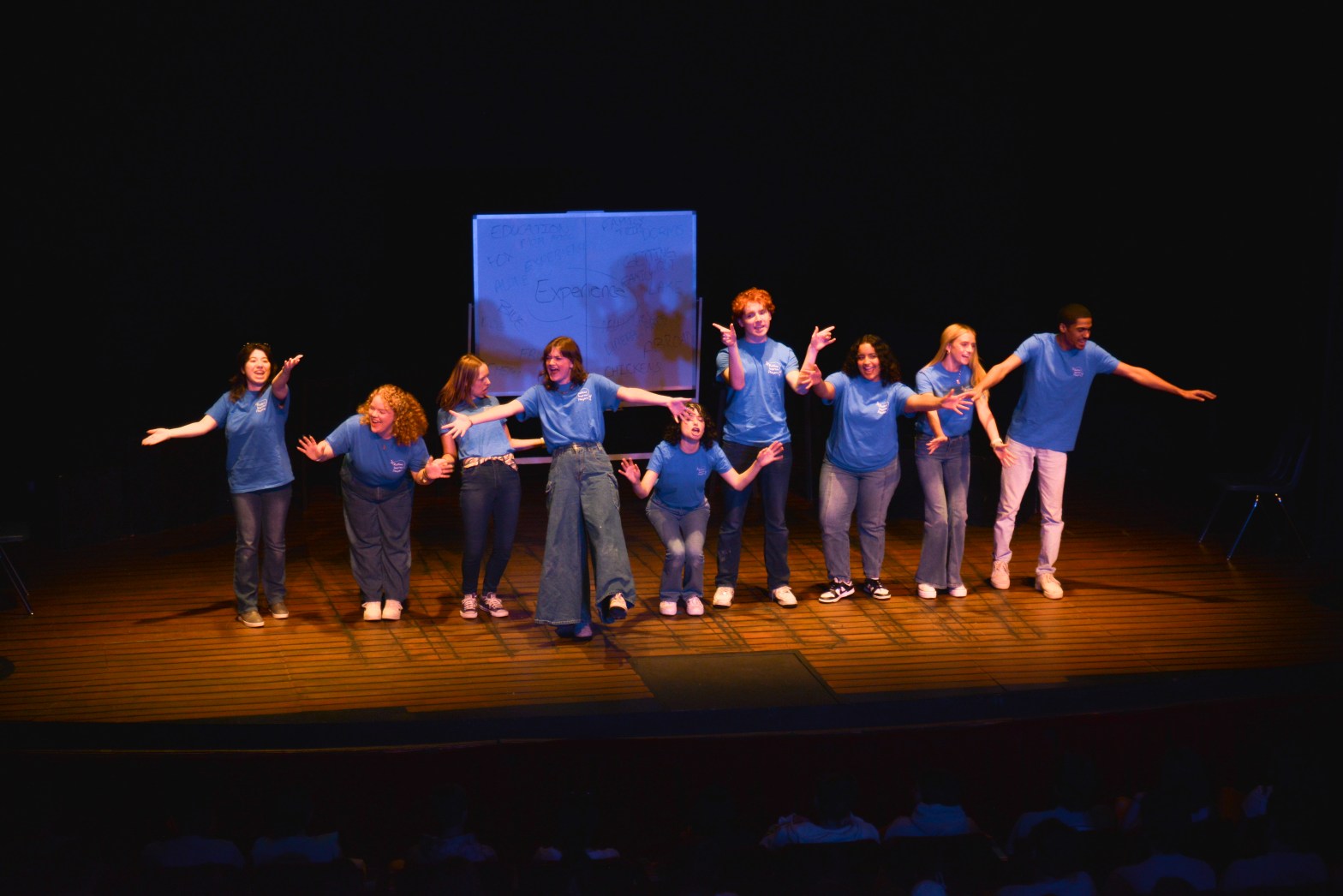
Played in a circle (surprise!), players establish a steady rhythm – I use two thigh slaps, followed by two finger snaps. The first player offers a word to their right (on the third beat or first finger snap). The tagged player then offers a new word that begins with the last letter of the prior word to the next improviser in the circle. Words continue to move around in this manner with two notable exceptions. If a new word ends in a vowel, then the direction changes so that now the prior player goes next (see below). Secondly, (and perhaps optionally), if a word ends in “y,” the speaking player can throw the focus to someone across the circle, who then passes the next inspired word in the direction of their choosing.

Example

The beat begins with each new word being provided on the “three.”

Player A: (to their right) “Profit”

Player B: (to their right) “Teacher”

Player C: (to their right) “Recoil”

Player D: (to their left due to the vowel ending) “Love”

Player C: (to their left) “Ecstatic”

Player B: (to their left) “Colorful”

Player A: (across the circle to “H” due to the “y” ending) “Lazy”

Player H: (to their right) “Yum…”

The Focus

This exercise has a word association on steroids vibe to it, although the spelling element adds a level of challenge and self-awareness that some may find joyful while others initially will not. If you’re looking to expand your vocabulary, warm-up for games like Alphabet Game, Alliteration, and Last Letter, First Letter, or develop a sense of poetic or genre-specific style, this frame will serve well as a brainstorming device.

Traps and Tips

1.) Start slowly. I’ve found most students (understandably) struggle with the competing mechanics at play, so give everyone a fighting chance by setting (and maintaining) a modest tempo, at least when the game is new. When words appear anywhere in the rhythmic accompaniment, it’s easy to throw each other off. In the example above, it appears as if players know which direction they will send the focus before they say their word, but in reality, this is rarely the case, so you’ll want to give each player the full four beats to get their word out and then direct the flow. It’s also important for players to get in the habit of saying something on the appropriate bat so the association chain remains unbroken, even if their word in no way honors the other rules of the game.

2.) Think small. I model most new games in one all-inclusive circle, but if you’re playing in a larger ensemble (more than eight or so players), you might want to break into smaller groups for the actual explorations. With newer players – and more experienced improvisers too, for that matter – the direction of the word passes is generally rather random and left up to chance. Subsequently, it’s easy for a section of the circle to become over- or under-featured. The “y” rule can also help in this regard, but such deliberate throws are few and far between when players are still just struggling to say any word on the beat. “Think small” is also helpful advice in terms of your initial word choices too, especially when you’re learning the game fundamentals. It’s more helpful to confidently over a two- or three-letter word on time than flub over something polysyllabic a moment or two too late. Gibberish or invented utterances are also problematic as they’ll invariably cause stalling spelling questions.

3.) Avoid homonyms. This is probably another “higher level” piece of advice, but the game can quickly grind to a halt if players aren’t sure which there/their/they’re is being used. When they do pop up – or when a player isn’t 100% sure of a word’s spelling, make your educated best guess – and just move on with a clear focus give. (The original speaker can help, too, by making a bold direction choice – “there” and “they’re” end in a vowel so will reverse the flow; “their” ends in a consonant, and so would keep the flow going.) It’s tempting to allow “dictionary police” to enter the game, and critique spelling errors, but don’t get distracted by the minutiae. If every offer is put under the microscope, you’ll quickly create the conditions where players will be afraid to say anything, and the game is challenging enough without the pressure of always being right. To that end…

4.) Embrace slips. Say the next word that appears to meet the current needs of the game, and then continue with playfulness and confidence; applaud wildly when breakdowns occur that require a deep breath and fresh start.

In Performance

Once the basics of the game are known and don’t feel too overwhelming, you can also add an overlay of a category (“words fit for a poem”), time period (“words fit for the ancient Greeks”), or show-specific style (“words you might use in a crime procedural”). In this way, the game can be used as a way of deepening your vocabulary bank or exploring less mundane word choices.

Cheers, David Charles.
www.improvdr.com
Join my Facebook group here.
Photo Credit: Tony Firriolo
© 2024 David Charles/ImprovDr

Game Library Expansion Pack I

Game Library: “Know-It-All”

Know-It-All is a classic short-form interview game that combines the collective knowledge (theoretically) of multiple players as they form one multi-headed expert.

The Basics

One player, or possibly the host, serves as the interviewer. A topic is obtained from the audience and the remaining teammates from a tight cluster or line to serve as the expert who must answer every question “one” “word” “at” “a” “time.” Alternatively, this game can be played one-voice style (see pointers for that speech dynamic here).

Example

The host begins the game using the audience suggestion of “street tacos.”

Player A: “Welcome back everyone to my original vlog series all about the foods that keep us coming back for more. I’m really honored to have today’s guest join us outside my home. Please introduce yourself…”

Player B: “Thank”

Player C: “you”

Player D: “Nicole”

Player B: “for”

Player C: “inviting”

Player D: “me…!”

The Focus

Played with attack, this game generates surprisingly detailed stories replete with delightful surprises and broad characterizations. Played without attack, this typically short game will feel like it lasts an eternity and doesn’t actually go anywhere meaningful! As I explore tips for word-at-a-time joy in my related entry concerning Double Speak (see here), I’m using this game entry to muse more exclusively on the equally important role of the host.

Traps and Tips

1.) Create a frame. Don’t throw away the joyful character and story potentials of the hosting position. If you think of this role as little more than a device to prod the expert to the next piece of schtick or joke, then that is all you will manage to do. In the opening moments of the scene, you have a great opportunity to establish the given circumstances and your own character point of view on the subject and your guest. While it’s perhaps a good rule of thumb that the interviewer shouldn’t be the most interesting thing on the stage, you needn’t hide blandly in the shadows either. When the host has their own sharp deal, backstory, objective, or relationship with the expert, the story often takes off in delightfully new ways. These specifics also lay helpful groundwork for when the story alone might not offer up a resolute button.

2.) Throw the spotlight. Know-It-All is one of those games with a built-in area of focus and while you don’t want the host to become irrelevant, it is important to remember that the primary interest will (should?) always remain with the expert as they playfully struggle with their language restriction. The host will often rightfully take a little extra time at the top of the scene, but once the givens are well established, be sure that you don’t needlessly luxuriate in your questions and ponderings. If the scene veers away from the expert for prolonged periods of time, the game can lose steam and it will become difficult for the many-voiced character to ever build up momentum. Put more plainly, if you’re offering twenty words to the expert’s two or three-word answers, then you’ve probably got the balance a little off.

3.) Mine the story. Another trap can be just meandering through a list of rather uninspiring or generic questions: “How old were you were you started this activity,” “Who has most inspired you,” “I hear you’re on an international book tour…” (I would offer that stock bits or gags can quickly fall into this category too.) Most of us have used some iterations of the above to fish for something of unique interest, but if you only recycle such questions or prompts again and again, then you will likely get the same milquetoast scene again and again. The scene and story come alive when you actively listen and strive to base each new question or lead on the latent potentials presented in the prior answer. Endeavor to find and elevate the hidden story potentials contained in a peculiar turn of phrase or playful stumble. Don’t ignore the unexpected moments in a misplaced effort to just drag the story back to old well-worn clichés.

4.) Relish the struggle. It’s certainly in the spirit of the game to “clean up” unwieldy expert answers a little – some cheerful justifying can go a long way to help the story emerge. But be wary of getting the expert out of too much trouble. There can be a lot of joy in holding the character’s toes to the fire a little and asking the expert to clarify a particularly opaque or rambling response, or to define a bizarre phrase or term. Whenever possible, invite the expert to navigate the path through their own creative mess rather than throwing a life preserver at any and every sign of rocky waters. Obviously if the expert players are struggling and in meltdown mode by all means lend a helping hand. But don’t lose sight of the fact that much of the artistic and entertainment value of the game comes from enjoying some struggle.

In Performance

The pacing of the expert tends to decrease with each additional “head” but there is something marvelous about the resulting struggle! I play this exclusively as an interview game which is a stock offering in most short-form show evenings. If you’re looking for a more scenic deployment of the same dynamic, check out Double Speak here.

Cheers, David Charles.
www.improvdr.com
Join my Facebook group here.
Photo Credit: James Berkley
© 2024 David Charles/ImprovDr

Connected Concept: Story Series for Improv I

Game Library: “Kick It”

Improv meets rap in this edge of your-seat hybrid short-form tour de force.

The Basics

At a caller’s discretion, a scene moves from regular dialogue (“Word”) to rhythmic rap (“Kick It”) and back again with players swiftly moving from one style of communicating to the other mid-sentence or mid-word as challenged.

Example

The action begins on a tour bus with Players A and B studiously reviewing a thick travel guide about Greece. They begin by speaking in regular dialogue.

Player A: “I can’t believe we’re finally doing this! After all that saving…”

Player B: (clearly covering something up) “Yes, honey, this is truly a dream come true…”

Player A: (tenderly) “Are you going to tell me what’s on your mind?”

Player B: (anxiously) “There’s something I’ve been meaning to…”

Caller: “Kick it!”

A rap beat drops, and Player B continues…

Player B: (rapping to the best of their ability)

“…tell you, and this is gonna be hard.
I put this whole trip on our now maxed-out credit card.
I should’ve been saving, cause we’re gonna get fleeced
By those less-than-great interest rates, but you really love…”

Caller: “Word.”

The accompaniment immediately drops out.

Player B: (talking again) “…Greece, and it would take years to save up for this.”

Player A: (disappointed) “We talked about changing our terrible spending habits…”

The Focus

Aim to move the story steadily forward in both the sung and spoken sections, fully embracing all the deliberate (and accidental) discoveries.

Traps and Tips

1.) Musician tips. This game sinks or soars a little depending on the rap accompaniment. Clumsy transitions, stalling intros, inelegant samplings, and unpredictable rhythms can all undermine the singers who already have a lot to contend with. If you’re fortunate enough to have a skilled beatboxer in your company, this can provide an amazing sense of polish alongside potentials for nuanced collaboration as the music can stop and start on a dime and gently morph to allow for unique emotional choices and organic rhyme and rhythmic patterns. More commonly, a canned track is used. When the rap is first introduced, a little play in can help establish the beat and tone for the players and audience. Once the scene is underway, however, you don’t want to have players stalling for a preamble to finish as that’ll kill the energy and flow. It’s worth taking the time to find and edit beats that work for the specific improvisers in your roster – a jaunty tempo might set a more proficient player up for joyful success while completely scuttling another teammate. It’s rough when that lesson is learned in real time in front of a paying audience. 

2.) Caller tips. Listen, listen, and then while you’re at it, listen just a little bit more. There are lots of fun little shivving moves you can make to heighten the fun (cutting the music out right before the last payoff word or rhyme is a favorite in my current home venue), but the scene can become murky and jumbled if the caller isn’t really serving the needs (and elevating the strengths) of the onstage ensemble. “Kick it” moments are a great tool for heightening and extending, as well as revealing some well-placed CADs. Pay attention to and honor the technical limitations of your live or recorded soundtrack. If the transitions between spoken and sung dialogue are a little clunky due to your technical parameters, it’s probably unwise to try and switch a player back and forth between styles multiple times in a single speech act. (Frankly, that’s probably a tall order even with an accomplished live beatboxer at the helm.) Many of the techniques used in Song Cue apply here, too, and thinking of each rap moment as a short song with its own structural sense and payoff can go a long way to adding polish.

3.) Dialogue tips. It’s important that the audience believes the conceit that the caller is messing with and challenging the team with each musical shift. That being said, the players can stealthily do a lot of the work of setting themselves, each other, the caller, and the musician or technician up for success. If you talk all over each other or in meandering run-on sentences, you’re making everyone’s life needlessly difficult. Clean transitions into and out of the rap are crucial. So, make strong, loaded offers that invite further elaboration. If it’s helpful, think in terms of the lead up to a traditional theatrical monologue in a play or power ballad in a contemporary musical. This type of emotional commitment will also make it much easier to find content in the rap that follows. And don’t forget while everyone is looking for fun switch opportunities, that it’s beyond classy to set someone else up for the big musically infused revelation. Don’t retreat into your head while coming up with your deal or that clever rhyme you want to land. (Is that ever a good idea in our scenes?!)

4.) Rap tips. There are a lot of structural and rhyming tips I could give here – and there are a few of those below – but my first and probably most important advice is to rap as yourself. This has been a conscious development in my own performance circle where once players may have ill-advisedly adopted some stereotypical persona as an overlay. That will strike most aware spectators now as icky (at best) and downright offensive (at worst). I’m a middle-aged, Caucasian, English-sounding dad. That’s the unapologetic vibe I bring into my rap sections. I might use more contractions and elision in my lyrics – as I would in any poetic form where rhythm and rhyme invite creative language tweaks – but I still retain my me-ness. Speaking of poetry, that would be my other major suggestion. Rap is poetry and delights in chasing fun rhymes, savoring repeated sounds, and developing dynamic or unexpected cadences. Enrich these speech acts accordingly as best you can – such a verbal approach also accentuates the contrast between the sung and spoken sections of the scene.

In Performance

Style games such as Kick It can wrestle with complex issues of appropriation and appropriateness that feel different from one community or country to the next. I will tend to quickly and resoundingly make fun of myself if I’m seeing this game up, acknowledging that I’m probably not the person they’d like to see rap that evening. In that way, I’m highlighting that I’m the target of the joke rather than the greater artform itself. It’s a small finesse, but in my experience, it tends to keep the game joyful and light.

New to ImprovDr.com or the Game Library? You can find the ever-expanding collection of games, exercises, and warm-ups here.

Cheers, David Charles.
www.improvdr.com
Join my Facebook group here.
Photo Credit: Kalani Senior
© 2024 David Charles/ImprovDr

Game Library Expansion Pack I
Game Library: “In the Studio”

This musical number is a regular fixture at my current improv home, Sak Comedy Lab, where we have more than our fair share of strong singers and improv musicians, both of which are needed to land the game well.

The Basics

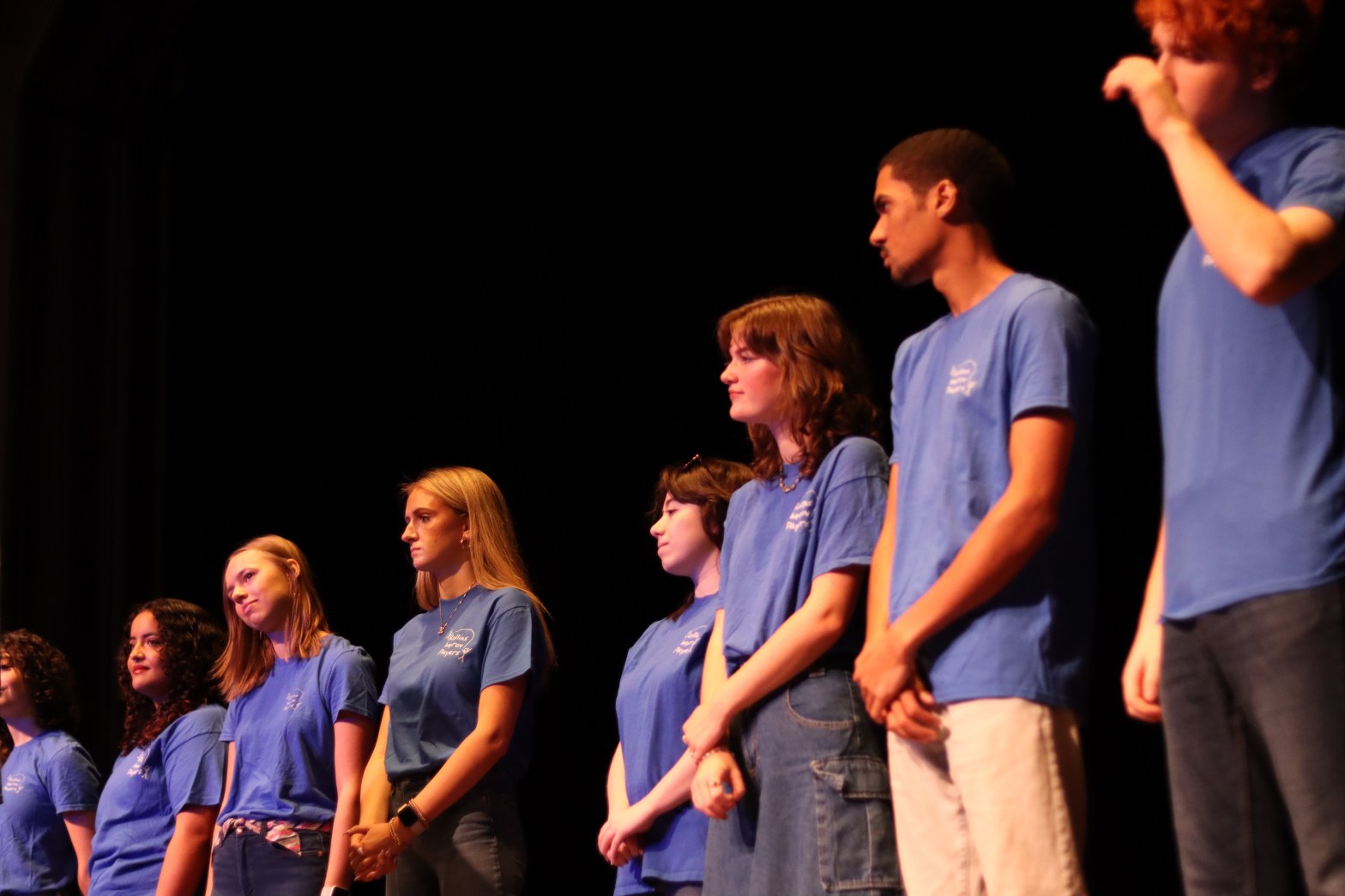
One team provides the singers who are In the Studio for a recording session (I usually play it with two or three improvisers in these positions). The opposing team – or perhaps a host or other player – provides the producer or producers in the booth who offer up new recording styles and challenges. The scene begins with the singers creating a base track of a well-known children’s or holiday song or similar. After this template has been established with the help of a live musician, the producers provide a series of adjustments or stylistic overlays (usually three in total) that the singers then use to breathe new life into the old song.

Example

The singers are given “Twinkle, Twinkle Little Star” as their base material and the trio songs the standard melody together.

Player D: (as a producer) “That sounded great. We’ve got some extra tape, so why don’t we just have a little fun with this and try some out-of-the-box alternatives.”

The singers offer their approval.

Player D: “So why don’t we do the song again but this time with a bit of a country flare for all our listeners in the south…?”

The musician offers an appropriate play in, and Player A steps up to the microphone to sing lead while their teammates grab imaginary instruments to assist...

Player A: (singing)

“I see you twinkling, twinkling, way up high,
Lying on my truck bed as I look up at the sky.
And I wonder to myself just what you are
And if I could live you more than my old car…”

The Focus

This game requires some finesseful understanding of popular musical styles and conventions, as well as the bravery and skill to attack each new song iteration. You’ll want to challenge the participants to keep the format fresh, but also be mindful of what your musicians (and their preferred instruments) as well as your singers can achieve. It’ll be a rough addition to your playlist if every called style proves to be out of reach.

Traps and Tips

1.) For the setup. When the inspiring song is simple and well known (rather than niche or innately complex), you’re more likely you are to set yourself up for success. You don’t want the first rendition to consist of the singers struggling to recall the lyrics (or your musician butchering the melody or accompaniment). We tend to prefer children’s songs for this reason (though we’ll rule out “Baby Shark” right out of the gate as it’s too simple and repetitive)! It can work to slog through a less familiar song with some charm and fearlessness if you’ve already developed rapport with the audience, especially if you know you’ve the voices in your stable to knock out great later versions, but generally the first verse or chorus of a common ditty with give you ample material for the fun to follow. From a technical perspective, if you have the lights and stage space, separate the “performance” and “producer” areas as best you can, ideally fading the producers out while the songs unfold. We tend to place the singers on a microphone stand downstage center with the producers on stools near the wing.

2.) For the producers. As with all caller positions, it’s fun to appear as if you’re messing with the other team, but in reality, you’ll want to give them the right kind of lead-ins. It’s certainly helpful to know each player’s strengths and to exploit these as you can without overly relying on going back to the same styles again and again. I tend to get musical theater and opera type calls when I’m a singer as those as the genres my teammates have seen me perform with some success, but some of my favorite memories have been of less anticipated calls, such as an All-American Bruce Springsteen inspired number. Try to build the level of difficulty and impressiveness, saving the biggest shot for the last spot. We default to three remixes, so will tend to put the riskiest or least expected call in the middle and might end with a duet if we’ve got a bank of two singers. You can leave it up to the players to self-select which song they’ll take lead on, but it can be helpful to pitch each challenge to a particular player, especially if you’re keeping something in your pocket to go out on. I also like to riff on the song title or lyrics themselves to help me come up with unique takes: “When I think of stars, I think of the biggest stars of all… on Broadway. So, let’s hear it again as if we were in a classic musical…” It’s also good form to let your musician know as early as you can in your intro spiel the general style you’re about to pitch so they have time to find a suitable patch on their keyboard. We’ll also try to steer away from offering up a specific musician as the prompt (unless we’re confident they are in the singer’s and musician’s wheelhouse), opting for more forgiving language such as “in the style of Taylor Swift,” or “reminiscent of a young Taylor Swift” rather than “do it as Taylor Swift.”

3.) For the singers. Be strategic and play to both personal and team strengths. If the producers aren’t assigning specific remixes, quickly determine who can best serve the genre (and audience). If you’re a less able singer, it’s generous to go earlier rather than wait for the third song when the pressure to go out big is now truly on. There’s also wisdom in having each replay move gradually further and further away from the original. In this manner, the first singer can largely recycle the foundational lyrics and song structure, while the third singer might use the base material much more loosely and purely as inspiration. If you get too far from the known song too quickly, however, it can stretch the curve of absurdity prematurely. You’ll also want to be mindful of the lengths of each replay. Singers can tend to become a bit indulgent (regardless of whether the song is hitting or not). Usually, one good verse and perhaps a chorus is more than sufficient, especially in those first two positions. (Such an approach can also gift the last version a bit more space to joyfully expand without making the whole affair last ten minutes). While the producers can help by editing the songs, it serves everyone when the singers and musician show discipline in this area too. If in doubt, leave the audience wanting more rather than beating that one style or idea into the ground.

In Performance

This form will quickly become an audience favorite if it’s not already in your game rotation. If you’re not accustomed to exploring different musical genres, this frame provides both a great mechanism for rehearsing new possibilities and a means for then showcasing this new level of experience and knowledge.

New to ImprovDr.com or the Game Library? You can find the ever-expanding collection of games, exercises, and warm-ups here.

Cheers, David Charles.
www.improvdr.com
Join my Facebook group here.
Photo Credit: James Berkley
© 2024 David Charles/ImprovDr

Game Library Expansion Pack I

Game Library: “Incomplete Sentences”

This language dynamic can serve as a fun individual character handle or provide the basis for a whole scene where everyone gets to play. This description assumes the latter conditions.

The Basics

Players explore a premise in which they are not allowed to complete their own… sandwiches.

Example

The action takes place in a large industrial kitchen where players are bustling to complete an important catering job that could make or break their company and careers.

Player A: (gathering together their team to review progress) “Okay, everyone, the guests should be arriving in…”

Player B: “… helicopters on the roof. These celebrities sure know how to…”

Player C: “…leave a carbon footprint.”

Player C turns to A, the head chef.

Player C: “Look, are we ever going to talk about…”

Player A: “The truffles? I don’t know how many times I can apologize for…”

Player C: “…binge eating them all on the floor of the walk-in refrigerator last night. You say you want us to succeed, Colin, and yet you always…”

The Focus

Relish the struggle and the delightful surprises that will keep you on your toes as the scene lurches playfully on and off the tracks.

Traps and Tips

1.) Throw the ball. The scene will tend to become ponderous and fizzle out a little if the incomplete sentences just dangle lifelessly in the air waiting to be justified. A little struggle adds to the charm, but generally, the flow will be helped if players clearly give the next moment to a specific scene partner. This also prevents the trap of having multiple justification attempts all hitting the stage at the same time. Again, a little of this will add risk and joy, but if overtalking becomes the norm, you won’t be able to craft much of a story. I find it helpful to explicitly have the player who completed the prior thought set up the next one for someone else. as such a tactic guarantees that one voice doesn’t monopolize.

2.) Embrace the unexpected. Most improv traditions are rightfully leery of needless originality as this approach to collaborative creativity tends to puncture nuance and suffocate more honest and connected story threads. This scenic dynamic contrarily demands a little playful eschewing of the obvious as completing sentences with the intended ending will quickly fall flat. Consider deploying a third thought technique or similar to jolt yourself out of the mundane. You’ll want to honor the rules of grammar and construct logical structures, but the contents should probably upend intentions at least a little.

3.) Honor the non sequiturs. Accept other’s amendments as factually true (unless they’re delivered with a clear sense of sarcasm or irony). It’s more delightful for the players and audience when each new idea is treated with an air of “of course that was exactly how I was going to finish my own thought had I been given the chance.” When every offer becomes contested, you’ll sail into the waters of action-draining conflict. Yes, the anticipated diners are arriving by helicopter. Yes, they are all celebrities. Yes, they are all oblivious about their carbon footprints…

4.) Heighten the action. As this is clearly a language game, players can tend to unhelpfully make the scene almost exclusively about the dialogue (which can easily become dominated by negotiations, discussions, and cerebral justifications). Establish a clear and powerful objective early and be sure to actively chase it. Make physical and emotional choices. Use silences and pauses to build tension and suspense. If the game only involves completing each other’s thoughts, the work will quickly start to feel frantic.

In Performance

As noted above, I’ve also explored this with a single character (usually the protagonist) who is responsible for leaving all their sentences unfinished for their fellow improvisers to complete. (This variant also offers the opportunity for a little more wiggle room between justifications which can give the story some space to grow.) An incomplete sentences gimmick could certainly be discovered organically in any open scene; however, it doesn’t take much for a well-intentioned but ill-informed scene partner to name or puncture the game, so there’s certainly a value in knowing (and practicing) the rules and best practices beforehand.

New to ImprovDr.com or the Game Library? You can find the ever-expanding collection of games, exercises, and warm-ups here.

Cheers, David Charles.
www.improvdr.com
Join my Facebook group here.
Photo Credit: Tony Firriolo
© 2024 David Charles/ImprovDr

Game Library Expansion Pack I

A Peek Inside: The Lost Comedies

I’ve described The Lost Comedies of William Shakespeare and several of my other research-infused long-form works as homages rather than parodies as my intent is to base them on a rich and loving understanding of the source material. This is not to say that the result on any given night or performance might not be markedly irreverent or giddily playful, but the intent is to base this abandon in an understanding of the period, style, and tropes of the source material. Each subsequent iteration of The Lost Comedies has endeavored to take this up a notch, examining existing characters, tensions, and societal pressures as depicted in Shakespeare’s plays. Of particular interest and import was the use of language and poetry throughout. If I had my druthers, all the courtly characters would speak in iambic pentameter, but this formidable target has proven elusive… thus far. That being said, the rehearsal processes always explored ways that we could enrich our modern language with some poetic flair and flavor.

As I mused on which game or exercise to pair with this particular production, my mind kept coming back to a game that I don’t think I’ve ever officially named, or at least not in a way that has stuck. In my notes I have Take It Up a Notch and Extended Metaphor, neither of which has become common usage in classes or rehearsals, so I think I’ll go with Image Building as it strikes me as the most efficiently descriptive. While certainly designed to assist in encouraging language of an epic or Shakespearean nature, I think it could easily be modified to help with other style or genre-based pieces and workshops.

Let’s have a peek as to how the exercise works:

The Basics

Players form a circle. One player offers a simple noun or image to start, such as “a tree.” A second player accepts this initial choice but takes the image “up a notch” by adding a new specific, so now the picture becomes “a young tree.” A third player offers a new addition: “a young tree reaching toward the sun…” Each subsequent player adds to the image, paraphrasing prior offers before adding something new. The process continues until the group agrees that the image is now complete.

The Details

This can feel a bit like a memory game which can be a distraction to the larger intent: if a small detail is dropped or diminished as another dynamic piece of the puzzle is added, that isn’t probably the end of the world as long as the prior image as a whole has been fully embraced. In the example above, our focus shouldn’t ideally move off the young tree to the sun, for example. Depending on the size and energy of the group, players can either add randomly when the mood strikes them, you could move in sequence, or have players physically nominate the next to go after they have contributed.

Example

The first player steps into the circle and says,  “a rose.”

The second steps forward and offers, “a delicate rose.”

The third adds, “a discarded delicate rose.”

A fourth provides, “a discarded delicate rose on a lover’s doorstep…”

Traps and Tips

1.) Don’t race to the finish line. One of the gifts of this exercise is seeing how an interesting image materializes one small step at a time. As players become familiar with the concept, they may want to sprint to the end. Especially when it comes to the first moves, players should endeavor to leave sufficient room for the contributions of others. Jumping from “a rose” to “a destroyed pungent rose with its petals strewn across the carcass of a dead man clutching a dagger” might be missing the “building” aspect of the exercise a little!

2.) Stress accepting. Bad improv habits can easily emerge in an exercise this simple and elegant, and it’s likely that players may start to think too far ahead and therefore miss the nuances of others’ additions. Deep listening is critical. Accepting the choices of others doesn’t mean, however, that the image can’t have conflicting or paradoxical elements. Making our rose, in the above example, pungent or decaying, is a cool and very Shakespearean way of placing beauty and death side by side in the same image. This is different than negating or erasing a prior choice if it doesn’t fit with your preconceived desire for the picture.

3.) Explore physicality. I’ve had some success with groups stepping into the circle and almost embodying or “scene painting” the image as it unfolds. The first may gently place the “rose” on an imagined window sill, with the next stepping in and adding the breeze “ruffling its petals.” Adding physicality can also prevent the game from becoming purely intellectual and help make the language have more emotional meaning and purpose. It’s also a palpable reminder that Shakespeare’s poetry was intended to be acted.

4.) Take liberties with the sequencing and phrasing. The game can feel like “I went to Mars and I took a…,” if we recall each choice in needlessly strict order and language. A lot of the fun and value of the game is allowing and encouraging poetic license and liberty. To return to the initial example, “a young tree reaching towards the sun,” a next step could become “a merciless sun scorching a suffocating sapling” or similar. The ingredients remain but have been repurposed and heightened. If you’ve explored other poetic tropes, such as alliteration in this case, this exercise is also a great vehicle for putting them to use as well.

5.) Jump it into action. If this is proving to be the right balance of challenging and joyous for your ensemble, you can cap each built image with a brief monologue. One volunteer, when they perceive the image is sufficiently rich and developed, can step into the circle and quickly offer a monologue inspired by the final image. The speaker can embrace the image as a central simile or metaphor (I find this the most helpful personally), speak to the crafted image imbuing it with personal meaning or significance, or perhaps even embody the object itself and offer wisdom to those assembled. “Oh father, why must I wither as the supplicant sapling in the scorching heat of your merciless gaze…?”

Final Thoughts

This exercise can have some pretty quick rewards in terms of reminding us of the potential of our language if we just slow down a little to smell the proverbial discarded delicate roses. It is certainly a performance-ready technique that, frankly, you can essentially play by yourself to jump start a soliloquy or scene, and it’s surprising how often a seemingly profound or complex concept effortlessly emerges from the process of describing something simply and methodically step by step.

And that’s your peek inside the poetry-enriching process of The Lost Comedies of William Shakespeare, my first fully-realized long-form show that began its journey at Western Illinois University in 1997. (Read more about it in the companion entry here.)

“With a nonny nonny nay, and a nonny nonny hey, and a hey nonny nonny nonny ho…”

Cheers, David Charles.
www.improvdr.com
Join my Facebook group here.
Or email me here to discuss bringing this show or a language-centric workshop to your company!
© 2024 David Charles/ImprovDr

Game Library: “Humanless Scene”

This is another one of those framing devices that is more of a loose conceit or challenge rather than a nuanced structure. Regardless, it’s a nice way to shake up the action and inspire outside-of-the-box characterizations.

The Basics

The basics are rather basic indeed: players create a scene in which they cannot embody human characters. That’s it!

Example

Players explore “kitchen” as their offer. The scene opens on two improvisers sitting on a counter.

Player A: (as a toaster) “I’m getting worried, Shannon. They’ve not used me for months. I think I’m getting rusty…”

Player A tries to shuffle around a little on the countertop.

Player B: “It’s all in your imagination, Paul. You’ll be back in fashion in no time.”

Player A: “That’s easy for you to say – you’re a blender. This gluten-free diet fad has been great for you…”

Player B swivels joyfully.

Player B: “I have been enjoying the extra attention. I won’t lie…”

The Focus

Explore a premise, location, or theme from a wholly different angle or perspective.

Traps and Tips

1.) Set the rules. The scene will struggle if the fundamental rules of the world aren’t established quickly and clearly. This may involve a quick check-in between players during the blackout or countdown (depending on your company norms), or just a bold player setting up the first move of a game or story with creative precision. Wishy-washy imitations or endowments, however, won’t prime the scene. If your first thought is to be an appliance in the kitchen, get that clearly to the stage as soon as possible so other improvisers can continue to build in the same direction.

2.) Play the game. This device thrives on the improv approach of “if this is true, what else is also true?” So, if we’re in a world of talking appliances, consider how the other facets of the universe affect our characters. Does electricity become a form of status or currency? Are our characters aware of their human owners, and do they understand their language? What might the family pet represent in this new and peculiar ecosystem? The answers to these questions matter less than the playful exploration of their ramifications, although it adds finesse to seek some consistency in your universe – whatever that might mean to you and your teammates.

3.) Use the field. As you find your “in” and develop your reality, be mindful that dynamic staging remains a consideration. If your characters become essentially unmoving blobs, you’ve steered yourself into talking heads territory (even if those “heads” are toasters and blenders). Once the novelty of the premise wears off, this static style will likely prove as problematic as any other more realistic “kitchen sink” scene. It’s smart to keep in mind the mobility of your choice when making your character selections. Our characters above at least have some modest potentials built into their primary functions, which can provide a start. Remember, however, that you’re also operating in a stylized world so your characters can move and function in more stylized ways

In Performance

The scope of this game is rather extensive, so don’t needlessly limit yourself. After sll, the charge only limits what you can’t be (humans) rather than what you can be (literally anything else). Our kitchen scene could result in a take of appliances, but could also follow a family of rodents or insects, or the various items of leftovers on a plate or in the refrigerator, or consist of a dance between a summer breeze and a set of kitchen chairs…

This is my last new “H” in the Game Library.  Find its siblings and all the other letters here. Details on getting your hands on my accompanying dictionary of improv terms can be found here.

Cheers, David Charles.
www.improvdr.com
Join my Facebook group here.
Photo Credit: James Berkley
© 2024 David Charles/ImprovDr

Game Library Expansion Pack I