I first encountered this long-form structure during my undergraduate days in Chicago from a fellow ComedySportz player, Tony Alcantar. It’s also known as Follow the Leaver, and it offers an elegant though perhaps unexpected device for creating a longer narrative piece.
The Basics
A broad location is obtained (ideally one with multiple smaller sub-locations for reasons that will become clear). Several players begin a traditional improv scene in the given environment. This continues until a character organically discovers a reason for leaving. As they clearly initiate their exit, the action now follows them with any characters remaining in the original location stealthily striking themselves (and any furniture they were using) from the stage. The audience now follows this exiting character in motion, watching then change locations until they interact with a new scene partner or partners in another facet of the greater location (or in a transitory location like a hallway or sidewalk). When new characters are introduced, this interaction becomes the next dramatic focus (and may require the quick arrangement of new furnishings to define the given setting). Scenes continue at will until another exit is prompted (possibly by the same “traveling” character or, more frequently, by a new improviser), and the audience now follows the next journey. In this way, focus is “passed off” much like a baton in a relay race between an array of personae and possibly back again (depending on the length of the party and the size of your cast and location).
Example
Players A and B begin a scene in an apartment, handwashing their dishes as their landlord still hasn’t fixed the dishwasher. After some gentle complaining, A believes they hear something in the common hallway and volunteers to investigate.
The scene follows A through their front door and into the hallway of the apartment complex. Several (literal) steps later, Player C establishes themselves as a maintenance worker changing a blown light bulb.
Players A and C now create a scene in which C remarks they never received a work order for A’s dishwasher and that they’re overworked and understaffed but will try to get to it later today. C observes they’ll need to head to the basement to get their toolbelt, thus becoming the next focus carrier.
The scene now follows C (while it’s assumed that A will head back to their apartment). C winds down the hallway and then down a flight of imaginary steps before encountering Player D, the teenage child of a resident, who is smoking in the stairwell.
Players C and D improvise a scene. Until D states they want to finish their cigarette in the stairwell without listening to their parents arguing. C observes they’re heading to the basement.
The scene continues to follow C. When they make it to the basement, they’re met by Players E and F sorting through their storage locker…
The Focus
This is a great mechanism for meeting a whole host of interesting characters who interact within one multifaceted location.
Traps and Tips
1.) Casting. This is a rare form that can house a robust number of players (comfortably ten or more, in my experience). It’s advisable to generally think of this as a “one character each” structure. This allows each player to really sink their teeth into their characterization, and so much fun emerges from seeing known personae in new or odd combinations. Player B, from the kitchen, will hopefully reappear later in the mix, as should D, the secretively smoking teenager (perhaps together). Once you’ve mastered the potentially tricky transitions, it’s helpful to craft them so that you’re maximizing these casting permutations in your favor.
2.) Motivating. The game is made richer by strong character deals, motivations, and secrets. Without anything pushing the characters into action (and motion, frankly), the exits will quickly start to feel clumsy and inorganic. Avoid the temptation to solve problems quickly or easily, as this tendency can tend to write you out of the longer story arc. Similarly, entering as the referenced or named character immediately can compress rather than expand the long-term possibilities. Meeting the technician rather than the landlord next feels connected, for example, but also leaves some wiggle room to establish other story elements. This game works best as an ensemble piece, so you don’t want every early move to be about the broken dishwasher. Strive to load up those content shelves with diverse story threads and potentials.
3.) Staging. Be ready to move quickly between various destinations! It’s helpful to have chairs and blocks within reach, but know that, by design, the action is unlikely to remain in any one place for a protracted period of time. So be strategic with your furniture placement as everything will need to be set and then struck and then probably set again swiftly. It can take some practice to become accustomed to the convention of watching character’s travel as this action is more typically edited. But these transitory spaces serve multiple functions, allowing time for set adjustments, staging variety, and typically public spaces where characters can easily bump into each other or reconnect. So don’t rush through these moments that can easily become entertaining and fully fleshed scenes in their own right.
4.) Exiting. And then there are the ever- important exits themselves. Traditional etiquette denotes that the action will follow the first character to announce their departure or begin to leave. In most improv frames, exits are used as decluttering devices to rid the stage of bodies that have become superfluous, so it can be engrained to leave when you feel you are done as the improviser and therefore no longer needed. Here, such kindhearted moves will bring the focus with the “finished” character rather than throwing the focus back to the players who are in the thick of a climactic exchange. So be careful. The side-supporting pizza delivery person will grab the story if they leave immediately after their delivery has been completed. Some accidental focus grabs are delightful – I still remember watching players forced to create a scene in a crowded closet when this was the natural next location. If you’re hoping to craft a longer and more nuanced offering, however, you’ll want to favor thoughtful focus tags. A helpful reminder is that if you don’t think you’ll serve the story by becoming the next link in the rising action chain, then you should default to staying in your current location so that someone else can become the protagonist.
5.) Containing. For your greater setting, consider helpfully compartmentalized locations where you might meet a fun variety of personalities and types. On a simple level, doors help as these give you clear transition moments between one vignette and the next. (It’s a fun finesse to set these entry points in different places around your stage and then to reuse these markers later to anchor established areas and furniture configurations.) Large, largely homogeneous spaces can become unhelpfully repetitive and limiting; exploring a food court and primarily moving between one cluster of tables to another won’t likely inspire as much playful creativity as using the greater mall where the food court is just one feature. While anything is possible and can possibly work, leaving the chosen environment will quickly pose potentially daunting obstacles. If our maintenance worker above goes to a bus stop and then takes a bus to their home on the other side of town, they’ve likely just edited out a host of characters in a problematic fashion. If in doubt, bring that needed character into the frame of the location so that they can then play with the family of characters we’ve already met.
In performance
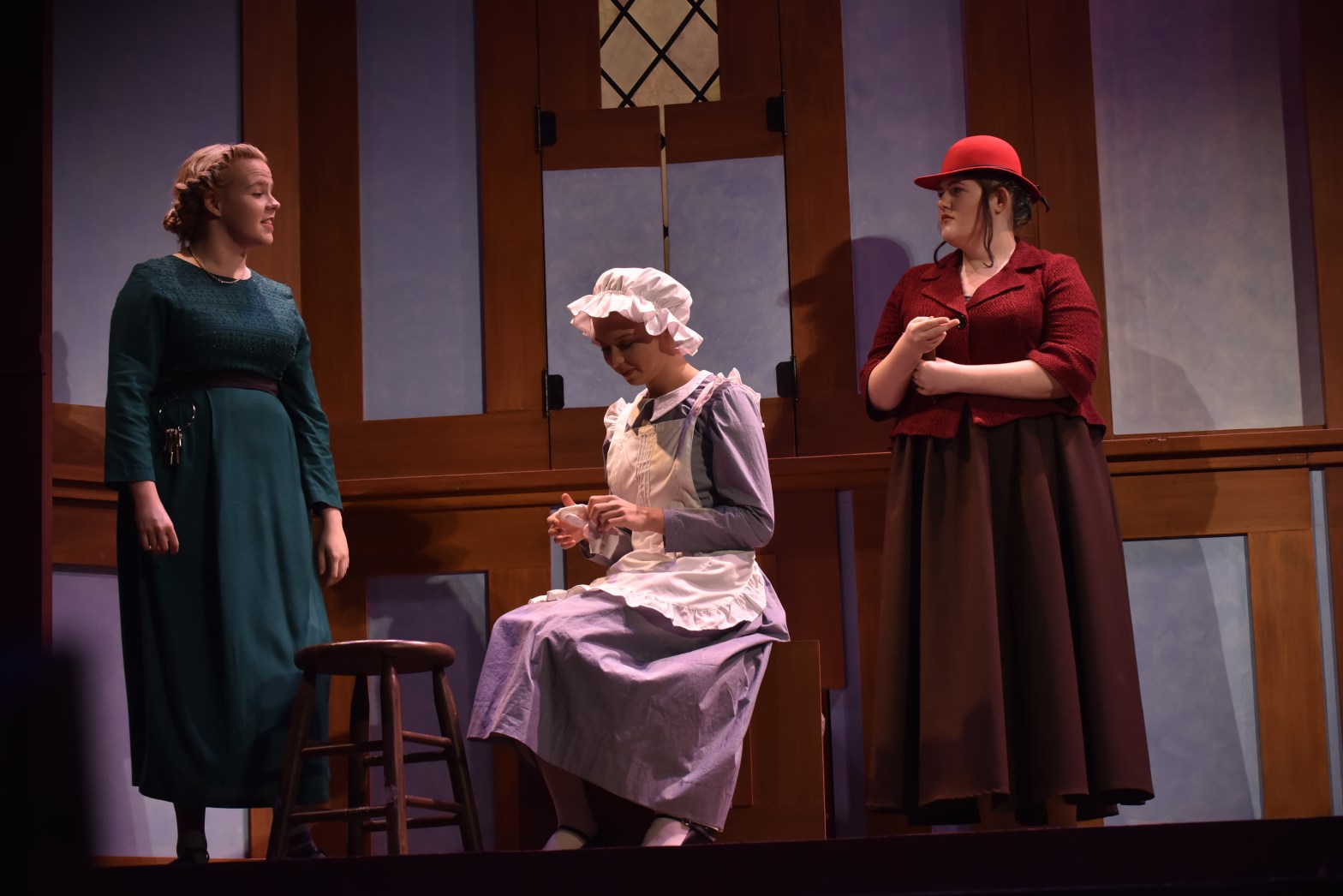
It can take a little time for the players and audience to learn and appreciate the resulting traffic patterns and staging “rules” but this approach to story and world building can result in pleasantly atypical results as your characters can now reap the benefits of a more dynamic and changing set. In addition to using this device as is, I’ve also woven it into longer long-form pieces, most recently and notably Upton Abbey: An Improvised Comedy of English Manors. Here, actors alternated leading the audience and each other through pre-designed rooms and hallways in an early twentieth century English estate (with considerable assistance from a set crew and improvising technicians and stage management). I know some less improv-savvy audience members didn’t immediately understand the conceit – especially as characters circled around a central staircase to facilitate changing floors – but it was a helpful solution for meeting a sizeable cast while also introducing key settings.
Cheers, David Charles.
www.improvdr.com
Join my Facebook group here.
Photo Credit: Tony Firriolo
© 2025 David Charles/ImprovDr
Game Library Expansion Pack I


Interesting
LikeLike