Game Library: “Chain Murder Endowment”

This short-form classic embodies the central device of the childhood game of telephone, but here information potentially becomes warped and misunderstood as it passes from one improviser to another in front of an audience that is all delightfully in the know.

The Basics

I prefer this game with four players (so that you get a total of three discrete vignettes). If time is too tight, a cast of three can prove workable as well. One player (A) remains in the theatre while their teammates leave the space so they can’t hear. Player A gathers three random and unconnected elements – a location, occupation, and prop. These suggestions combine to form the features of a crime, with the prop now becoming an unlikely weapon of sorts. Player B returns to the stage, and a scene is played in which Player A must endow the obtained elements, while both players only use gibberish and body language. When the incoming player believes they know the selected components, they perform the crime in the pertinent location, against their scene partner (who represents the occupation), and with the peculiar choice of weapon. The victim dies dramatically and then strikes silently to the side of the stage, as the next potential criminal enters the theatre with Player B now serving as the gibberish clue-giving partner for Player C. When four players are used, the process then repeats one last time for Player C and D.

Example

Player A obtains “pyramids of Giza,’ “phlebotomist,” and “slinky,” as the elements before the absent Player B returns.

Player A: (welcoming their teammate while wiping away the sweat from their brow) “Shiminy popo!”

Player B, intuiting that they might be in a dense jungle or similar, starts slashing through imaginary scrub.

Player B: “Fashega taneeka jay.”

Player A nods in agreement that it has been hard going before kindly removing the machete from their partner’s hand and gesturing towards their new mode of transportation while offering them a leg up.

Player B: (with excitement) “Kaneep sha a nay-nay!”

Player A: (gently correcting the horse assumption while miming fastening the cumbersome saddle over a gigantic hump) “Gah, nay-nay! Shalee paplincha gavine!”

The scene continues with Player B ascending the unspecified creature. After the location becomes clear, Player A suddenly feels the urge to donate blood and starts to communicate as much to their scene partner…

The Focus

Enjoy the party game element but also strive to construct a (probably) simple story that justifies the need and appearance of each component. Avoid devolving into outright charades, or taking on any of the critical of the crime yourself when you are in the endower position (or essentially showing or demonstrating rather than creating the conditions under which the pertinent item would be needed).

Traps and Tips

1.) Know your order. The game will get off to a rocky start if the endower and endowee are on different pages and working at cross purposes. I advise working through the elements in the order they were obtained above – we use the acronym LOW in my current home venue, which stands for location, occupation, and weapon. This also allows you to accumulate the needed pieces of the puzzle in a helpful way onstage, beginning with the largest immovable item and ending with the typically most portable.

2.) Give clear feedback. All endowment games have to walk the tenuous path of accepting ideas the endowee offers up and sending unequivocal signals when a choice is wildly off base. Whenever possible, the endower (Player A) should acknowledge the endowee’s intent even if they then quickly move on – putting aside the machete or laughing that their friend has mistaken a camel for a horse! Inversely, don’t be needlessly opaque when the guesser is on the right track, or they might accidentally throw out the good with the bad. Similarly, if the endowee has all the needed information (or is as close as they’ll get in the time limit), joyfully invite the playful murderous climax of the vignette.

3.) Exploit your gibberish. While most would consider it poor form for the improviser who is in possession of the missing informative to fudge their gibberish to include known words or sounds, it’s a common tactic for the endowee to judiciously utilize creative signs to confirm their suspicions. In this way, “nay-nay” is a reasonably transparent approximation of a horse sounding gibberish word (at least for English speakers). If Player A used such a device first (or early in the scene), it would likely feel like a cheat. When such a move comes from the endowee, it can help narrow the focus a little. I wouldn’t advocate using this carelessly or as a default, but it’s a helpful tool if players are becoming unhelpfully stuck.

4.) Reinvent the wheel. Much of the fun of this game, in my opinion, is the chain element that places three scenic attempts in quick succession. While the elements of the crime (as best as they were communicated and understood) should remain the same, players shouldn’t mindlessly repeat their former partner’s tactics. If Player A uses a camel as an entry point to the pyramids, Player B should ideally begin somewhere else. In the worst-case scenario, players can recycle earlier clues when they find themselves at a dead end, but the audience enjoys the challenge of seeing new takes on a common problem.

5.) Sell the ending. Enjoy the silly deaths that punctuate each round (this also reduces the potential for ickiness, especially when the elements are wonderfully ludicrous). The game usually culminates with the players forming a line on the lip of the stage and the host beginning with the final criminal (our as yet unseen Player D in my example) and reviewing the understood facts of the crime. (It can be fun to coach the audience to provide loud “noes” or similar for each incorrect assumption). The host can then travel back through the line as needed until the desired answer emerges – even if this might mean returning all the way to the source, Player A! If you’re playing in a competitive show, this recap can occur before or after the scores are obtained. I like getting scores prior to the review as the overall enjoyment and quality of the scene often have little to do with its success, and there can be a nice bump in audience energy immediately after the last murder which can serve as a helpful throw to the scores.

In Performance

It’s admittedly a risk, but I’ve enjoyed weaving an audience volunteer into the chain. Typically, Player C (the second endowee) provides a strong position as this requires the volunteer to both receive and then give clues. Such a position also grants them a little time offstage with a (hopefully) confident improviser who can walk the guest through the basics, such as using the LOW acronym described above.

Cheers, David Charles.
www.improvdr.com
Join my Facebook group here.
Photo Credit: James Berkley
© 2023 David Charles/ImprovDr

Game Library Expansion Pack I

Game Library: “Can I Talk to You for a Second?”

A delightful modern twist on the classic tradition of asides, Can I Talk to You for a Second offers characters a playful and highly theatrical device for creating mischief.

The Basics

During the course of a suggestion-inspired improv scene, players may self-select to pull another to the side of the action for a private “talking to” by using the titular phrase in a typically high-pitched cadence. Once the unsolicited advice has been proffered, players return to the scene in progress.

Example

Players explore the scenic promise of a 20th wedding anniversary. Player A assumes the role of one of the celebrants as the lights rise and is in the middle of an impassioned speech.

Player A: “… and I didn’t believe the poets when they said that you could grow to love someone even more with each passing day. But as I look now at my amazing spouse of 20 years, I will happily admit that the pessimist of my youth was wrong.” (Raising a glass) “So, I’d like you all to join me in a toast to…”

Player B: (who has been standing beside the speaker all this time, and in a quiet bit high intoned voice) “Can I talk to you for a second?”

Player A: “Of course, sweetie. If you’ll all hold that thought for a moment…”

Player A and B step to the side for their private exchange.

Player B: (in hushed tones) “You promised me you weren’t going to drink tonight. You know how you get with a few wines in you…”

Player A: “And that’s why I explicitly told the bartender to serve me sparkling grape juice for the whole evening, darling.”

Player B: “I’m so sorry. I shouldn’t have doubted you…”

Player A: “I know you only want the best for me, for us… May I continue with my speech?”

Player B: “Of course. Forgive me.”

Player A returns to their prior position and raises their glass.

Player A: “So I’d like to toast my better half who always has my back!” (They raise their glass and drink as the guests do the same.)

A nervous looking member of the wait staff, Player C, approaches the jubilant speaker.

Player C: “I’m terribly sorry to interrupt, but…” (Their pitch rises) “…can I talk to you for a second?”

The new pairing crosses to the edge of the performance space.

Player A: (confidentially) “How can I help you?”

Player C: “Well, I just learnt from my manager that all those refills I’ve been giving you tonight should have been…”

The Focus

Capitalize on the fun shifts in tone and staging and keep an eye (and ear) out for games lurking in the secretive asides.

Traps and Tips

1.) Build your world. It’s easier and more effective to introduce the novel device after the audience understands the basic premise of the scene, so put your energy there first. Once strong and grounded relationships have been established, you’ll have more to playfully upend and tilt. (I’ve needed to leap ahead in my example a little to showcase the unique dynamic in play.)

2.) Pace your ruptures. The frequency of the asides tends to escalate on its own, so exert patience initially as you familiarize the audience with the conceit. It’s not unusual for the scene to end in a volley of sidebars, so avoid the temptation to start with this level of aggressiveness.

3.) Give big gifts. There is a revelatory function to the private chats, so be cautious of entering into these moments without the intent or energy needed to shake up the apple cart a little. If the asides become too mundane or momentum sapping, they’ll do the scene more harm than good. If in doubt, explore the possibility of a good old-fashioned CAD.

4.) Listen to everything. As is the case with most improv games that involve some element of secrecy, it’s critical that players hear everything even as each whispered aside goes unnoticed by their characters. In this way, games can be discovered and built upon, as I’ve endeavored to model with the wait staff member adding to Player A’s revelation about the sparkling grape juice (although I’d recommend exerting more patience than my example allowed).

In Performance

I love the stylistic silliness of the almost whining phrase and veneer of politeness leading into increasingly searing or blunt adjustments and critiques. Don’t feel the need to mask or hide the launching phrase as it becomes such a joyful and predictable catchphrase for the scene.

Most of my tips for Asides (found here) also apply to this variant.

Cheers, David Charles.
www.improvdr.com
Join my Facebook group here.
Photo Credit: Mariah Clinkscales
© 2023 David Charles/ImprovDr

Game Library Expansion Pack I

Game Library: “Blind Freeze Tag”

A simple but helpful variation on a short-form improv classic…

The Basics

Players form a line at the back or side of the stage – the first person (stage right typically) stands so that they are facing away from the playing space. Two improvisers begin a scene based on an audience prompt. When they have established a clear scene and find themselves in a suitably dynamic pose, a fellow observing player (or perhaps the host or instructor) calls out “Freeze,” and the players do so. The improviser who was unable to see the scene turns around and enters the playing field, tagging out one of the current characters so they can assume that exact position which they use to inspire a brand-new scene. The back line shuffles with the newly released improviser joining one end (usually stage left), and the player on the other turning around so they can’t see the new action.

Example

Player A and B volunteer to play first while Player C faces away in the back line. The first scene finds inspiration from “boating.”

Player A: (holding out their hand to assist Player B) “The river is a little choppier than I expected.”

Player B: (carefully stepping into the raft) “I’m sure it’s nothing, sweetie. I can’t wait to check ‘white water rafting’ off our bucket list! Hand me my paddle…”

Player A turns to do so as B mimes the raft slowly drifting into the rising river. They raise their hands in a panic.

Player A: “Um, honey…”

Player D: “Freeze.”

Player A and B hold their poses as C spins around and quickly tags A out so they can assume that exact position with their hands nervously raised. Player A strikes to the back line while B holds onto their own position facing towards the floor.

Player C: (after a moment of squirming) “I’ve told you I don’t know the combination to the safe.”

Player B: (their intended oar transforms into a floor panel) “I know where you keep your money – I’ve been scouting out this video game store for months…”

Player C: “Then you should know only the owner opens the safe. She doesn’t trust me with the combination.”

Player C slowly lowers their hand to trigger a panic switch as Player B fumbles uselessly with the safe dial.

Player E: “Freeze.”

The Focus

Committing to clear specifics and quickly justifying peculiar poses provide the lifeblood of all freeze tag games.

Traps and Tips

1.) Enter quickly. Players on deck should move to the stage as swiftly as they’re able when the “freeze” is announced. The game will quickly lose steam and playfulness if each transition becomes needlessly laborious. Usually, one pose will immediately feel richer or more dynamic than the other, so trust your first instinct and don’t waste time assessing your options as this will grind everything to a halt.

2.) Freeze bravely. Players who are able to see the playing field should actively look for promising new stage pictures and relationships and grab these moments for each new “freeze” call. My example errs on the side of shorter vignettes, and it’s good form to allow the first few scenes some space to develop. But as you construct your fourth, fifth, and sixth scenes, the game should become jauntier. Be wary of lethargic calls deflating the momentum.

3.) Pose resolutely. When you are caught by a “freeze,” strive to maintain all the physical, facial, and emotional details of your position. If you inadvertently relax into a more generic pose, you’re robbing the incoming player of vital and inspiring information. Similarly, as you assume a previous position, pay attention to the minutiae as much as you can during such a quick transition. Smudging gestures or ignoring notable choices, such as the line of sight or an emotional quality, will lower the stakes in an unhelpful way.

4.) Justify specifically. Similarly, the more nuanced you can make your justifications, the better. These details are often cumulative and represent the concerted efforts of both players, so don’t feel the need to just voluminously spew a disconnected diatribe. But when our robbery becomes located in a video game store, with an in-the-floor safe and an absent owner, the scene transcends the initial germ of an idea of a generic hold up. It’s good form for the new (entering) player to get the first crack at defining the altered reality, but when both players then polish that initial idea through the lens of their current physicality, the scenes quickly take on a glossier sheen.

See Conducted Freeze Tag here for additional pointers.

In Performance

As an improv mainstay, freeze games can feel trite or overdone when they become safe or a mechanism for recycling old bits and jokes. Challenge yourself to play every scene (and the game as a whole) with the joyful attack and abandon of a neophyte.

Cheers, David Charles.
www.improvdr.com
Join my Facebook group here.
Photo Credit: James Berkley
© 2023 David Charles/ImprovDr

Game Library Expansion Pack I

Game Library: “Big Game”

This exercise pushes players to the limits of their physical abilities.

The Basics

Players scatter through the available space and claim an area as their individual stage. If you’re workshopping in a smaller room or theatre, improvisers can work in pairs with one person performing the activity for the other. (There is also an inherent value in everyone having a little audience to enjoy the process and offer up some feedback at its conclusion.) Improvisers self-select an everyday activity – such as washing the dishes, brushing their teeth, or wrapping a present – and, upon the facilitator’s signal, patiently mime their action for a minute or so. The facilitator then gradually increases the size of the objects involved, and the task is repeated until the objects have become absurdly unwieldy.

Example

Player A (partnered with Player B) mimes brushing their teeth with a typical-sized toothbrush, tube of toothpaste, sink, and faucet.

The caller increases the object size by 100%, so now the toothbrush more closely resembles a hairbrush, and the toothpaste a rolling pin. Player A endeavors to brush their teeth again.

Objects grow again. Now the toothbrush is approximately the size of a cricket bat… the activity is repeated.

The objects expand once more so that Player A must manipulate an oar-sized brush and tube that evokes a rolled up carpet…

When the objects have become truly enormous, Player A and B exchange roles, and B undergoes a similar process with their own action.

The Focus

Commit to the escalatingly absurd conditions. In the above example, it’s foreseeable that Player A will need to brush their teeth across the huge brush when it becomes too heavy to lift or move.

Traps and Tips

1.) Explore weight. As each object grows, make sure you are appropriately increasing its weight and adjusting your efforts accordingly. A hairbrush doesn’t weigh that much more than a toothbrush, but a cricket bat certainly does.

2.) Explore mass. Similarly, consider how each object’s inflating size necessitates your own physical choices and approaches. Keep the features of each item specific and nuanced. How do you need to grab and operate an oversized faucet? Does this require an entirely new strategy than a mere flip of the wrist?

3.) Explore energy. Exertion should increase alongside the size of the objects, so be wary of meandering through each reenactment without a proportionate change in your attack and energy. Squeezing a toothpaste tube is a rather simple affair for most of us under normal conditions; when the tube becomes the length and thickness of a rolled up carpet, a gentle push won’t do the trick and needs to become a full-bodied action.

4.) Explore creativity. While I tend to teach this game in classes with a physical focus, I’m always reminded that the results can unlock delightful playfulness, imaginative problem-solving, and engaging silent stories. When you add character, point of view, and emotion, the scene can become something surprisingly pleasing.

In Performance

Although I love the idea of crafting scenes in almost alien landscapes with enormous, mimed props, you probably won’t stumble into this opportunity often. However, most scenes can benefit handsomely from the increased attention to prop construction that this big little game fosters.

Cheers, David Charles.
www.improvdr.com
Join my Facebook group here.
Photo Credit: Scott Cook
© 2023 David Charles/ImprovDr

Game Library Expansion Pack I

Game Library: “Beyond Words”

Subtext, physicality, and high stakes all provide essential ingredients for this emotionally powerful exploration.

The Basics

The climax of each of these variants consists of a similar dynamic – players performing a tense or rich relationship in silence. These three different launches, however, offer contrasting energies and frames.

Variation One: Players (typically a pair) obtain a scenic ask-for, and a scene is improvised without any dialogue at all from beginning to end.

Variation Two: Players (often a pair) are provided with an inspirational theme or word. The team is provided time for a quick brainstorming session (about a minute) and roughly decides upon a CROW that would support a highly emotional encounter. A silent scene uses this information as its foundation.

Variation Three: Players (perhaps a pair) elicit an ask-for and begin an improvised scene in the usual fashion. When the dramatic action reaches a zenith, a caller rings a bell, and the remainder of the scene continues in silence.

Example

Half of a separated couple, Player A, waits anxiously on a train platform, looking intensely at each face in the passing windows of the slowing cabins only to be met by one stranger after another. There is a sense of hopelessness as the train finally pulls to a stop, and Player A has to navigate a sea of arriving bodies. Just when the train seems to have emptied, a figure, Player B, appears on the platform behind Player A, holding a duffle bag heavily over their tired shoulder. As B recognizes their lover’s silhouette, Player A finally turns. Neither character has the words to describe their relief or love; Player B drops their bag and steps slowly forward until the couple embraces, at last.

The Focus

All three variants clearly demand a heightened sense of physicality and commitment to patient specificity; this scene also necessitates crafting emotionally evocative material and scenic arcs that simultaneously justify and earn the profound silence.

Traps and Tips

1.) Avoid insincerity. The silence restriction can push players to a broad and demonstrative style of play that can lose all subtlety and sense of realism. There can certainly be a value in exploring highly stylized scenes, but the challenge of this format resides in its commitment to honest and powerful emotions.

2.) Avoid approximating. Give each moment full attention, especially in the rising action, as if you gloss over choices in pursuit of that “big ending,” you’ll likely undermine the journey as a whole. These scenes invite a little luxuriating so that one specific detail can naturally evolve into the next even more intense detail.

3.) Avoid rushing. Speaking of luxuriating, especially if you’re unaccustomed or uncomfortable with a more body-centric style of play, there can be a temptation to forge ahead regardless of the potential of the here and now. Perhaps it’s a little predictable that our couple will reunite on the train platform, but it’s the artful suspension and complication of this climax that elevates the encounter to a scenario worthy of being beyond words.

In Performance

As is the case with most subtextual games of this ilk, while players should avoid dialogue, strategic utterances – a gasp, sigh, cough – are fair game. Just be cautious that such choices are building suspense and energy rather than diffusing it. I personally use the first two variants most frequently in the improv lab as they can unlock a powerful and emotionally vulnerable style of play. While the third variant is perhaps the most “audience friendly,” it can easily morph into a Scene Ending in Slow Motion, which is a fine game in its own right, but tends to encourage a broader and more comical performance.

Cheers, David Charles.
www.improvdr.com
Join my Facebook group here.
Photo Credit: Tony Firriolo
© 2023 David Charles/ImprovDr

Game Library Expansion Pack I

Game Library: “Be A…”

Here’s a fun icebreaker warm-up that requires players to work together quickly and quietly.

The Basics

Step One:

Invite the ensemble to work through the rehearsal area, striving to fill in any empty spaces and while walking an unpredictable pattern. Once the group is sufficiently shuffled, the instructor or facilitator calls out a number, and players are instructed to quickly shuffle into groups of the designated size (or as close approximations as mathematically feasible).

Step Two:

Groups are assigned an object that they must collectively sculpt with their combined bodies while working in silence. In this manner, players might be instructed to quickly “Be a… washing machine,” or “great oak,” or “table place setting…” The group facilitator might also provide a clear time restriction to further heighten the stakes.

Step Three:

Each tableau is briefly viewed by the remainder of the group (perhaps with a little lighthearted feedback to acknowledge finesses or refocus the intent of the exercise). Once all the images have been briefly celebrated, players are instructed to break their groups and walk randomly through the space again, and the process repeats.

The Focus

Keep your attention on the process of creation rather than the results. A finely etched image that was essentially dictated by one over-eager participant is less laudable than a clumsier tableau forged by brave individuals all contributing a connected idea.

Traps and Tips

1.) Look out for cliques. Especially (but not exclusively) if you’re working with younger players, the wandering phase can devolve into friend groups clumping and moving together to make sure they won’t become separated – especially once everyone learns the basics of the exercise. Encourage independent and varied movement patterns. Similarly, it’s important that no one feels excluded when numbers are announced, and groups are formed. If you’re not blessed with an easily divisible number, remind players that groups need only be approximate and to actively seek out new player combinations. If you’re able to do the math and offer “groups of five, and one group of six…,” that can help too.

2.) Look out for individuals. Players should actively work together to form the various elements of the named object. So, if a washing machine is offered as inspiration for groups of four, each group shouldn’t consist of four unique and independent renditions but rather one (likely imperfect) conglomeration. In some instances, such as the place setting, players might create isolated elements – one player is a spoon, another is a knife…. As a caller, I prefer using items that require a more robust sense of connected collaboration as it tends to invite players to get a little more into their bodies and out of their heads.

3.) Look out for (well-intended) directors. It’s useful to remind participants that the construction process should occur in silence. Ideally, this will discourage particularly excited players from accidentally dominating the process by telling their peers what to do (although this can still certainly happen in silence as well). Players should confidently make and adjust their own bold choices, but this should not be at the expense of other’s agency as well. If you know the short-form game Machines, this exercise offers a helpful template in that each player builds onto a first choice gradually one at a time until the final image is completed.

4.) Look out for too much feedback. I really enjoy the third step of viewing everyone’s creations, but be wary that this doesn’t needlessly bog down the momentum or introduce an overly critical energy that scrutinizes minutiae. I tend to use this moment to acknowledge particularly playful or unexpected choices, or to increase the boundaries or potentials of the game. For example, if everything defaults to a flat, almost 2D, portrayal on the floor, I might nudge that different staging planes or configurations can be used as well. Regardless, this stage should generally be filled with laughter and joy.

In Performance

If you’re using this exercise as an early warmup, I’ve found four or five creations will usually suffice before the novelty stays to wear off a little or players start becoming needlessly clever in an effort to keep the exercise engaging. This desire to reinvent the game works against its rather simple but elegant goals a little.

Cheers, David Charles.
www.improvdr.com
Join my Facebook group here.
Photo Credit: Tony Firriolo
© 2023 David Charles/ImprovDr

Game Library Expansion Pack I

Game Library: “Balladeer”

I first encountered this game at Sak Comedy Lab, where it quickly became a personal favorite. It combines narrative, rhyming, and music, which are three improv tools that provide particular joy.

The Basics

One player (A) assumes the role of a medieval balladeer (think strolling minstrel or troubadour) with a pantomimed or approximation of a lute (we use an unstringed prop guitar). They sing verses of a narrative song that are then enacted and enriched by the remaining members of their merry troupe. As an homage to Chaucer, I enjoy eliciting the inspiration in the form of “The Tale of the Blanky Blank,” with the audience providing the missing adjective and type of person. If you’re familiar with the short-form game Typewriter, the mechanics are similar, only now the intermittent narrative is sung and tends to be more uniform in length and structure.

Example

The improvising musician provides a suitable play in as Player A pretends to create the music on their lute. The remaining members of the team wait in the wings but quickly step onto the stage as characters are introduced in the unfolding song based on the suggestion of “The Tale of the Lonely Farmer.”

Player A: (singing)

“Oh, gather round fair peasants all, a tale here I must tell
Concerning a sad farmer, all alone on a poor dell.
Her heart was barren, like her land, where naught took root and grew.
She sat this day, like those before, a-stirring her sour stew… a-stirring her sour stew. “

Player B enters during the first couplet. As the lights transition, the actor bemoans loudly into the universe.

Player B: “Oh, cruel world, what sin have I committed to warrant your angry indifference? Do I not faithfully toil on your land and tend your creatures? And yet you reward my efforts with famine and drought.”

Player C crawls on as the farmer’s loyal but equally distraught sheep dog. Player B lovingly greets the creature.

Player B: “I am afraid there is little more than a potato and rock in our pot tonight, dear friend, but I will share all that I have with you.”

Player B spoons out some of the modest meal as the music restarts and the lights return to the balladeer…

Player A: (singing)

“And so the farmer and her dog eat scraps in that sad place.
A watching angel saw their plight and changed that sweet dog’s face…”

The Focus

Avoid leaving heavily on gimmicks or shtick, and you’ll find this elegant structure actually enables compelling parables and narratives.

Traps and Tips

1.) For the musician. Think of the musical interludes as verses of the same song as opposed to individual and unique songs in their own right. This provides a level of predictability for the troubadour once a template has been established, which is helpful as the singer has a lot of lyrical machinating to juggle. That being said, there is still ample room to play: each verse could gradually modulate up from the prior, or gently increase in tempo, or feature new stylistic embellishments. And it could be a fun conceit to feature a bridge feel in a later offering if the scene is assuming a more sizeable length. After the initial verse, which might invite a more robust introduction to establish the mood and form, strive to launch into future interludes concisely so that the scene doesn’t lose steam every time it transitions back to the song. (Generally, I’d advise against underscoring the scenic pieces, but with clear dynamic shifts, this can add color and enable elegant transitive from dialogue to song.)

2.) For the balladeer. Just as it’s helpful for the musician to find and set a feel and structure, endeavor to honor your own initial melody and rhyme scheme. In addition to giving the song a more polished feel, it gives your fellow players a clear signal when the action is about to recommence. Target rhyming serves the game well, especially in your second couplet (if you follow the four-line verse structure illustrated above). While you’ll want your first verse to squarely focus on the audience’s suggested character or premise, I find it helpful to avoid the actual elicited words (“lonely” and “farmer”) in rhyming positions, so you have those in your pocket for the final button. It’s perhaps unavoidable that some mental energy will be expended on formulating couplets, but make sure you’re really watching the scenes so that you don’t miss or ignore rich offers (such as the arrival of the dog). Accept as much as you endow.

3.) For the players. Leap into the action. It’s a helpful device to preset and begin (in pantomime) as each verse is sung so that the moment focus is given, the enactment can spring to life. While it’s certainly good form to begin by honoring the balladeer’s choices, physicalizing and heightening the sung plot points, as in any narrated game, don’t be afraid of deliberately moving beyond the stated knowns and discovering your own inherent next step. In this manner, Player C need not wait to be introduced as a dog before bringing this helpful next step to the stage. If you’re playing this game in a short-form setting, there isn’t a lot of time for each vignette to find its footing, so be deliberate and disciplined: one or two strongly embodied choices will serve better (as always) than a scattershot of numerous half-baked ideas that will likely overwhelm the narrator who will be looking for an obvious and connected next step to sing about.

4.) For the team. Generally, the scene consists of four or five sung verses between three or four brief scenes, with song introducing and buttoning the scene as a whole. Subsequently, it’s helpful to think of each small scene as fulfilling one essential plot element. Whether you prefer the language of introduction, problem, solution, and resolution (as modeled in Four Sentence Story), or balance, ignition, rising action, climax, and denouement, you’ll find it incredibly helpful to keep some sense of greater structure in mind. This helps pace the narrative arc, ensures players aren’t working at cross purposes, and keeps the story helpfully marching forward. When the scenes meander or merely comment upon the verses (rather than bravely build upon them), the whole affair can become a little tepid. The scene needn’t end in song, but this often gives an opportunity to provide a nice moral to the story, which feels very in keeping with the base material, and if you can end on some variation of the story’s title, that’s a great finesse too.

In Performance

This form could easily become expanded into a lengthier affair (or provide the impetus for a more complex long-form). It’s likely that the material will include some modern satirical winks or commentary, but I’d generally advise against making the content of the scene itself modern (unless this is serving some greater artistic end). There’s something innately delightful about embracing the historical tone and language that makes this game stand apart from other offerings in the musical improv canon.

Cheers, David Charles.
www.improvdr.com
Join my Facebook group here.
Photo Credit: Leesa Brown
© 2023 David Charles/ImprovDr

Game Library Expansion Pack I

Game Library: “Backwards Interview”

Not for the faint of heart or easily discombobulated, Backwards Interview demands a rarefied level of joyous reverse engineering.

The Basics

Improvisers begin an interview scene at its conclusion and rewind it beat by beat until it reaches an organic beginning, which also delightfully serves as the scene’s final moment.

Example

Player D: (stepping out from behind the studio camera) “Good show, everyone. And we’re clear.”

Player A: (turning to the studio audience) “I hope to see you again next week on That’s All You Need to Know. And that’s all we have time for tonight.

Player B: (shaking A’s hand rigorously) “The pleasure has been all mine.”

Player A: “It’s really been an honor finally getting to meet one of my culinary heroes.”

Player B: “Hopefully, you’ll get that pancake out of the lighting grid later.”

Player C wheels off a model kitchen bench as A and B stand and finish their demonstration. Player D flashes a “wrap other up” signal. Player A mimes catching a pancake in their flung frying pan.

Player A: “I’m not too confident about my technique, but here goes…”

The Focus

Small steps are key, especially those that firmly and clearly connect to what has just transpired. That being said, keep in mind that the scene essentially begins at the climax, so it’s useful to start with a major outcome or energy and then slowly make your way back from there.

Traps and Tips

1.) Think sentences, not paragraphs. Each choice should carry the weight of one beat in the story arc, whether this is a physical reaction, a piece of staging, or a line of dialogue. Just as you wouldn’t consider an epic fight as one moment but rather a closely connected series of escalating parlays, the same strategy applies to your words. If your character dramatically needs a monologue, be sure you start it at the bottom of the page and then work your way up one line at a time. This keeps the structure cleaner and enables smaller discoveries (and reactions from your scene partners) along the way.

2.) Think contained (at least initially). Unless you’re one of the handful of improvisers whose minds “just get” this generally torturous dynamic, it’s wise to keep the action focused. I like the interview format for this reason as it offers a comparatively digestible template of questions and answers – although these are now answers and then questions! If you tend to play in larger teams or ensembles, those not occupying the roles of expert and interviewer can contribute meaningfully in ancillary positions so as not to accidentally overwhelm or clutter the action. There’s no going backward (forward?) to justify dropped offers, so be wary of overloading the storyline. Speaking of questions and justifying, if the expert always provides answers as their verbal contribution, the interviewer will end up doing nearly all the justifying, so look for ways to playfully invert and complicate this basic pattern once you have a sense of the dynamic at play.

3.) Think movement as well. As difficult as the dialogue can feel, many improvisers really struggle (at least initially) with the physical component of the game. Give each stage direction its full value in the story progression (regression) and break these choices down into bite-sized pieces, too. A seemingly obvious tip is that characters will typically walk backwards for the duration of the scene, and any major action will need to be broken down into its constituent elements. So, if we know a pancake is eventually lost in the rafters, the team needs to gradually click back from that destination: cooking the batter in the pan, pouring in the pancake mix, melting butter in the pan, turning on the stovetop…

4.) Think emotion. Without any emotion, subtext, or strong character points of view, the scene will quickly devolve into a rather heady party game. Just as it’s useful to leap to a climactic action to close (start) the interview, it’s equally powerful to have a strong deal as your character. It’s a little odd to think about a status or emotion tilt in reverse, but in essence, there’s little difference: change is the common denominator. If our interviewer ends the exchange embarrassed after their terrible pancake effort, now we can slowly build to that, and perhaps the scene commences with a braggadocios vibe that magnifies the comeuppance in a pleasing way.

5.) Think about rehearsing. Obviously, part of the joy of this game is undeniably the struggle, but without a little previous unpacking and exploring, the scene will likely amount to little else than messiness. Some companies have rehearsals more deliberately and frequently built into their culture than others, but this game really benefits from some good old-fashioned drills. Be careful that this doesn’t become practicing “bits” to later recycle into the public performances but rather focuses on developing an agreed upon understanding of how time functions and the ramifications of this new directional flow. Sure, glorious mistakes will still occur on stage, but now (hopefully) they’ll be helpfully contextualized with a sense of how the scene “should” have honored the rules.

In Performance

There is a lifetime of challenge awaiting in this base model, so I reluctantly offer two potential overlays (and, in all cases, recommend setting the players up for joy and going out on a high, even if that high isn’t as high as you’d ideally like). If the team is on fire, there is something remarkable about them immediately running the scene forward after successfully reaching the first line of the interview. And, if the warped logic of this dynamic starts to make eerie sense, you can dispose of the interview concept entirely and just make it a Backwards Scene, a game that I very much love… in theory.

Cheers, David Charles.
www.improvdr.com
Join my Facebook group here.
Photo Credit: Tony Firriolo
© 2023 David Charles/ImprovDr

Game Library Expansion Pack I
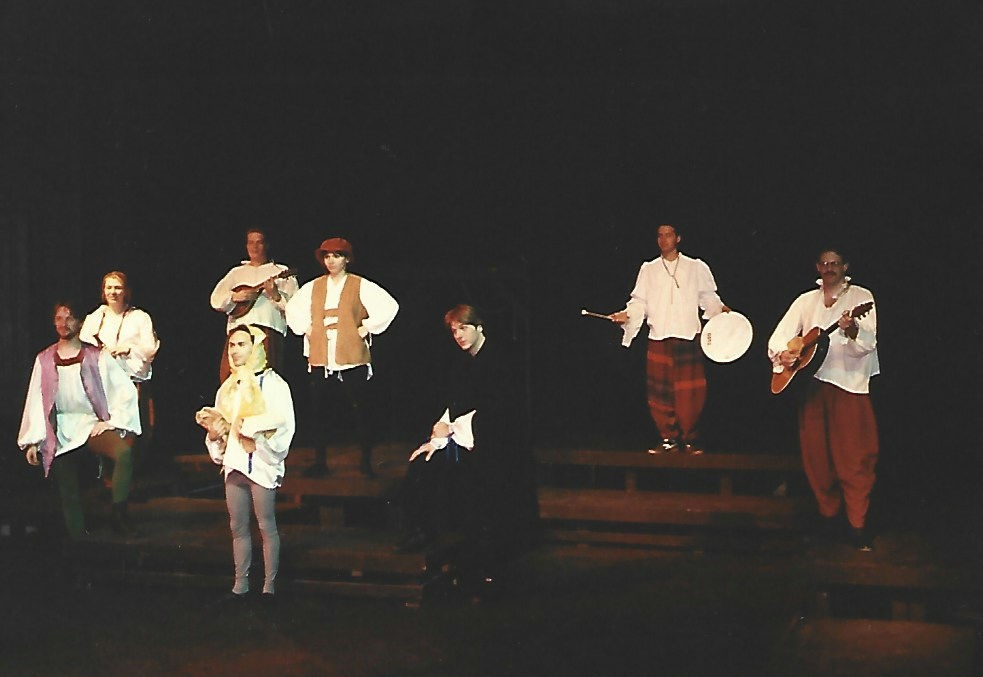
Game Library: “Audience Sound Effects”

Give your Foley artist or sound technician a break with this highly interactive structure that places one or more audience members in the hot seat.

The Basics

Variation One: An individual audience member is selected (perhaps through a brief audition process – see below). A suitable location or premise is obtained, and the volunteer provides both solicited and unsolicited sound effects that must then be incorporated and justified by the onstage players as they construct a scene. This variant strongly benefits from the use of a microphone and suitable sound system.

Variation Two: The entire audience is invited to provide the necessary sound effects for the improvised action, responding to clear cues and offers from the stage (and also, likely, introducing some of their own mayhem along the way).

Example

Player A hails a taxi from a street corner as Player B quickly assembles four chairs for the purpose, and the lights rise.

Player A: (calling) “Taxi!”

Player B slams on their breaks and waits for the audience volunteer who makes a suitable screeching sound. As the taxi driver mimes lowering their window, another noise is offered and acknowledged.

Player B: (leaning out their window) “It’s the end of my shift. Where are you going?”

Player A: (frantically) “I just need to get downtown. I’ll give you a twenty dollar tip.”

Player A retrieves a small coin purse for which the volunteer provides a “click.” Player B reluctantly gestures to the back of their cab.

Player B: “OK. Get in.”

As Player A reaches for the rear door, the volunteer provides a loud police siren instead. Both players take a second to process the choice before Player A, now a bank robber, mimes picking up a heavy duffle bag…

Player A: “There’s plenty more where that twenty came from if you can shake the coppers…”

The Focus

Set the audience up to shine and revel in the justification frenzy and struggle that generally ensues.

Traps and Tips

1.) Model the gimmick. Regardless of which version you’re exploring, it’s beneficial to demonstrate for the audience the give and take you’d ideally like to occur in the scene proper. In version one, a quick audition of two or three audience members can quickly determine who is game and has some basic requisite skills: for some unknown reason, my home venue always asks contenders to demonstrate their best cow sound and then the rest of the crowd selects their favorite. In either version, it’s helpful to offer a few obvious scenic beats prior to the game for the Foley artists to embellish. “If I open a creaky door, it’d sound like this…,” “If my alarm clock wakes me up, it might sound something like this…” Avoid burning your best or cleverest material here, but this strategy gives you a chance to measure the temperature of your new collaborator(s) so that you can adjust your expectations and coaching accordingly. I’d recommend eliciting your ask-for after this demonstration so that you don’t inadvertently use sounds that are likely to be needed later.

2.) Ground yourself. It may be a little unavoidable for the scene to devolve into a bit of a scramble, but this will certainly become the result if the scene starts with one panicked cue for an offstage sound effect after another. A scene that doesn’t begin with calmness and clarity won’t develop these crucial qualities further down the improv road. Endeavor to establish a helpful CROW quickly and efficiently so that you have these anchors to return to as needed. Yes, you don’t want the volunteers to feel superfluous, so you’ll want to invite them to play reasonably swiftly, but this needn’t consist of providing a cartooning string of prompts devoid of any subtext or emotional weight. Pace the game, trusting that greater mischief awaits and will land more triumphantly when it’s patiently earned.

3.) Give a little. It’s a common trap to become so anxious for your offstage collaborators that you might overwhelm them with well-intended but ultimately unhelpful directions. If you’ve made a call for an element with a likely sound, provide enough space for a response, remembering that a lack of a sound is also an offer, even if it isn’t what you might have wanted or expected. It’s difficult to really justify a delightfully unique (or aptly obvious) sound effect if you haven’t given it sufficient room to gestate. Overeager volunteers might require a little judicious editing, but their timid counterparts will generally vanish into the scenery if they feel stomped on in any way. Also, strive to respond to what you actually heard as opposed to what you might have requested or imagined. Much of the justification fun derives from embracing the odd approximation of a cued effect (although be cautious of not just making the scene one long commenting fest).

4.) Give a little more. Finally, remember that you’re not exclusively playing with the Foley volunteer(s). As the predictable and unpredictable offstage noises will usually have a mind and a tempo of their own, make sure you’re sharing the work and joy with your onstage scene partners. If you’ve a more aggressive improviser, it can become a trap to feel the need to always be the character to offer and justify everything, especially if you have an idea at the ready; but, such a style of play will quickly marginalize your teammates. If you’re a less aggressive improviser, make sure you are performing with sufficient stakes and energy so that you are more likely to be reactive and affected. In both instances, it’s good to keep front of mind that justifications need not always be rambling verbal choices but can be an expression, look, or physical adjustment as well.

In Performance

I like both of these variants for different reasons. Version one tends to enable a more reasonably paced and focused scene as you only have to wrangle the instincts of one guest. Version two, alternatively, often invites a little more chaos (and requires more deliberate pitches on the part of the players), but there is also something quite magical about experiencing an entire audience happily playing along.

Cheers, David Charles.
www.improvdr.com
Join my Facebook group here.
Photo Credit: Tony Firriolo
© 2023 David Charles/ImprovDr

Game Library Expansion Pack I
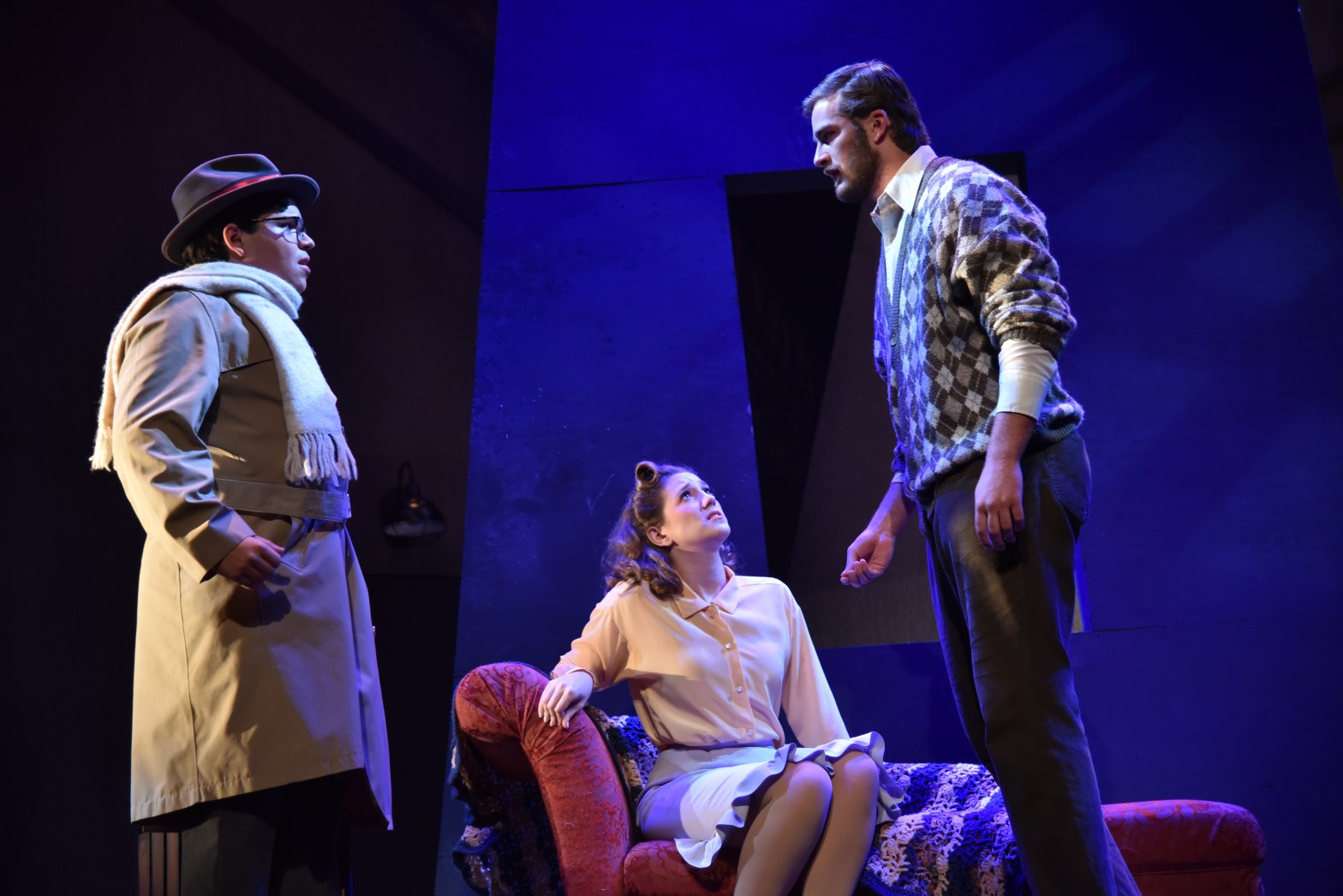
Game Library: “Alliteration”

This exercise provides a great starting point for enriching your language and adding a little style to your improvisational efforts. I’ve also included a more whimsical version below that offers a mind-numbing short-form crowd pleaser. And there’s a variation that can work as a decider too!

The Basics

Each player obtains a different consonant (or, possibly, consonant blend such as “fl,” “ch,” or “st”). For the duration of the scene, players should endeavor to begin as many of their words as possible with their preassigned sound.

Example

The scene takes place in a community garden with players A, B, and C being assigned “B,” “S,” and “Fr,” respectively.

Player A: (digging) “What a beautiful bounty! This is bound to be our best season yet.”

Player B: (carrying a basket to fill) “Sam, you’ve certainly outdone yourself. Such sublime sweetcorn….”

Player A: “Brilliant yellow and blue kernels!”

Player B: “Scrumptious succotash awaits.”

Player C: (entering with indignation) “Friday, friends, we clearly said Friday was when we’d harvest from this fragrant garden…”

The Focus

Don’t let the verbal handle overly stall the scene. Embrace the challenge, but be sure to contribute (physically, emotionally…) even when you’re verbally running dry.

Traps and Tips

1.) Think sounds, not letters. Many consonants produce different sounds depending on their context, so make sure you’re focusing on how they hit the audience’s ear as opposed to how they appear on the page or screen. While Player B is riffing on the “S” sound in the example above, “certainly” fits the charge even though it begins with a “C.” Similarly, although there’s often a better punch when the sound starts a word, you’ll also create the desired effect if the sound begins a syllable as is the case with “yourself.” If you acquire a letter with several possible pronunciations, it’s advisable to ask the audience for a preference to inform the scene: “corrupt city” may look like alliteration, but it won’t strike the ear as such.

2.) Work smart, not hard. Some sounds appear more robustly in the vernacular than others. If you’re fortunate enough to garner a relatively common consonant, it’ll probably serve the scene and your partners for you to take a more featured position. Player C, with the “Fr” blend, will probably struggle a little more than their scene mates, and it’s in the spirit of the game to make them a later entrance accordingly (which may give a little time to brainstorm at least a few verbal options too). The audience will relish some struggle in the game as that’s part of the contract, but if you have literally nothing to say, justify an exit just as you would in any other scene. Or embellish the environment. Or experience a passionate feeling. Just don’t sit on stage lost in your head searching for a word.

3.) Season rather than suffocate. Unlike the more overtly silly variation below, there is no obligation to start every word with your provided letter. I think it’s good form to strive to have the sound appear at least once in each significant speech act as this honors the construct while also keeping the sounds alive in the minds of the audience and fellow players. Sometimes, the brain will inadvertently circle around one or two words in a panic, but be cautious of becoming overly repetitive, especially if you’re not shifting the tone or subtext under the word in question. If in doubt, it can prove a delightful risk to occasionally just start your next sentence with your letter and discover in real-time where this will take you. (Many would argue this is the way to play the game if you want to avoid the trap of retreating into your intellect.)

4.) Remember you’re not alone. The scene won’t get far if every player spends the majority of the action in their own heads running through the alphabet looking for suitable words. Keep your eyes up and focused on the developing action, and don’t forget to listen to, and accept, and heighten the work happening around you. Calm and cognizant players can also do a lot to set teammates up for joy and success. Rather than endow yourself (or another) with a name that begins with your own sound, you could plant a seed for another: if Player A and B name each other Freda and Frank, then they’ve given Player C an easy game for later; Player B entering with the basket (or bucket, or bowl, or banana…) can pitch a helpful element that incorporates A’s designated sound. Look to offer gifts whenever you can.

5.) Or play “Jonathan” style. I’m not sure who Jonathan is or was, but in Jonathan’s Alliteration players must make every word begin with their assigned sound regardless of its original spelling. Player A’s opening line in this iteration would then become: “Bhat ba beautiful bounty! Bis bis bound bo be bour best beason bet.” This creates exactly the type of silliness you’d imagine as every line becomes some form of tongue twister and provides ample opportunities for mischief as words become accidentally (or mindfully) contorted into whimsical approximations of themselves. As opposed to the base game, which can result in rather impressive poetic pontifications when played bravely and with finesse, this variant is likely to quickly cave in on itself in a nonsensical but nonetheless joyful implosion.

In Performance

There are conflicting views as to whether or not vowels are alliterative – I was taught, perhaps erroneously, that this is considered assonance. Regardless of your stance, I find using vowels a little “chewy” as they don’t tend to pack the same punch as a good fricative or plosive. If you are inclined to include vowels in the mix, I’d advise making them an exceptional ask-for (similar to the consonant blend demonstrated above) just so that you increase the likelihood of having at least a couple of characters who can string together something resembling a useful sentence!

There is also a simple line game that goes by this name in which the emcee acquires a letter from the audience that players must use to start a new word upon the host’s signal. When players stall, falter, or are unable to offer a new word, they are eliminated and a new letter is obtained until only one player (or team) remains. This fast-paced exercise serves as a nice warm-up into the more scenic offering described above.

Cheers, David Charles.
www.improvdr.com
Join my Facebook group here.
Photo Credit: Tony Firriolo
© 2023 David Charles/ImprovDr

Game Library Expansion Pack I