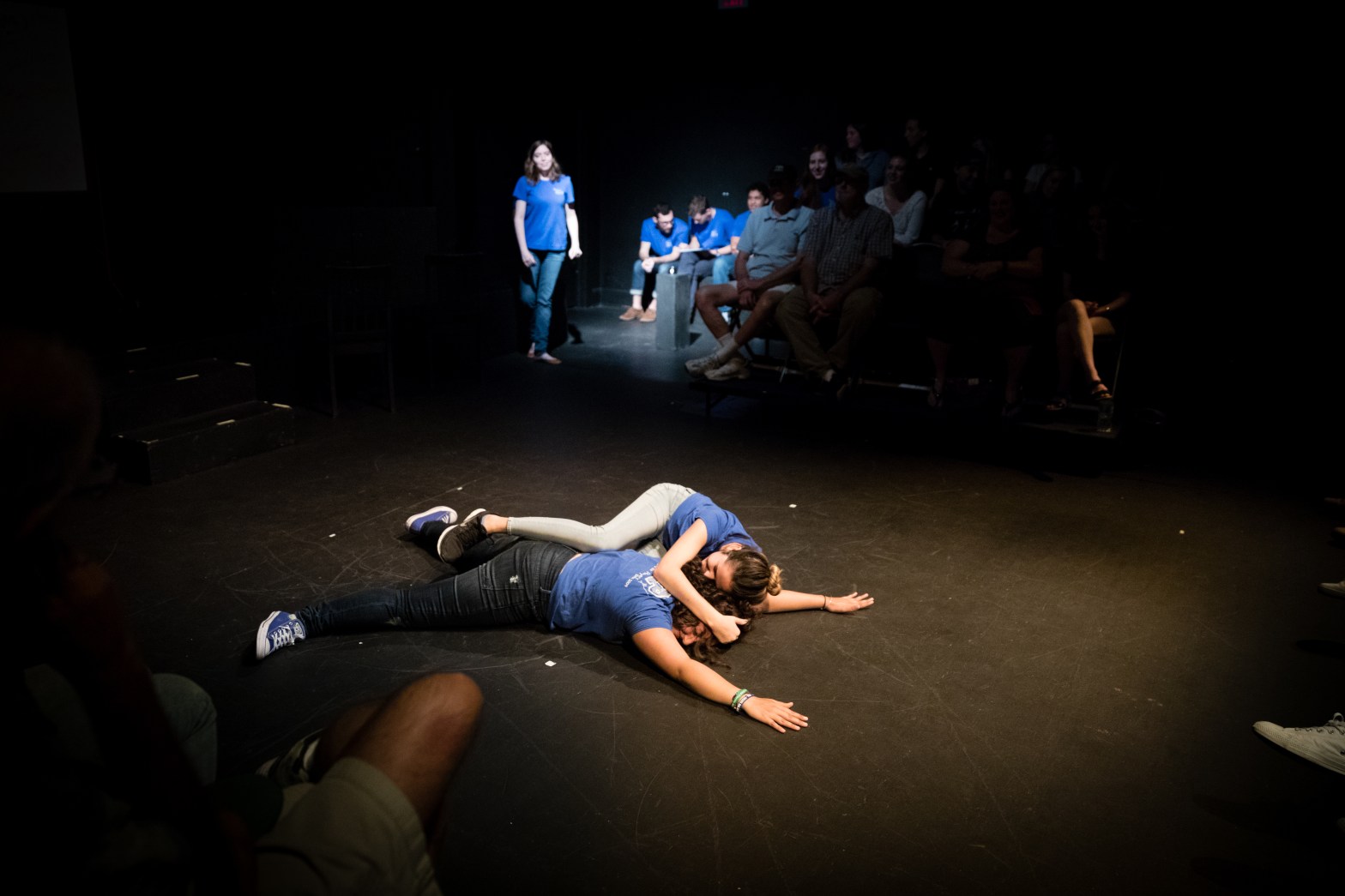
“H” is for “Handle”

A playful addition or overlay that offers a new challenge or point of concentration to the team.

Getting a Handle on Handles

This is just a taste of this entry/concept. Go here for more information.

Related Entries: Caller, Game of the Scene, Long-Form, Short-Form  Synonyms: Hoop, Overlay

Cheers, David Charles.
www.improvdr.com
Join my Facebook group here.
© 2021 David Charles/ImprovDr

Connected Game: Oscar-Winning Moments

Game Library: “Counting Circle”

This exercise, Counting Circle, encourages a greater awareness of the group while inviting everyone to selflessly work towards a common goal.

The Basics

Players form a tight circle – if you’re comfortable being in each other’s personal space we’ll usually play this game in a huddle with our arms draped over each other’s shoulders. A target number is set that is greater than your membership. Players work together to count up to this target with any random player providing the next number in the sequence at any random moment. If two or more players contribute at the same moment or speak over each other (even slightly) the game is reset and starts again at the number one. The exercise continues until the goal has been accomplished.

The Focus

This game embodies the concept of Groupmind and finding a collective flow or connection. Every now and then the target is quickly reached as if by magic, but more often than not it will take many restarts. I’m wary (possibly needlessly) to offer up this game unless I know there’s sufficient time to get to a “victory” as it can be a little bruising if you use it as a closing ritual and everyone leaves the space feeling thwarted. Select your target number accordingly, especially with groups that are still building rapport and trust, as you can always let the game extend beyond the target if everyone is in the zone and this is preferable from having to set a less formidable goal after the fact if the vibe isn’t with you.

Traps and Tips

1.) Listen. I like to play this game with my eyes closed as it tends to build the group’s overall awareness and presence – although eye contact can definitely help the cause. Regardless of your preference, there should be a sense if some voices have been absent or if a player is anxious to contribute. This is perhaps a little metaphysical, but it can be helpful to think “does the group need my voice and number now” as opposed to serving your own desires to contribute.

2.) Play. Avoid “solving” the dynamic with strategic choices or patterns. Moving around the circle in order would be the plainest example of avoiding the challenge, but players can seek other patterns as well that have a similar effect: “I’m always going to quickly take the next number each time this other particular player contributes.” Yes, there is a goal that the ensemble wants to reach, but this shouldn’t eclipse the process of working together with calm attentiveness. Embrace the risk: risk “failure.”

3.) Breathe. Be wary of the game becoming a little manic or aggressive, especially if the group has experienced a handful of re-starts in a row. Invariably a strong centering breath can get everyone out of their heads and back into the space and will often allow a more measured build. There are certainly no guarantees with this game but often such a reset will get you closer to the finish line if players use it as an opportunity to calm their inner tempos and frustrations.

4.) Include. I’m never quite sure what goes without saying but just in case, reaching the target without everyone participating isn’t really a success. Once in a while I’ll have a player confess that they just stayed silent for the whole game after it’s all wrapped up and this always leaves me feeling icky as a facilitator. Win or lose, the ensemble needs to arrive at the destination (or not) together.

5.) Celebrate. Ultimately it doesn’t matter if you get to that exact target number, especially if there is a palpable sense of trust, connection, and joy. There will be something worth applauding, perhaps even just releasing the need to “win,” so be sure to cap the exercise with a suitably sincere celebration or acknowledgement.

In Performance

If the concept of groupmind feels a little alien to you, Counting Circle can provide a little taste of this intoxicating feeling. When your troupe has had a rough rehearsal or is in need of just reconnecting, this could well be the circle game for you! (And you can leave the circle altogether and wander freely around the space while playing as an alternative too.)

Cheers, David Charles.
www.improvdr.com
Join my Facebook group here.
© 2021 David Charles/ImprovDr

Connected Concept: Groupmind

“G” is for “Groupmind”

A magical improv moment when the company of players are all on the same page. Or a careless rallying cry that can reduce diversity and difference within the ensemble.

Groupmind Dynamics Worthy of Interrogation…

This is just a taste of this entry/concept. Go here for more information.

Related Entries: Ensemble, Inclusiveness

Cheers, David Charles.
www.improvdr.com
Join my Facebook group here.
© 2021 David Charles/ImprovDr

Connected Game: Counting Circle

Game Library: “Focus Ball”

This is a simple and effective exercise I use to introduce the foundational concepts of Giving and Taking focus. Focus Ball has multiple phases that you can tailor to fit your own specific needs.

The Basics

Players form a circle, and one person (typically the instructor) begins by playing with a mimed ball or similar, establishing themselves as having the focus.

Phase One: For the first round, players move focus around the circle by giving the focus to each other. Only one player may be in possession of the energy ball at any given moment. When player’s have the focus, they may morph or transform it in any way that gives them joy: a mimed ball may become a hula hoop, or baby carriage, or giant sandwich… literally anything that the player in focus can imagine. Players can hold on to the focus as long as they like, but the intended purpose of the game is to explore ways of moving the focus from one player to another. If players are keeping the energy for a minute or more each, they’ve probably missed the point a little! This phase should continue until everyone has been in possession of the focus at least once.

Phase Two: The game continues with new instructions that now, instead of giving the energy, players should exchange focus exclusively through a series of takes. Subsequently, players must retain the energy focus until someone else in the circle makes the clear choice to take it from them. Takes may assume various forms (subtle movements, large “grabs,” verbal offers…) but shouldn’t be resisted by the current player who possesses the energy. Players should continue to feel free to change the physicality of the energy ball as is their whim. Split focus is considerably more likely during this phase; in these moments, players should quickly determine who will now own the focus so as to prevent lengthy periods of confusion. As was the case with the prior round, play should continue until everyone has successfully experienced taking the focus from a teammate.

Phase Three: This next evolution is cumulative, and players may now elect to either give the focus to someone else or hold onto the focus until it has been clearly and resolutely taken. Regardless of the way in which focus moves, only one player should still clearly and unequivocally possess the group’s attention at a time: all focus struggles should be quickly addressed in the moment. Players should be careful not to cede focus into the ether or allow it to dissipate instead of knowingly moving it from one body to another. Many players will feel a strong preference for one or the other forms of exchange, so encourage them to explore the less comfortable choice. As before, the focus ball should continue to playfully evolve and take on as many shapes and energies as the group cares to imagine.

The Focus

I’ve found that this exercise can generate great joy and playfulness when the ensemble exhibits patience, generosity, and attention. The various transformations and creative focus shifts will usually prove captivating even for a more experienced group of players. Keep an eye open for focus struggles, such a player being left in focus uncomfortably for a protracted period of time. These types of breaches can quickly undermine the sense of ensemble and trust. If you’re playing with the company, it can be helpful to serve as the safety net in such moments.

Traps and Tips

1.) Beware of fidgeting. One of the many gifts of this exercise is a heightened awareness of how little it takes to inadvertently compete with or steal the intended focus. As the game is introduced, I’ll often gently note if there is some behavior or extraneous movement in the circle that is creating a secondary area of interest: someone may be swaying, or stretching, or sharing a quick word with a teammate. As the game moves through the three phases, such movement becomes increasingly problematic. Keep an eye on the goal of only having one clear player in focus at any given time.

2.) Accept the transfers. Just in case it doesn’t go without saying, the contract of the game is that players will gladly accept any focus pitches that are offered. If you’re working with less experienced or less confident players, the mere act of being in focus may cause some understandable discomfort but strive to encourage relishing this moment of creative freedom. Moving attention to the ever-changing energy ball and away from the player themselves can help a little in this regard. In moments when two or more players initiate a take (or, less commonly, when a give isn’t clearly directed at one person) allow room for those involved to solve the riddle but reiterate that it shouldn’t become a prolonged competition. Some rules of thumb that I use in general are that it’s generous to defer to a new energy (that is, a player who may have not been in the sequence for a while or at all) or to allow the player whose energy is clearly stronger or more committed to assume the focus with others quickly offering up clear gives.

3.) Value full participation. I’ve noted a similar idea elsewhere in my consideration of the warmup Go but beware of cliques or sub-games infusing the play in such a way that there are those who feel that they are included and others who are passively observing. An ensemble that is well tuned and self aware should know when a member has been accidentally excluded for a while or sense when someone may have unsuccessfully attempted to take focus and may be anxiously awaiting their turn in the limelight. On the other end of the spectrum, it’s easy for someone to dominate the game merely through their sense of joy and excitement. A simple reminder of “Is everyone getting to play?” or “Has everyone had a chance to try a focus take?’ can be enough to gently cajole the group if you sense an imbalance. Invariably, some recurring dynamics will tend to organically appear – perhaps two players keep finding themselves trying to take the focus at the same time – and this is certainly part of the process. But especially if you’re working in a larger group, it’s not unforeseeable that more introverted members may fall to the wayside if the group doesn’t display care.

4.) Explore the potentials. Other than making offers that could inflict physical harm, there aren’t really wrong choices in terms of focus gives and takes so much as more or less effective choices. A player could just reach out to the teammate to their side and grab the focus ball, or gesture across the circle as if they were snagging it with a fishhook on a mimed fishing pole. Players could give the energy by rolling it across the floor with a clear sense of direction and intent, or merely say another player’s name. A lot of the fun of this game is realizing the broad array of options at your disposal. While the concepts of give and take are simple, the manners in which they can be executed are not. That being said, players shouldn’t feel the pressure to come up with something that no one else has done: it’s always fine for the mimed energy to just become a ball again, or for players to just toss the focus to their intended recipient. There can be a danger in over-emphasizing originality or creativity rather than just encouraging an environment in which these qualities might appear.

In Performance

This exercise and the skills that it seeks to fine-tune have an important place in performance. Reducing distracting movements that might steal focus, providing strong focus gives with clear recipients, and developing an awareness of when focus has become strained or murky are all invaluable gifts for the improv stage.

Cheers, David Charles.
www.improvdr.com
Join my Facebook group here.
© 2021 David Charles/ImprovDr

Connected Concept: Give

“G” is for “Give”

To Give is to provide your fellow improviser with focus (when they want it).

Ways to Give

This is just a taste of this entry/concept. Go here for more information.

Related Entries: Commandment #2, Edits, Focus, Take Antonyms: Split Focus Synonyms: Exits, Sharing Focus

Cheers, David Charles.
www.improvdr.com
Join my Facebook group here.
© 2021 David Charles/ImprovDr

Connected Game: Focus Ball

Game Library: “Subtitles”

A personal favorite option amongst the cadre of games that feature Gibberish as an element, Subtitles encourages heightened physicality and well-defined relationships as improvisers work together to craft a playful and clear screenplay.

The Basics

Two players serve as the “actors” in the movie performing in the original (read gibberish) language. Each actor is partnered with an offstage translator who converts each line of dialogue into English (or your native language). The scene unfolds alternating between the gibberish actors and their translating counterparts. Action is typically inspired by an invented movie title such as a country and an occupation, as in “The French Accountant.”

Example

Players A and B perform as the actors while C and D translate and situate themselves to the side of the stage. The scene is inspired by “The Antarctic Optometrist.

Player B begins by lying on the ground, wriggling in pain. Player A rushes in...

Player A: “Karnardin peesh shalookie ka deenaw!”

Player C: (translating from the side of the stage) “I came as soon as I heard!”

Player B looks up to A with a sense of panic as they gesture wildly towards their eyes.

Player B: “Jaloopida neeva! Jaloopida neeva!”

Player D: (translating from the other side of the stage) “The snow blindness! The snow blindness.”

Player A tries to calm B as they reach into their bag…

Player A: “Jaloopida neeva? Sheepa ka nervadda, Kayshee.”

Player C: (translating) “Snow blindness? This is the third case I’ve seen today, Kayshee.”

Player A begins the examination as B becomes more concerned…

The Focus

In addition to the more obvious areas of focus, such as physicality and the crafting of effective and scene-specific gibberish, Subtitle scenes will typically center on one relationship, so make sure to sufficiently invest in this central dynamic. The language restriction needn’t serve as a barrier for portraying a story and character connection that displays care and detail. An overtly broad or almost pantomimic performance style can greatly reduce the likelihood of discovering a story with depth and significance: consider erring on the side of a more realistic tone and energy.

Traps and Tips

1.) Use the gibberish. This game is partnered with my earlier consideration of gibberish, so I’d recommend that you review those pointers here if you’ve just stumbled across this game and don’t have much experience with the technique. The plus of acquiring a country or region to inspire the action is that it can jump start you out of bad gibberish habits and encourage the team to really listen to each other and build a unique vocabulary. If you happen to know the language in question, this can actually put you at a bit of a disadvantage: it can be surprisingly difficult not to just use the words you know (rather than the more generic sounds) which will generally feel like a bit of a cheat. My major gibberish advice, which bears repeating here, is to repeat. Part of the magic is for some words or phrases to actually start carrying meaning, such as “snow blindness” or the invented character name “Kayshee” above. When we erroneously think of gibberish as random sound, we often neglect to infuse our verbal choices with deliberateness and subtext, and we miss the opportunity to create these joyful language patterns.

2.) Establish a rhythm. As is the case with other scenic games where you are balancing contributions between on- and off-stage players, it can take a little while to get into this groove of give and take, especially at the top of the scene or if players haven’t workshopped this particular dynamic together before. So, in addition to the obvious advice of workshopping this dynamic (!) I’d also offer that you’ll want to default to letting a little more air into the top of the scene to allow sufficient time for translators to insert their choices at the appropriate moments. Players working as the actors should be mindful to give clear ending punctuation and avoid long-winded diatribes as the scene begins; those in the translator positions should leap into the fray on cue regardless of whether or not they have “figured out” what the original line means. Part of the fun is also seeing this process unfold in real time.

3.) Earnestly translate (at least initially). There are a lot of inherited bits and gimmicks that can burden the elegant core of this game, which consists of actors speaking and translators doing their best to interpret the intent as quickly as they can. I ardently believe that this dynamic alone is more than enough to present a surprising and entertaining scene. Much of the joy and humor comes from when the audience and players view a translation as impeccably executed or in the moments when clearly a disparity has occurred in spite of everyone’s efforts to the contrary. In the introductory moments of the scene, in particular, it can be disheartening or outright frustrating for the actors if they are making strong and connected choices that are then undermined deliberately by their offstage partners. This can also reduce the scene to little more than a gag or pimping fest. If your venue enjoys the playfulness of strategic shivving, there are certainly opportunities to surprise the actors with revelatory or unexpected translations or to mischievously thwart a clear character intent or desire. But I’d still advise that such moments should emerge organically and that this approach should not become a substitute for collaborative storytelling.

4.) Lean into emotion and activity. It’s generally strong advice when working with gibberish to rely a little more heavily on your physical and emotional choices than you might in an unrestricted scene. As noted above, this can result in a more stylized or pantomimic tone of play which is by no means inappropriate; but there is also value in maintaining a strong sense of realism while gently heightening how physicality can deepen the relationship and story. A talking heads scene is certainly a trap to be avoided, especially if it involves monotonous or nonspecific gibberish use. Remember that you still want to avoid vague choices as the actors: translators shouldn’t be expected to invent content to make up for a general lack of decisiveness. Audiences delight in seeing a well-etched choice soaring or becoming bunted by a well-intended teammate who experienced and named a different specific than originally pitched. I personally find these honest miscommunications much more entertaining than those that are obviously manufactured with the express aim of eliciting an audience response. An added advantage of creating a strong environment and physical activities is that you can make these your focus in those potentially awkward silences as you await your translations.

5.) Start in the middle. I’d also offer that simply in a mathematical sense these scenes have about half as much room as a regular scene for shaping and presenting a story as each line or choice takes twice as long to present by the time both the actor and translator have participated. If too much of the scene is spent in a state of balance or preamble, it can prove daunting to build to a climax or discovery that doesn’t feel approximated or unearned. Jump into a moment of interest and dynamism. You generally only have the two characters to develop, so make sure this relationship is interesting and important. In the event that a third or fourth character is needed, have another company member also join as a new translator if you have the numbers, or one of the two established translators can just take on this new vocal role as well.

In Performance

The conceit of seeking inspiration from a foreign country can prove problematic and potentially offensive if it is not executed with care and awareness. Make sure you’re punching up if you elect to utilize this frame or at least exercise mindfulness of how your onstage company demographic may contextualize the scene. My heritage, for example, is of colonizers, not the colonized, so I will generally take countries in the former rather than the latter category. It is also more than appropriate to use a more “universal” gibberish that doesn’t replicate the sounds of any given region or country if a more satiric approach makes you or your audience uncomfortable.

There is a version of this game where the translating players literally run across the front of the stage as they speak as if their bodies were the subtitles showing on the bottom of the screen: flashing jazz hands adds to the effect. This certainly enhances playfulness, but I’ve found that it generally becomes clumsy in spaces that do not have sufficient room, and, frankly, the burden of this energy investment increases as you gain decades as a player. This staging variant invariably pulls content towards sillier hues as well, which may or may not be in keeping with your greater goals.

Speaking of foreigners chatting about improv – if you want to find out what happens when a Kiwi and a Canadian walk into a podcast, check out my guest spot on Michael Dargie’s award-winning RebelRebel series here.

Cheers, David Charles.
www.improvdr.com
Join my Facebook group here.
© 2021 David Charles/ImprovDr

Connected Concept: Gibberish

“G” is for “Gibberish”

A non-sensical and invented language that nonetheless communicates meaning, emotion, and details within the scene.

Bableshing Kadool Galoney (Strengthening Your Gibberish)

This is just a taste of this entry/concept. Go here for more information.

Related Entries: Physicality, Subtext, Verbal Skills, Waffling Antonyms: Talking Heads

Cheers, David Charles.
www.improvdr.com
Join my Facebook group here.
© 2021 David Charles/ImprovDr

Connected Game: Subtitles

Game Library: “Bus Stop”

There are a few improv forms floating around under the name of Bus Stop, so this might not be the dynamic you are expecting! In this version, players work patiently together to build and recognize the Game of the Scene.

The Basics

A simple bus stop is constructed, perhaps with a few chairs forming a bench or similar. A team of four to six players works together. One at a time, they enter – in silence – and start to wait for the bus. As each new character arrives, players should pay particular attention to the choices and assumptions of their teammates and seek to gently mirror and build on any evolving dynamics. By the end of the silent scene, all the onstage characters should simultaneously leave the stage at the same time and for the same reason thereby bringing the scene (and the discovered game or games) to a climactic end.

Example

Player A is the first to enter. They mime that they are bundled up to escape the cooler weather, and after glancing down the street, place themselves in the middle of the petite bus bench. They have a self-conscious air as they sit and wait…

Player B is the next to enter after a few moments of silence. They, too, adjust their jacket, acknowledging the coolness of the day, and as A did before them, glance to see if the bus is coming (but this time in the opposite direction). They look at the bench, and Player A casually moves aside a little to make room. After a moment’s hesitation, Player B sits, and they both wait while avoiding eye contact or any interaction…

Player C enters…

The Focus

There is an innate beauty to this dynamic when players cede control to the group and playfully follow each other’s whims and cues. Avoid overthinking, over-planning, and over-manipulation. Often, the subtlest of choices will result in the most revelatory of journeys when it is given air and attention. While the game occurs in silence, simple utterances (sighs, grunts, coughs…) are certainly in the spirit of the exercise.

Traps and Tips

1.) Accidents should happen. There can be a tendency when we are improvising or teaching the craft to encourage obvious “choices” or “moves.” While Bus Stop requires specificity, the game will generally suffer if players try to pointedly pitch or force a game. Rather, the scene flourishes when players engage in simple and honest behavior, trusting that something of interest will emerge of its own accord. It’s often the innocuous and inadvertent gesture or reaction that unlocks the scene’s potential and launching point. Player C could enter being chased by a swarm of killer bees, but this doesn’t really honor anything that has come before. Instead of “solving” the riddle of the scene, enjoy the process of discovery. Player A and B have already offered several potentials in their seemingly mundane behavior, in addition to the smaller gestural or emotional moments that don’t easily translate into the written word.

2.) It’s about others. When you release yourself of the pressure of having to individually “fix” the scene, you open yourself up to the manifold possibilities exuded by your teammates. Move your focus onto them and their actions. What has someone else done that triggers your interest or imagination? What inspiration are others offering and exploring that you can elevate and join? There are few improv exercises that teach so clearly the gift of releasing personal agendas in lieu of supporting the flow and momentum of the ensemble. Enjoy this individual lack of responsibility. The task isn’t one player figuring out a solution or motivation and then dragging everyone else along but rather everyone finding a common path forward together that can ultimately result in a mass exodus. If you enter the stage having determined how you want to justify the requisite exit ahead of time, the resulting experiment will retain little cogency.

3.) Silence is golden. Silent improv can prove discomforting to many, but it truly provides a helpful frame as you don’t have to worry about the words of the scene or constructing witty or interesting dialogue. The small gestures – a turned head, an awkward smile, a nervous cough – all become the language of the scene. Make sure you are looking for and actively exploiting these subtle gifts. Be wary of anxiously pushing the scene forward too quickly. Entrances should be patiently staggered so as to give your teammates sufficient time to find their rhythms and energies: the more players there are on stage, the more likely it is for something beautiful but understated to go unnoticed. Keep this in mind as you are waiting offstage for your entrance, as inattentiveness will easily trample the embers of the game already in progress.

4.) Parallels reign supreme. I’ve confessed elsewhere that I tend to prefer complementary actions in my own work, but Bus Stop resolutely invites a parallel approach and attitude. If players think and offer up different as opposed to elevate and heighten same, the scene is likely to stall in its efforts to find a collective climax and unified exit. Gently replicating and mirroring the choices of your fellow players will likely elevate existing choices and keep them in the mix. Needless cleverness or originality will usually have the opposite effect. Don’t be afraid of the obvious: if the three players before you have all agreed upon a certain behavior, attitude, or staging choice, then you have been provided a helpful path to follow. If they were a little cold, be a little cold too but in your own way. There’s no need to venture into brave new territory, and, in fact, such an attitude will likely result in everybody ending up lost!

In Performance

To return to the example above, Player C has been gifted many possibilities that could become the game of the scene with a little attention and heightening: the frosty weather, the way that prior characters have checked the time, or looked in different directions for the bus, or sat squished on the bench, or avoided eye contact, or the dozens of even more nuanced quirks or peccadillos that can’t help but emerge in embodied performance. What’s critical in this scene (and arguably more generally) is that games most readily and robustly develop when we play by the rules and parameters others have offered. One player alone can’t ordain a desired rationale for making everyone leave the bus stop together.

Cheers, David Charles.
www.improvdr.com
Join my Facebook group here.
© 2021 David Charles/ImprovDr

Connected Concept: Game of the Scene

“G” is for “Game of the Scene”

The Game of the Scene describes the thread, dynamic, or point of view that provides both the players and the audience joy, interest, and creative energy.

A Non-Exhaustive and Glaringly Incomplete List of Some Different Categories of Games

This is just a taste of this entry/concept. Go here for more information.

Related Entries: Accepting, Active Listening, Ambiguity, Handle, Heighten, Physicality, Verbal Skills Synonyms: The Deal

Cheers, David Charles.
www.improvdr.com
Join my Facebook group here.
© 2021 David Charles/ImprovDr

Connected Game: Bus Stop

Game Library: “World’s Worst”

While word play, quirky characterizations, and punning aren’t always examples of Gagging, these tendencies certainly all draw from the same bag of tricks. World’s Worst offers a way to train and tame these comedic habits without potentially stepping on the grounded scene work of your teammates.

The Basics

In this line game a caller (or fellow member of the ensemble) periodically elicits a new occupation for the awaiting players who stand against the upstage wall. When inspiration hits, improvisers step forward and embody an example of the world’s worst… [insert job or role here]. Improvisers scroll through several rounds with the game typically ending on a particular high (or low) note.

Example

The audience suggests “best man.”

Player A: (stepping forward in a flustered and disheveled fashion) “I’d just like to apologize again to the happy couple for over-sleeping this morning… and for missing the actual ceremony… and for losing the ring…”

Player B: (assuming a rather cynical air) “So we all know mathematically that there’s a good chance we’ll be back here in a few years doing this again, so I’ll keep it short…”

Player C: (clearly inebriated) “Well, I for one will admit that I never thought I’d see this day: Rob’s criminal record alone – which I promised not to mention – should have been a deal breaker…”

The Focus

This game benefits from attack and finding both jokes (one-liners) and humor (ironic behaviors) through strategically exploring characters from unexpected angles.

Traps and Tips

1.) Seek contrast. As the very game title suggests, much of the fun comes from seeing a variety of clearly ill-suited characters step into the named job or function. As much as a great zinger can land, there’s usually a lot to mine from simply exploring behavior. Think opposites and contradictions: if the role usually requires reliability, empathy, and discretion, what would the inverse of one or more of these qualities look like? Or, put another way, who is the last person you would like to meet in this job (or perhaps have encountered in this job)?

2.) Inhabit the role. Quick hits certainly belong as part of the mix, but I find it helpful to consider each example as a small vignette in its own right. Snap into the character point of view and don’t rush to the punchline haphazardly. The way you embody the character will often create as much joy – if not more – than the joke they are enabling or embodying. Well-crafted characters also increase the likelihood of callbacks, runs, and echoes which add depth to an otherwise simple game. Perhaps our over-sleeping best man returns later in his day job as an ill-equipped surgeon, explosives expert, or time management consultant…

3.) Seize your moment. Line games live or die based on their level of attack. If the row of improvisers all loiters fearfully against the theatre’s back wall, rehearsing and then dismissing possibilities in their heads in search of comedy gold, the game can quickly stall and feel lethargic. Step forward – even if you only have the seed of an idea. If fellow players are becoming tentative such an approach guarantees that the game doesn’t lose momentum. A brave and charming choice will usually land well, and even if it’s a little shaky, your generosity will buy your teammates a few extra seconds to find their own footing.

4.) Celebrate the effort. An astute caller – either standing aside from the action or playing beside everyone else – can help set everyone up for abandon. I quite like just the simple device of ringing a bell or verbally announcing a button once each character has had sufficient time to play out their angle. (You can also encourage the audience to clap, laugh, or groan so that efforts aren’t met with suffocating silence.) This editing device also offers a safety valve if an improviser had something but can’t quite find it now that they’re standing in front of the audience. When the caller (and the ensemble in general) really communicates a sense of joy, this does a lot to reduce the sting of a “less than stellar” attempt. Furthermore, keep an eye out for when an energy drop or home run invites a new suggestion or calling the game as a whole.

In Performance

Line games tend to privilege individual wit and a more gag-infused style of play. Although these facts hold true for World’s Worst, the frame also encourages and rewards more character-centric choices and develops a taste for irony, inconsistency, and contradiction. These are all improv tools that will serve you well across multiple games and formats.

Cheers, David Charles.
www.improvdr.com
Join my Facebook group here.
Photo Credit: Tony Firriolo
© 2021 David Charles/ImprovDr

Connected Concept: Gagging