Game Library: “Good, Bad, Worst Advice”

This interview-based game that I know as Good, Bad, Worst Advice promotes strong characterizations, clear points of view, and insightful steering on the part of the Host.

The Basics

You’ll generally need four improvisers for this scene: three will assume the roles of experts or guests – typically sitting on stools or similar in a line – with the final team member serving as the host. It’s helpful to acquire a topic or theme, such as home improvement, college life, or public transportation. The three guests each assume the stature of an expert or pundit on the topic: the first offering “good” or sound guidance, the second providing “bad” or questionable thoughts, and the third sharing the worst advice of all. The host provides various questions – moving focus between the three candidates – allowing each to express their varied thoughts on the established topic. The scene usually begins with a brief preamble from the host, followed by character introductions. It’s also helpful for the experts to physically position themselves in “descending” order across the stage and for the questioning to generally follow the titular order as well.

Example

The scene continues based on the topic of “dating” after the host has established the premise and the characters are known…

Host: “…Which brings us to our next audience question. What words of wisdom do you have for someone keen to make a good first impression on their date? Seth?”

Player A: (“good” with an almost saccharine level of intense sweetness) “An excellent question. First impressions are crucial when you’re dating, so I’d recommend taking that extra moment to put on something that makes you feel like the best version of yourself. Pamper yourself a little, play your favorite music while you’re getting ready. Let your date see you at your very best.”

Host: “Excellent advice. What would you like to add, Kristen?”

Player B: (“bad” with an air of slight indifference) “Look, I want to be real with everyone. I think it’s a mistake to make a date feel like a job interview. Be comfortable, really comfortable. It’s easy to like someone who is on ‘their best behavior,’ but you’ll really know if the relationship has any potential if they like you as you really are, sweatpants and all.”

Host: “An interesting approach. Has that been working for you?”

Player B: “Well I don’t like to brag… and on an unrelated matter, if anyone out there is interested, come and see me after the recording…”

Host: “Well, okay! And Akin, how about you?”

Player C: (“worst” sitting in a slouchy posture with a beer and an esoteric demeanor”) “Would you repeat the question? I was checking out the audience…”

Host: “Of course. How do you make a good first impression on a date?”

Player C: “Impressions. What exactly are impressions? But leaving your mark, so I’d strongly advise that you write your name and number on everything you can so that everywhere they look, they will always remember you…”

The Focus

Clicking into a point of view or attitude helps so much in this game as it gives you an immediate take on the question even if your perspective continues to evolve and tighten as the scene continues. If you don’t thrive in or particularly enjoy formats that tend to expect us to “bring the funny,” this character-based approach can really make a difference as the humor will develop from your behavior as opposed to your quick wit. This advice also applies to the host who shouldn’t feel the need to be “neutral” in their facilitation.

Traps and Tips

1.) “Good” advice. The host should generally start with the guest occupying this position, so in some ways, your primary responsibility is to set the tone and introduce the conceit of the game. With a slightly quirky point of view, it’s often almost enough to just answer the prompt at face value or with a slight edge or tilt. I’ve found that a lot of the playfulness of this role can come from their reactions to and interactions with the other two guests, although exercise caution in not bogging down the sequence too much. There can also be value in offering up a satire of good advice by pitching replies with a level of exaggeration that might reveal interesting tensions or assumptions in commonly held “wisdoms.”

2.) “Bad” advice. Each subsequent guest should be sure to find their voice based on the choices established by their teammates (hence the importance of a quick introductory round). To this end, be cautious of mining material or assuming a perspective that aligns too closely with either of the other guests. In some ways this position can prove to be the trickiest in that you don’t want to be too bland (something “good” can do with a wink) but you also don’t want to be too interesting or inappropriate (which is the terrain of “worst”). Finding this balance becomes easier as you develop a sense of where others are going, but it’s good etiquette to at least take a moment to assess the third expert’s energy as the scene begins so that you can move in a different direction if your initial instinct feels similar. Seek generosity as the “worst” expert can have the weight of landing the climactic punchline or perspective.

3.) “Worst” advice. This role can simultaneously feel both the most frightening and the most exciting. There is built-in permission for “worst” to go off the rails a little (although this isn’t a must), and such a stance can provide a great energy that the others have to playfully wrestle. Make sure that you are “reading the room.” Worst advice isn’t synonymous with offensive or ugly advice. In fact, I would offer that this is the trap of this final position as there are so many gateways into terrible advice: naivete, passion, narrow mindedness… Finding a playful (dare I say likable) quality can frame the mischievousness in a more palatable manner, which (ironically), then allows you to push boundaries a little further. Often, this role can become the engine of the scene, so make sure you’re throwing the focus sufficiently to your teammates for them to continue their own games as well.

4.) “Host” advice. There are a lot of the traditional hosting functions involved in this role, such as defining the premise, modeling the rules, and moving the focus between the various players. Chief amongst these duties is facilitating the scenic arc and helping the guest characters find their unique perspectives in a way that serves the greater scene. Give characters sufficient time to define themselves in the opening moments of the game as later material is likely to develop more effortlessly and land more successfully if this groundwork has been laid and the audience “knows” the gist of each persona’s deal. Some side conversations with the host can help in this regard; but, be cautious of slowing the momentum down too much. Some hosts like to gather questions from the audience: be aware that this practice might not give you a good build or organic escalation, and you might need to do a little polishing. And while the game usually benefits from moving predictably from “good” to “bad” to “worst,” don’t become married to this order, especially if the fun or funny has unexpectedly developed elsewhere. If a character is on fire and “worst” is struggling a little to find their angle, there’s no reason not to shuffle up the order.

In Performance

A little warning from the trenches that this game can expand considerably, especially if everyone is in their stride. I vividly recall hosting the form as my first offering of the night in a Gorilla Theatre show where each director gets a cumulative time limit of fifteen minutes for all their scenes. We were having so much fun basking in the characters and relationships (one of the guests ended up being endowed as the host’s disaffected teenage child) that I ended up accidentally using over twelve minutes on my first scene alone – although it was worth it!

Most improvisers will have an innate preference for one of the four positions above but as each role truly offers up a unique set of lessons, take the risk of rehearsing or rotating into the other positions as well. The “worst” position can feel the most glamorous, but I’ve thoroughly enjoyed playing as the other two guests as well. In fact, if you consider yourself a more aggressive improviser, assuming an earlier guest spot can help you to cede some control for the joy of your teammates and the betterment of the scene.

Cheers, David Charles.
www.improvdr.com
Join my Facebook group here.
Photo Credit: James Berkley
© 2021 David Charles/ImprovDr

Connected Concept: Hosting
“H” is for “Hosting”

The complex and vital skill of serving as an intermediary between the stage and auditorium (or improvisers and audience).

Hosting Hats

This is just a taste of this entry/concept. Go here for more information.

Related Entries: Caller, Ensemble, Shape of Show, Sidecoaching Antonyms: Audience Synonyms: Conductor, Director, Emcee, Improviser, Joker, Referee, Umpire

Cheers, David Charles.
www.improvdr.com
Join my Facebook group here.
© 2021 David Charles/ImprovDr

Connected Game: Good, Bad, Worst Advice

Game Library: “Heightening Circle”

Here’s a helpful exercise, Heightening Circle, to promote small and connected steps as we explore the concept of Heightening.

The Basics

As the title suggests, players form a circle, and one player volunteers to go first. This player offers up a simple sentence, often a personal brag or observation, such as “I bake great cookies.” The game now moves around the circle with each sequential contributor heightening the dynamic a little, so the second player might offer, “I bake great organic cookies.” This process of gentle amplification continues until the exercise reaches a natural conclusion. The process can then be repeated with a new prompt as needed to make sure everyone in the group has an opportunity to participate at least once.

Example

Player A: “I got a good night’s sleep.”

Player B: “I got a good restful night’s sleep.”

Player C: “I got an uninterrupted and rejuvenating night’s sleep.”

Player D: “My children slept in late and I got a great uninterrupted night’s sleep…”

The Focus

I like how the stripped-down focus of this exercise allows players to consider the connection and magnitude of their additions. It can result in some understandable headiness, but it’s a good opportunity to rehearse the critical skill sets involved in recognizing and joining improv games.

Traps and Tips

1.) Work in the same direction. As you make your way around the circle, be sure that players are all building the narrative in the same direction. The first comment might be intended as complimentary or self-deprecating, but as is typically the case when heightening and launching scenic games, it’s actually the second and third moves that are most critical. If the second player decides to amplify the bragging quality of the initial statement, when this is echoed by the third, then the trajectory of the game has now been set. Be wary that players don’t accidentally invert or negate these paths as they become clear. This heightening concept can also apply to different facets of the statement that are viewed as fruitful for investigation – what kind of cookies do you bake, which superlatives best describe your efforts, who has bestowed accolades on your culinary creations? This specific focus may shift and evolve as the narrative expands and morphs (although it can prove helpful to play in one field at a time).

2.) Leave room for those that follow. It can be helpful as you play the exercise to keep in mind the improvisers waiting in the circle after you and to consciously leave room for their musings as well. This can certainly become more difficult as the build nears its zenith, but if the first move goes from “good night’s sleep” to “the best night’s sleep of my life” then we may already only be one or two moves away from the natural conclusion. On a simple level, this patient and generous approach requires careful listening and not pre-determining your offer well before the narrative gets to you in the circle. In the spirit of taking small steps, look for the most inspiring clue in the player who has just gone. If the ensemble is clearly suffering from pre-planning, you can thwart this trend by having players throw the focus randomly across the circle to another improviser after each new contribution.

3.) Prioritize the journey. I think it’s a fun challenge and in the spirit of the exercise to see just how many steps you can playfully accomplish based on each new starting point. It can prove difficult to keep our competitive spirits at bay, and this game resembles one-upping and one-downing games where this unchecked instinct is equally problematic. Keep the focus on playing together towards a common goal rather than on any one individual’s success or cleverness. Look for the subtle or modest move rather than the seemingly impressive leap. Even in my example above, pacing the game can feel like a bit of a struggle, which is exactly why this exercise is worthy of some attention.

In Performance

Do your best to keep out of your head and in the space so that each offer clearly demonstrates a close connection to those before. And don’t be afraid to add simple, small, and obvious heightening steps!

Cheers, David Charles.
www.improvdr.com
Join my Facebook group here.
Photo Credit: Tony Firriolo
© 2021 David Charles/ImprovDr

Connected Concept: Heighten

“H” is for “Heighten”

Making a choice or scenic element more important, dynamic, or energized.

Taking Heightening to New Heights

This is just a taste of this entry/concept. Go here for more information.

Related Entries: Accepting, Extending, Game of the Scene Antonyms: Commenting, Deadpan Synonyms: Stakes, Urgency

Cheers, David Charles.
www.improvdr.com
Join my Facebook group here.
© 2021 David Charles/ImprovDr

Connected Game: Heightening Circle

Game Library: “Oscar-Winning Moments”

Oscar-Winning Moments is essentially a short-form delivery system for Handles! It’s silly, unpredictable, and provides a great vehicle for trying out new dynamics in your scene work.

The Basics

One player (often a member of an opposing team or the emcee) serves as the caller for the game. An original movie title traditionally serves as the ask-for and inspires the resulting scene. Players perform excerpts from this unique award-winning film and, at regular intervals, are interrupted by the caller who assumes the airs of a film critic. The caller announces “Freeze” and then explains why the next moment won accolades, pitching a playful handle in the process. Once this artistic feat has been witnessed, the caller dramatically whispers “Oscar” (ideally in a microphone), and the players return to the regular action of the movie. Generally, three Oscar-worthy moments are featured before the scene culminates.

Example

Players improvise excerpts from the original Western “A Bouquet of Bullets.” The action begins with Players A and B lying on the ground during a stake out...

Player A: “And you’re positive that this is where the cattle thieves are hiding?”

Player B: “I followed them here and saw it with my own eyes, Sheriff.”

Player A: “And they didn’t know that they were followed?”

Player B: “I did everything just like you showed me, Sheriff.”

Player A: “And you rounded up the rest of our posse and told them to meet us here?”

Player B: (pausing) “Well, I knew I forgot something, Sheriff, and I just figured out what it was…”

The Sheriff throws the deputy a dirty look.

Caller: “Freeze. This next moment won the Oscar for the most intense whispered apology.”

Player A: “I gave you three measly jobs, deputy…”

Player B: (with increasing whispered intensity) “Look, I realize I’ve just gone and let you down, Sheriff, and I won’t pretend that you haven’t been like a parent to me. There’s nothing that you could say that could possibly make me feel any worse than I already do right now. I know you’ve put your trust in me. And I know this ain’t the first time I’ve let you down. I also know it probably won’t be the last time I let you down… But I’m trying, Sheriff, and I’ll keep trying as long as you keep letting me try. I am sorry that I can’t live up to your expectations…”

Caller: (dramatically) “Oscar!”

Player A has sat up with a startle.

Player A: “Look, there’s the ringleader coming out on the porch. I guess we’re going to have to take care of this ourselves. Now hand me my gun…”

Player B: “…About that…”

The Focus

Leap into the scenic fire! This game rewards fearlessness, playfulness, and joyful mischievousness. It’s also a great opportunity to flex your style muscles as an improviser and explore some dynamics and handles that are outside of your typical comfort zone.

Traps and Tips

1.) Commit. When played bravely, you really don’t know what you’re going to get as an improviser in this scene. There’s more than a chance you may be pitched something a little peculiar or ill-formed, especially if the caller isn’t just walking through the paces. Take the risk to throw yourself fully at the challenge with a good faith effort to understand the caller’s intention. Sell the dynamic even (especially) if it’s a little odd or imprecise. Embracing strong emotions, character points of view, and the scenic style can help greatly when the handle itself feels a little unreachable. The caller should ultimately have your back and can always edit the “Oscar moment” as a quick hit if need be. The audience will appreciate your commitment and goodwill if they see you giving your all even (especially) if it doesn’t quite land.

2.) Share. A little generosity goes a long way in this game. When played with joy and fearlessness, there can be an unintended consequence of clutter as the handles are introduced. Make sure players are diligent and deliberate with focus in these moments and don’t just start randomly launching ideas into the scene: when the handles are enticing this can be an understandable temptation. Keep telling and sharing the story through the lens of the game. The caller can help in this regard by sharing the improv wealth and pitching various “moments” to specific characters – at least initially. This gives the team a clear launching point and will hopefully allow everyone an opportunity to have a chance in the hot seat. Using clear terms, such as “monologue,” “duet,” or “group number,” can also help by providing a clear expectation so that the team has the advantage of all starting on the same page.

3.) Discover. While it is good to have some potential handles in your pocket as the caller, avoid approaching the game with an inflexible agenda. Discovering unique handles that react to, frame, and elevate the current action is the challenge and gift of the structure. Instead of having specific handles in mind, I find it helpful to have broad categories to guide me when I’m serving in the caller role. I offer some potentials in my handle post here, such as language, characterization, and physicality. Using these or similar prompts to inspire your choices guarantees some variety while also keeping you open to the ebbs and flows of the story. Furthermore, when the caller honors their instincts, they are also more likely to utilize the inherent offers from their fellow improvisers in the scene.

4.) End big. I’ve found that the rule of threes tends to fit snugly with this game (unless you have an unexpected quick hit in the mix), so generally, the scene ends as the third Oscar-winning moment culminates. It is useful to offer up a larger energy for this final act of virtuosity. If you have access to a live musician or sound technician, challenges that incorporate music, dance, or an “epic” style tend to land well. If the team has been struggling, it’s also a good time to pitch to strength so as to maximize the likelihood of a strong out. I’ll typically avoid calls of this ilk earlier in the scene so as to keep this option open even if I ultimately elect to go in a different direction. It can make the game a little wonky if you start with “the Oscar for the most unexpected show-stopping musical number” and then are unable to provide increasingly impressive dynamics to follow. Making the last call a moment that can eventually incorporate the team as a whole also makes sense.

In Performance

I like the porousness of this short-form game and that the caller is emboldened to think outside the box. Other called games can tend to fall into repetitive patterns if you don’t mindfully avoid them. Enjoy the fact that there is room to experiment with new handles. Assume that some of these will live and die in that moment, never to return to the stage again. Jump back up on the horse with joviality and let the audience relish these struggles alongside the successes!

Cheers, David Charles.
www.improvdr.com
Join my Facebook group here.
Photo Credit: Scott Cook
© 2021 David Charles/ImprovDr

Connected Concept: Handle

“H” is for “Handle”

A playful addition or overlay that offers a new challenge or point of concentration to the team.

Getting a Handle on Handles

This is just a taste of this entry/concept. Go here for more information.

Related Entries: Caller, Game of the Scene, Long-Form, Short-Form  Synonyms: Hoop, Overlay

Cheers, David Charles.
www.improvdr.com
Join my Facebook group here.
© 2021 David Charles/ImprovDr

Connected Game: Oscar-Winning Moments

Game Library: “Counting Circle”

This exercise, Counting Circle, encourages a greater awareness of the group while inviting everyone to selflessly work towards a common goal.

The Basics

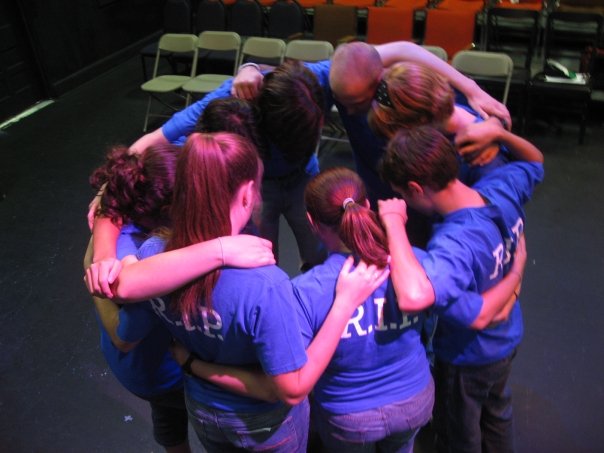
Players form a tight circle – if you’re comfortable being in each other’s personal space we’ll usually play this game in a huddle with our arms draped over each other’s shoulders. A target number is set that is greater than your membership. Players work together to count up to this target with any random player providing the next number in the sequence at any random moment. If two or more players contribute at the same moment or speak over each other (even slightly) the game is reset and starts again at the number one. The exercise continues until the goal has been accomplished.

The Focus

This game embodies the concept of Groupmind and finding a collective flow or connection. Every now and then the target is quickly reached as if by magic, but more often than not it will take many restarts. I’m wary (possibly needlessly) to offer up this game unless I know there’s sufficient time to get to a “victory” as it can be a little bruising if you use it as a closing ritual and everyone leaves the space feeling thwarted. Select your target number accordingly, especially with groups that are still building rapport and trust, as you can always let the game extend beyond the target if everyone is in the zone and this is preferable from having to set a less formidable goal after the fact if the vibe isn’t with you.

Traps and Tips

1.) Listen. I like to play this game with my eyes closed as it tends to build the group’s overall awareness and presence – although eye contact can definitely help the cause. Regardless of your preference, there should be a sense if some voices have been absent or if a player is anxious to contribute. This is perhaps a little metaphysical, but it can be helpful to think “does the group need my voice and number now” as opposed to serving your own desires to contribute.

2.) Play. Avoid “solving” the dynamic with strategic choices or patterns. Moving around the circle in order would be the plainest example of avoiding the challenge, but players can seek other patterns as well that have a similar effect: “I’m always going to quickly take the next number each time this other particular player contributes.” Yes, there is a goal that the ensemble wants to reach, but this shouldn’t eclipse the process of working together with calm attentiveness. Embrace the risk: risk “failure.”

3.) Breathe. Be wary of the game becoming a little manic or aggressive, especially if the group has experienced a handful of re-starts in a row. Invariably a strong centering breath can get everyone out of their heads and back into the space and will often allow a more measured build. There are certainly no guarantees with this game but often such a reset will get you closer to the finish line if players use it as an opportunity to calm their inner tempos and frustrations.

4.) Include. I’m never quite sure what goes without saying but just in case, reaching the target without everyone participating isn’t really a success. Once in a while I’ll have a player confess that they just stayed silent for the whole game after it’s all wrapped up and this always leaves me feeling icky as a facilitator. Win or lose, the ensemble needs to arrive at the destination (or not) together.

5.) Celebrate. Ultimately it doesn’t matter if you get to that exact target number, especially if there is a palpable sense of trust, connection, and joy. There will be something worth applauding, perhaps even just releasing the need to “win,” so be sure to cap the exercise with a suitably sincere celebration or acknowledgement.

In Performance

If the concept of groupmind feels a little alien to you, Counting Circle can provide a little taste of this intoxicating feeling. When your troupe has had a rough rehearsal or is in need of just reconnecting, this could well be the circle game for you! (And you can leave the circle altogether and wander freely around the space while playing as an alternative too.)

Cheers, David Charles.
www.improvdr.com
Join my Facebook group here.
© 2021 David Charles/ImprovDr

Connected Concept: Groupmind

“G” is for “Groupmind”

A magical improv moment when the company of players are all on the same page. Or a careless rallying cry that can reduce diversity and difference within the ensemble.

Groupmind Dynamics Worthy of Interrogation…

This is just a taste of this entry/concept. Go here for more information.

Related Entries: Ensemble, Inclusiveness

Cheers, David Charles.
www.improvdr.com
Join my Facebook group here.
© 2021 David Charles/ImprovDr

Connected Game: Counting Circle

Game Library: “Focus Ball”

This is a simple and effective exercise I use to introduce the foundational concepts of Giving and Taking focus. Focus Ball has multiple phases that you can tailor to fit your own specific needs.

The Basics

Players form a circle, and one person (typically the instructor) begins by playing with a mimed ball or similar, establishing themselves as having the focus.

Phase One: For the first round, players move focus around the circle by giving the focus to each other. Only one player may be in possession of the energy ball at any given moment. When player’s have the focus, they may morph or transform it in any way that gives them joy: a mimed ball may become a hula hoop, or baby carriage, or giant sandwich… literally anything that the player in focus can imagine. Players can hold on to the focus as long as they like, but the intended purpose of the game is to explore ways of moving the focus from one player to another. If players are keeping the energy for a minute or more each, they’ve probably missed the point a little! This phase should continue until everyone has been in possession of the focus at least once.

Phase Two: The game continues with new instructions that now, instead of giving the energy, players should exchange focus exclusively through a series of takes. Subsequently, players must retain the energy focus until someone else in the circle makes the clear choice to take it from them. Takes may assume various forms (subtle movements, large “grabs,” verbal offers…) but shouldn’t be resisted by the current player who possesses the energy. Players should continue to feel free to change the physicality of the energy ball as is their whim. Split focus is considerably more likely during this phase; in these moments, players should quickly determine who will now own the focus so as to prevent lengthy periods of confusion. As was the case with the prior round, play should continue until everyone has successfully experienced taking the focus from a teammate.

Phase Three: This next evolution is cumulative, and players may now elect to either give the focus to someone else or hold onto the focus until it has been clearly and resolutely taken. Regardless of the way in which focus moves, only one player should still clearly and unequivocally possess the group’s attention at a time: all focus struggles should be quickly addressed in the moment. Players should be careful not to cede focus into the ether or allow it to dissipate instead of knowingly moving it from one body to another. Many players will feel a strong preference for one or the other forms of exchange, so encourage them to explore the less comfortable choice. As before, the focus ball should continue to playfully evolve and take on as many shapes and energies as the group cares to imagine.

The Focus

I’ve found that this exercise can generate great joy and playfulness when the ensemble exhibits patience, generosity, and attention. The various transformations and creative focus shifts will usually prove captivating even for a more experienced group of players. Keep an eye open for focus struggles, such a player being left in focus uncomfortably for a protracted period of time. These types of breaches can quickly undermine the sense of ensemble and trust. If you’re playing with the company, it can be helpful to serve as the safety net in such moments.

Traps and Tips

1.) Beware of fidgeting. One of the many gifts of this exercise is a heightened awareness of how little it takes to inadvertently compete with or steal the intended focus. As the game is introduced, I’ll often gently note if there is some behavior or extraneous movement in the circle that is creating a secondary area of interest: someone may be swaying, or stretching, or sharing a quick word with a teammate. As the game moves through the three phases, such movement becomes increasingly problematic. Keep an eye on the goal of only having one clear player in focus at any given time.

2.) Accept the transfers. Just in case it doesn’t go without saying, the contract of the game is that players will gladly accept any focus pitches that are offered. If you’re working with less experienced or less confident players, the mere act of being in focus may cause some understandable discomfort but strive to encourage relishing this moment of creative freedom. Moving attention to the ever-changing energy ball and away from the player themselves can help a little in this regard. In moments when two or more players initiate a take (or, less commonly, when a give isn’t clearly directed at one person) allow room for those involved to solve the riddle but reiterate that it shouldn’t become a prolonged competition. Some rules of thumb that I use in general are that it’s generous to defer to a new energy (that is, a player who may have not been in the sequence for a while or at all) or to allow the player whose energy is clearly stronger or more committed to assume the focus with others quickly offering up clear gives.

3.) Value full participation. I’ve noted a similar idea elsewhere in my consideration of the warmup Go but beware of cliques or sub-games infusing the play in such a way that there are those who feel that they are included and others who are passively observing. An ensemble that is well tuned and self aware should know when a member has been accidentally excluded for a while or sense when someone may have unsuccessfully attempted to take focus and may be anxiously awaiting their turn in the limelight. On the other end of the spectrum, it’s easy for someone to dominate the game merely through their sense of joy and excitement. A simple reminder of “Is everyone getting to play?” or “Has everyone had a chance to try a focus take?’ can be enough to gently cajole the group if you sense an imbalance. Invariably, some recurring dynamics will tend to organically appear – perhaps two players keep finding themselves trying to take the focus at the same time – and this is certainly part of the process. But especially if you’re working in a larger group, it’s not unforeseeable that more introverted members may fall to the wayside if the group doesn’t display care.

4.) Explore the potentials. Other than making offers that could inflict physical harm, there aren’t really wrong choices in terms of focus gives and takes so much as more or less effective choices. A player could just reach out to the teammate to their side and grab the focus ball, or gesture across the circle as if they were snagging it with a fishhook on a mimed fishing pole. Players could give the energy by rolling it across the floor with a clear sense of direction and intent, or merely say another player’s name. A lot of the fun of this game is realizing the broad array of options at your disposal. While the concepts of give and take are simple, the manners in which they can be executed are not. That being said, players shouldn’t feel the pressure to come up with something that no one else has done: it’s always fine for the mimed energy to just become a ball again, or for players to just toss the focus to their intended recipient. There can be a danger in over-emphasizing originality or creativity rather than just encouraging an environment in which these qualities might appear.

In Performance

This exercise and the skills that it seeks to fine-tune have an important place in performance. Reducing distracting movements that might steal focus, providing strong focus gives with clear recipients, and developing an awareness of when focus has become strained or murky are all invaluable gifts for the improv stage.

Cheers, David Charles.
www.improvdr.com
Join my Facebook group here.
© 2021 David Charles/ImprovDr

Connected Concept: Give

“G” is for “Give”

To Give is to provide your fellow improviser with focus (when they want it).

Ways to Give

This is just a taste of this entry/concept. Go here for more information.

Related Entries: Commandment #2, Edits, Focus, Take Antonyms: Split Focus Synonyms: Exits, Sharing Focus

Cheers, David Charles.
www.improvdr.com
Join my Facebook group here.
© 2021 David Charles/ImprovDr

Connected Game: Focus Ball