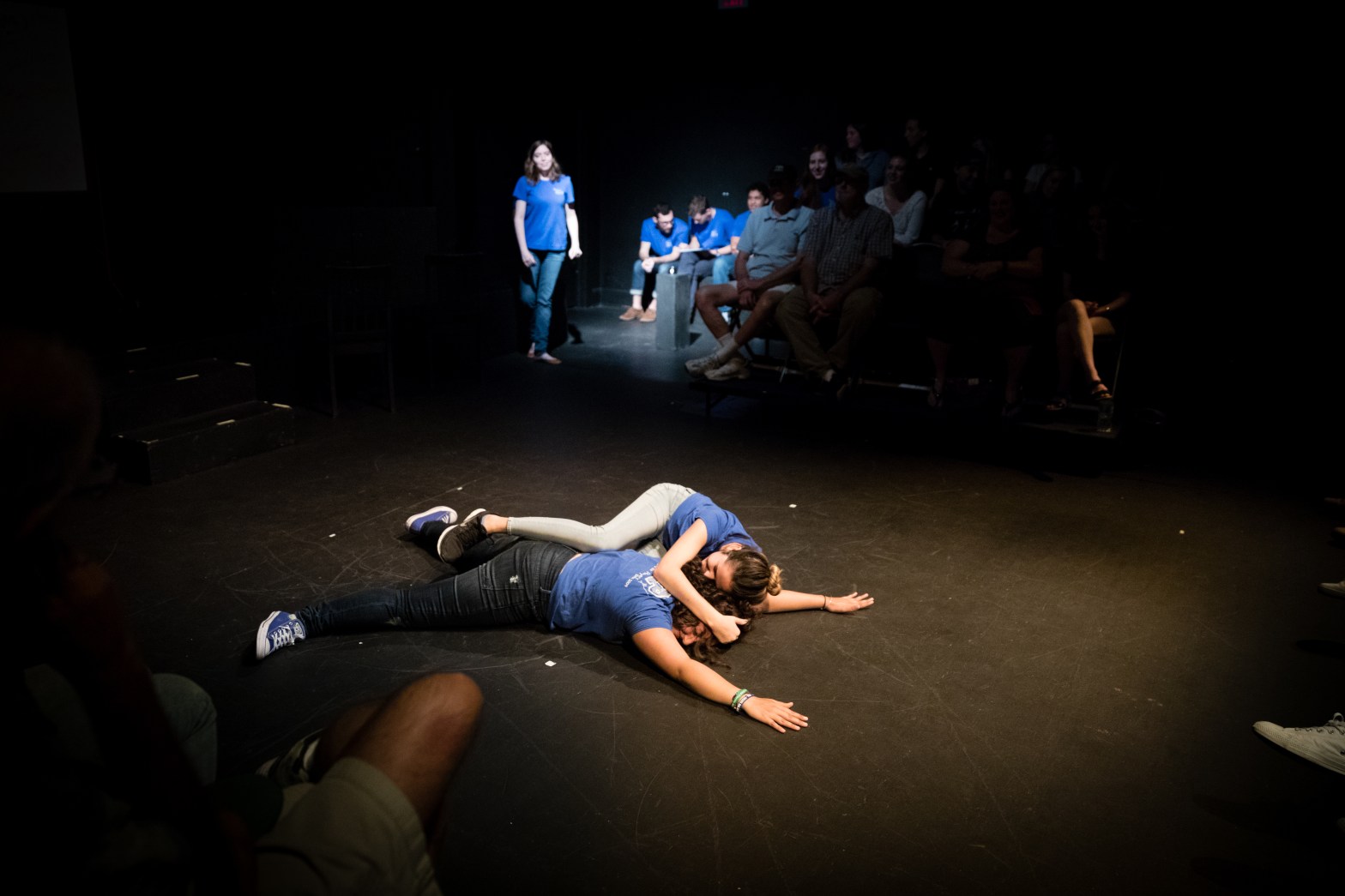
Game Library: “Nicer Than You”

While I primarily use this game as a skill-building exercise, Nicer Than You can work equally well as a scenic overlay in the short- or long-form tradition. The central dynamic invites an earnest and nuanced exploration of Kindness.

The Basics

At first glance, this game may appear similar to one-upping and one-downing scenes, although in this instance, the focus is more sincere and less overtly competitive. (You can read about these related formats here.) Players work in pairs (generally) and must strive throughout the scene to display the most honest kindness to each other as possible. These scenes can be played with multiple pairs working unobserved simultaneously, or one group at a time in front of the ensemble.

Example

Players A and B are given the relationship of “married couple” to explore. Player A is cleaning up the living room as Player B arrives home late.

Player A: (looking lovingly to B) “You’ve had a long day, honey. Come and put your feet up.”

Player B: (dropping their briefcase at the door) “You’re so right. Just give me a second to get your dry cleaning out of the car.”

Player B leaves for a moment while Player A fluffs the pillows on the couch.

Player B: (returning) “I know you’ve got your big presentation tomorrow and I wanted you to have your lucky outfit!”

Player A: (carefully stowing away the cleaning) “You’re wonderful for remembering that.”

Player B collapses on the couch.

Player B: “I thought this day would never end. Do you want a drink?”

Player A: “Only if you’ll join me!”

Player B starts to get up to go to the liquor cabinet…

Player A: “You stay right there – I’m closer anyway…”

The Focus

The focus is largely stated in the title of the game, with players working to display the most thoughtful and kind gestures towards each other as the scene evolves. This dynamic can prove surprisingly challenging and revealing, especially if players are accustomed to rushing towards conflict.

Traps and Tips

1.) Accept acts of kindness. Blocking can have a tendency to emerge in these scenes while players defer actions in an effort to not put their partner at an inconvenience. If both players, for example, insist that the other sits down to relax, you can end up with an odd passive-aggressive sub-textual argument that undermines that greater goal of the game. As is the case with all improv scenes, strive to accept the gifts bestowed by your partner with joy and gratitude. Embrace these offers and allow your characters to do so as well. Part of truly being kind is enabling and appreciating other’s acts of kindness too. That being written, obviously important contracts regarding consent still apply throughout.

2.) Don’t play to win. Or, perhaps, don’t play to win in the conventional sense with your victory coming at the expense of your partner’s success. The title implies a level of competitiveness, but players should take the risk of savoring each “victory” as it lands. Relish acts of love that are sent in your direction and experience how these kind moments inform and develop the central relationship. I’ll sometimes ask the group if we’re observing these scenes when the performers have wrapped up, “Who was the kindest?” But it’s the discussion of the why that is always more revealing than the who. Often, smaller and less “flashy” gestures have a lasting influence on the audience, which is important for us to recognize and remember as players in general.

3.) Keep it real. I would suspect this is often a side effect of misplaced competitiveness as well, but the scene loses its shine if characters start to become saccharin or overtly insincere. Holding onto the reality of the exploration takes more patience and (frankly) vulnerability as it invites forging a more emotionally honest connection to your fellow player. If you find yourself evading this level of sincerity, you are probably missing one of the larger gifts of the exercise. Yes, these scenes can become delightful farcical commentaries climbing the curve of absurdity, but given the chance, they can also uncover softer hues that resonate on a deeper level. If your scene work tends towards the former energy, allow yourself the journey of experiencing the latter.

4.) Follow the scene. Another temptation when you first play this game is to strive to make every line a clear “move” or act of niceness. Allow the scene to follow the natural ebbs and flows of improv discovery. It’s helpful to provide details and nuances within the general tone of the exercise without worrying about each line of dialogue or action overtly landing as a sweeping gesture. Frequently, subtler moves are unlocked through such an approach, or you’ll find simple details that you’ve established weaving poetically into later choices. If you craft a scene where both characters have truly felt warmth and love from each other as the lights fade, then you’re playing in the right ballpark.

In Performance

This approach to relationship and scene building can prove to serve as a helpful antidote if your work has become overpopulated with inorganic conflict, animus, or hostility. There is something indescribably engaging and joyful in watching characters on stage showing care and love for one another. I, for one, would enjoy seeing more of these energies embodied on the improv stage with greater frequency and depth.

It’s common advice in the improv studio to warn players away from being nice people doing nice things as this frequently results in scene work without risk, action, or culpability. At first glance, this exercise might seem to fly in the face of this common wisdom. But, while I’ve seen scenes suffer from a player’s desire to use niceness as a shield that protects them against doing or saying anything a little ugly or unadmirable, I’m not sure I can say the same in regards to scenes that were deeply and sincerely grounded in love.

Cheers, David Charles.
www.improvdr.com
Join my Facebook group here.
Photo Credit: Tony Firriolo
© 2022 David Charles/ImprovDr

Connected Concept: Kindness

“K” is for “Kindness”

An important tool for crafting meaningful bonds between players, characters, and the greater communities in which we work and play.

Practice Kindness Towards…

This is just a taste of this entry/concept. Go here for more information.

Related Entries: Archetype, Audience, Ensemble, Postmortem Antonyms: Anger, Pettiness Synonyms: Empathy, Forgiveness, Love

Cheers, David Charles.
www.improvdr.com
Join my Facebook group here.
© 2022 David Charles/ImprovDr

Connected Game: Nicer Than You

Game Library: “Freeze Frame”

Open eyes.

This classic short-form game is clearly dated a little by its very title, Freeze Frame – you may have seen or played similar variants with the name of Slide Show or PowerPoint! In addition to providing a great opportunity to flex your narrating muscles, this playful game blossoms when performed with fearless Justifications.

The Basics

While you can certainly utilize technical components to sell this game, I’d actually encourage a very low-tech approach as it invites the audience into the mechanics of the scene. Typically, one player will serve as the host or narrator with others using their bodies to craft various tableaux. After a brief introduction, the host cycles through a series of these hastily embodied frozen frames, providing narration that justifies each image in a way that moves the story forward. In my preferred rendition, slides are changed by the narrator saying, “Close eyes,” at which point they and the audience close their eyes as the onstage players quickly adjust the image. After a second or two (though not too many), the narrator then says, “Open eyes,” and the tableau players must immediately freeze. It’s important that the teller shuts their own eyes during these transitions (and someone in the audience will nearly always “cheat” to make sure this is happening) otherwise the stakes of the challenge are unnecessarily lowered. If you adopt this method of changing slides – and I sincerely hope you do – it’s helpful to do a very quick dry run of the dynamic with the audience prior to the scene so that they can rehearse (and appreciate) the transitions.

Example

Player A volunteers to serve as the narrator, and the suggestion of “insomnia” inspires their action. The remaining team members strike to the side of the stage as the lights transition and the scene begins...

Player A: (assuming the persona of the narrator) “Welcome everyone to tonight’s frightening tale that is sure to haunt your dreams… that is, if you can get to sleep. Let us enter the world of Insomnia! Everyone, close your eyes.”

Player A and (hopefully) the audience all close their eyes as Player B enters the space and sits downstage center with their eyes wide open and a look of panic on their face. After a few seconds...

Player A: “Open eyes.”

The audience and narrator can now view the image. The narrator, who is positioned at the edge of the stage, turns to assess the image as they continue…

Player A: “It had been a long and fitful night as Paolo laid nervously in his bed. He had spent the last three hours tossing and turning as menacing creaks in an unfamiliar house rattled his nerves. He’d ignored the warnings he’d read on the hotel’s webpage, dismissing them as efforts to add intrigue to the rickety old estate. But now he was starting to wonder. Close eyes.”

Everyone (except the posing players!) close their eyes once more. Player B (Paolo) stands pressing himself against an imaginary wall, while Player C enters and slumps down on the floor.

Player A: “Open eyes.”

Everyone does so as Players B and C freeze if they have not done so already.

Player A: “As his eyes adjusted to the darkness, it was then that he saw her silhouette in the shadows! The fright made him leap to his feet. An elderly woman gently whispering incomprehensible sounds sitting in the middle of his bedroom floor…

The Focus

Seek to balance strong storytelling with surprise. If the tableau players are too random (especially initially), the narrator can struggle to craft anything of value or meaning. On the other hand, if the posing improvisers are too “helpful” (that is, they defer completely to the elements already established by the narrator), the story can feel too “easy.” It’s part of the fun to see the narrator visibly challenged or a little thrown off by an image; however, it can quickly become less fun if they appear completely overwhelmed from the get-go and unable to anchor their story in anything solid.

Traps and Tips

1.) Share the work. The narrator in this game inarguably has some heavier lifting in general as they strive to make sense of the various images, but the game suffers if it becomes completely one-sided. Posing players certainly have agency and the ability to craft dynamic choices that can radically change the direction and energy of the story. Strong and imaginative tableaux feed and inspire the narrator; if posing players assume a lackluster attitude, this can quickly sap the game of its creative spark. Well-timed playful mischief (or shivving) is a wonderful gift, as are images filled with intensity and emotion. With some generous guidance from fellow “posers,” Freeze Frame can also incorporate volunteers, which can prove helpful if you’re playing with a smaller ensemble or are looking for new ways to include your audience.

2.) Help the narrator. There are some tried and true strategies that can assist the narrator as they work to launch a promising story. I advocate for an empty stage initially so that they have a little time and space to set a tone and style. It can also prove helpful to gently pace your entrances: this allows the narrator to clearly assess and define each addition so that there isn’t confusion as to “who was playing the giraffe again?” Four or five bodies in the first tableau can prove overwhelming, especially if there is no clear area of focus or connection. When a few players hold back, they also have a better chance of being able to recognize what the evolving story might need and then being available to embody that choice at the appropriate time. I have seen this game played effectively with scores of players in every image, but such an approach tends to privilege a series of loosely connected justifications – “Who are all these people at the party?” – as opposed to a more elegantly crafted narrative and rising action.

3.) Embrace your character. It’s common practice to retain character endowments provided by the narrator, so if you’re cast as the protagonist (Paolo) you’ll play this role for the duration of the piece (and in this case will appear in most – if not all – of the images). Lean into and enjoy these endowments: it’s a rare gift for many of us to create a character purely through our physical choices. As is the case with any improv scene, if you wear your character lightly, you’re less likely to challenge yourself or forge dynamic relationships with your teammates. It can be easy to inadvertently “approximate” your physical poses rather than compose them with significance and weight. Expend energy. Similarly, if you are in the role of the narrator, don’t overlook the potential for fun character work here as well. The preamble or introduction, in particular, is a great place to establish a point of view that can, in turn, help you when the story elements or justifications prove elusive.

4.) Take a risk. There are many seemingly helpful performance strategies that will actually diminish the inherent risk and playfulness of the game. If the narrator provides lengthy or predictable “close eyes” durations, fellow team members are less likely to jump to quick and unexpected decisions. Those forming the tableaux can also have a tendency to plan too much given the chance: while it’s wise to have a general sense of what your partners are doing as you make your choice, don’t be hesitant to just make your own independent and bold pose, especially once the story has found its footing. Conferring too much tends to reduce the likelihood of exciting accidents. If the narrator only gives a second or two between poses, this tends to keep things dynamic. Also be wary of the narrator diffusing the challenge by essentially describing exactly what they want as the next image (“Let’s see the ghost appear from the closet and attack Paolo”) as opposed to more broad setups that encourage players to make their own big decision (“And then Paolo heard a noise…”)

5.) Explore different contexts. Freeze Frame is wonderfully resilient as a short-form conceit. You can tell a traditional story, provide a series of images as part of a lecture, or recount a family holiday based on old, rediscovered photographs (among many other options). I’ve seen it work well with two characters sharing the narrative duties, often providing contrasting points of view on the topic or event. There’s also a great value in considering how you “cast” your audience as well: perhaps they are disinterested college students, or rambunctious kindergarteners, or esteemed colleagues at an annual conference. With a little care and clear framing, the audience can become more fully involved in the unfolding action beyond the simple but pleasing device of opening and closing their eyes. A small shift in the context or conceit of the game unlocks dynamic new stories and potentials. I’ve woven this device into a Greek tragedy long-form as well with strong results – as seen in the image above!

In Performance

Yes, this game certainly works with an able technician bringing the lights up and down (with the narrator cueing the adjustment with “Next slide” or similar) but trust me that there is surprising value in having the audience just opening and closing their eyes along with you. I like the agency this gives. Some will enjoy having the opportunity to peek behind the scenes and watch the players scramble to move from pose to pose. For those who embrace the device, there is something oddly pleasing about the simple magic of the images transforming on cue. This approach also has the added advantage of keeping the players (and perhaps audience volunteers) safe as they move around a lit stage; when you use technology there is always an awkward tension between creating true blackouts and allowing some ambient light so that improvisers aren’t in jeopardy of crashing into each other.

For the R&D Show XVI: History we deployed a large cast version of this game with two historians narrating a series of slides as teams of players (initially) rotated into the posing duties. Each slide can then take the form of a historical moment or artifact that connect to form a greater theme. Perhaps not the shortest of warm-up games (!) but it was a true crowd pleaser and a lovely way to get the whole ensemble working together closely right at the top of the act.

Close eyes.

Cheers, David Charles.
www.improvdr.com
Join my Facebook group here.
Photo Credit: Akin Ritchie
© 2021 David Charles/ImprovDr

Connected Concept: Justification

“J” is for “Justification”

Combining ideas in pleasing and perhaps surprising ways.

Justifying as a Source of Creative Strength

This is just a taste of this entry/concept. Go here for more information.

Related Entries: Accepting, Commandment #1, Curve Ball, Offer, Postmortem Antonyms: Blocking, Bulldozing, Commenting Synonyms: No Mistakes, Weaving

Cheers, David Charles.
www.improvdr.com
Join my Facebook group here.
© 2021 David Charles/ImprovDr

Connected Game: Freeze Frame

Game Library: “Bell’s Kitchen”

Several of the long-form formats I’ve devised for my current campus troupe utilize an almost Brechtian device in which scenes are briefly introduced by another player who pauses the prior action with the ringing of a bell. This tradition evolved for numerous reasons – primarily to help jumpstart scenes with a clear and concise gift – and has become a unique and defining characteristic of my work in this academic venue. Bell’s Kitchen emerged as a workshop exercise to polish this technique of pitching dynamic Initiations that can quickly launch scenes into promising territory. I can’t take credit for the delightfully “punny” name, although unfortunately, I can no longer recall which long-since-graduated troupe member first coined it.

The Basics

Players are randomly divided into two teams, which form parallel lines facing each other. The first player from each line steps forward into the battle arena and stands in front of two bells placed on small blocks or stools. A caller provides an inspiring ask-for, such as “parents,” “beach,” or “co-dependence.” Players alternate ringing their bell and then providing an original narrative lead-in for a scene that is explicitly connected to the provided suggestion. The two competing players continue offering new possibilities back and forth until one of them commits an infraction (such as needlessly stalling, repeating the essence of a prior narration, or failing to clearly use the ask-for in question). The triumphant player earns one point for their team; both competitors then rejoin the end of their line so that two more teammates can enter “Bell’s Kitchen…”

Example

Player A: “Siblings, Mark and Kylen, fight over the television remote…”

Player A and B step forward representing their two teams; the caller provides the category of “siblings,” and the players start ringing in...

Player B: “Katherine doesn’t expect to see her older sister Cailin when she’s called to the principal’s office…”

Player A: “At the hospital, Brian sees his baby brother through the glass for the very first time…”

Player B: “Twins Alex and Lauren get radically different looks at the mall salon…”

Player A: “Things go awry between siblings Travis and Pete when there is only one slice of pizza left in the box…”

The Focus

Take risks, seek specificity, and embrace the need to ring the bell before you have an idea formulated. Often, the most intriguing ideas bubble up from “nothing” once players have expended those concepts that were pre-loaded or familiar.

Traps and Tips

1.) Enjoy the competitive element, but keep it in check. While the competitive frame adds playfulness and stakes, be mindful that it doesn’t warp the larger intent; namely, to encourage brave and instinctual scenic frames. If someone is new to the exercise, by all means, give them a re-start or a do over if they fumble right out of the gate so that they have a chance to find their footing. The greater goal is to nurture a skill set not to thwart growth.

2.) Use prompts pertinent to your peculiar needs. I generally rotate between relationships, locations, and theme words when we explore this exercise as these are all elements that we use frequently as sources of inspiration in our long-form pieces (and that we need to rehearse defining with nuance and variety). You could certainly also brainstorm genre-specific initiations, (song) titles, or character objectives… The frame can easily accommodate a wide array of different inspirations.

3.) Establish infraction criteria (and apply them with playful joy). Stalling or struggling to verbalize an offer quickly often provides the most obvious cause for elimination, but depending on your greater goals you can also call out verbosity, lack of clarity, failure to obviously use the prompt and the like… As players become more confident and experienced we sometimes introduce additional criteria just to keep the game moving, such as no character name repeats or no using the prompt in the same way or with the same energy as a prior bell.

4.) Encourage both strong content and form. The excitement of this game can tend to manifest itself in rather frenetic deliveries that would be problematic in front of an audience. This is of particular concern in my campus work as this narrative introduction device is used as is onstage. To this end, I encourage players to deliver their ideas – no matter how odd they may become – with confidence and poise. The gift of these initiations will largely be lost if the intended players (and audience) are unable to hear and comprehend the nuances of the speaker’s intent. And it’s also just good practice to really sell your ideas regardless of how well they are formed when they emerge.

In Performance

Played with carefree attack, this exercise also serves as a helpful reminder that one suggestion (especially those that might feel stale or overdone) can inspire an almost endless multitude of unique starting points. This improv drill can also easily be adjusted to explore second or third steps in a scenic progression by having two players present a “first scene” and then having other members of the ensemble belling in possibilities for the next iteration. Similarly, rather than narrating the first move you could certainly adapt the game to involve delivered first lines (as opposed to narrated descriptions) that established the given circumstance through the use of character-based dialogue: “Mark, mum said it’s my turn to get to choose what we watch. Stop hogging the remote…”

Cheers, David Charles.
www.improvdr.com
Join my Facebook group here.
© 2021 David Charles/ImprovDr

Connected Concept: Initiation

“I” is for “Initiation”

An improv move or offer, or in the context of this entry, the first significant idea that lights the fire of spontaneity.

Strong Scenic Starts

This is just a taste of this entry/concept. Go here for more information.

Related Entries: Ask-For, CROW, Offer Antonyms: Button Synonyms: Launches, Starting Scenes

Cheers, David Charles.
www.improvdr.com
Join my Facebook group here.
© 2021 David Charles/ImprovDr

Connected Game: Bell’s Kitchen

Game Library: “Identity Circle”

This exercise has become a right of passage of sorts for my campus troupe, providing members with an opportunity to share and model empathy and vulnerability. I wouldn’t consider Identity Circle as particularly appropriate for younger players or ensembles that haven’t built an initial foundation of trust – Neighbors offers a more light-hearted option for these situations – but conducted with care, this experience can initiate important conversations and discoveries.

The Basics

The ensemble forms a circle. It is important that players understand the tonality and intention of the experience that is about to take place and that nobody is expected to share or reveal anything that makes them uncomfortable or nervous. If you are working in an environment in which you are a mandatory reporter. it is important to remind participants of this function as occasionally intense narratives are revealed. Players are invited to randomly step into the circle and make statements that they hold as true and important. Upon the completion of each statement, other players who identify with the proffered statement may then also take a step into the circle to mark this shared experience or belief. After a moment, players then return to the periphery until a new volunteer steps forward to make a statement.

Example

Players have formed a circle and understand the conceit and tone of the exercise.

Player A: (stepping forward) “I am an only child.”

Several other players step forward to indicate that they connect to this statement. After a moment, they all return to the greater circle.

Player B: (stepping forward) “I don’t have a passport.”

Several other players step forward to indicate that they connect to this statement. After a moment, they all return to the greater circle.

Player C: (stepping forward) “I’m afraid of heights…”

The Focus

Played gently and with awareness, this game can reveal connections, acknowledge differences, and recommit players to the ensemble. Played carelessly or hurriedly, it might isolate, trigger, or alienate group members. The experience both builds trust but also requires that a certain level of trust is already in place. If the exercise is to encourage and model inclusiveness, it needs to be introduced and guided with attention and care. When I play this with my campus troupe there are always improvisers present who are familiar with the spirit and purpose of the game and are able to illustrate the intent by providing help as needed if the material proves challenging or potentially harmful. If everyone is new to the game, I would strongly recommend taking extra time with the setup and preamble.

Traps and Tips

1.) Clearly state the game’s purpose. I know of few other games that equally allow players to remove their social facades and honestly share their lives, fears, and passions with each other. It’s important that everyone is in agreement that what is shared in this moment and the circle remains in this space and does not find its way into casual conversations outside the space (especially with others who weren’t in attendance or in any manner that might resemble gossip). This contextualization can suggest that the exercise will be morose or needlessly bleak, which has not been my experience as a sense of joy or comradery also permeates the event; but, it would be fair to say that as the exercise unfolds that there are often serious and vulnerable revelations and it’s important to prepare the ensemble for this eventuality. At its core, Identity Circle allows the group to safely share what connects and also isolates members.

2.) Gently establish and monitor the tone. While moments of joyful laughter are not uncommon, the exercise generally occurs with a slightly more reverent tone. It isn’t in the spirit of the experience for players to comment on the choices or statements of others with looks of judgment or side chatter. Such behavior will quickly undermine the overall mood needed for the game to offer an honest and meaningful experience. Typically, the exercise should take place in silence; if you are facilitating and hold a position that is unequal to your fellow participants (as is the case when I facilitate this as a professor with my students) it can prove helpful to also have a soft focus so that players don’t feel needlessly observed or scrutinized. I do think it’s important not to merely observe, however, but to also contribute and participate if for no other reason than hopefully dismantling or subverting this perceived power imbalance.

3.) Discourage any coercive behaviors. It’s critical that players do not feel coerced during this activity. If players become uncomfortable, they should feel welcome to step away from the circle, perhaps to return at a later time, or perhaps not. It’s important that players step forward and share facets of their lives or identities that they are comfortable sharing – this threshold will likely vary markedly from player to player and from ensemble to ensemble. Statements should not be used to figuratively or literally out others in the circle or mine for biographical information that fellow players do not want to share. To this end, it’s important for the facilitator to note that players need not step into the circle in response to any statements that cause them distress or discomfort (and players should not signal or gesture to others to do so). Participants should also feel free to internally modify statements in any fashion that best suits them. If someone shares “I am an only child” and someone else feels so estranged from their sibling that they feel like an only child, then it is more than appropriate for them to take a step forward. No one needs (or should) serve as the arbitrator of others’ truths.

4.) Allow the rhythms of the exercise to emerge organically. This may be more of an issue when you have improvisers in your group who have experienced Identity Circle before, but sometimes there can be a tendency for “returners” to push the experience too quickly into heavier material that can alienate those who are taking their first steps. While, as noted above, no one should be coerced to share if they do not wish to do so, the likelihood that more reserved or introverted members will feel inclined to participate declines precipitously if you do not allow sufficient time for some simpler (or even trivial) statements: the activity undoubtedly benefits from some room for “I love dogs” and “My favorite color is red.” The ensemble needs to find its footing and sense that trust is present and growing before embarking into more vulnerable terrain. Once the exercise has been established, it can then be helpful to have “returners” who understand the ebbs and flow of the game offer up slightly more personal statements if the exercise has floated on the surface for a problematically long amount of time.

5.) Be prepared for residual and a slow transition. With a group of sixteen to eighteen, this exercise will often take 45 minutes to an hour or more, and it doesn’t lend well to then suddenly plunging into scene work or other rehearsal business afterward. It can prove difficult to find an “out” as some players find the dynamic liberating and may subsequently have a lot of import to contribute. Side-coaching should be sparse and exclusively structural (if used at all) but I’ve found sharing a statement to the effect of “I feel ready to conclude this game in another 2 minutes” or similar is a gentle way of sounding out the needs of the group while nudging them to an ending if it’s appropriate or needed. It’s not unlikely that some (or many) players might be a little stirred and in need of some support, or space, or both. I’m often struck by some rather intense themes of isolation and loneliness that tend to emerge, for example, and it’s not really appropriate nor healthy to unlock these feelings and then carelessly release everyone back into their private bubbles. I’ll program this at the end of a rehearsal for that reason, allowing for sufficient downtime to tend to those who need some extra attention. Also, be aware that you may not be the person someone wants to connect to in this moment, and that’s more than okay.

In performance

I fear that this description and coaching suggestions might make this game feel a bit dark or risky so I think it’s important to note that my company actively requests it now that it has become a known part of our annual training tradition. Yes, it certainly has sad or intense moments, but it can also prove affirming, joyful, and cathartic. In this sense, it is very much allied with improv traditions in the healing arts such as Playback Theatre and Sociodrama. I would just caution that if this is new territory for you as a facilitator or troupe that you exert care and thoughtfulness as the experience often proves surprisingly vulnerable and raw.

Cheers, David Charles.
www.improvdr.com
Join my Facebook group here.
Photo Credit: Scott Cook
© 2021 David Charles/ImprovDr

Connected Concept: Inclusiveness

“I” is for “Inclusiveness”

A commitment to increasing the reach of our art and work together.

Questions to Consider on the Path to Inclusiveness

This is just a taste of this entry/concept. Go here for more information.

Related Entries: Ensemble, Groupmind, Improvisation Antonyms: Cliques Synonyms: Yes, And…

Cheers, David Charles.
www.improvdr.com
Join my Facebook group here.
© 2021 David Charles/ImprovDr

Connected Game: Identity Circle

Game Library: “New Choice”

New Choice provides a wonderful example of the variability and immediacy of Improvisation and its essential spirit. I know this format primarily as a short-form game, but its central conceit could easily serve as a rehearsal device in most spontaneous modes of play and creation (and some scripted ones too, for that matter).

The Basics

One player (often the host or member of an opposing team) acts as the caller for the scene. As players craft an original story, they are interrupted sporadically by the caller who asks for a “new choice” (or perhaps a series of new choices). Players craft alternative offers until a “satisfactory” idea has been found and the scene continues forward.

Example

Players obtain the offer of a “surprise birthday party,” and as the lights rise, the audience discovers Players A and B hanging up decorations.

Player A: (grabbing one end of a long banner and stepping up onto a chair) “The room is starting to take shape! Can you help me with this sign?”

Player B: (rushing over) “Of course! You’ve been such a huge help! My sister is going to be sooo excited. She’s never had a surprise birthday party before…”

Player A: (looking at the sign) “Are you sure you got the right sign? This says, ‘We’re sorry to see you go…'”

Caller: “New choice for the sign.”

Player A: “…This says ‘Congratulations on your twins…'”

Player B gasps with dismay.

Caller: “New emotional choice.”

Player B: (giggling) “That’s just a running family joke. She’s going to love it!”

Player A: “I don’t know if I’ll ever fully understand your family…”

Player B: (finally fastening the banner) “There. That looks fantastic.”

Player A gingerly gets down from the chair to look at the room.

Caller: “New dismounting choice.”

Player A quickly remounts the chair and then leaps off it (safely) with balletic finesse…

The Focus

New Choice reveals the playful disposability of improv, and players should strive to quickly rebound from one choice to another as they are challenged to concoct new pathways for the scene. This game will often enable well-worn premises to arrive at surprisingly fresh and unpredictable conclusions.

Traps and Tips

1.) Establish the conceit. It is certainly possible for the caller to merely provide the titular side coaching phrase of “new choice” (and I’ve seen the game played successfully in this manner) but I like adjusting this prompt as the scene develops. It’s helpful for the audience if the first few calls remain somewhat simple, such as “new dialogue choice,” but as the action takes off, you can adjust the prompt significantly to serve the needs and foibles of the action. It’s more than fair game to offer several “corrections” in a row, especially if the first change feels safe or too similar, and in these cases it can prove more efficient just to use the simpler “new choice” variant for subsequent do overs. But, as is always the case, make sure the audience (and players) have had a chance to learn the game before attempting particularly challenging finesses.

2.) Enjoy the variety. This frame provides a joyful variety of potential adjustments, so avoid merely returning to the same one or two variants again and again. Yes, it’s helpful to perhaps start with asking for dialogue changes, but you can also invite new emotional, staging, delivery, and motivational tweaks, as well as even more substantial resets such as having performers offer whole new relationships, characterizations, props, and plot points. When I’m assuming the role of the caller, I’ll often challenge myself not to return to a prior category if I can avoid it just to encourage my own sense of discovery and creativity. The game shouldn’t become about the caller, but there is room to really open up less typical scenic pathways and discoveries if you remain open to new ways of applying this device, and you always have the failsafe as the caller of just prompting a second or third attempt if you’ve inadvertently led the scene astray.

3.) Don’t overwhelm. As a player, seek conciseness and clear gives and takes between your fellow improvisers. If the scene assumes a frenetic tone right from the beginning – or is overcrowded with characters competing for focus – you are setting yourself up for an almost combative dynamic with the caller who will likely need to interrupt the action just to cue shifts. Similarly, when you’re serving as the caller, make sure you are providing sufficient room for established choices to breathe and grow. Nearly any choice could invite an adjustment, so exercise self-control and judgment, especially at the top of the scene where  needlessly resetting core story components could undermine the foundation and potential of the scene. Let helpful choices stand whenever you can, trusting that there will be many other opportunities to upset the apple cart just around the corner.

4.) Leap then justify. Played fearlessly, the central conceit of this game can provide such a gift to the scenic players. When you are the focus of the caller’s adjustment, don’t overthink the “why” but rather just grab a new approach and sell it. Allow yourself to be surprised alongside your audience as this is the richest gift of the game. If you’re asked to assume a new emotion, or staging choice, or greeting ritual, launch yourself fearlessly at a new option and then figure out why your character might behave in such a way or how this behavior connects to your greater goal and the scenic arc. The game loses much of its charm and danger if you justify an offer before it makes it to the stage rather than after you have delivered it with bravery and gusto. Get yourself into delicious trouble knowing that, ultimately, your teammates and the caller are there to help you if you really get yourself into a jam!

In Performance

This short-form game is very similar in terms of its inner workings and central conceit to Should’ve Said (it’s worth checking out those game play pointers here)  This variant, however, allows for a wider array of adjustments and re-sets which I greatly enjoy as a player, caller, and audience member.

Cheers, David Charles.
www.improvdr.com
Join my Facebook group here.
Photo Credit: Scott Cook
© 2021 David Charles/ImprovDr

Connected Concept: Improvisation

“I” is for “Improvisation”

Spontaneous and collaborative play.

Five Improvisational Values

This is just a taste of this entry/concept. Go here for more information.

If this topic intrigues you, a digital copy of my full dissertation is available online here. It includes a strong bibliography and timeline although these reflect what was available in print in English in 2003 and the world of improv (and the internet) have changed greatly since then!

Related Entries: Audience, Groupmind, Long-Form, Punching Up, Short-Form Antonyms: Repeatability Synonyms: Spontaneity

Cheers, David Charles.
www.improvdr.com
Join my Facebook group here.
© 2021 David Charles/ImprovDr

Connected Game: New Choice