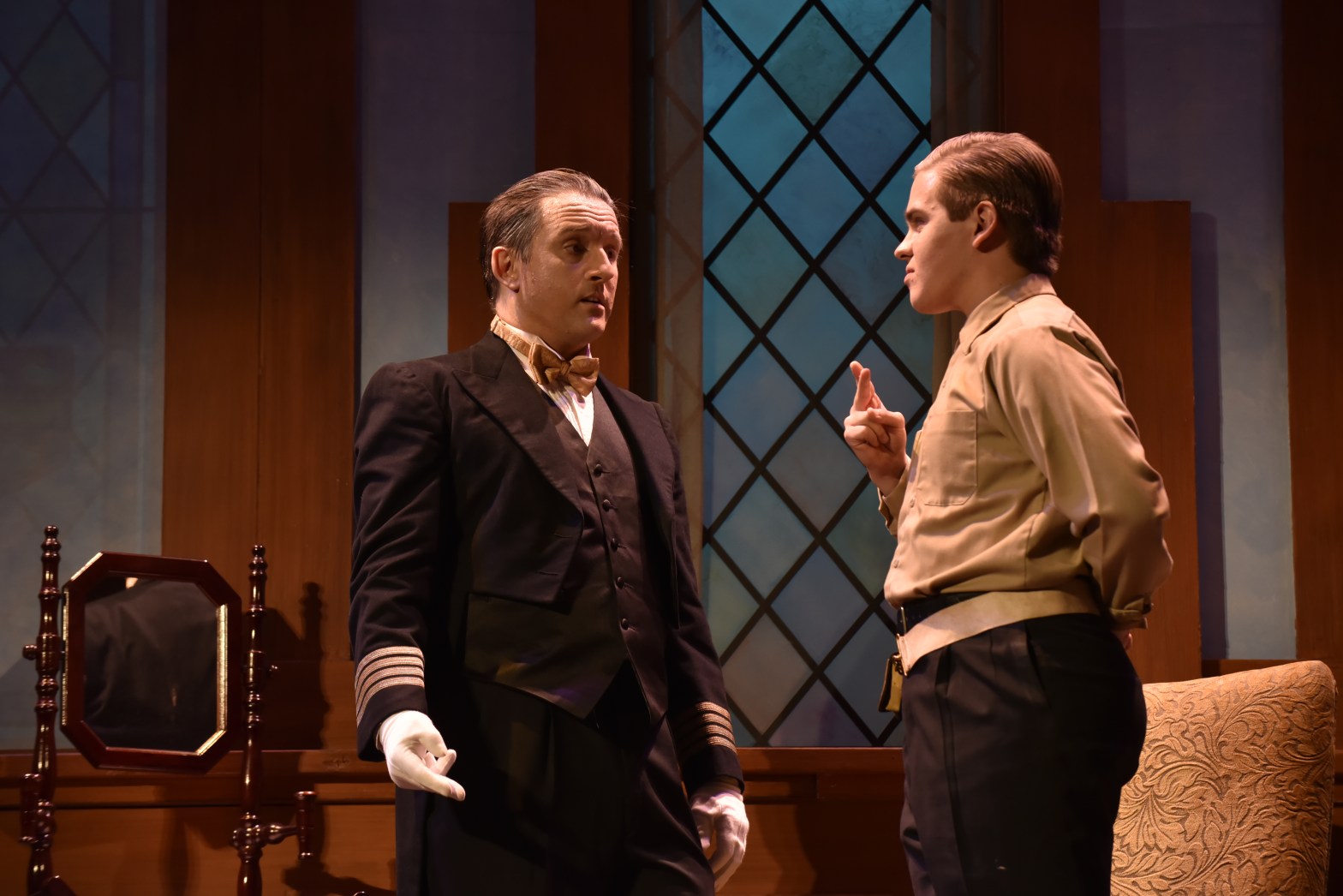
Game Library: “Universal Translator”

The core conceit of this game warrants some care in terms of its framing and implementation if you don’t want the silly physical hijinks to feel as if they’re at the expense of those in the hearing-impaired community. In my current venue, the new name Universal Translator was embraced to aid in this endeavor, as was greater care with the set-up. Some may view this as an imperfect or incomplete gesture. Frankly, some nights I’m still on the fence as well.

The Basics

To accommodate everyone in the audience, an interview scene is conducted in which a player uses pantomime to translate the dialogue into a make-believe (and made-up-on-the-spot) “universal” language.

Example

Player A assumes the role of the translator stage left while Players B and C sit in chairs on the opposite side of the stage where they take on the functions of the interviewer and expert. The audience provides the topic of “lawn maintenance” as the focus of the show.

Player B: “And welcome back to ‘Let it Grow,’ where we get to the bottom of all your gardening needs.”

Player A gestures throughout, waving and then pointing to their back, miming Pinocchio’s nose after a lie, turning and gesturing to their posterior, and finally digging a hole with a pretend shovel, all roughly in sync with B’s dialogue.

Player C: “It’s a real pleasure to be with you, John…”

Player A smiles broadly while shaking an imaginary hand, before creating the illusion of a man standing at a toilet or “john”…

The Focus

This game thrives when players balance embracing the simple and obvious (specifically their obvious), alongside mining less expected and more left-field uses of the speakers’ language.

Traps and Tips

1.) For the interviewer. I tend to play this role a lot and quite enjoy its essential function of enabling the fun for both the expert and the translator. It’s a small detail, but taking the chair facing away from the translating player (if your performance space doesn’t allow good views for both talking characters) generally allows the expert to watch the action and set the speed of the conversation accordingly, as they tend to contribute the bulk of the language. A lot of helpful content will still likely come from the interviewer’s chair, but ideally this role should focus on assisting the expert in the crafting of an interesting and detailed story – arguably the function of the interviewer in all expert games in general. There can be a tendency to only lean into the gag of setting up unusual or naughty words and phrases for the translator to craft. While this is certainly and delightfully part of the game, the interview can quickly stumble if no one is looking after the more mundane mechanics of also weaving a more meaningful tale or account. So, have a strong point of view, connect the dots of the narrative, and fight to get to the bottom of something in the scene, whether that is the truth or merely the most specific details about the given topic as possible.

2.) For the expert (and interviewer as well). Noting the chair placement suggestion above, and in addition to keeping an eye on the general pacing (so that the translator doesn’t become overwhelmed in a tsunami of words and images), the expert provides much of the raw material for the scene. Specifics are great in this regard, as they’ll tend to unlock novel approaches for physical storytelling, but even better than specifics are colloquialisms, poetic whimsy, and playful turns of phrase. “I haven’t seen you in a while,” will offer fewer enticing possibilities than “It’s been an eternity since our paths have crossed,” or “I feel like you’ve been hiding from me as you’re not returning my texts.” Be mindful that you don’t needlessly repeat words or key phrases over and over again, particularly those that belong to the base topic. It’s one thing to keep saying “lawn” if the translator has found a joyful mime that keeps building and evolving: it’s another thing to just accidentally or clumsily dwell on the word when nothing of interest is being discovered. Having your expert able to see the translations helps enormously in being able to determine and exploit the difference. Stock bits can easily become a curse of this game, too, so avoid just inelegantly scrolling through a list of countries or movie stars to prompt a repeat of old physical schtick. (I’ve found that these types of choices also invariably invite an ick as the translator now feels pimped into hitting blunt gags rather than working toward more complex and narrative-based humor.)

3.) For the translator. This role can be played beautifully with a real sense of physical control and restraint, but more often it closely resembles a rather intense workout. (I play in a venue that uses body mics, and it’s become common practice for the translating improviser to remove theirs during the game preamble just so that their movement is truly unimpeded.) Even when the speakers are working at a reasonable pace, there can be a lot of information flying around the stage, so it’s important to unapologetically and ruthlessly edit. You needn’t strive to mime an equivalent for every little word. Instead, look for the bigger ideas and phrases that get to the core of your teammates’ idea. Exploiting homonyms, or pop cultural references, or previously established choices or relationships between players, can provide great grist for the creative mill. (And if you’re in a venue with porous content parameters, you’re likely to use a heaping does of double entendre and strategic winking as well!) If you do find yourself being led back to similar words or thoughts, endeavor to breathe new life into them – this could be as simple as acknowledging as the translator that you’re getting bored making the same translation again and again and again. Also, look for a greater story arc – this may be strictly in line with the narrative created by your fellow players, or mischievously antithetical to their goals. There can also be a delightful value in maintaining a rigorously professional air even when your content becomes increasingly naughty or absurd! And finally, if you’re getting advanced in years (as I am) you’ll want to warm up to your most impressive feats of skill so that you don’t run out of steam before the proverbial improv train has even left the station!

In performance

We have a bench of particularly strong physical comedians at Sak Comedy Lab, and so, in the right translating hands, this game often hits the improv ball out of the park. While it can be dangerous to pander to an audience and its laughter, this game benefits from keeping the spectators in the greater creative bubble, so that choices can be emphasized, heightened, or repeated when they are clearly striking a pleasing nerve.

Cheers, David Charles.
www.improvdr.com
Join my Facebook group here.
© 2025 David Charles/ImprovDr

Game Library Expansion Pack I

Game Library: “Unearthly World”

Here’s an opportunity to break out of realism which can tend to be the improv assumption (at least in most commercial western companies).

The Basics

Teams are challenged to craft a scene that is set in an Unearthly World, that is, a location that extends beyond the boundaries of commonplace existence. I typically play this “Spolin-style” with teams taking a moment to brainstorm a ripe starting point of their own, but it could also certainly work with a traditional audience ask-for.

Example

Players elect to explore a world in which anthropomorphized animals roam the land.

Player A: (assuming the physicality of a lemur and calling to their children) “Dinner’s ready!”

A scramble of similar creatures rushes to the bounty set out on the floor.

Player B: (grasping at the meal with great relish) “Over-ripe cantaloupes! My favorite.”

Player A: (scolding but lovingly) “Now, what have I told you about your table manners…?”

The Focus

Similar to the related Humanless Scene, this structure encourages players to think and act outside the (realism) box.

Traps and Tips

1.) Think physicality. These scenes offer an opportunity to dispense with talking head tendencies and throw yourself into the action in new and unexpected ways. To that end, start big and brave. In the above example, the premise could be shaped so that the characters were still essentially human in their movements, but such a choice would sap the innate energy and creativity of the experiment.

2.) Think style. Whether you’re pursuing a “parallel universe” approach where the world is largely as we know it but with a seismic shift due to an important evolutionary or behavioral anomaly, or you’ve envisioned a completely different construct altogether, consider style and how movement and vocal norms can elevate and define the action in unique and interesting ways. Some good old-fashioned paralleling or mirroring (other’s choices and qualities) will go a long way in this regard.

3.) Think mapping. And while these scenes aren’t necessarily mapping games, this provides another useful approach as human bodies will invariably take on the unearthly components of your creations. Some thoughtful mapping – using the tropes of one scenario as an overlay to shape the action of another – can unlock satiric or parodic hues, which will elevate the game beyond pure fantasy.

4.) Think contrast. I’ve also had success using this frame with one human character in the mix in an “Alice through the looking glass” kind of dynamic. Here, the unearthliness of the experience can benefit from the presence of a foil who engages with the strangeness as a fish out of water, whether they’ve been pulled into a fantasy land, or a wardrobe, or a portal into another dimension. Scenes needn’t take on this approach (as it can become a little stale if overused); however, this adjustment can help if players are struggling to tap into the freedom of the construct.

In performance

While I’m less likely to issue this as a challenge per se in an evening of scenes, rehearsing the potentials of the dynamic can unlock an awareness and ability to pursue more fantastical locations and premises when the inspiration hits, which is in and of itself a great mindset to nurture and hone.

Cheers, David Charles.
www.improvdr.com
Join my Facebook group here.
Photo Credit: Olivia Skvarenina
© 2025 David Charles/ImprovDr

Game Library Expansion Pack I

Game Library: “Two Chairs”

My current home venue tends to play a lot of improv games with handles and gimmicks (and understandably so, as they tend to be audience pleasers). When Two Chairs pops up on the playlist, those more inclined to patient, unstructured improv tend to get excited as the openness of the scene encourages a different style of storytelling.

The Basics

An audience member volunteers and (typically) two players walk randomly around the playing area with chairs in hand, creating an array of equally random poses and angles. When the volunteer announces, “Stop,” the chairs are immediately put down and the stage lights plummet. As the lights return, the onstage players must now use the configuration of the two chairs as the only inspiration for the following scene.

Example

The audience member is coached on their role, and music plays as Players A and B briskly move with their chairs through the space. “Stop” is called when the improvisers are at opposite edges of the stage with their backs to each other. The lights go down and up, and both players begin by sitting in their respective seats, looking into the wings.

A prolonged (but dramatic) silence.

Player A: (without looking over their shoulder) “You know what you’ve done.”

Player B huffs and doesn’t take the bait.

Player A: (tensely) “I’m happy to sit here as long as you are… until I get an apology.”

Player B contemplates not talking again, but eventually cedes a little territory.

Player B: “Well, if you know what I’ve done that demands an apology then I don’t see the need to tell you what you already know…”

A is tempted to turn around but ultimately doesn’t.

Player A: “Young man…”

Player B: (mockingly) “Old man…”

The Focus

I feel a little cheeky noting this as the focus, but it is really about building a scene, so do that!

Traps and Tips

1.) Breathe. I’m a big fan of crafting the CROW boldly and early in the vast majority of my improv work, but this scenic structure generally has a slightly different vibe. Yes, you’ll certainly want to tend to those integral ingredients but slapping them on the stage (and your partner) inelegantly as the opening line will dispel much of the game’s magic. “Son, you’ve been sent home from school again for bullying, and I’m not letting you out of that corner until you learn the error of your ways…” Instead, lean into the energy of the chairs and your partner, assess each new moment thoughtfully, and offer small pieces of the puzzle (arguably, the approach to most enthralling scenes).

2.) Share. I know this primarily as a two-hander which results in explorations that privilege one central (and pivotal) relationship. Sure, offer up some well-timed and appropriately toned endowments, but as with the CROW work above, allow sufficient space for your partner’s instincts and fingerprints to guide the journey. If you’ve intuited an important detail, avoid offering the next three related ideas. Save room for your partner’s process as this will also invariably increase the likelihood of pleasant and organic surprises. Player A might be intending “Young man” as a move that makes B their son, but a little strategic specific ambiguity leaves room for B to frame this in a way that makes sense to them.

3.) Sit. There are different wisdoms regarding exactly how (or how not to) use the two furniture pieces, and when I offer the advice to sit, I don’t necessarily mean that literally (although literally sitting is a fine first choice). I like to think of the two placed chairs as dominant energy centers for the game, each with a default occupant (the improviser who placed the chair there right before the blackout). If players immediately move away from the chairs, or rearrange them, or accidentally ignore them altogether, the initial choice provided by the audience volunteer becomes a rather impotent launch that doesn’t amount to much. I’ve seen a lot of great, grounded improv come out of this simple premise, and it may not be coincidental that these scenes tended to embrace the grounded qualities of the two placed chairs. Sure, you can relax your relationship to the furniture pieces if another intriguing door opens that’s worth your attention, but there is a value to really honoring those random positions, and if you stay seated (or connected, or adjacent) to the chairs, that’s much more likely to occur.

4.) Honor. Again, attitudes might be split on this last point, but I think something is also lost when the chairs become quickly endowed as something non-chairy. To tease out that point, sure the two chairs could become a park bench, or thrones, or beams on a high-rise construction site – all essentially chair substitutes with a decidedly “you can sit on me” function! But if they suddenly become sheep that you’re sheering, or trees that you’re cutting down, or giant snowballs that you’re forming in your backyard during a brisk winter’s day, then the peculiar challenges (and gifts) of the premise feel undermined (to me, at least). Of course, those later three ideas could all result in fantastic improv, but now the puzzle of using the two stationary furniture pieces has been diffused.

In performance

My current long-form obsession, The R&D Show at Sak Comedy Lab, takes short-form games and expands them into full one-acts for the first half of our set. Two Chairs proved delightfully malleable with multiple resets prompted by five different audience members and accompanying music. We added some little finesses to give the vignettes some unified purpose, but the bare bones of the base game were wonderfully resilient and inspiring, reminding me of the beautiful central premise: improv inspiration can come from anyway, including just the configuration of two otherwise benign set pieces.

Keep exploring the Game Library by going here. Currently approximately 270 unique entries, many with game variants and aliases too!

Cheers, David Charles.
www.improvdr.com
Join my Facebook group here.
Photo Credit: James Berkley
© 2025 David Charles/ImprovDr

Game Library Expansion Pack I

Game Library: “Two by Four”

Perhaps more of a skills-building exercise than a commonly played game in its own right, Two by Four challenges improvisers to craft multiple characters in the same scene.

The Basics

Two players perform a scene in which they each embody two distinct characters each. At some point – usually during the story’s climax – all four characters should be onstage at once, with the two improvisers leaping between their creations as deemed necessary and helpful. (It’s always struck me that this is actually a Four by Two, but I’m maintaining the title under which I encountered the game many years ago at Players Workshop in Chicago!)

Example

It’s game day, and Player A begins the scene sitting on the family couch with a large bowl of potato chips in their lap.

Player A: (calling offstage, in a gruff and midwestern dialect) “Clara! You’re going to miss kick off!”

Player B: (appearing a few moments later, with a tray of goodies) “We’ve been waiting for this game all season. I wouldn’t miss it for the world, John.”

Clara sits beside John on the couch and they get comfortable.

Player A: “The perfect day, the perfect partner, and the perfect team…”

Player B: (turning to the offstage window upon hearing a sound) “Is that car pulling into our driveway?”

Player A: (distracted) “Just ignore whoever it is and they’ll go away.”

Player B moves to the window.

Player B: (with anxiousness) “It’s your parents, John. And they have a lot of luggage.”

Player A: “I can’t have got the dates wrong…”

While A’s “John” remains on the couch, improviser A dashes to the other side of the door established by B and knocks. B does not watch as A moves from the body of one character to the other.

Player B: (looking at the ghost character “John” on the couch) “That’s definitely your mother.”

Player A: (assuming a new gait and tone, from behind the door) “John, darling, don’t keep your mother waiting. That was a long drive, and I need to use the restroom…”

Player B (Clara) opens the door to welcome her mother-in-law (A)…

The Focus

Strong characters with defining and recognizable traits are the key to success, as are sharp transitions between the various personae. Moving between embodied (seen) and ghost (imagined) characters is both the gift and the curse of the enterprise, and it can take many attempts to find any finesse with this element of the format.

Traps and Tips

1.) Seek variety. If you have a cast of largely homogeneous characters – four teenagers at a party, for example – it can prove difficult to clearly craft useful distinctions which can create difficulties further down the line. When the story allows, look for a diversified cast with contrasting ages, genders, physical and vocal energies, and the like. How you distribute these roles initially can also assist. Player A taking on “John” and then John’s mother, for example, increases the likely distance between the actor’s two home personae, which in turn encourages boldly different choices.

2.) Lock in. My examples are always a little truncated for flow, but you’ll want to make sure you give each character a chance to find their voice (literally and metaphorically) before putting them in a sea of new entrances. Now that we’ve met the first couple, it might be helpful to focus on B’s Clara and A’s mother before throwing in the fourth character (probably A’s father who might be busy unpacking the car in the driveway to facilitate that choice). Strategic exits are key as any characters who remain onstage and in the scene need to be carefully tracked and kept “alive”. In this way, if Clara and the mother have a mini scene at the door, they should keep looking to “John” even if he isn’t speaking, and Player A might want to leap back into that body to give the occasional reaction or two as well. (Don’t feel the need to always offer a verbal gift as you move between your characters.)

3.) Retain focus. Be careful where you look! As the fourth player enters, in particular, there will be a lot of movement as embodied characters engage in traditional stage movement and blocking, and improvisers need to dart between their creations in order to inhabit formerly ghost personae. Strong eye contact should be maintained for the former (when a character is looking at another character whether or not they are actually there) and rigorously avoided for the latter (when an actor needs to dash from one role to the other and not have their partner’s eyes follow this technical business). Interacting with ghost characters as if they were there is a huge part of the fun and entertainment value, so work to clearly know who is sitting or standing where and refer frequently and often to these resting places and people.

4.) Move deliberately. Related to the above, make sure your movement quality is radically different when a character moves as opposed to when an actor leaps from one persona to the next. If everything feels a little sluggish or same-ish, then it’s easy to become confused. When characters have unique movement qualities, and fazing dashes feel notably different, players (and the audience) will generally have a better time discerning between the two. While a little confusion is probably unavoidable and, frankly, part of the fun, lethargic jumps between characters tend to rob the scene of its natural flow and will decrease rather than increase the overall energy.

5.) Pursue balance. This is more of a consideration in the training hall but work to give each character their due. If we only see a glimpse of A’s Dad as he spends the rest of the scene in the driveway, the audience can feel a little cheated. Part of the contract of the game as described in the (possibly backwards) title, is that we’ll see four characters crafted by two actors, and it’s exciting for this moment to feel significant and sizable.

In performance

The skills honed through this exercise enable the construction of larger pieces that may often require single improvisers to don multiple hats. This bite-sized version allows players to explore the key dynamics and techniques in a concentrated environment. In this iteration, players don’t typically take on each other’s roles, but this is certainly a tradition with ghost characters in derivative pieces, especially if the performance would be better served by that configuration (rather than have the one actor portray a lengthy scene leaping clumsily back and forth between their two creations while their scene partner watches helplessly on).

Cheers, David Charles.
www.improvdr.com
Join my Facebook group here.
Photo Credit: Tony Firriolo
© 2025 David Charles/ImprovDr

Game Library Expansion Pack I

Game Library: “TV Remote”

This is yet another fun Freeze Tag variant that works well with a smaller team.

The Basics

A caller or other member of the ensemble has an imaginary TV Remote that can be used to shift between three different channels (the literal number of channels I remember growing up with in New Zealand when it finally expanded from 2!) Each channel is assigned a different program or theme, such as soap opera, detective series, and children’s cartoon. At the side of the stage, the caller nominates which channel will start. Periodically, the channel is then changed which causes any onstage player to freeze. As the new channel picks up, old poses must be justified in this next context.

Example

As the lights rise, the caller announces, “Channel 1: Soap Opera”. Players A and B assume pompous poses holding martinis.

Player A: (looking offstage at another imaginary character) “I can’t believe the nerve of her, showing up after all she’s done to the family…”

Player B: (after sipping their drink) “And during papa’s seventieth birthday no less.”

Player A: (turning toward B) “Haven’t we made a pact never to let anyone come between us and our father…”

Player B: “…And his money…”

Players A and B clink glasses as the caller announces, “Channel 2: Detective Series,” causing the onstage players to freeze with hands raised.

Player A: (after a moment of struggle) “The key… to my handcuffs is in my back pocket, constable. If we can carefully turn around…”

Player B: (attempting the feat, but in a panic) “If they find out I was responsible for letting the suspect get away, and for letting her put us into this predicament, I’ll never be promoted to detective…”

Player A: “That’s a problem for another day. For now, let’s get ourselves freed from this pipe.”

They continue to squirm until the caller recognizes another playful pose and announces, “Channel 3…”

The Focus

As a freeze game, the usual foundational tools and techniques apply. I’ve briefly summarized them below.

Traps and Tips

1.) Move. Each scene will only get a limited amount of screen time, so it’s important that the action advances and the poses change. Start in the middle of each storyline whenever you can and allow the narrative to take the necessary leaps when each arc is revisited. The more physical the onstage improvisers become, the more opportunities the caller will have to get them into appropriate trouble. Talking heads, on the other hand (body?), will decrease the challenge and creative spark needed to push the game along.

2.) Freeze. As soon as you hear the next channel call, swiftly freeze. These moments of stillness punctuate the key moments of transition, while also giving the players (and the audience) a second to process the next channel or scenario in play. (The caller can help improvisers navigate the early shifts by naming the channel offer alongside with the number initially. As the scene gains steam – and everyone has hopefully learnt the various prompts – it can be helpful to just name the channel number.) Crisp freezes prevent the series of scenes from unhelpfully merging into each other.

3.) Stagger. This game can work quite nicely with just two players in the action, but if you’re performing with a larger casting pool, be sure to stagger your entrances carefully. Too many bodies onstage will necessitate slower builds and transitions as it’s a bit disappointing for the audience if every pose isn’t incorporated and honored before moving onto the next channel. Shuffling character combinations can help in this regard, so perhaps we see the aforementioned father or challenger in the soap opera, or the villain in the detective series, later in the mix. (Generally, each actor should play the same character on each channel when they reappear as opposed to jumping into and out of those embodied by their teammates.)

4.) Justify. And general justification rules apply as well. Don’t fudge your frozen poses, give space for others to solve the riddle of their own physicality, and strive to incorporate all the delightful minutiae of the previous tableaux in new and exciting ways – (generally) avoid having characters that were dancing on one channel become new characters that are also dancing in another setting.

In performance

Pace the channel changes, don’t be afraid to linger in or over feature a program that has found firmer footing and fun, and look for the greater game that might creatively unite or complicate the three disparate narrative strands in unique ways.

In many ways, this game adds a third universe to the similar Parallel Universe format, and those pointers remain pertinent to this endeavor. And if you’re in the market for still more Freeze variants, you can search the Game Library data base here.

Cheers, David Charles.
www.improvdr.com
Join my Facebook group here.
Photo Credit: James Berkley
© 2025 David Charles/ImprovDr

Game Library Expansion Pack I

Game Library: “Town Hall”

This all-play game invites audience involvement as players position themselves in the auditorium to engage in a heated Town Hall.

The Basics

The name of a small town is provided, as is a real or invented event or announcement that recently featured in the news. One player serves as the town mayor or official who must break this news to their constituents (the remaining teammates who have seated themselves in the greater auditorium amongst the audience). As the mayor attempts to make their announcement, they are periodically interrupted by other improvisers who have (exponentially absurd) follow-up questions and observations. The town hall meeting steadily devolves from its initial agenda until it (usually) culminates in a panicked breakdown or retreat from the hosting official.

Example

Player A dons the role as the mayor and stands at a microphone on the lip of the stage. Their teammates have strategically scattered themselves through the audience.

Player A: (in an official tone) “Hello Dunedin! It’s so great to see so many familiar faces in the hall tonight. I’m going to jump right into our agenda for the evening. I’ve been receiving a string of complaints about a new resurgence of graffiti in our CBD…”

Player B: (standing and interrupting) “Excuse me mayor – Jay from the corner dairy – are you advocating for keeping our recreational drugs free from such reckless behavior? As I for one…”

There is a murmur of support from the crowd.

Player A: (correcting their constituent) “Jay, you’ve made your opinion on that topic abundantly clear. on multiple occasions. The CBD I’m referring to is Dunedin’s Central Business District…”

Player C: (standing and interrupting) “Yasmine from the Otago Daily Times. So, you’re telling us that you know where this drug usage is happening, but you’re not doing anything about it…?”

The Focus

Generally, this slightly mad game works best when viewed through the arc of a curve of absurdity. Broad characters, inspired diversions, and clever word play, all assist the action as well.

Traps and Tips

1.) The set-up. I like soliciting a small town and real issue as the launching points as these tend to provide a ripe playing field. (We have great tech improvisers in my current venue who will often frame the game with an image of the town in question on one of our theatre screens, too, which adds a fun finesse.) As the game tends to get a little crazy a little quickly, a rather mundane or uninteresting piece of “news” usually serves quite well. If the opening announcement is too peculiar or amusing in and of itself, it can sometimes stunt the flow of the game.

2.) The mayor. This role can be a little self-selecting as some players will enjoy its gifts and challenges more than others. There tends to be a foil function for this character – trying to maintain their cool and composure in the face of exceedingly bizarre comments and interruptions. How you choose to embody that particular energy will likely reflect your own performance proclivities and personality. The major might feel overwhelmed, or overly apologetic, or belligerent, or ill-equipped, or flirty, or corrupt… Soooo many options. In addition to keeping the meeting moving forward, this improviser can greatly assist their teammates in the house by actively seeking to include rich and easily misinterpreted language in their justifications and responses. Throwing in some colloquial or poetic turns of phrase and the like can give your audience more to play with. And remember, each correction should ideally provide the next doorway for another flight of fancy.

3.) The constituents. Some attempts at this game can require a lot of spaghetti throwing until something finally sticks to the improv wall (or hall, in this case). You need to be brave and grab at possible elements before the mayor is forced to ramble on for too long. Strong characters help a great deal in this regard, as do relationships with the mayor (and others in attendance), and clear emotional points of view. Introducing your character with a fun name, handle, or function in the town can help you quickly leap into this level of specificity. Strive to leave room for each other while also recognizing that someone might have an energy that is serving the experience well and will therefore benefit from being over-featured. Similarly, while the mayor will likely become buried under an avalanche of questions eventually, give them time to keep their reality intact and thriving initially.

4.) The thread. There are many different discovered games that can elevate this performance piece. The scene might become largely character and relationship driven, giving the audience a snapshot into the inner personal dramas of the small town. Players might encourage nearby audience members to add their voices and foment revolution or change to the town council and its standard operating procedures. More commonly, the dynamic features an escalating series of compounding miscommunications, where one small incorrect assumption becomes built upon by subsequent characters in the hall. Often, the game might feature a little of several different energies, but it tends to excel when everyone is working in a similar direction and manner. Alternatively, the scene tends to struggle when each audience character is truly doing their own thing without any connection to the devices and offers made by the mayor or others.

In performance

Played joyfully and boldly, audience members might spontaneously join in the fun with their own interruptions, especially if the featured players skillfully model the preferred approach and skills. Regardless of the desired level of audience involvement, this game can offer a fourth-wall-busting all-play in an evening of more traditional scenic games.

New to ImprovDr.com or the Game Library? You can find the ever-expanding collection of games, exercises, and warm-ups here.

Cheers, David Charles.
www.improvdr.com
Join my Facebook group here.
Photo Credit: Olivia Skvarenina
© 2025 David Charles/ImprovDr

Game Library Expansion Pack I

Game Library: “Tennis”

Insert tennis pun here, such as “you’re sure to love this game,” or “this exercise will set you and your ensemble up for success…”

The Basics

Players work in pairs and spread through the rehearsal area to claim their own tennis courts. A game of tennis is mimed. With each hit of the imaginary tennis ball, the featured player must name a new item in a category provided by the facilitator. If players are unable to return the volley with an appropriate and new item, their opponent scores a point, and a new serve begins. The facilitator should change the category several times when the prior offering becomes exhausted.

Example

Players A and B face off as their classmates do the same. The category of “fruit” serves as their inspiration, and A prepares to serve with a sweeping motion. As the mimed ball passes over the mimed net, they announce…

Player A: “Watermelon.”

Player B follows the path of the fast ball and reaches out with their mimed racket and replies…

Player B: “Grapes”

The ball is returned high into the sky, giving A a second longer to formulate their response…

Player A: “Banana…”

The Focus

This warmup promotes spontaneity, physical (and mental) commitment, and embracing the loss alongside the win. I often teach it in lessons focusing on listening skills as the acoustics of multiple pairs playing simultaneously can prove challenging but ultimately feasible if everyone really tunes into their own designated partner.

Traps and Tips

1.) Commit. My mimed tennis is no better than my real tennis, which I imagine is the case for most of us! Regardless of your prior experience or skill level, be sure to really attack the physical component of the game. In doing so, it will serve as a good active warm-up while also preventing you from making it a purely intellectual affair. In terms of vocal energy, you’ll want to commit as well; it’s difficult to play freely if you’re constantly struggling to hear your opponent’s offer.

2.) Commit. There can be a temptation to stall or slow the action to enable you to find that next elusive item on the list, but endeavor not to bend the laws of nature and physics when it comes to the tempo in which you return each volley. If you’re facing a gentle lob, sure, take that extra second to determine your reply. But if you’re facing a breakneck serve, make your choice quickly, come what may.

3.) Commit. To that end, when your wits fail you – which they likely will often – don’t grind the match to a half standing and stalling and postponing the inevitable. Take the loss with abandon and grace, ideally with your best effort at a new entry on the given list, even if it’s a repeat or completely nonsensical. Don’t let the momentum and joy of the game become subverted by the presence of real (as opposed to performed) competition.

In performance

All going well, your rehearsal hall will erupt with great energy. Insert a closing pun here, such as “this level of playfulness will be hard to match…” I’ll often ask for the final scores to close out the warm-up. Some pairs will manage to keep tally, but it’s telling that most players tend to give into the silly fun and thus forget scoring entirely.

A thought that I’ve yet to apply but will do so when I next play this in my Improv I classes: I usually offer up predictably big categories to maximize the likelihood of success and longevity. However, if you’re working with an ensemble that generally struggles to lose (graciously, strategically, and joyfully), then it could serve to deliberately put some stumpers into the mix, such as car engine parts, or Nobel prize recipients (in physics!), to further encourage bold, brave losses.

Search the ever-expanding list of games and exercise in the ImprovDr Game Library here.

Cheers, David Charles.
www.improvdr.com
Join my Facebook group here.
Photo Credit: Olivia Skvarenina
© 2025 David Charles/ImprovDr

Game Library Expansion Pack I

Game Library: “Stunt Doubles”

Bring the energy and excitement of an action movie to your improv stage with Stunt Doubles!

The Basics

Select a suitably dramatic location and divide your team evenly into “actors” and “stunt doubles.” Actors provide the dialogue and scenic work until they hit a suitably intense moment in which their contracts demand the use of trained doubles. When this occurs, the action freezes, and the onstage players call, “stunt doubles.” This cue (usually accompanied by a dynamic soundtrack) brings each actor’s body double to the stage who quickly tag out their counterpart, assume the exact prior pose, and then perform a breathtaking stunt in super slow motion. When this feat of brilliance is complete, the stunt people freeze and call “first team,” which reverses the process so that the actors now find themselves in new poses from which they continue their dialogue and story. Typically, the action pauses for three “impressive” stunt interruptions.

Example

The movie is set on a cable car high in the Swiss Alps. Players A and B begin as two battling spies.

Player A: (clinging to the side of the car) “You may have stopped these cars from running, but now we’re both trapped in here.”

Player B: (laughing menacingly) “Do you not think this was my plan all along, Mr. Payton? Only one of us will leave this mountain alive, and if I was a betting man…”

Player A: (pulling out a recording device) “I’ve already captured your plan and broadcast it to the authorities.”

Player B: (laughing again) “And I have been jamming every signal from this mountainside for the last thirty minutes.”

Player A: “Then you give me no choice…”

Player A mimes rocking the gondola just before both actors freeze.

Players A and B: “Stunt doubles!”

Players C and D tag A and B out respectively and mime an accompanied slow-motion fight in the rocking gondola that results in C (A) gaining the upper hand and sitting astride their nemesis.

Players C and D: “First team!”

The actors return and assume the exact positions of their doppelgangers as the music fades.

Player B: (not laughing) “Well, it would seem the tables have turned…”

The Focus

Embrace the style and size of the scene (although it can also prove entertaining to use the same tools for a very mundane scenario)!

Traps and Tips

1.) For the actors. Don’t approximate the details or reality of the base scene. The more specifics you include (character mannerisms, scenic elements, available props), the more your stunt doubles can reincorporate into their mimed action. Yes, there is a structural need to move from one stunt opportunity to the next, but this needn’t be pedestrian or predictable, and there can be enormous fun gleaned from the actors truly discovering what obstacles could require trained intervention. Also, strive to build the stunts in terms of challenge and impressiveness. (I may have made this more than a little difficult with my example above.) A simple, perhaps even benign, offer to start – such as the villain taking off their jacket – can leave ample room for more complex feats later.

2.) For the doubles. Don’t carelessly approximate the details of the stunts. The more precise and careful you are with each element (tracking injuries, incorporating nuances of the setting, getting and stowing props from assigned places), the more the mimed activities will take on a life of their own. Yes, you’ll want to keep safety at the forefront of your mind during these moments, and make sure you’re considering consent and the safety of your scene partners as well. To this end, working in true slow-motion is absolutely key. But look for the exciting path even (especially) when you’re performing reasonably commonplace tasks. Often, the biggest gift resides in the unintended step or move.

3.) For the transitions. And don’t neglect the delight of the transitions themselves. As is the case with all Freeze Tag games and derivatives, the devil (and the angel) is in the details. Take that extra second to assess your assigned partner so that you can mirror more than the gist of their pose. It’s joyful to watch actors trying to recreate the physical twists and turns that their stunt doubles wind up in and then justifying these final positions through their dialogue. And the same holds true in the opposite direction, too, as the doubles work to incorporate expressions, emotions, and physical quirks into their silent choreography.

4.) For the singers. If you have strong singers in your company (and, perhaps, those who find much less joy in the act of singing!), the related Musical Stunt Doubles might provide an option suited equally to everyone’s tastes. Here, the basic premise above holds true, but now the dialogue pauses so that “stunt singers” can leap onto the stage and provide musical excerpts. I don’t think this variant quite has the same oomph as the original due to the decrease in physical finesse, but it’s still worthwhile in its own right.

In performance

There are certainly opportunities for both casts to mess with each other in this dynamic by setting up whimsical or unappealing challenges and then leaving actors in perhaps compromising positions to justify. I tend to prioritize storytelling above this style of play but will acknowledge that in this particular game, some strategic cheekiness adds considerably to the adventure.

Cheers, David Charles.
www.improvdr.com
Join my Facebook group here.
Photo Credit: Olivia Skvarenina
© 2025 David Charles/ImprovDr

Game Library Expansion Pack I

Game Library: “Story, Story Die”

I first learned this game as a fast-paced decider, but since have also played it as a frame for an entire set with each “death” becoming the inspiration for a lengthier scene. Either way, Story, Story Die suitably flexes your story and listening muscles.

The Basics

Players form a line. The host or emcee typically serves as the facilitator and positions themselves in front of the improvising storytellers. A title is obtained and when players are pointed to by the emcee they must continue the story narrative. As the lead moves from player to player, new narrators should pick up exactly where the prior speaker left off. If a narrator falters, repeats, stumbles, or otherwise impedes the progress of the story in an unpleasing way, the audience calls “Die” (or makes a game show buzzer sound) to eliminate the offending player. The exiting player might perform a brief death ritual or scene. Generally, the story then resets (I tend to begin a new chapter) and the process continues until only one remains victorious.

Example

The story is inspired by the title “Lost in the Forest.”

Player A: “It was an unseasonably hot day in the woods behind Fatima’s house. She’d wandered aimlessly into the…”

The caller shifts the focus to Player B.

Player B: “…dense trees, oblivious to the time, and without bothering to look for landmarks that could led her back to the fam…”

The caller shifts the focus to Player C.

Player C: “…ily home. She was in the mood to explore and couldn’t be bothered with such things. A pleasant stream caught her at…”

The Focus

Endeavor to tell a good story. Allow the eliminations to come when they will by playing bravely and with grounded presence.

Traps and Tips

1.) Thoughts about the storytelling. Yes, this game generally needs players to go out, but it is so much more impressive if you also get a good story along the way. Don’t start with a manic energy or let the fear get the better of you. Establish strong specifics and a unifying voice and tone. It’s helpful to tell the story in the third person, create a clear protagonist, and take small steps. A strong introduction, platform, or balance (depending on your preferred terminology) will set everyone up for success. Especially if you’re playing with more than a handful of players, the story will likely last a while and move through multiple chapters. If nothing is clearly established or built upon, it can quickly just become a clutter.

2.) Thoughts about the transitions. Make sure you’re paying close attention to the caller or facilitator. When their hand or focus moves away from you, immediately stop talking. Much of the fun comes from players finishing each other’s sentences or words in unique or unexpected ways and if you quickly try to cram in that last idea or phrase that you really wanted to say, you’re actually robbing the game of much of its delight. Similarly, when you are the new designated speaker, grab the narrative thread right away, avoid repeating the last word or two (this is a legitimate reason for being called out) and aim to continue developing the narrative arc. Each death also provides a natural reset moment when the conductor can move the story to a new chapter so as to provide a clean (but connected) start. It can serve to offer a brief story recap here too if the action is becoming unwieldly and needs a little help.

3.) Thoughts about the conducting. Look to pace the challenge from round to round. I like to start rather leisurely, allowing players to get a full sentence or two out as the story first takes shape. This stops the narrators from becoming needlessly jittery and tends to give you richer material that grounds the later chaos. Once the story has some bones, then ramp up the speed and unpredictability of the shifts. If the players are truly excelling – which is a wonderful problem to have – you can then deploy other challenges and “fouls” to increase the likelihood of an out, such as forbidding “and,” “or,” and “so,” as transitional words on the passes (or just altogether), or banning words that start with or feature a particular letter of the alphabet suggested by a random audience member. I tend to scale back my aggressiveness if the story is faltering too much as no one really wants to hear minutes of panicked nonsense, so strive to balance the needs of the story and the desire to find an eventual winner.

4.) Thoughts about the deaths. I’ve seen (and enjoyed) a wide variety of approaches to the eliminations. On the simplest level, players can just accept the call and leave the stage. Sometimes when we play this for Halloween-themed shows on my home campus we might just add the simple choice of having the person slump in place to the ground so that the final narrators are now talking amidst a pile of their former teammates. Depending on your audience, time restraints, and personal sensibilities, some companies have departing players get an ask-for to inspire a quick pantomimed death. And as noted above, you could also lean the format into long-form territory by having the deaths expand into full-blown scenes that culminate in the demise of the losing player. At Disney’s Comedy Warehouse the “award” for winning the whole shebang when it was used for an entire set was then completing the story in a style or manner of your choosing, which gave a lovely climax to the story and show.

5.) Thoughts about the style. It’s a simple matter to theme the story to your particular event needs or audience demographic. In addition to embracing one overarching style to steer the narrative, once you’ve mastered the central dynamics it can also prove fun to have each narrator tell the story through their own unique lens. In this manner, one player might be telling the story as a detective novel, another in the style of science fiction, and yet another as a young adult fantasy. Particularly fearless improvisers can have the audience assign these styles before the story begins, but it also works well for players just to select a genre with which they are familiar, announcing their choice beforehand. If you’ve played this game a lot, this little adjustment will breathe new life into the stories, just make sure you’re still really listening to each other and picking up the narrative where you partner left off. There can be a tendency to retreat into your mind in search of the next useful trope and then just shoehorning it into the mix when it’s your turn regardless of whether or not it serves the story – avoid that whenever possible!

In Performance

Especially if you’re hoping to tell a good story (and why wouldn’t this be your goal?) be mindful that this decider can take a little while so perhaps limit the number of players in the mix. If you’re playing with more than four or five, you might end up burning more time than you intended.

Or you can also just remove the elimination feature entirely, which moves the warm-up into Conducted Story territory!

Cheers, David Charles.
www.improvdr.com
Join my Facebook group here.
Photo Credit: Olivia Skvarenina
© 2025 David Charles/ImprovDr

Connected Concept: Story Series for Improv I
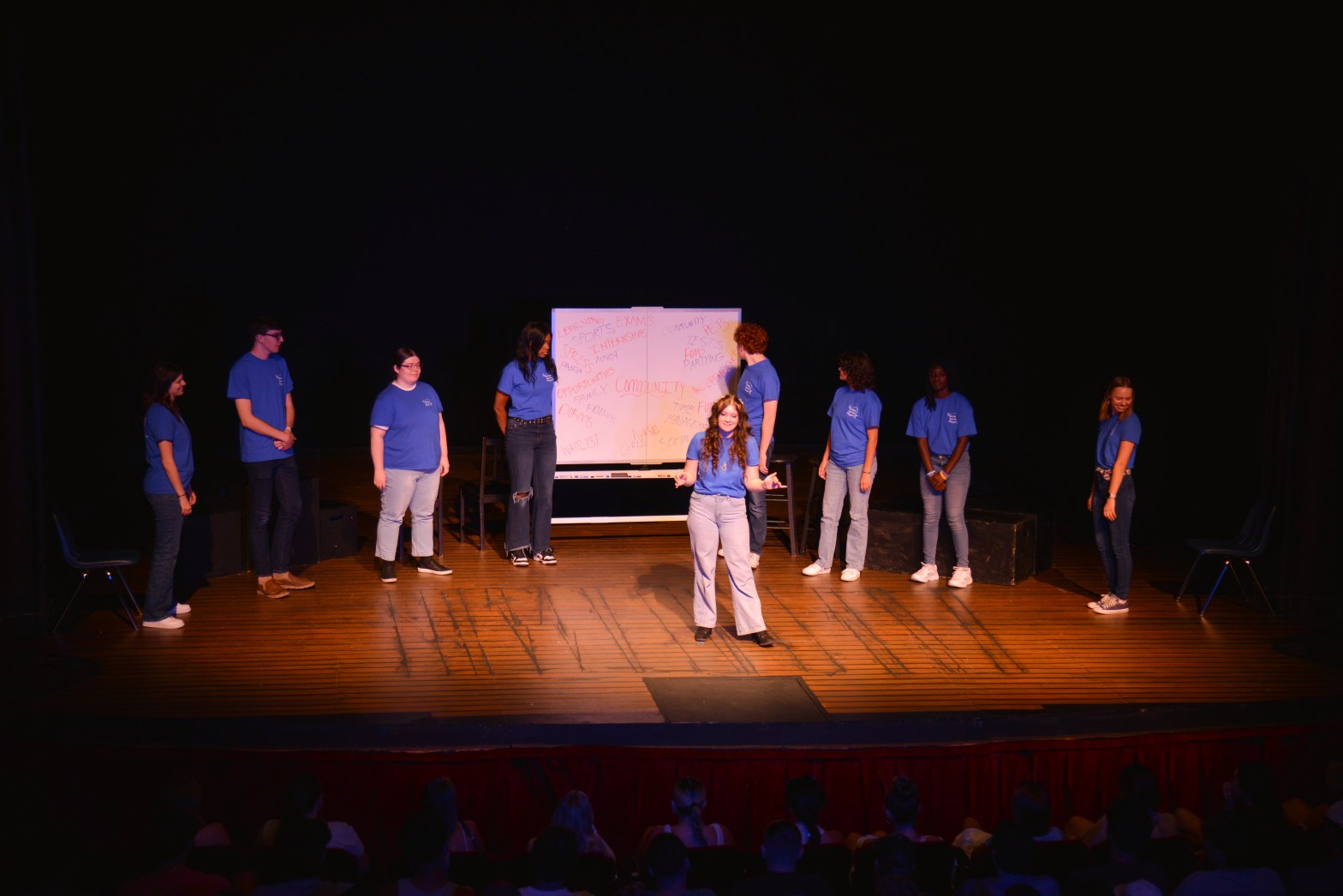
Game Library: “Statues”

Players will find themselves in odd positions in this justification classic.

The Basics

Team members (typically four) spread across the playing field. Audience members (or an opposing team) have a limited amount of time to quickly pose each improviser’s body into a specific pose. The sculptors then leave the playing field. A location or inspiring ask-for can be gathered by the host (or players can use nothing more than their positions to launch the action). One at a time, plyers unfreeze and come to life, justifying their prior statuesque positions as important facets of the unfolding story.

Example

The team stands onstage at the ready, and four audience members place them in dynamic poses as the host leads a ten-second countdown. Amongst other components, Player A has been modeled to cover their eyes with their hands, Player B is lying on the ground with their hands over their chest, and Player C is crouching upstage behind a large block. The volunteers leave the stage, and the host decides to grab an ask-for – “cemetery” – before the lights fade to start the scene.

Player A: (stumbling forward as they become animated) “Okay, I’m trusting you, but this is really the strangest first date ever.”

Player C: (from behind their block, jovially) “Just a few steps more, and you can open your eyes…”

Player A: “And you’re not going to give me even the slightest clue as to where we’re having our picnic…?”

Player C mischievously darts behind another obstacle to prolong the game, just as B, a seemingly dead body, slowly starts to reanimate much to C’s shock.

The Focus

Enjoy the challenge of really using your poses in connected and important ways as the building blocks of a unified scene. This format shares a great deal with Scene from Music (discussed here). The mechanic for finding the opening positions is different, but the tools for successfully incorporating those poses remain largely the same. So, review this earlier entry to further expand on the concepts below.

Traps and Tips

1.) Make the most out of your poses. Use every detail of your assigned pose to the best of your ability. It’s anticlimactic (and not particularly helpful to the scene) if you quickly drop the essence or energy of your position just to do or say that thing you wanted to do or say anyway. When the poses really shape the characters, action, and story, the game will similarly deepen and expand.

2.) Make space for your teammates. It’s helpful to think of every unfreeze moment as a unique form of character entrance. Once you’ve found a way to justify your physicality, make sure you’re keeping an eye out for others who are in the process of doing the same. If you sense another player coming to life, give them focus so that their choice can be seen and heard by the cast and the audience. Excited over-talking will rob the scene of these pivotal moments (and the company of the innate gifts contained within each justification).

3.) Make every unfreeze count. Players might find themselves quickly joining the fray within the first few beats of the action, but generally, the scene benefits from patient and disciplined additions. I’ll often play this game as a one- or two-minute scene, and in these cases, it’s common to have at least one player remain unutilized until the climax or latter portion of the story. When you pace entrances deliberately, each new entering character can help advance the story to its next exciting moment. When everyone panic unfreezes in a clump, you’ll often meander to the end of the scene without the gift of an expertly timed reveal or discovery.

In performance

For a fun twist on the game, consider Reverse Statues where players must end up in the given poses rather than start with them. Once positions are set, players can start the scene on- or off-stage as they wish. (Just be careful not to set up a bunch of furniture in the countdown that will then get in the way of achieving the desired tableau. If you want a more dynamic arrangement of blocks or set pieces, put these in place before cast members are assigned their random positions.)

New to ImprovDr.com or the Game Library? You can find the ever-expanding collection of games, exercises, and warm-ups here.

Cheers, David Charles.
www.improvdr.com
Join my Facebook group here.
Photo Credit: Tony Firriolo
© 2025 David Charles/ImprovDr

Game Library Expansion Pack I