Game Library: “Reiterate/Repeat”

This entry spotlights an elegant little exercise that embodies the first commandment concept of blocking (negating) and accepting (yielding). Let’s explore Reiterate/Repeat.

The Basics

Generally, but not exclusively played in pairs, players create a scene where each subsequent line of dialogue must first reiterate or repeat the essence of their fellow player’s prior line of dialogue before adding new material.

Example

Player A: “It’s a beautiful day for a picnic.”

Player B: “It is a beautiful day for a picnic. I just happen to have the perfect picnic blanket!”

Player A: “The perfect picnic blanket?! You won’t believe that I have a basket already packed!”

Player B: “Already packed?! Then jump on my bicycle and let’s go…”

The Focus

As you play, it quickly becomes clear that the reiteration is a literal equivalent of the improv “yes…” with the new information serving as the “and…” As an added bonus, the game truly promotes active listening as you can’t repeat something that you were too distracted to catch and similarly encourages small and inherent steps as your addition should build clearly off the prior idea.

Traps and Tips

1.) Don’t abandon the language game too early. Encourage players to really embrace the central dynamic as the excitement of the scene can quickly result in no longer using and reaping the benefit of the given frame. This has the added advantage of slowing overeager players down a little, enabling them to pay closer attention to the details of the scene as they unfold.

2.) You can take liberties with the repeats. Reiterations and repeats need not be cumulative (you don’t need to paraphrase all prior choices), nor do they have to be literal. You can shift emphasis, change pronouns, and abridge the content as it feels appropriate. In fact, I’d say taking such liberties is half the fun of the game.

3.) Repetitions shouldn’t become “filler.” Avoid the trap of repeating the prior line in a non-emotive manner: it helps for you to have a clear point of view and energy rather than using the repetition as a stalling device while you come up with what you’d like to add. Give it a nuanced subtext and full emotional weight. (Always turning the reiteration into a question can have a similarly postponing effect, too.)

4.) Push to the action. This is good advice for all scenes and exercises, but the verbal focus and nature of this game makes it particularly prone to becoming a talking heads dynamic. Make sure you’re not just intellectually musing about things but that they actually transpire as well.

5.) Explore different tempos and heats. The resulting game can have a shorter shelf life as a scene, especially if players really allow the energy to build between each offer. Challenge players to explore a more gradual build or assume a “kitchen sink” premise to prolong the game and its benefits.

In Performance

This is probably not an approach you’ll use frequently within an improv evening although it can be a great way to kick-start a scene or get onto the same page with another improviser with whom you may not be initially gelling. Style scenes with elevated speech, on the other hand, can often really benefit from this dynamic: it has a nice Shakespearean feel, in particular, and can encourage fun word play and connections.

This is the first contribution to the ImprovDr Game Library where you can access a wealth of exercises, warm-ups and performance frames. Further explore the library here or head over to the search engine here.

Cheers, David Charles.
www.improvdr.com
Join my Facebook group here.
Photo Credit: Tony Firriolo
© 2020 David Charles/ImprovDr

Connected Concept: Commandment #1

Commandment #1

The first Theatresports Commandment is:

Thou shalt not block

Blocking refers to the energy of unhelpfully avoiding others’ ideas and choices onstage.

Complicating the Strategy

This is just a taste of this entry/concept. Go here for more information.

Cheers, David Charles.
www.improvdr.com
Join my Facebook group here.
Photo Credit: Tony Firriolo
© 2020 David Charles/ImprovDr

Connected Game: Reiterate/Repeat

Six Great Times to Ask a Question

There are a lot of improv “rules” floating around, typically designed to assist the novice improviser as they take their first steps on the stage. Some practitioners express an overt skepticism to such rules in general, noting that they don’t necessarily lead towards more successful improv but instead more in-you-head-improv. Overall, when taken with a grain of salt, I believe that such guidelines are more helpful than hurtful, offering up players some best practices to increase the likelihood that everyone is working together in a helpful fashion and in a similar direction. I think that there is also something to be said for the fact that most experienced improvisers can rattle off these inherited norms which provides some semblance of a foundational philosophy uniting improvisers when we get together for festival jams and all-plays. In the 1980’s, when I was first introduced to improvisation, Theatresports in New Zealand even formalized many of these nuggets of wisdom in its “Ten Commandments” that I still have in a dog-eared manual from my high school days.

One such rule (though interestingly not a commandment – I just checked) is the notion of “Don’t ask questions” in your scenic work. The rationale generally observes that this habit puts all the generative work on your scene partner, while the questioner essentially steals away the momentum and spark of the scene. As with most less-than-helpful improv habits, asking questions tends to emerge from fear: fear of not quite understanding what your partner was intending; fear of not coming up with the perfect addition to the scene; fear of being vulnerable or looking out of control for a moment.

I have frequently seen this type of fear-induced improv onstage and in the rehearsal hall. It usually takes the form of lackluster dialogue such as “What is that?” or “How are you?” or “What are you doing?” often at the top of a scene when little has been established. I imagine these moments are familiar to us all. And, generally, such moments don’t add energy or interest and do punt the ball back to the other player without any resonating potential or detail. While I agree that this type of question asking doesn’t typically lead to joyful scenic work, I would offer that the improv community doesn’t often talk about when questions in our scene work are helpful or perhaps even critical for our creative success. Yes, I agree that mundane questions generally lead nowhere, and furthermore that assumptions are typically more dynamic, but not all questions are created equal nor used in the same energy-draining way.

And so I offer six great times to ask a question:

1.) You didn’t understand your partner. I’ll start with perhaps the simplest scenario (and one that probably occurs with greater frequency for those of us teaching and playing online at the moment). If our partner has made a rich and grounded choice, and the acoustics, audience applause, internet connection, their accent or dialect, other onstage business, or perhaps even just our own inattentiveness, obscured this offer in such a way that we just didn’t receive it, I strongly believe a check in along the line of “What was that?” or “Would you mind repeating that?” is appropriate. A quick question strikes me as infinitely more helpful than making an ill-conceived assumption that might actually completely negate the intent or nuance of our partner’s choice. Sure, our response based on a misheard fragment might get a laugh, but especially in a long-form or narrative setting where we’re striving to more patiently build an arc, this will often be inferior to a more honest reaction stemming from what our partner was intending. We don’t hear each other at times in real life, so we can certainly have that happen to our characters onstage too. Here, I believe a question is an act of honoring our partner’s gift and making sure we are fully appreciating the intent behind it. As an improviser predominantly working in the United States who still very much has a New Zealand idiom, I’ve also included dialect and accent on my list of potential contributing factors as I’m aware that, despite my efforts to the contrary, I have been the source of miscommunications and I’d always rather have my fellow improviser (as their character rather than as the actor preferably) seek quick clarification so that the scene can then continue to dance forward.

2.) You immediately answer the question yourself. Though this perhaps isn’t a good reason to ask a question in the first place, it is a helpful strategy for those moments when a bland one slips out. If you inadvertently ask your partner, “What is that?” and then immediately follow up with “You found my missing engagement ring,” or “That is the answer sheet to our history test this afternoon,” or “We agreed that we weren’t going to bring home any more stray animals,” then you’ve quickly taken a dull choice and given it some added luster and specificity. If the initial dull question was primed with a strong emotion or point of view, then this works even better with the second choice adding content to the tension or dynamism of the first. Essentially you’re playing “yes, and…” with yourself at this point, noting that your “yes” wasn’t the most inspiring offer at first.

3.) You are playing a role that would usually ask questions. This is perhaps the most obvious exception in my mind, and while many would agree that we want to avoid transaction scenes and that questions are often at the core of these dynamics, some scenarios almost demand that we embrace our function at least initially as the questioner. A teacher calling in a student to a conference, a mechanic initially examining a car, a doctor giving a patient their annual exam — it is not unlikely that each of these scenes might take its first steps with some paradigmatic questions… “Did you get any help writing this paper?” or “Do you know where the clunking sound was coming from?” or “So what brings you into my office today?” I would suggest that we wouldn’t want the scene to typically consist only of one-sided open questions, but it is not unforeseeable nor unhelpful for this dynamic to emerge and help provide the platform or balance of our world. In this particular case it could also be a fun inversion to use questions but have them come from the unexpected character, so now the patient asks the doctor about their health issues. You could also apply the above strategy to up the heat so that “Did you get any help writing this paper?” is quickly followed by “Because I wrote one exactly like it when I was an undergrad.” Or, use the strategy below…

4.) You are asking a loaded question. In terms of question strategies, this is probably the approach I recommend most in my own classes. Acknowledging that questions will slip out and that we don’t want to get in our heads about it, I offer that it is the intensity of the question that is important. Most of us would agree that a “How are you?” is less likely to get creative juices going than “Have you been managing okay at home alone after your back surgery?” There is no reason that the question can’t in and of itself make nuanced assumptions about the world and relationship we are creating. The first question likely evolved from fear while the second clearly presents interesting opportunities for the partner and scene, especially if it is accompanied with a thoughtful physical action and perhaps justifies any previously established energies or circumstances.

A warning with loaded questions that is somewhat embedded in the surgery example above: improvisers should pay as much attention to how they are saying their question as to the details of the question itself or it can start to feel as if you are “cartooning” or announcing choices rather than giving them full emotional weight. In this way our inquiry about recovery could be showing great care for our partner, frustration that they keep calling for us to come around, or a more sinister hope that our plan to off our rival is finally working. Emotion and subtext here make all the difference. In short-form interview games where questions are central to the premise and structure, loaded questions are also an excellent way to give the interviewer a little more dynamism and weight as a character in their own right rather than merely a facilitator for the fun of the expert.

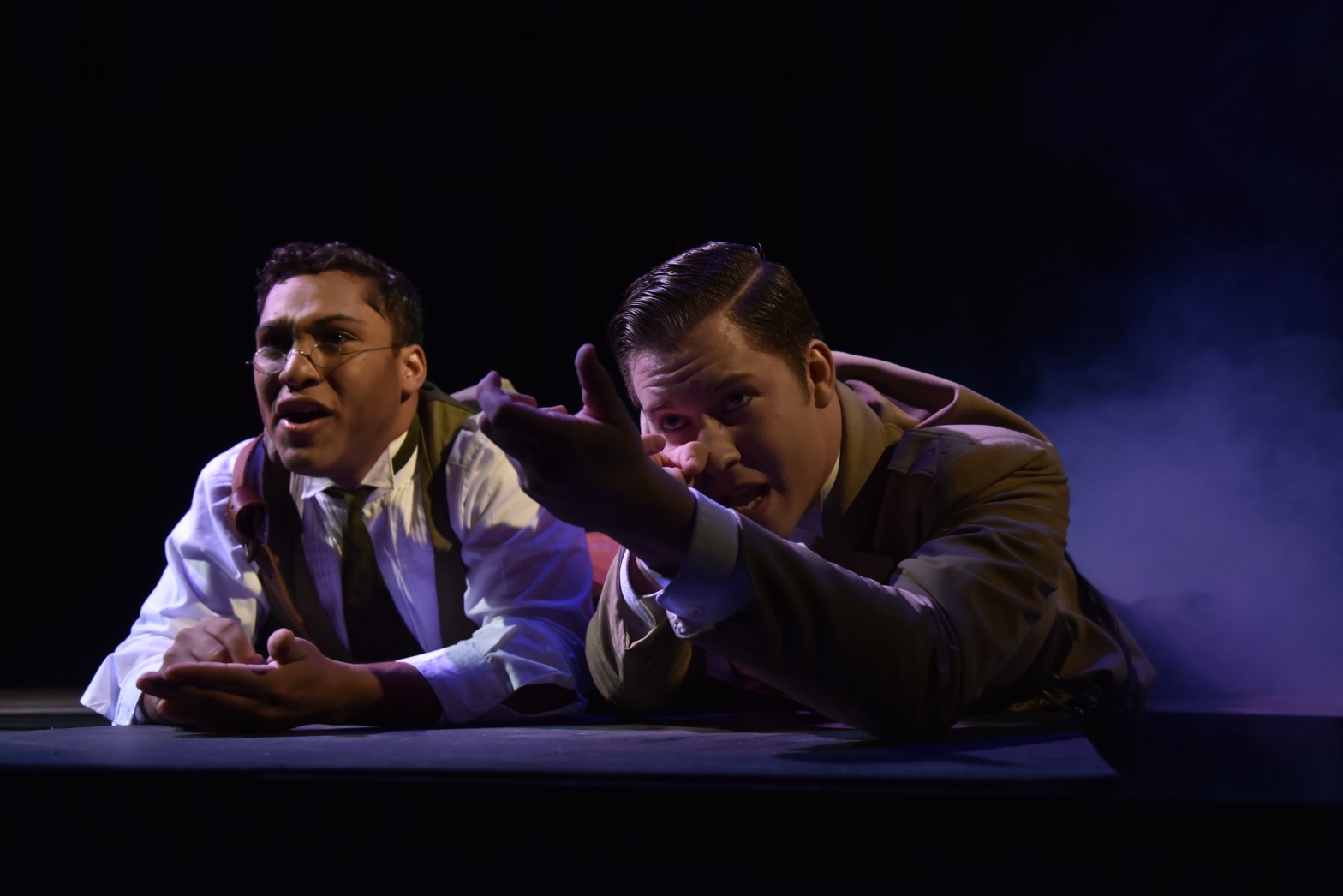
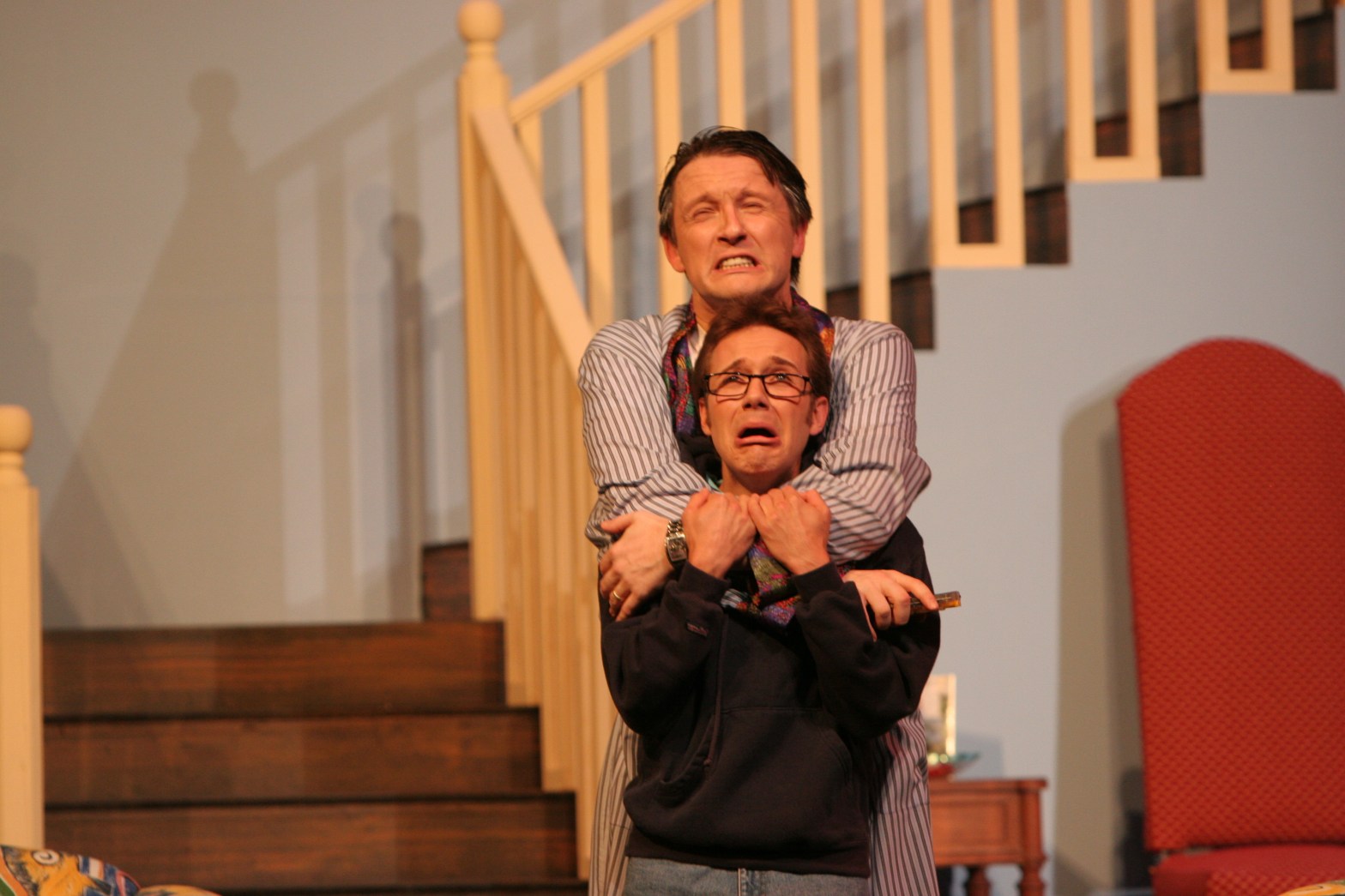
5.) You are using questions to heighten a game. Some scenes thrive on questions. The short-form game Questions Only or any of the multiple Expert variants serve as obvious examples, but there are many other situations where questions might add to the style or finesse of a scene. A cascade of questions can be thoroughly successful in a Shakespeare or period-specific scenario when they escalate and create tension or playfulness between characters. I can’t imagine Private Lies: Improvised Film Noir (pictured above) without a good dose of detective questions, for example, as that’s part of the gumshoe’s raison d’être. If a scene is exploring a more complex dynamic, such as in a mapping scene (where one scenario is played with the intensity and tropes of another) questions especially of a vaguer variety can help prolong the game and fun. If we’re playing a scene in which a parent has discovered a comic book but is mapping this moment with the energy of a parent discovering illicit drugs, a carefully pitched “What is this?” along with a suitable gesture will likely serve the scene well. Here the audience and players alike know the identity of the “this” so there’s nothing problematic about the choice. We often play a version of Old Job, New Job in our Gorilla Theatre show at SAK Comedy Lab which similarly deploys this mapping concept, and I could certainly happily watch a whole scene-full of questions coming from a doctor who used to be a mechanic: “Do you know where the clunking sound was coming from?”

6.) You are checking in with your scene partner. I’ve worked with many companies that deal with this issue in different ways but there are times on stage (stage violence, intimacy, or potentially triggering or sensitive material) when I would argue it is not only appropriate to ask a question, but it is critical that we do so. We’re improvising, and especially if you’re playing in a context where “mature” or “adult” themes might emerge, we need to keep the safety of our partners at front of mind. I think it’s important to note that I don’t really mean racy when I say “mature” or “adult”, although sadly I think that’s what a lot of improv inclines towards when it says it’s pushing the boundaries or is edgy. What I mean by these terms is that we’re dealing with material with sincerity and nuance in such a way that it might resonate deeply with our partners or audience. This is the type of edgy improv I’m personally most interested in. In these instances, a careful question can be an important way to check in with our scene partner, especially if this is someone we don’t know particularly well yet. If I ask, “Do you want to fight me?” in a heated exchange then my partner can have me take that action offstage if that is what they need to do. If I ask, “Would you mind if I kissed you?” then my partner can frame a response that can honor the energy of the scene while maintaining their personal boundaries: “I desperately want to kiss you, but let’s do it inside so the neighbors won’t see…” If I nudge into material that I can see is stirring my partner I can ask “Do you need me to leave now?” and then can honor their response while maintaining the integrity of the scene. I’ve found this to be a less commonly needed tool in troupes that have developed deep rapport and know a lot about each others’ comfort zones, but I think this is an important strategy to have in our pockets to maintain a safe and playful stage. It’s worth noting that this approach should also be applied to potentially racy material if the company hasn’t previously agreed upon performance parameters prior to the show.

A side note that, yes, with some mental wrangling many of the questions illustrated in the above examples could be wordsmithed into statements, but I’m not sure that is a good use of our energy and concentration as improvisers; and furthermore, modeling consent on the improv stage strikes me as an important result of not needlessly demonizing the act of asking a question in and of itself.

So these are my six notable exceptions to the “no questions” rule that many of us utilize in our classes and ensembles. All too often it strikes me that the “problem” is not so much that a question was asked, but rather the under-committed and non-specific way in which it was asked. Any questions? Have you found other situations in which questions are the best approach in your own scene work?

Cheers, David Charles.
www.improvdr.com
Join my Facebook group here.
Photo Credit: Tony Firriolo
© 2020 David Charles/ImprovDr

Politics and Improv

I’ve been struggling over the last week or so to find a voice that honors the important historic moment we find ourselves experiencing in the United States – a voice that serves appropriately as an ally without becoming performative, a tone that acknowledges my own privilege and need to grow while empowering and adding important volume to others, a way to express myself honestly as an artist without being blind to or distracting from the critical and timely struggle of the Black Lives Matter movement. I haven’t figured the balance out, and I offer this post with that context in mind, because there are moments when I think it’s important that we add our imperfect voice rather than remain silent or absent for fear of not being the most paradigmatic ally or having the best observation or the sagest wisdom.

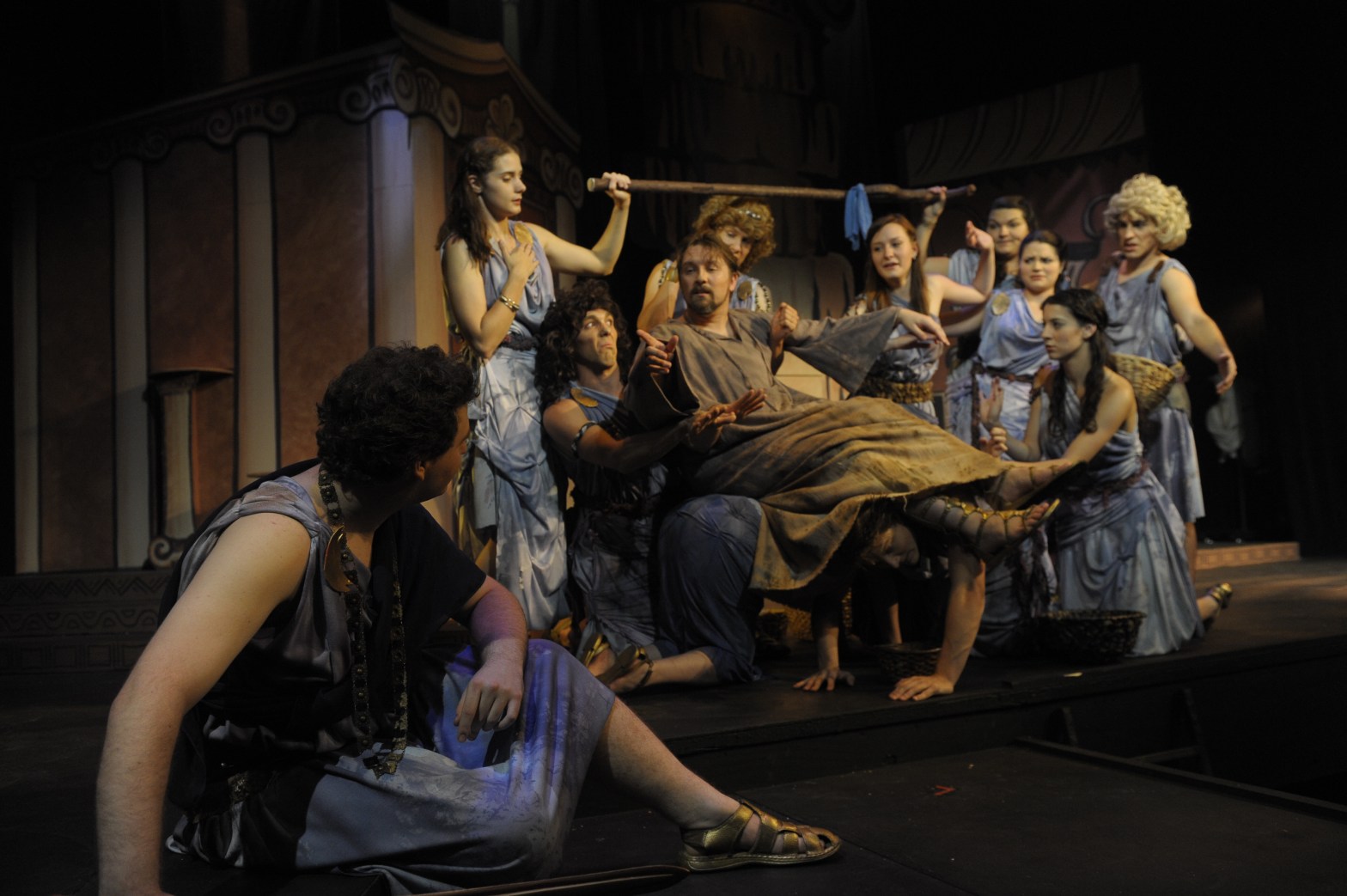
I offer this first blog post back from my hiatus from the vantage point of a theatre historian, a lens that I admittedly don’t overtly utilize much in my current life as an improv practitioner, although I’d note my historical and critical musings have very much informed my practice and strategies. I’ve been thinking a lot lately about what the role of improv should/could be in the current political discourse and what responsibilities we might have as practitioners as we wield this tool. I’ve also been thinking a lot about Carlo Goldoni and Carlo Gozzi, two theatre makers working in eighteenth century Italy during a time of social unrest as the rising middle class sought to grasp power from an increasingly ineffective and unresponsive elite. If you haven’t heard of them before, I was in the same boat until I stumbled across them in my studies. That’s Gozzi smugly smiling at you in the image above.

Many improvisers tend to think of our craft as innately progressive or radical as it has a tendency to question, satirize or undermine institutions of power, and this has often been the case historically. The performer in general, and the improviser in particular, has been legislated and viewed with distrust by the hierarchies that control the means of production: this mistrust and control acknowledges the inherent and potentially subversive power in the act of performance. Religious figures were banned from commedia dell’arte stages across Europe for fear of the contempt or ridicule that might occur, the Mexican carpa and Boal’s Theatre of the Oppressed often served and represented voices that were otherwise disenfranchised or prevented from entering social discourse, and Keith Johnstone’s initial improv demonstrations literally defied England’s Lord Chamberlain’s role as theatrical censor for the Crown as there was, in fact, no script to view and control. In these, and many (most) other global traditions, the impetus to “punch up” and take aim at those in power is clear and connected to the very core of the improvisational performance instinct. If you take yourself or your institution too seriously, improv has the critical power to hold you up for closer inspection and to proverbially or literally knock you off your high horse.

There are a handful of examples where improv has appeared in a more conservative manner (conservative here meaning it displayed a clear interest in conserving current power systems and inequities.) Japan’s improv performative tradition of renga poetry became incredibly formalized and elite (although there were instances of a more accessible companion form), carnival traditions arguably serve as moments of temporarily suspending power systems only so that they can shortly return in full force without further question or challenge, and then there is the eighteenth century literary and theatrical feud between Gozzi and Goldoni.

This isn’t the place to get bogged down with too much of the minutia of this historic moment but here are the broad strokes. Carlo Goldoni, also known as the Italian Moliere, was born as a member of the upper echelons of the Venetian “common people” and he had lost patience for the stale traditions of the “improvised” commedia dell-arte. At this time, so much of the craft and lazzi had become essentially set that the audience could almost speak the dialogue along with the supposedly improvising performers. (A quick note that mature commedia dell’arte always seemed to straddle the line between generating and recycling material.) Goldoni also had some issues with the immorality of these shows, and the lack of a true and nuanced representation of the emerging middle-class, to which he belonged. His solution was to breathe new life into these characters by incorporating them into an essentially written literary tradition where he could more deliberately take aim at the useless and out-of-touch aristocracy. Among his better known plays is The Fan which is a good example of how he elevated the middle class while taking some deserved knocks at those who had long since ceased to be of any real service to society.

In response to Goldoni’s efforts to use the commedia dell’arte characters and devices as a sharper satiric tool, Carlo Gozzi emerged as his theatrical rival. In simple terms, Gozzi embodied the very aristocratic leech that Goldoni had so successfully brought to the stage and critiqued. He was the embodiment of privilege, unearned status, and patriarchal oblivious excess. As Goldoni had done, Gozzi also deployed the commedia dell’arte masks, but in many cases he retained their bawdy impromptu nature, allowing particularly the lower class characters comedic freedom in his fiabes or fables, such as The Love of Three Oranges. These plays were sumptuous escapist affairs with little in the way of social commentary or satire: his scripted prologues often set the scene and actively invited his audiences to return to a dream-like and intellectually disengaged childhood wonder.

As practitioners, there are obviously a myriad of paths forward as we contemplate returning to the theatre boards post COVID, and yet this struggle between Goldoni and Gozzi has returned to me perhaps as an historical warning of sorts. Goldoni sought to breathe fresh air and social commentary into his commedia dell’arte inspired characters and plays, and consciously held up an archaic system of rule for ridicule. While you could make the case he greatly diminished improvisational freedom, he retained or perhaps re-inspired an approach to art that sought to give voice to the masses. Gozzi, on the other hand, retained the guise of improvisational freedom, but pursued an escapist tradition in an effort to sustain the status quo. He maintained an appearance of improvisation, but arguably, inverted its inherent promise or responsibility, deploying it as a means to appease and ultimately control the masses with frivolity and fantasy.

There are several lessons I take from this distant historical moment. Our art will always be framed, inspired and informed by the political landscape. As improvisers and artists, we can adopt an apparently non-political stance, as Gozzi did, but often our unwillingness or inability to face sociopolitical realities merely results in us upholding the status quo. Escaping into the theatre or our craft may strike us as necessary or appropriate — “everyone needs a break from what’s going on in the world” — but this also smacks of un-interrogated privilege as not everyone is able to or wants to put aside this moment of import. Is this really a moment to blow off collective steam in the theatre (a critique often leveled at Aristotle’s concept of catharsis) or rather a time to find new agency and ways of empowering voices and narratives that need a space now more than ever? As practitioners, do we want to allow our craft to become so stale and “set” that it no longer serves our constituents, as was the case with commedia dell’arte when Goldoni interceded to return agency and vibrancy to the craft? Or do we want to commit to use the unique tools of improv to respond honestly and powerfully in the moment, “punching up” while lending our hands, voices and stages to those most in need?

While I predictably know my own answers to my pedantic questions above, I will confess that I do not know exactly what this reactive and informed improv should look like in my own work. To use my campus troupe as an example, our short-form show is much less likely to be able to interrogate issues of racial injustice and inequality with appropriate depth than our long-form narrative work, although there are also problems here in terms of representation and finding ways to engage current affairs responsibly. As with many improv companies, we still have ample room for growth in terms of racial diversity and inclusion, although we have done better in terms of balancing sex in our casting and have a long history of strong female improvisers excelling in positions of leadership. In general, however, for many improv can still feel closed, inaccessible, or predominantly straight, white and male.

In some contexts, I’m thinking particularly of competitive-style short-form shows, bringing current political issues front and center into our content may feel jarring or inappropriate as it runs the risk of minimizing the issues at hand or, perhaps worse, might give the impression if done without care that we are poking fun at the very communities and tensions that so urgently require our attention. But even in our most joyful and lighthearted enterprises I believe we should honor that the world and stage can not merely be business as usual. I wonder if exploring creative partnerships, organizational sponsorships, pre- or post-show speakers or discussions, offering curated resources and the like could be a first move to frame our improv events in a way that acknowledges our greater responsibilities as artists. And perhaps we should not unduly focus all our attention on our onstage material but also interrogate how we are representing, supporting and building up our larger communities in general.

Regardless of the specific next steps we each take, however, I hope we can all agree that we shouldn’t be a Gozzi, an out-of-touch aristocrat crafting escapist fables designed to draw attention away from the fact that we are simultaneously perpetuating, masking and embodying the very problem we need to address as a society.

Don’t be a Gozzi.

Cheers, David Charles.
www.improvdr.com
Join my Facebook group here.
Here’s an interesting article about race and improv from American Theatre.
© 2020 David Charles/ImprovDr

My First Improv Steps in Stripy Socks

As I’m deeply missing playing on the improv stage and eagerly looking forward to the time that will happen again, I can’t help but think about my first steps into this spontaneous art-form that tends to keep its claws in you once it takes hold.

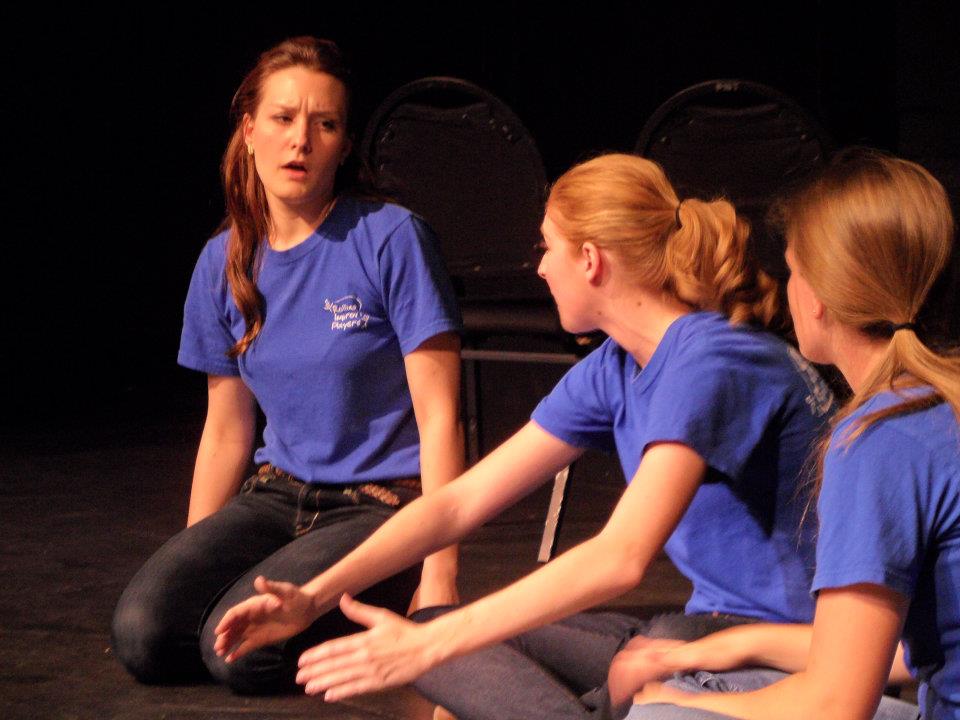
When I reminisce about my teenage years in Dunedin, New Zealand, the images can tend to feel a little Dickensian. I oftentimes describe my family as being “blue t-shirt” rather than “blue collar” as we couldn’t afford the collar to the shirt. My father was an Anglican minister (not a career path for wealth in NZ) and my mother was a solo parent on welfare due to some complicated medical issues. In New Zealand, being poor still meant you had access to a great education, housing, healthcare and a social safety net, and I came from a family that had really never valued “stuff” growing up, but I do recall some pretty bleak holidays and birthdays in terms of material elements – getting a toothbrush and facecloth for Christmas, sharing a tin of spaghetti and meatballs on my Mum’s bed that I had warmed as my birthday dinner, receiving food hampers from the Salvation Army on a pretty regular basis. Luckily, I certainly never wanted for love or a sense of value and belonging, and boy did we laugh, often at our seemingly grim plight.

We had bounced around geographically when my family was still together following my father’s various appointments in the Anglican church, but had settled in Dunedin as family lore goes so that me and my three siblings would have access to better schools and employment opportunities. My parents had divorced by the time I had made it to my high school years, and I followed my older brother and sister to Logan Park High School. I was “painfully shy” as a child, and I credit LPHS with a lot in terms of bringing me out of my shell, introducing me to theatre in general and improv in particular, and opening door after door for me which culminated in auditions for theatre programs in the United States with my high school thespian troupe. We had excellent teachers, a culture where student cliques often evaporated in our theatre auditorium, and as I found connections and friendships in my drama classes it also became easier to find a place in the sea of uniformed bodies.

During the late 1980s Theatresports was in an enviable position in New Zealand. With generous sponsorship from the United Building Society, the short-form franchise was branded as United Theatresports and funding included money to pay for local improvisers to train and mentor high school students taking their first steps. In my sixth form year (US junior) I fond myself in such a workshop with the formidable Stayci Taylor as our teacher, and the rest, as they say, is history. Suddenly I was in a space where all those weird things I liked to do, like make up original songs while walking down Pinehill Road to school, had a name and a value. I recall volunteering to try improvising a song in one of those early sessions, and much to everyone’s surprise, including my own and certainly Stayci’s, I sort of did. Needless to say, I was hooked.

I don’t completely recall how we banded together, but soon I was in a team with three fellow students: Jason, Sarla and Jane. If I am remembering correctly, when it came time to settle on a team name, one of the ladies (I think it was Jane) offered that she had a large collection of long stripy socks, and so these became our dress code and our title. Much like these socks, in all the best ways, we were a rag-tag collection of folks you’d probably never consciously put together on a team, but we were relentlessly playful, and my teammates were willing to put up with my type A tendencies that were already amply present, making jars of ask-fors pre-written on slips on paper so we could just quickly draw one to inspire our rehearsal scenes, and the like.

Yes, I still have those jars. Thirty years later. They are in my quarantined office at work or I’d provide photographic evidence.

Theatresports had a pretty limited set of stock games in those days at least for those in the high school league (in addition to a snappy anthem extolling our sponsor) and we certainly did better in some of those structures than others. Our penchant for songs, and the luck of the draw in our local competitions got us to the first high school national finals and a trip to the North Island where the fates of improv did not smile as brightly on us! We certainly lacked the polish of some of our northern countrymen and women. I don’t think they quite knew what to make of us and our costuming choices. We placed third.

I owe a lot to those early Theatresports instructors, Stacyi Taylor, Patrick Davies and Martin Phelan specifically, as they also quickly opened doors for me into Dunedin Theatresports and soon my first paid gigs as a performer. They also taught the craft in a beautifully nuanced way, privileging story and connection, and were kind but unflinching in their feedback. I am also deeply grateful that from the get-go I had strong female role-models in the craft. My high school drama teacher, Denise Walsh, certainly deserves mention here too, although she is worthy of an entry all of her own.

And so, as the blog title states, I literally made my first steps as an improviser in knee-high stripy socks on an improv team of the same name.

I leave you with this refrain etched into my brain that we all sang before each performance from those days: “A story or verse, you just can’t rehearse, The sort of a sport you improvise… It’s United Theatresports. It’s United Theatresports.” Let it be said, it’s also the only sort of a sport that I’ve been able to play with any modicum of success. What sport has improv saved you from?

Cheers, David Charles.
www.improvdr.com
© 2020 David Charles/ImprovDr

Zip, Zap, Zoom: Focus and Online Improv

I’m teaching a couple of classes through Zoom for SAK University at the moment (one on narrative and the dramatic arc, the other on Shakespearean language and style, – thanks for asking!). During my spring semester at Rollins College in Winter Park, I also had to suddenly move an Acting course and Fundamentals of Improv class online with little notice as well. Needless-to-say it’s a steep and daunting learning curve to make theatrical performance work through an often less-than-reliable online medium. I know I’m not telling you something you don’t already know there! Putting aside the discussion for perhaps another day whether such a move is advisable or laudable, online platforms certainly pose new challenges (opportunities?) for live improvisers. (I do think it’s important to note here that companies such as the Hideout Theatre and Impro Theatre here in the States have been making valiant and exciting experiments in this area.)

A current student posed the question with this new technological reality in mind as she’s exploring a new project of her own: “What exercises have you found to be best for working on sharing focus in a scene?” First, I should contextualize my following musings with the disclaimer that, like many of us, I have been thrown into this new performance reality with little warning and that my experience in this world is no deeper than most. But here are a few focus-related discoveries in terms of what has seemed promising to me when working scenes and games in the digital classroom that has become home to so many of us overnight.

1.) Keep it small. At first I aimed to keep my syllabus and structures as planned, but I quickly found that the more students or improvisers that we used in a scene, the more likely communication missteps undermined the veracity and flow of the action. When I simplified nearly all of my scenic work into pairs (sometimes with a third waiting with “camera off” in the proverbial wings in case they were needed), the process and results became noticeably stronger. In this way, actors can also set their scene partner as their exclusive focus on the screen and have a fighting chance to make a more honest and fruitful connection. If you are playing in a larger group, turning off your camera as your character leaves is an obvious but helpful choice as well to minimize visual clutter.

2.) Don’t ramble. A move online has, for many of us, made us rely too heavily on our verbal gifts as improvisers and it’s easy for our bodies to become disengaged and for our words to lose specificity and agency. If we are cognizant that our words must carry the majority of our meaning and offers, then we must be economical and deliberate with those words. We should use each word with care, and make sure that we are providing clear and dramatic final punctuation. As our partner(s) await behind the screen, it doesn’t set them up for success if they are constantly unsure if we have, in fact, finished our sentences… or if… we’re still contemplating… how we might finish… our sentence. You get the picture.

3.) Use old-fashioned gives. My introductory improv classes always include a unit on giving and taking focus as I note, without a playwright or director in the traditional sense of those terms, we are responsible for always knowing where the focus should be on stage at any given moment. Especially if you’re in a larger group, throwing the focus carelessly into the air will typically create either a prolonged awkward silence or a cascade of overlapping dialog as your teammates try to figure out who was organically next in the scene. Use character names often (or familial equivalents, honey, son…) to mark the next likely speaker especially as the scene is being established. Clearly shift your focus and the target of your emotion on the screen to designate your focus throw, and explore tonal shifts to provide clues to your partners: most of us don’t talk to our parent with the same energy/voice that we talk to our significant other, and we can mine these distinctions to help share focus around.

4.) Scenic painting can help. If you can find simple ways to refer to your environment, and the people in it, you can set each other up for clear entrances and initial dialog exchanges. If we’ve been sitting at that restaurant table waiting to be served for what feels like an eternity, observing the carefree waiter who seems to be avoiding us, when we note that “I’ve finally caught his eye” and “he’s coming over,” we have set this actor up for a clear focus transition. If you don’t have the technology or skill to make clever green-screen background changes or add ambient sounds, heightened scene painting strikes me as a must in general as it allows for more fully fleshed out worlds to play within.

5.) Err on the side of interruption. This may be a personal preference, but the dead air between speech acts in zoom-based improv is one of the features that makes it most uncomfortable for me as an observer. If we’re using some of the strategies above, we then need to jump into the scenes with abandon thereby risking cutting off our partner(s). If someone interrupts you, embrace that they clearly thought you were wrapping up (or that you should have been wrapping up). If, as a group, this becomes too caustic or combative, check in afterwards and adjust the aggressiveness of your takes accordingly. Connected to this is making sure that your scenes have an energy that would justify such a strong approach to focus gives and takes. Deadpan or under-energized characters are equally as problematic on the screen as they are on the stage.

6.) Use the technology. For good or evil, this is the way many of us are improvising at the moment. If your audio cuts out, that needs to be justified. If you didn’t catch what someone said, you need to honor that and ask them to repeat it or make an assumption. If you’re a professional at changing backgrounds or have someone who is adept at wrangling different improvisers and screens onto a common online stage, then make sure that person is deeply thanked and use those dynamics to the best of your abilities. Again, perhaps a personal preference, just note that meta scenes about characters using zoom have largely been played out so look for content elsewhere.

It’s a little difficult for me to pinpoint precise exercises to develop each of these strategies as, in most cases, it strikes me that it’s largely about getting in reps under these new performance conditions; however, I think moving through each of these ideas as the point of concentration would help a lot. “We’re going to do 2-person scenes exclusively for this next round,” or “Let’s do some vignettes with strict limits on word counts,” or use the short-form game “Speak in Turn” to practice using a deliberate and repeating order. Then rinse and repeat, focusing on the techniques that feel most useful to your particular group and circumstances.

For those teaching and performing improv online, do these strategies resonate with your own best practices, or have you found other ways to make the most out of your zoom room?

Thanks for the question! Feel free to pose others in the comments below or by emailing me HERE.

Cheers, David Charles.
www.improvdr.com
Join my Facebook group here.
© 2020 David Charles/ImprovDr

Welcome to ImprovDr.com

Hello! Let me take a moment to introduce myself and welcome you to ImprovDr.com. I’m David, and I’ve been an improvisational practitioner for over 35 years now. I’ve spent the bulk of my professional and academic life writing about, dreaming about, and figuring out different ways to use improv in my teaching, directing, and on the stage as a performer.

Take a look around the website to learn a little more about me and my various experiences and projects. I’ve called my blog “The Short and the Long of it” as I’m one of those improvisers who likes to play on both sides on the fence, and as many do, believes that skills learnt in one style truly make you stronger in the other: are there still (m)any folks out there who don’t agree that these are really two parts of the same thing despite any posturing to the contrary?

A little about my journey: I was introduced to improvisation through Theatresports in my home nation of New Zealand during the late 1980s, and those lessons have deeply shaped my view and approach to the craft. (Shout out to Logan Park High School and Stripy Socks where the passion began – more on that in another post!) During the early 90s I came to the United States to study theatre and was a financially poor but artistically enriched student at Roosevelt University in Chicago. While I played with ComedySportz and later studied at the Players Workshop of the Second City, I now kick myself looking back on those days that I didn’t have the time and money to fully take advantage of all the amazing things that were happening at that special time in that dynamic place.

And then, as I often joke, I followed the Mississippi river (loosely) to Western Illinois University in Macomb for my MFA and then to Louisiana State University in Baton Rouge for my PhD. Because, of course, nothing makes more sense that someone committed to improv leaving Chicago in the mid-1990s… These new locations, needless-to-say, had much less access to improv, and so like many have done before me and will continue to do so now, I made as many opportunities as I could, creating shows and organizing troupes as there wasn’t anything ready-made, all the while reading up on anything I could get my hands on to further expand my own horizons.

In 2003, my doctorate fresh in hand, I relocated to the Orlando area in Florida to accept a teaching position at Rollins College, where the improv continued, and I had the good fortune to quickly connect with Sak Comedy Lab. This venue has been my professional improv home for about 20 years now minus a hiatus of 18 months or so when I was in the company of Walt Disney World’s now sadly defunct Comedy Warehouse. In the early 2000s there was little in the way of long-form in the area, and I’ve been doing my part to push that envelope whenever and wherever I can: on my home campus of Rollins, at Sak Comedy Lab, and in other Florida venues when they’ve let me onto their stages! This website includes some images and descriptions of the fruits (fresh or otherwise) of these improvisational long-form labors, and you’ll also see that I’ve never strayed far from being an active short-form player at the same time.

So, that’s the short and the long of it (this was probably more on the long side than I intended, but if you become a frequent visitor, you’ll quickly learn that I love words and am as verbose on the page as I am on the stage despite my best efforts to the contrary!) I’m going to strive to make weekly posts about games or techniques that I’m currently working with or musing on, and I also welcome you to pose any questions or conundrums that you might have in regard to this art-form that consumes so many of us so wonderfully and so completely. Maybe I’ll have a few thoughts that can help you unlock something in a new way.

Cheers, David Charles.
improvdr.com
Join my Facebook group here to be the first to know when a new game entry drops.
All website and blog material (c) 2020-2025

Looking for the ImprovDr “Game Library”? Then go here.

Or looking for the ImprovDr “A to Z of Improv” now in print with Routledge? Then go here. You can read about my journey creating this resource in this feature in Winter Park Magazine.

If you want to learn more about my improv path, you can listen to the RebelRebel podcast here or the Improv Autopsy podcast here and here.

Read my recent co-authored article in the Journal of Dramatic Theory and Criticism here.

And you can see some love for my blog from Feedspot here.