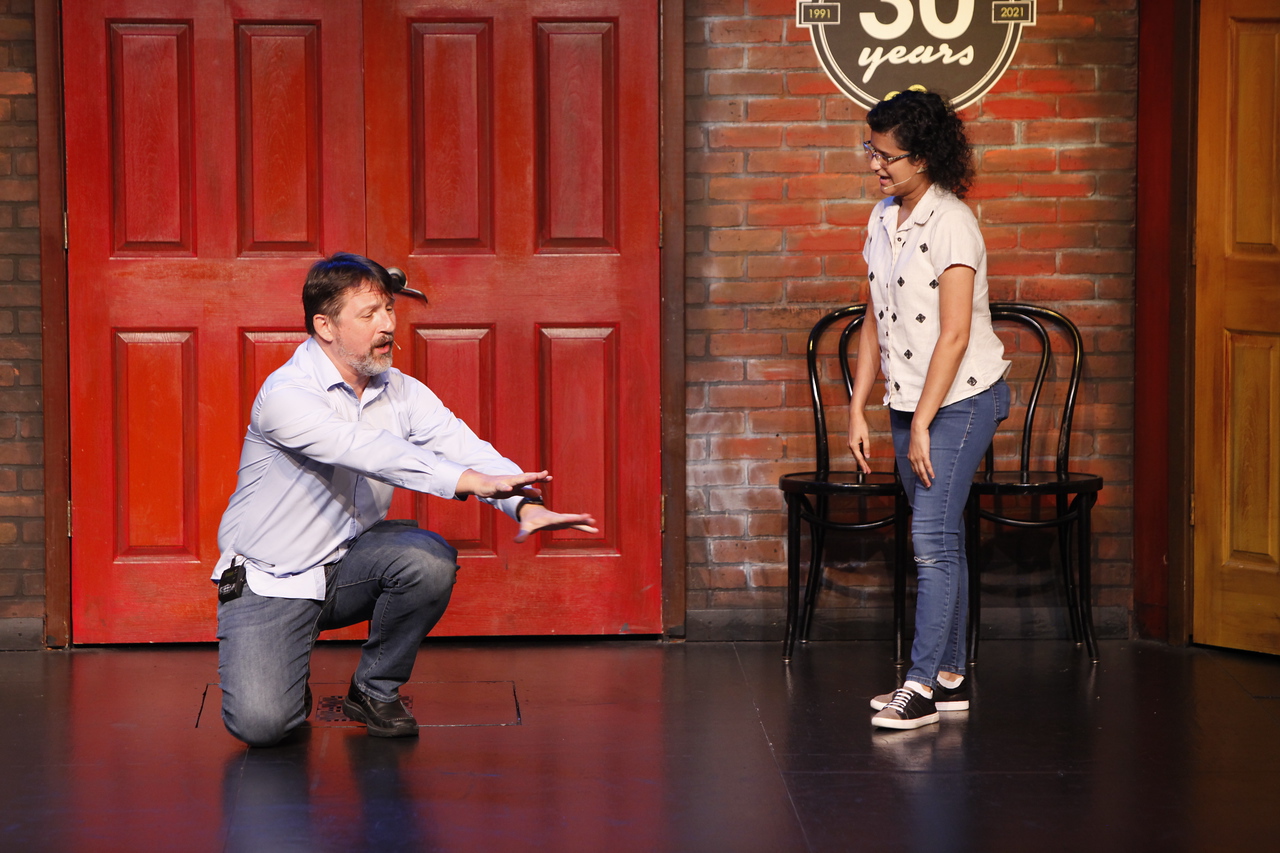
Game Library: “First Line, Last Line”

This game provides a quick hit as players must create a minute-long scene based upon two lines (or texts) obtained from the audience.

The Basics

Players elicit two disconnected lines, phrases, or texts from the audience and use these as the spoken bookends for a scene.

Example

The audience provides “You won’t believe who I just ran into” and “Just another endless day of work,” as the inspiration. Two players begin the scene huddled by a work photocopier as the lights rise. A third player, C, runs into the workroom.

Player C: “You won’t believe who I just ran into!”

Player A: (looks up from the photocopier) “Please tell me our boss isn’t wearing a disguise again to spy on us…”

Player C: “You guessed it – this time she’s posing as a photocopier technician. Shall we have a little fun at her expense…?”

Player B: (with great excitement) “Please!”

Approximately 40 seconds later, the undercover boss, Player D, has their hand stuck in the photocopier and is on the phone to the district manager…

Player D: “Nothing unusual to report here… Just another endless day of work.”

Blackout.

The Focus

This is a justification game at heart as players work to make two disparate lines connect and make sense. In case it doesn’t go without saying, the more context and rationale for the unrelated second line you can offer, the more fulfilling the ending will feel.

Traps and Tips

1.) Say the first line. While there can (should) be stage action prior to the first line – that establishes the setting and CROW elements perhaps – be cautious that no dialogue precedes the phrase obtained from the audience. This happens with surprising frequency as players find inspiration from the innate offers contained in the audience’s offer and then launch joyfully into the scene while forgetting this basic contract. If you’re not accustomed to an “I’ll start” mentality, it is particularly helpful in a short game such as this so that there’s no confusion in the critical opening moments.

2.) Walk, don’t run. Enjoy the scene and make sure you’re fully utilizing the offers of your teammates and following where they might go. As everyone knows (and hopefully remembers) the ending line, it can be tempting to just sprint to that idea without really mining the riches that are organically emerging. As I note with the related format Famous Last Words (see here) you also want to avoid inelegantly dragging elements you deem necessary for the final moment prematurely into the action or any coherent story will quickly evaporate.

3.) Run, don’t walk. That being written, this is typically played as a one-minute scene, so you’ll also want to be mindful that your scene has energy, stakes, and momentum. If characters are just standing around as little more than talking heads, even if you manage to get the scene to the finish line, it’s highly unlikely that the ending will feel fulfilling and serve as the culmination of a well-crafted story arc. Starting in the middle of the rising action can help in this regard, as can making strong and grounded assumptions (as Player A did in the example above rather than spending time asking unloaded or generic questions).

4.) Say the last line. Sell that final line and moment. Again, while there might be a sliver of action after the final line has been offered that helps stick the landing, generally the scene is designed to go out on the second line of dialogue garnered from the audience. Be wary of throwing it away, muttering it when you’re out of focus in the background, or delivering it with an energy that isn’t worthy of a scenic climax. A small finesse that can prove helpful when the time is ticking toward that final sixty second mark it to work towards pitching the line to another teammate. In addition to just being generous and supportive, such an approach has the added advantage of framing the closing line.

In Performance

The time limit certainly invites a compressed scene, but don’t mistake this for a rushed or frantic one. A measured approach with a team actively listening and accepting each new offer boldly can result in a pleasantly bracing story arc; there just isn’t time for meandering and vagaries.

Cheers, David Charles.
www.improvdr.com
Join my Facebook group here.
Photo Credit: Rollins Improv Players
© 2024 David Charles/ImprovDr

Connected Concept: Story Series for Improv I

Game Library: “Family Drive”

I like this game so much that I took its essence and constructed an improvised musical bearing the same name. Family Drive playfully assigns relationships and emotional centers to a carload of characters, resulting in surprisingly complex and rich journeys that can really go the distance.

The Basics

Four players serve as the norm as this configuration also easily fits into an improv car. For the setup, each improviser obtains a random role in the family (broadly and inclusively defined). Each character then receives an unrelated emotion or mental state, and a unifying destination or reason for the drive can also be elicited. A scene is played in which this patchwork of personae all shares a car and hits the road.

Example

Four chairs are deployed to construct a basic sedan as the lights rise to reveal Player A doing one last maintenance check. 

Player A: (an irritated grandfather) “Where is everyone? We agreed to be out of here by 10 am, sharp.”

Player B bounds onstage holding their backpack and a teddy bear – they are a giddy grandchild.

Player B: “I cannot wait! Five whole hours with you in the car, grandpa!”

Player A: (seeing B’s backpack) “I explicitly told everyone to bring their luggage downstairs last night.” (He begrudgingly goes to open the trunk.)

Player B: “I’ll just put it under my feet, grandpa. I don’t mind. It’s full of joke books for the trip anyway. I know how much you love my jokes.”

Player A grumbles while Player C, a lovesick middle-aged parent, dawdles to the driver’s seat.

Player A: “I thought we agreed last night that I’d do the driving. I’ve mapped out the fastest route that should keep us out of any traffic jams…”

The Focus

While you might acquire a destination for your passengers, as is the case with all improvisation, this scene is really about the journey first and foremost. When the characters are vivid and reactive, it’s unlikely your audience will care if the car makes it to the Saint Louis Gateway Arch or not!

Traps and Tips

1.) When getting the relationships…. it’s useful for someone to keep an eye on the big picture. If possible, it’s advisable for a host or other non-playing cast member to assist with this duty. Don’t be overly literal or restrictive with your definition of family but do be wary of constructing a carload of characters with too many unhelpfully missing links. In this way, having a grandparent without anyone they are a grandparent to can prove challenging, or not having anyone who could legally operate the car, or having a cast of complete strangers. Strategic mischief is another matter entirely. If you have three strong and clear relationships, for example, it can be nice to throw in a little curve ball as the fourth, such as a hitchhiker, a foreign exchange student, or random Uber passenger.

2.) When getting the emotions… endeavor to err on the side of contrast and variety. These scenes can easily expand into lengthier explorations, and it’s nice not to have several characters painting with a similar set of colors – happy, jolly, and excited, for example, might feel oddly alike as you roll into your third minute. You can explicitly have your audience help you avoid this issue by carefully phrasing your ask-for prompts: “OK, the grandfather has an emotion that feels a little negative. What’s something on the more positive side of life for this next character?” More than one internally focused choice (perhaps lovesick in our framing illustration) can discourage energized interactions as well, which are key to building scenic energy and longevity.

3.) When playing the emotions… seek to exploit variety in intensity, tactics, and tones. Player B’s giddiness toward their irritable grandfather should probably feel at least a little different than the way they engage with their lovesick patent. Don’t fall into the trap of playing your one emotion in the same one way – at least let it have peaks and valleys. Also, avoid naming your or anyone else’s state of being – “Grandpa, why are you always so irritable?” – as this will feel like bringing a sledgehammer to a sushi bar. I wouldn’t strictly consider this game as an endowment exercise, but it shares some foundational techniques. So, if I know the grandparent skews irritable, it’s fun to offer this improviser some obvious (and not-so-obvious) opportunities to model that energy. Complementary offers are extremely helpful in this regard.

4.) When staging your car… show care where you place each chair. Be mindful of inherent sight lines and any subsequent challenges. Even if you place the car on an aesthetically pleasing angle or extend the distance between the two back seats, there will usually be at least one chair that is a little problematic. Select and adjust your stage picture accordingly. It’s unkind to stick your smallest or least vocal emotion in the bad seat (likely our lovesick character) and then just leave them there. If you’ve received a larger or more aggressive energy, taking a weaker position will probably still serve you and the scene as your emotion will more easily prompt an array of reasons to make yourself seen and heard. And don’t forget that you can at least occasionally swap seats around (and even tag out the driver), especially if this will help more evenly share the focus and fun and therefore help tell a more cohesive and polished story.

In Performance

For my Family Drive: The Musical, I inserted some various song structures and opportunities into the mix and kept the basic inspirational frame intact. If you’re aiming to craft a fuller one-act, there’s plenty of room for the characters to evolve beyond their initial temperament (and the story will probably demand at least one significant inversion or transformation). Actually, that same philosophy holds true just to a lesser degree for the end of a smaller single scene as well. In either case, the deceptively simple combination of a strong relationship and emotion can jumpstart surprisingly exciting road trips.

(I think I may have used the above image before for another blog entry but it’s sadly the only good photo I have from Family Drive: The Musical!)

Cheers, David Charles.
www.improvdr.com
Join my Facebook group here.
© 2023 David Charles/ImprovDr

Game Library Expansion Pack I

Game Library: “Family Dinner”

Here’s a fun game that I’ve rediscovered while poring through old teaching notes in my ongoing quest to expand the ImprovDr Game Library. Although this particular frame has fallen out of my personal rotation, the premise shares a great deal with On the Right Track (which I hope to cover in a future entry), and this is a regular feature of our weekend shows at Sak Comedy Lab.

The Basics

An audience member volunteers to provide the raw material of the scene and is interviewed by a company member or the host of the show. Questions should center around the immediate members of the volunteer’s family (broadly and inclusively defined). Players then improvise a typical family dinner featuring a stand-in for the audience member and all the memorable characters they’ve described. The interviewee has the option, at any time, to ring a bell to indicate that a “correct” offer has been made (in relation to their described family) or making a buzzer sound when an incorrect assumption was made. In this latter case, the players in question must quickly rewind and erase the failed offer and make a new choice until the audience volunteer is satisfied.

Example

After the initial interview, players construct a table setting for the volunteer’s family of roommates. The audience member sits at the edge of the stage with their bell and microphone (for buzzing) as their doppelganger, Player A, begins to set the table.

Player A: (placing plates and silverware on the table) “This is really unlike everyone to be late for our Wednesday dinner together…”

The audience member buzzes, marking the choice as inaccurate, prompting Player A to try again.

Player A: (placing plates and silverware on the table) “Looks like everyone is running a little late again. I’ll just pull the lasagne out of the oven so it doesn’t burn…”

The volunteer rings their bell, and PlayerA continues with their stated activity.

Player A’s roommate, B, who was described as extroverted and boisterous, explodes through the door.

Player B: “Let the fun begin! I’ve brought wine…”

The volunteer buzzes.

Player B: (resetting) “I’ve brought beer…”

The volunteer buzzes.

Player B: (resetting) “I’ve brought myself as that’s all that’s needed for fun…!”

The Focus

Craft bold characters, make brave choices, and actively invite the volunteer’s ongoing involvement and critique.

Traps and Tips

1.) For the interviewer. Interviews can tend to go long if you’re not mindful (or, frankly, even when you are) especially if you have a reluctant (or overly eager) volunteer. This iteration is about characters and relationships gathering around the dinner table (or an equivalent), so tailor your questions with this in mind. Endeavor to get rich descriptive words or story fragments for each important member of the cast (including the protagonist themselves). Qualities such as nice and kind are generally less helpful and playful than peculiar quirks, mannerisms, or that “thing” the family member always says or does. A lot of the fun stems from the in-the-moment corrections, so don’t feel the need to acquire bucketloads of details, but each improvise should at least have a starting point. Also, don’t forget that the interview is part of the event as well, so keep this energized, moving, and playful.

2.) For the volunteer. Don’t forget that the volunteer’s presence and reactions are an integral part of the entertainment equation. If it’s possible, stage them in such a way that they can be easily seen by the players and audience during the scene. If they’re a little reluctant to provide the requisite bells and buzzes, it can prove helpful to have a fellow company member chaperone them a little, at least initially. If the logistics of your venue allow, it’s nice to bring the volunteer onto the stage for the interview as well so that everyone can see their body language and subtext. Often, what they don’t say, or perhaps how they say what they do say, is equally as revealing as their more measured responses. Take a second to rehearse the bell and buzzer mechanics, too, before the scene launches just so that they know what’s expected of them.

3.) For the audience member’s actor. This isn’t by any means a strict rule, but it can prove effective to allow the improviser assuming the volunteer’s identity a little space at the top of the scene. A sparser stage allows them some time to build rapport with the volunteer and model the basic premise of making choices and then getting immediate feedback. If there’s a rush of characters immediately hitting the stage together, there can be a tendency to overtalk and, subsequently, overwhelm your featured author. This can discourage their feedback, which both robs the game of its central dynamic but also reduces important information that can help players shape and sharpen their characterizations.

4.) For the family members. Be wary of half choices. It’s difficult for the volunteer to quickly assess ideas that are vague or guarded. Be gloriously wrong so that you can then have another shot at being gloriously right (or wrong again in a gloriously new way). It can take a little getting used to, but make sure you’re leaving windows for the volunteer to respond. (If the scene is getting cluttered, a performative look to the audience member can help cut through the chaos.) Too many choices overwhelming the stage all at once won’t empower the volunteer to help you with strategic adjustments. To this end, it’s wise to gently pacing entrances so that each new character has an individual moment to receive coaching, as is checking in with the teller’s actor – in the parlance of Playback Theatre – as they are often best situated to assist the arc and rhythms of the scene.

In Performance

It can be tricky to embody real people in front of those real people. This game invites playful ribbing and lambasting, but you’ll want to make sure the portrayals don’t veer into mean-spirited caricatures. (This is doubly so for the improviser embodying the volunteer as they’ve taken the additional risk of sharing personal information.) Play fearlessly, but with joyfulness and love.

Cheers, David Charles.
www.improvdr.com
Join my Facebook group here.
Photo Credit: Tony Firriolo
© 2024 David Charles/ImprovDr

Game Library Expansion Pack I

Game Library: “Factory Line”

This simple series of exercises used to be a staple in my university Improv I course until I had to edit the accompanying lesson for time, but I still like the way it introduces different ways to combine activity and dialogue.

The Basics

Divide the class or ensemble into roughly equal sized groups (four or five players works well).

Round One

Players work in a team and mutually agree upon an object or product that might be constructed in a factory line. Students assume consecutive positions in the assembly process with each worker providing one action or component towards crafting or piecing together the final item. Each team can privately rehearse this process, seeking the greatest level of nuance and fidelity possible before groups silently perform one “production cycle” before an audience who then guesses the identity of the product. Feedback from this first effort should then be applied to the future iterations below.

Round Two

Teams of players repeat their factory positions but now add dialogue that only pertains to the activity at hand. A scene is created that consists of both the established detailed physical process and conversation connected to that specific physical reality.

Round Three

As players continue assembling their given product with focused mimetic detail, they must now craft dialogue exclusively about some discovered past event and refrain from talking about their work at all.

Round Four

Once again, the factory line is set in motion. Workers may now talk about some common event and the current activity as the needs and whims of the scene dictates.

Example

A team decides upon a bicycle assembly plant and assigns four workstations accordingly…

The Focus

While each stage provides a slightly different focus and lesson, the sequence offers a gentle entry into the world of crafting activity (the factory line) and improvising dialogue that may or may not be connected to that activity. Improv students are often warned against talking exclusively about the past (or future, for that matter), but this accessible game reveals the pleasant and helpful characters and relationships that can emerge from such banter.

Traps and Tips

1.) For round one… encourage players to really take their time on the physical elements of their factory line. Where do components and tools come from in the space? How does the product change in mass and shape as it moves from worker to worker? Most of us won’t necessarily understand the minutiae of assembling a bicycle, for example, but make bold and detailed choices regardless. How would you install or test a wheel to the best of your current knowledge and ability? If this first stage is half-hearted or approximated, the series will tend to feel juvenile. Players might find themselves organically helping each other or exchanging duties so it’ smart to pay close attention to other’s tasks as well as your own.

2.) For round two... it’s a little unnatural to talk exclusively about your activity, and the scene can become a little stilted after a sequence of “pass the wrenches.” An intriguing scene can emerge, especially in the hands of savvy players who place deeper meanings and more interesting shades in the subtext but, in my mind, this phase serves primarily to accentuate that dialogue rarely sizzles when it just announces what the audience can see for themselves. In this way, this step can provide a via negativa lesson (although I do like that it offers a chance for teams to use their language to solidify and clarify the production process). Generally, however, this stage reinforces the difference between activity (in this case, building and talking about making something) and action, which usually consists of the dramatic fight for something of personal value and worth. These scenes will usually achieve the former but not much of the latter.

3.) For round three... really embrace that the scenic dialogue will now only loosely (if at all) connect to the physical choices of the improvisers. It’s helpful for the past event to be something that everyone was at least tangentially involved in (even if it was a party, for instance, that one co-worker was pointedly not invited to attend). Scenes will struggle if every character chats about something that only they individually can riff on. If you’re sidecoaching the exploration, nudge players from activity talk if they slip into this as one of the neatest gifts of this version is how the emotions and context gained from the conversation can now infuse and enrich the previously mundane activity. If our “non-invited” coworker is forced to listen to how much their colleagues loved the party event of the year, that would likely affect the way they attached the bicycle handlebars and any other work-related interactions…

4.) For round four… enjoy putting the pieces back together at will. Hopefully, players will retain the wherewithal to avoid needlessly just talking about what they’re doing (a near cousin to the trap of commenting) but they can now naturally include work-adjacent chatter when it serves the arc of the scene: “We’re out of shipping boxes – I’ll be back in a moment with some more from the warehouse…” Obviously the focus of the dialogue could be a future event or some other obtained or found topic, but there is something helpfully unifying about setting a more singular goal, especially if you’re using this as an early foray into dialogue construction. A past event helps mightily in this regard as it usually provides a relatively level playing field in which every character can find an “in” and point of view. If scenes feel too mundane, encourage exploring more dynamic or emotionally charged character and relationship energies and objectives.

In Performance

If you or your improv troupe tends toward talking heads scenes, this is a nice and palatable way to introduce at least a little activity and (ideally) will remind players of the doors that open as a result of an increased commitment to embodied work in terms of subtext, staging, and organic focus shifts as the produced item moves from one set of hands to the next.

Cheers, David Charles.
www.improvdr.com
Join my Facebook group here.
Photo Credit: Scott Cook
© 2024 David Charles/ImprovDr

Game Library Expansion Pack I

Game Library: “Everybody’s It”

This is probably a better fit for a more homogeneous group rather than an ensemble with a wide variety of energies and mobility considerations (and requires a decent sized space), but it can provide a fast warm-up to get everyone’s blood flowing.

The Basics

A traditional game of tag is played; however, in this version, everybody is it (or in) at the same time. Any player that is successfully tagged by another must remain frozen in place until the end of the game when only one unfrozen player remains. Alternatively, if you want to add a little heat and prolong the game, tagged players can be given a target number which they must (slowly) count to aloud – such as 30 or 40. If they reach the target (without being re-tagged) they may rejoin the hunt.

The Focus

This is a rather high energy warm-up that I’ve become increasingly reluctant to play as I personally get older! As is the case with all games, players often focus on the “winning” aspect, so make sure this doesn’t overshadow the other gifts such an energetic exercise can offer.

Traps and Tips

1.) Focus (a little) on winning. The game will lose any sense of vibrancy if players do not embrace the core challenge and accept the objective of catching and tagging out others in the field of play. In this sense, the game can model stakes and the need to fully commit to your objective, no matter how seemingly absurd it may be.

2.) Focus (a little more) on playing. Don’t let the desire to win eclipse the joy of playing (and probably losing) well. Take appropriate risks (that don’t put yourself or others in any form of physical danger). Explore the delights of both offensive and defensive strategies. In doing so, the game can also illuminate the importance of changing up your tactics on stage so as to ultimately get what you want.

3.) Focus (most of all) on accepting. Be careful of allowing the warm-up to devolve into a series of contestations or arguments about what was or wasn’t a successful tag. If you feel someone making (appropriate) contact, accept the offer, and just freeze. Improv requires risk-taking winners and good-natured losers. Creating a climate where both are embraced and celebrated reminds players that the only path to success of any meaningfulness is when we all agree to play generously together.

In Performance

With younger participants (or over-eager older participants for that matter), it can prove wise to quickly review what are acceptable tag types/strengths and bodily locations – such a limbs, shoulder, and backs. No one should get hurt. Or be made to feel icky. There are plenty of other fun warm-ups if you suspect that either of these things might happen. Also, it’s nice to acknowledge the winner briefly, but I think it’s also in the spirit of this particular game to equally and joyously acknowledge the losers!

Another variant consists of a caller changing up the movement quality that everyone must explore, so one moment everyone is running at full speed, the next they’re on tippy toes, and then they’re crawling on all fours…

Cheers, David Charles.
www.improvdr.com
Join my Facebook group here.
Photo Credit: Scott Cook
© 2024 David Charles/ImprovDr

Game Library Expansion Pack I

Game Library: “Epistolaries”

Two characters created by the players from two different teams exchange letters in this narrative all-play.

The Basics

Team members stand shoulder to shoulder (or similar) to embody two letter writers, one on either side of the stage. A relationship or reason to correspond is obtained, and the host assigns each “character” a style of communicating – generally one team collaborates by constructing their sentences “one,” “word,” “at,” “a,” “time,” Double Speak style, while the opposing team must sound out their response simultaneously in One Voice. The lighting improviser or host shifts focus from one author to the other to enable a series of letters and responses.

Example

The lights rise first on Players A and B who have been assigned to write in one voice as a long-distance lover.

Player A/B: (sounding out each word together) “Dear Ani, it has been too long since I have held you in my empty arms…”

Several sentences later, the first author signs their letter, and the lights move to Players C and D, who must use word at a time” technique...

Player C: “Dear…”

Player D: “Vern…,”

Player C: “it…”

Player D: “gave…”

Player C: “me…”

Player D: “great…”

Player C: “joy…”

Soon, the lights shift again…

The Focus

Pursue fearless and detailed narratives. I’ve most often played this game in a two-on-two configuration, which tends to allow attack and a decent tempo, especially when the paired players know each other well. Using larger teams of authors unquestionably increases the level of challenge.

Traps and Tips

1.) Err on the side of brevity. There’s a lot of latent fun awaiting in the letter exchanges, so be careful not to luxuriate too long in any one correspondence. While the host or lighting technician will likely call the shifts, these should typically come after resolute buttons from the team (often the farewell or postscript). There’s something innately pleasing about each writer getting three letters apiece (though this is by no means mandatory). If you pace each writing moment with this target in mind, however, it will tend to encourage helpful conciseness. 

2.) Err on the side of speediness. Both communicative techniques are rife with playful challenges but avoid overly careful or laborious sentence construction. Often, the most out-of-the-box discoveries and choices emerge from the improvisers’ efforts to fruitfully combine disparate ideas and words. Embrace and justify “mistakes” rather than dwelling on them or allowing such moments to sap your steam.

3.) Err on the side of collaboration. A common trap in these types of language- restriction games is for players to seek ways to “solve” the innate challenge. It can prove tempting, in the One Voice position in particular, for one player to (well intentionally) bulldoze a little in order to keep the narrative moving. (Or, alternatively, for one player to assume a passenger stance and cede all the decision making to another in the name of expediency.) Make sure no one player dominates the lead, remembering that a little messiness and struggle adds to the overall entertainment.

4.) Err on the side of physicality. This game can tend to become a stand and deliver scene, and, frankly, this will still usually appeal to an audience. Adding committed physicality, however, allows for more fully fleshed out characters and stories. On the simplest level, I like one improviser to provide the “writing hand,” and there can be other potentials for fun when it comes to folding or sending away each missive. Consider other factors as well, such as your character’s gait, mannerisms, and surroundings, as these facets of the game shouldn’t be overlooked or underestimated. And just because the scene begins with the two characters writing to each other from afar doesn’t necessitate that this is how the scene should end as well…

In Performance

Visit the two related games linked above in the basic definition for more boiler plate advice on the requisite narrative techniques (such as being sure to write and speak from a first-person singular perspective). This game is often played in Sak Comedy Lab’s King of the Hill when the host is tight on time for a full round of games and so wants to feature both competing teams together (or just to shake up the rhythm and look of the show).

Cheers, David Charles.
www.improvdr.com
Join my Facebook group here.
Photo Credit: James Berkley
© 2024 David Charles/ImprovDr

Game Library Expansion Pack I

Game Library: “Emotional Symphony”

This audience-worthy warm-up takes a little preparation and a good dose of charm but routinely yields surprisingly captivating musical results.

The Basics

Players form an aesthetically pleasing clump or series of orchestrated lines before the audience. The “conductor” (host) passes out a series of large, shuffled cards, each containing a random emotional state or condition. On cue, players reveal these emotional “instruments” to the audience. After a brief orchestral warm-up, the conductor moves focus to various individuals and small clusters of players who use their assigned emotions as the basis of a repetitive musical motif. These offers, in turn, form pleasing melodic and percussive “conversations” with other selected instruments. After each player has enjoyed at least one featured moment to explore their unique emotion-inspired sound, and perhaps following several well-crafted “movements,” the conductor engineers a climactic exchange with the majority (if not all) of the instruments sounding off together.

Example

Players stand in well-crafted lines, reveal their cards, briefly warm-up, and then, upon the conductor’s signal, a symphony begins…

Player A: (exploring the emotion of giddy in a steady rhythm) “Eee heeeee, Eheee Eeee…”

The conductor points to Player B…

Player B: (in the emotion of frightened as A continues) “Ooooooh, ah ah ahhhh…”

[Hopefully, that’s enough to give you the gist as it all seems quite absurd when you try to notate it!!]

The Focus

Look for smaller joyful games and interactions between particularly interesting emotional combinations. And amidst the fun, endeavor to pace the overall musical arc.

Traps and Tips

1.) Explore tempo. This warm-up has a lot in common with one of my other favorite short-form musical games, Madrigal. In both cases, finding, establishing, and maintaining a foundational rhythm is central to the game’s success. As players, look for ways that your assigned emotion can augment and enrich the overall orchestral sound. If you’re an early addition, consider leaning toward the percussion section, or at least offering up a structured, repeatable, and musically clear “bar” of music. (This is generally sound advice for everyone who’ll want to craft and maintain a sustainable pattern rather than just riff freely and unpredictably with no concern as to how such a solo might work alongside other improvisers). As the conductor, look to visually set this tempo once it becomes clear so that others can utilize the benefits of your vantage point. If your ensemble has players with a wide variety of musical experiences – as most do – I’d advise leaning on someone with a good ear and rhythmical sense for this first position. If the first few offerings are erratic and devoid of any clear musical structure, you’ll have a hard time building the opus.

2.) Explore musicality. Once a strong base tempo has been set, look for opportunities to pitch a wide range of different types of instruments and voices. What part of the orchestra does your emotion evoke? Are you bold and brash and belong in the brass section? Or mellow, lush, and full-bodied and a member of the sultry reeds? Or perhaps the strings appeal with their potential for more harsh, screeching, and abrasive tones? Obviously, your own vocal instrument and abilities will also likely influence your decision, as well as (hopefully) the choices and hues already established by your teammates. I like to think of the players essentially becoming the instruments themselves, rather than just merely playing them, so don’t neglect these performance potentials too. For example, I love maintaining a rather pompous and official air until the instrument is activated by the conductor because it makes the silliness of the game even more delightfully silly. I’d also recommend against using recognizable words (as opposed to emotional utterances, sighs, and howls). Creating dialogue tends to puncture the instrument conceit in a manner reminiscent of telling (rather than showing). If an earlier player, in particular, creates a “lyric,” it becomes especially difficult for those that follow not to mirror that choice.

3.) Explore dynamics. Once each instrument has previewed their musical choice to the audience, much of the finesse and pleasure of the game stems from artistically layering on various dynamics and combinations. The majority of this shaping function resides in the hands of your conductor, so it’s worth taking some rehearsal time to teach and practice various signals. I use a distinct point to start a new instrument, a wave up or down to adjust volume (or a hand to my ear if I can’t hear a new instrument amongst the din), and a clenched fist to pull a voice out. I tend to pulse my hand a little to visually represent the beat as well. It can prove helpful to think of the orchestration in “movements.” The first section consists of hearing all of the available sounds in small clusters of three or four voices introduced one at a time. The second movement features revisiting established instruments in intriguing combinations – perhaps all the positive or extroverted or subtle emotions. This exploration often serves as the main course of the game. Usually, my final section gradually builds to a crescendo by restarting one improviser after another until everyone is jamming together. (I will confess to a somewhat “standard” ending of then suddenly cutting everyone off and having perhaps the funniest or most memorable instrument offering up one final refrain by themselves.)

4.) Explore polish. Finally, take some time to set the symphony up for success. You certainly can perform the game without clearly printed cards naming each emotion, but the audience delights in this visual reminder when each player adds their voice (and if you’re playing in a larger ensemble, these signs are incredibly helpful for your conductor as they seek to maximize fun combinations and callbacks). Consider setting and staging how players get into their orchestral positions as this transition can add to the slickness of the whole event or just appear clumsy and amateurish. It’s also critical that the conductor has a clear line of sight to communicate with each member of the band. (While players sing out to the audience, they’ll also want to always keep a vigilant eye on the conductor and their gestures.) If you’re using cards to reveal the instruments, it’s worth taking a little time to stage how these signs can be swiftly distributed and revealed – I deploy a fun little choreographed communal card flip which adds a nice finesse. Don’t shy away from rehearsing your preferred conducting signals and style, too. This will enable subtler games and more impressive dynamic shifts.

In Performance

This warm-up is a quick-hit all-play charm-fest and a great addition to the top of a show, especially if you routinely play in a larger cast of ten or more as there aren’t that many stage worthy numbers for robust companies. It might have diminished appeal if you program it too often, although the basic symphonic form is easily tailored to other “instruments” and times of year. I’ve used occupations, university majors, types of office equipment, Halloween creatures and objects, and the like, all with similarly successful results.

The Game Library continues to expand. Check out all current entries here.

Cheers, David Charles.
www.improvdr.com
Join my Facebook group here.
© 2023 David Charles/ImprovDr

Game Library Expansion Pack I

Game Library: “Dub Our Musical”

Here’s one last Dubbing variation that warranted its own featured entry.

The Basics

A cast of improvisers creates an original theatrical production with original staging, characters, and dialogue. When the action builds to a song, offstage counterparts “dub” the actors’ singing voices. After each (typically brief) song concludes, actors provide their own speaking voices once again… until the music restarts. Think Milli Vanilli but in a full-fledged musical!

Example

Players A and B begin a scene at a county fair. A holds a large stick of cotton candy (candy floss) while B steers then both towards the Ferris wheel.

Player B: “There’s barely a line! I can’t believe our luck.”

Player A: “I’m not so sure about this. I’ve eaten a lot of carnival food, and I’m not on the best terms with heights…”

Player B: (lovingly) “I’ll be with you the whole time. It’s meant to be the best – the most romantic – view from the top of the wheel.”

Player B hands their tickets to a fair worker and helps A into the swinging cabin. The worker fastens the chain across the opening and signals to the ride operator. The musician begins a vamp…

Player B: “Don’t worry, I’ve got you. And there’s something important I want to ask you when we get to the top.”

Player E (standing in view but offstage) begins to provide A’s singing voice as they mouth and act out the lyrics as best they’re able.

Player E (singing) and Player A (acting):

“I think I know the question. There’s no need to guess,
But for the life of me, I just can’t quite say ‘yes.’
We’ve just been dating weeks. It’s all moving so quick,
It’s not this rocking Ferris wheel that’s making me feel sick…”

Player B stands, signaling to their offstage voice (F) and the musician that they’re ready to join the song…

The Focus

This dynamic offers rich potentials for playful contrasts and juxtapositions. Enjoy the larger-than-life tropes and conventions of the musical theatre canon.

Traps and Tips

1.) For the onstage actors. Be wary of deferring all the scenic power to the offstage singers. If you meander through the dialogue sections, you’ll quickly become a passenger. Instead, use the spoken moments to make and set strong choices and character points of view. It’s critical for the singers (and musician) that you playfully but clearly craft resolute song launches. Otherwise, the scene will likely struggle to result in meaningful or useful songs. When your singing voice emerges, be sure to really sell the content and emotion with fully embodied staging. Having your dubber located at least partially in your field of vision will further help in this regard. Don’t forget that you can also offer an occasional (and helpful) spoken line within a song as well, although strive to do so in a moment that structurally makes sense so that you don’t accidentally grind the number to a halt.

2.) For the offstage singers. As is the temptation with all dubbing formats, be wary of immediately leaning into pimping territory, trying to get your actor to sing or do the most ridiculous thing you can imagine. (The actors can also certainly pitch similarly dubious material to their singers.) Some joyful shivving will undoubtedly emerge of its own volition, so focus instead on active listening, generous accepting, and crafting lyrics that will support the inherent story and current relationships. Gives and takes can prove challenging, especially as musical numbers start to include more bodies and voices. You’ll be well served to make sure you can visually communicate with the other actors and singers so that every song doesn’t just become a clutter of voices. And give your actor a definitive and memorable voice – whether it’s just your own typical singing voice, something pitched to match their unique character energy, or (judiciously) a tonality that provides a whimsical contrast or commentary.

3.) For the overall story. Lean into the tropes of musical theatre storytelling but don’t feel the need to push all of these features and gimmicks to the stage immediately and at the same time. It’s great to get some big group numbers into the mix – our Ferris wheel number above might organically evolve in such a way – but if your time parameters allow, don’t forget the power of including a ballad and duet (or two) into the mix, even if they’re very brief affairs. Such songs also allow actors and their assigned singers to find and set their combined voice and deal before attempting a more freewheeling choral number. Similarly, it’s fun to mix up songs that are more simply staged “park and barks” with those that feature attempts at group choreography! The short-form game, Diamond Dance, can provide a simple mechanism for crafting movement that looks at least a little unified and finessed.

4.) For the overall technique. General dubbing etiquette and techniques apply. (See my earlier Game Library post here.) This format thrives with a larger cast – a team of four or more actors voiced by an equally robust offstage ensemble. Such numbers allow for a wide array of playful choices, such as using the briefly establishing fair worker as a background singer with their own disembodied voice. (My strong preference is for everyone onstage, no matter how marginally featured, to have anything sung provided by an offstage counterpart.) With so many people involved – and at least one musician – the chances for confusion increase exponentially. So, take your time to find and establish each unique vocal combination and physical connection before putting everyone onstage together for a full company and fully choreographed showstopping climax. Or at least wade into these waters gradually and knowingly, giving each new singer a verse or featured opportunity to find themselves.

In Performance

I don’t see this dubbing variant played often. It’s a dynastic way to craft an all-play if you’ve got uneven teams in terms of musical ability. That being said, the game can quickly feel imbalanced if the acting squad views their contributions as less crucial in any way or, alternatively, the singing team treats the game as their opus alone and gives little space and attention to the non-singing components.  Make sure the ensemble leaves room for acting, physical, and perhaps even dancing discoveries as well.

You can also play this with one (overworked) singer providing all the onstage voices. This moves the game more fully into a “torture” and “shining” dynamic, and so you’ll want to exert even greater cognizance when it comes to rigorous listening and generous accepting (and making each sung voice as distinctive as you can). What you lose in harmonies and a fuller group sound can be amply replaced by an able singer if they exude fearless attack as they face the gauntlet. But it’s probably not a particularly kind variant to spring on an unsuspecting and unprepared troupe member!

Cheers, David Charles.
www.improvdr.com
Join my Facebook group here.
© 2023 David Charles/ImprovDr

Game Library Expansion Pack I

Game Library: “Dubbing”

Other players literally put words into your mouth in this challenging group of improv games.

The Basics

There are several related varieties of this dynamic that I outline below. The central conceit, however, remains the same: players do not provide their own speaking voices. Instead, they mouth or imitate the mechanics of talking (while providing fully developed emotional, gestural, and staging choices) as another (offstage or onstage teammate) crafts their dialogue.

Example

Two players (A and B) begin a scene as a young couple shuffling into their seats at an orchestral concert…

The Focus

Explore all the facets of effective communication in this often-whacky dynamic. Yes, a great deal of fun can be engineered from getting your dubbing partner into playfully challenging situations, but don’t underestimate the impressiveness of voices and bodies finding seamless moments of agreement. My favorite experiences in a dubbing scene are when the audience (and perhaps the players, too!) forgets that a character isn’t providing their own speaking voice.

Traps and Tips

1.) Dubbing. The “basic” version of this game consists of offstage players being assigned onstage counterparts for whom they speak. If you play in teams of four or more, you might partner with one of your own teammates or enlist another team to serve this purpose. (There are variants of this game, such as Audience Cafe, where a volunteer or two might actually play in the scene alongside cast members and have their voice provided for them.) It’s really important to clearly set before the game begins who is providing which voice or the scene will launch in a messy state of confusion. Make sure you follow normal scenic speaking etiquette and don’t just randomly talk all over each other. Those being dubbed should remember to move their mouths (perhaps a little exaggeratedly) when they hear their assigned dubber while also taking each vocalized choice fully into their body. Dubbers should also remember that speech can (and should) be prompted by the dubbed player moving their mouth, so don’t think of this as a one-way street in terms of initiations.

Player E: (providing A’s voice from offstage as they nudge past another patron and while A accentuates moving their mouth) “I’m terribly sorry to disturb you. We couldn’t find parking.”

Player B shuffles behind them while looking for their assigned seating.

Player F: (providing B’s voice from offstage while B accentuates moving their mouth) “That wouldn’t have been an issue if someone just prepaid for event parking like I suggested…”

2.) Double Dubbing. The next level of challenge occurs when actors pair up and provide voices for each other. In Sak Comedy Lab’s King of the Hill, we’ll often play this just as a two-hander so that the scene consists of only two characters being voiced by their onstage counterpart. This dynamic is sufficiently challenging to work in this more contained manner as the device will keep both players extremely busy. In larger teams, you have the potential for more personae, which adds to the glorious chaos and fun. Again, it’s helpful to set (and perhaps even briefly preview for the audience) the pertinent voice combinations. As the level of difficulty increases, you’ll also want to be extra mindful of player sight lines as the dubber will struggle to meet their dubbed’s needs if they can’t even see that they’re striving to communicate. If you’re playing with four improvisers, it can prove helpful to at least start the scene with only one member of each pair so that there’s a better chance of getting the ball rolling successfully. While onstage dubbers will want to fully invest in the emotions of their gifted dialogue, they should be cautious not to perform the text as their own. Rather, they should seek to maintain their own character’s world and activities while giving voice to their assigned partner. (It’s an added challenge not to make direct eye contact when you’re providing another’s voice, too.) This attention to physical detail also helps to sell the often-baffling conceit to the audience. This is how the two-hander version might start…

Player B: (discreetly providing A’s voice from onstage as they nudge past another patron and while A accentuates moving their mouth) “I’m terribly sorry to disturb you. We couldn’t find parking.”

Player B shuffles behind them while looking for their assigned seating.

Player A: (providing B’s voice from onstage while B accentuates moving their mouth) “That wouldn’t have been an issue if someone just prepaid for event parking like I suggested…”

3.) Round Dubbing. If you’re playing in a team of three or four, this variant provides another fun and mind-bending stumper! In a trio, Player A provides B’s voice, B voices C’s dialogue, and C returns the favor for A (forming a communicative circle or “round,” hence the name). It’s easy to forget this critical pattern (and that’s part of the delight), so the game demands a heightened level of vigilance. Don’t rush or overcrowd the story, especially during the first few moves. Take some time to clearly introduce and establish each character and their voice. There’s an implicit expectation in these games that all characters at some point will appear onstage together, but this is a better place to end than start as it’s nearly impossible to successfully dial back the chaos once you’ve let it loose. I’m assuming a three-player team below…

Player C: (providing A’s voice from offstage as they nudge past another patron and while A accentuates moving their mouth) “I’m terribly sorry to disturb you. We couldn’t find parking.”

Player B shuffles behind them while looking for their assigned seating.

Player A: (providing B’s voice from onstage while B accentuates moving their mouth) “That wouldn’t have been an issue if someone just prepaid for event parking like I suggested…”

4.) Solo Dubbing. This last variant focuses the lion’s share of the torture on one player, as the title suggests. Here, an individual player must provide the voices for all their teammates (as well as their own). It invites a level of shining that might not suit all troupes or styles of play but can serve as a playful reward (punishment?) for a winning (misbehaving?) performer or someone who’s been inadvertently underfeatured. There’s value in either starting with the dubbing player onstage as a protagonist of sorts in the thick of the action or saving their entrance as the climax of the piece. Regardless of your preferred approach, consider having the whole cast of characters onstage together eventually as this is a particularly pleasing finesse. Crafting distinct and instantly recognizable voices for each dubbed player is a must for all these iterations, but it’s a crucial strategy when one player provides all the dialogue!

Player D (providing A’s distinct voice from offstage as they nudge past another patron and while A accentuates moving their mouth) “I’m terribly sorry to disturb you. We couldn’t find parking.”

Player B shuffles behind them while looking for their assigned seating.

Player D: (providing B’s very different voice from offstage while B accentuates moving their mouth) “That wouldn’t have been an issue if someone just prepaid for event parking like I suggested…”

In Performance

Some improvisers consider these games as almost requiring a high level of pimping and shivving to excel – forcing teammates to engage in or squirmily evade unsavory actions, for example, when providing their dialogue. I do not share this particular opinion! Often, some shivving-adjacent silliness will emerge of its own accord, but I don’t think players need to aggressively seek it out for the dynamic to prove wonderfully successful.

Dub Our Musical offers yet another variation that I’m giving its own treatment shortly.

Cheers, David Charles.
www.improvdr.com
Join my Facebook group here.
Photo Credit: Tony Firriolo
© 2023 David Charles/ImprovDr

Game Library Expansion Pack I

Game Library: “Double Gibberish Scene”

Here’s an entry about another game whose name provides much of what you need to know.

The Basics

A scene is performed in which two different gibberish languages are used that may or may not be understood by one or more onstage characters. Think in terms of two foreigners (or two clumps of foreigners) meeting but not knowing much (if anything at all) of each other’s language.

Example

A scene takes place at a Parisian street café. Two players (A and B) are sitting at an outdoor table as two tourists (C and D) arrive with a crumpled city map. 

Player C: (speaking in C/D gibberish while apologizing profusely for interrupting) “Tau nooti pa needu shaveen?”

Players A and B exchange a confused look, not having understood a word.

Player A: (to B in A/B gibberish, trying to solve the riddle of C’s request) “Kaneeca kee chazinga?”

Player B: (in response to A who they understood in regards to C who they did not) “Ikka nu bapa?”

Much to C’s confusion, Player B offers them some bread from the café table…

The Focus

A sense of character confusion is perhaps inevitable when exploring this dynamic. However, don’t let that diffuse your desire to communicate clearly. Make big choices and brave assumptions.

Traps and Tips

1.) Remember that you’re speaking a language… even if it happens to be a language that no one else can understand! Don’t let your speech acts become under-energized or contentless. It’s an important part of the concept that characters should want to understand each other. Using your full emotional and gestural range will help in this regard as well. Don’t fall into the trap of just being a (gibberish) talking head.

2.) Remember which language you’re speaking… even though it’s completely made up. I love playing in the configuration illustrated above as this gives each speaker a scene partner who does understand them (even while the audience does not). Player A’s tone and inflection while talking to their fellow countryman B should feel markedly different than when they’re trying to chat with C as a foreigner. It’s also a nice and helpful finesse for characters to use similar sounding gibberish as other speakers talking in the same “language” whenever you can.

3.) Remember that most of us recognize a few words in many different languages… even if that knowledge is limited, ill-informed, or just plain incorrect. Allow your characters this level of playful grace in the scene. When Player B randomly offers up some bread, does this word (or prop) provide a small opportunity for understanding or moving the exchange along a step. Be wary of turning the scene exclusively into a teaching dynamic and little more, even if a dash of this energy can prove useful. It’s also possible for characters to have different levels of familiarity with each other’s language. In this spirit, the previously silent Player D might later reveal that they know enough of A and B’s language to (correctly or otherwise) recognize a whispered insult or secret between the dining pair.

In Performance

I’ve seen this elegant yet simple conceit unlock some really engaging commentary on how we communicate (and don’t communicate) across language barriers. It can also level the playing field in terms of putting both “languages” on the same footing, which can diffuse the possibility of layering an “other” with xenophobic overtones.

If you’re less experienced with gibberish performance, consider mining my other blog posts for helpful strategies.

Cheers, David Charles.
www.improvdr.com
Join my Facebook group here.
Photo Credit: Tony Firriolo
© 2023 David Charles/ImprovDr

Game Library Expansion Pack I