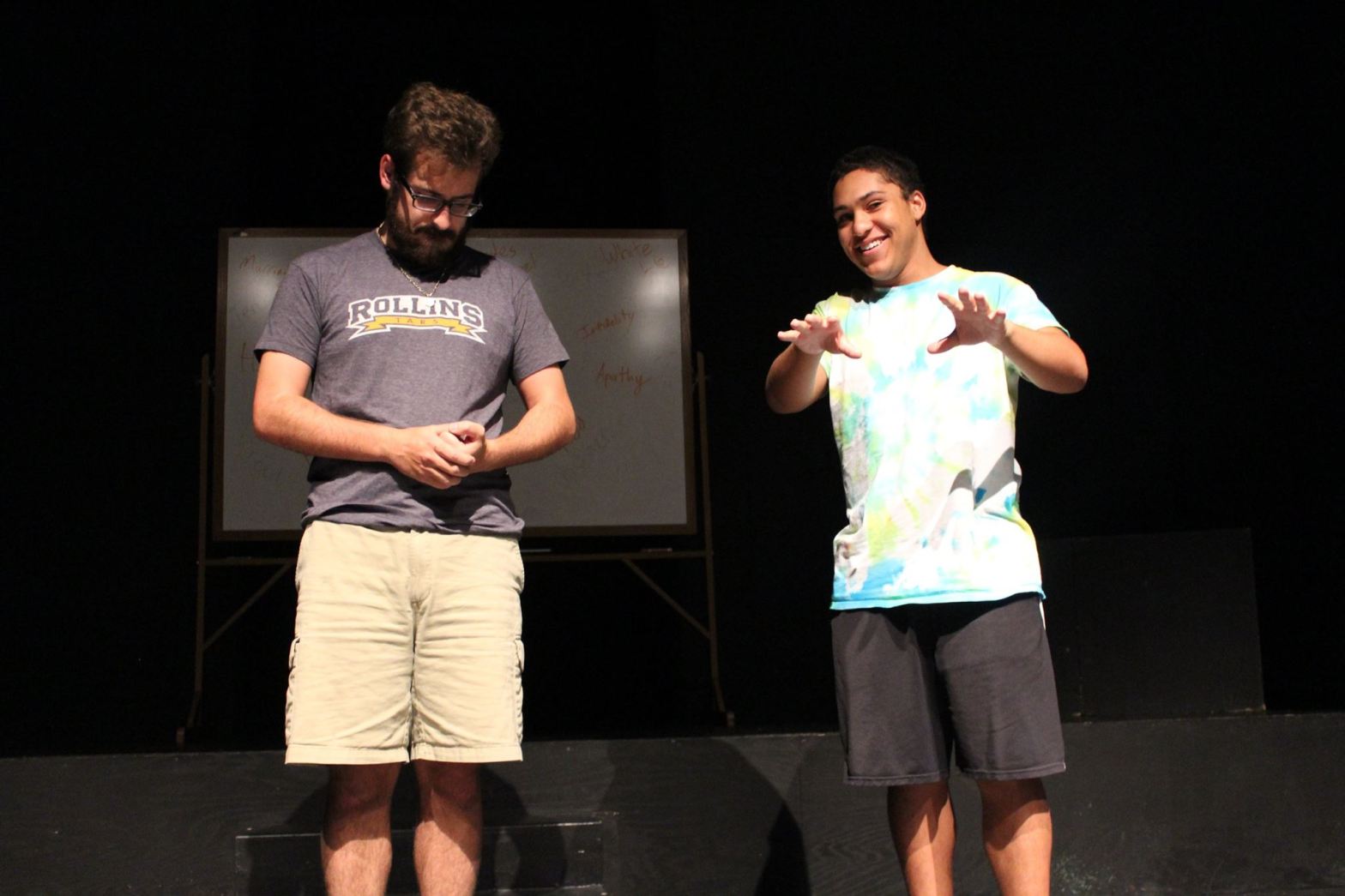
Game Library: “Ritual Scene”

There is no room to hide in Ritual Scene, and players must commit one hundred percent in order for the game to land. Performed without full Presence, or with an air of apology, the central dynamic is likely to flounder or whimper away. When attacked with gusto and relish, the results are often surprisingly invigorating and breathtaking!

The Basics

Players acquire a mundane or everyday activity or chore to inspire their scene, such as washing the dishes or combing your hair. This simple action then provides the roadmap for an epic scene that heightens the task into the grandest and most august of rituals. Generally accompanied by larger-than-life music or a suitably dramatic soundtrack, players break down the action into its constituent elements, making each moment deeply significant and theatrical. Language, if used at all, is featured sparsely or with the emotional intensity of a chant or summoning.

Example

The team explores the ritual of “brushing your teeth.” The scene begins with an empty stage as players begin a steady and ominous percussive drumming that is soon joined by the improvising musician.

Player A is the first to enter the space. With their hands aloft, they present an imaginary basin, and with great ceremonious precision, they slowly march until they are center stage. Here, they place the basin down in full view and then slowly walk backward until they finally drop to their knees in a deep bow.

From the opposite side of the stage, Player B now enters with a heavy water jug. They display it to Player A, the audience, and then to the heavens before making their stately procession to the stowed basin. Once they arrive, with a flourish of music and percussion, they raise the jug and, in a sweeping motion, fill the previously empty basin. As Player A did before them, they then back carefully away and lower themselves in a prostrate position.

As the music swells once more, Players C and D now enter simultaneously but from opposite sides of the stage, one holding the toothbrush, the other the toothpaste tube...

The Focus

This is a great game and exercise for exploring heightened stakes and developing an organic but unified sense of style. In lieu of a traditional story, the game thrives on breaking down the simple steps of the proffered action and using these as the beats of the dramatic arc. Give each moment its due and sell it for all its worth.

Traps and Tips

1.) Slow it down. Rituals, whether secular or sacred, treat each moment with care, and there is typically very little superfluous or insignificant movement. Make every offer and choice deliberate and meaningful. Elevate or celebrate the tools or elements needed to complete the assigned task and don’t rush to the ending. Most tasks could be reasonably completed rather quickly; by embracing their ritualistic qualities or potentials, these actions should now feel almost operatic. This format provides a rare opportunity to really indulge and extend.

2.) Break it up. Don’t throw away the theatricality of ceremonial staging, prop reveals, and protagonist arrivals. In the toothbrushing example, the scene has probably been nearly a minute without the toothbrusher even arriving, and this feels completely in the spirit of the game. The story in a ritual scene really is little more than the sequential steps of the task, so the audience is far less interested in what is going to happen than they are in watching how it all unfolds. Part of the scene’s effectiveness, then, is exploring and exaggerating the little rituals that are familiar and making them delightfully strange and new again.

3.) Honor what has come before. Aim to play with the same movement vocabulary and sense of style. If the first entrance is walking-down-the-wedding-aisle slow, then be cautious of upending this choice through carelessness. Ritual innately invites repetition and parallel actions. Just as is the case with more traditional language-based scenes, look both for the deliberate offers and also the delightful accidents that can be accepted by the judicious mind and woven into the fabric of the grand event. This also keeps the scene fresh and avoids the risk of just recycling a short list of tropes while replacing “toothbrush” with the next object du jour.

4.) Give it all you’ve got. Much of the reward of this premise resides in the stark juxtaposition between the banal prompt and the operatic treatment. Avoid undermining this fun with needlessly pedestrian or undersold physical work. One improviser taking on a deadpan energy or air of commentary in an effort to be different, or just as a means of remaining personally safe, makes it so much more difficult for their teammates to keep the game building towards a scenic crescendo. Without fully present players, the scene will rarely flow; when everyone rows in the same direction, the ritual can take on a life of its own.

In Performance

If you are a more verbal-centric improviser, Ritual Scene encourages a whole different style of play that can prove truly liberating. Language can have a place, but I’ve found that chanting or keening more opaque sounds (or perhaps just simple singular words) adds powerfully to the piece. If you are more movement-centric, then this game likely has your name written all over it! Enjoy.

Cheers, David Charles.
www.improvdr.com
Join my Facebook group here.
Photo Credit: Tony Firriolo
© 2022 David Charles/ImprovDr

Connected Concept: Presence

“P” is for “Presence”

The difficult to describe but immediately recognizable quality of an improviser who exudes confidence, focus, and a sense of belonging.

Attributes of the Present Improviser

This is just a taste of this entry/concept. Go here for more information.

Related Entries: Abandon, Change, Commitment, Focus Antonyms: Absence, Distractedness, Passenger Synonyms: It (as in, they have “it”)

Cheers, David Charles.
www.improvdr.com
Join my Facebook group here.
© 2022 David Charles/ImprovDr

Connected Game: Ritual Scene

Game Library: “Word at a Time Crime”

Players must work together closely to overcome the inherent challenges posed by Word at a Time Crime. This game shares a great deal with other word-at-a-time short-form formats, but its utilization of narrative and predisposition towards action make it a particular fitting pairing with Postponing as there’s little time to waste if the scene is to make it satisfyingly to the finish line.

The Basics

A non-violent or petty crime is obtained and two players volunteer to serve as the featured criminal. They link arms (or connect in a way that is comfortable) and narrate their actions in a word-at-a-time fashion, taking extra care to speak in the first-person singular. Other team members populate the scene as characters or obstacles, adding complications for the narrating criminal and engaging in dialogue as the scene requires. The scene may incorporate a strict time limit to add urgency, and the story culminates in glorious success, abject failure, or some interesting combination or alternative to these unequivocal results.

Example

Players A and B are working together as the criminal and are given the prompt of “stealing a garden gnome.” They put their arms around each other’s waists and begin the scene crouching on the ground. Player A, with their outer hand, is holding a mimed flashlight and scans the horizon as the criminal begins to crawl, all-the-while narrating.

Player A: “Crawling…”

Player B: “on…”

Player A: “the…”

Player B: “neighbor’s…”

Player A: “lawn…”

Player B: “I…”

Player A: “quickly…”

Player B: “eyed…”

Player A: “their…”

Player B: “pesky…”

Player A: “garden…”

Player B: “gnome.”

Both players have begun slithering awkwardly on the ground, retaining their physical connection as best they can, while Player A continues to direct the flashlight. Character C quickly assumes the role of the porcelain gnome by adopting a suitable pose. Their narration continues…

Players A and B (continuing to alternate one word each) “Your… days… of… watching… my… every… move… are… over… little… man!”

As the criminal lunges towards the gnome, Player D can be heard from offstage.

Player D: “No, something has definitely triggered the motion sensor in the front yard. I’ll be back in a second, sweetie.”

Players A and B frantically look around for somewhere to hide and leap behind an imaginary bush…

The Focus

Imposing a one or two minute time restriction on the game serves well as it pushes players into action and discourages long criminal preambles or planning sessions. Despite the language restriction, players should make strong verbal and physical choices trusting that their fellow players will join and justify anything that is unclear or clumsy. When the criminal encounters other characters, the paired persona should utilize word-at-a-time dialogue as well.

Traps and Tips

Many of the core features of this game resemble Double Speak so those tips (which you can read about here) apply to this short-form game too. The significantly unique quality is the narrative device so that serves as my primary focus for this entry.

1.) Avoid passive language. The criminal will quickly discover the hindrance of passive or intellectual verbs. If they “thought” or “decided” rather than “lunged” or “climbed” the scene often becomes bloated and inactive. Use your words to spur action and discovery rather than to muse and reflect. Even if you are utilizing a rather silly or mundane crime as your inspiration, imbue your language with intensity and conviction. Embrace the delightful turns of phrase and unanticipated details as they emerge.

2.) Avoid just talking. It’s foreseeable that the language restriction will create communication challenges so don’t rely on your words alone to advance the story and give it interest. Make assertive physical choices that define the space in dynamic ways. Why walk if you can slink? Why open a door if you can kick it down? Why just grab the gnome if you can meticulously place it in a custom-built bag with an intricate locking mechanism? Do your best not to rush through or approximate complex actions but rather savor the challenge of completing these with your scene partner. Furthermore, craft environments that will provide suitably rich physical playgrounds and opportunities rather than stand idly in the void.

3.) Avoid prolonged conversations. Word at a Time Crime can move between descriptive first-person narrative and dialogue with other characters – which is “normal” for the partner but also constructed in a word-at-a-time fashion for the criminal – but be cautious of not allowing sufficient space for the criminal to return to their narrative device. Brave narration serves as the center piece of the format so supporting players should be mindful that the criminal needs ongoing opportunities to craft narrative asides. Supporting players can certainly quickly set the scene to provide context for the criminal, but it’s generally wise to let this titular character have a little free rein initially so that they can find and strengthen a word-at-a-time rhythm.

4.) Avoid imbalance. I refer to the supporting players in this game as the “To Make Matters Worse Squad” as their main function is to playfully pitch challenges to the protagonist. If an obstacle becomes too difficult or too omnipresent, the criminal can find themselves stumped without any path forward. For example, while Player D could come out and check their lawn, remaining on their well-lit porch for the remainder of the scene would probably prove unwise. Assuming the role of important props (such as the gnome), providing environmental elements (lawn sprinklers), or sound effects (a lightning bolt), are other helpful ways teammates can contribute. It doesn’t ultimately matter if the criminal succeeds or fails, but the crime shouldn’t feel so impossible that they are discouraged from making any progress towards their goal.

In Performance

And speaking of things to avoid, I actively avoid violent or physical crimes in the set up as they can just make a rather silly game feel unnecessarily icky. If you are uncomfortable with the crime frame altogether you can easily substitute it with a prompt calling for a physical problem to overcome – instead of “stealing the coins out of a parking meter” the word-at-a-time character might need to “escape from quicksand” or “rescue a beached whale…”

Cheers, David Charles.
www.improvdr.com
Join my Facebook group here.
© 2022 David Charles/ImprovDr

Connected Concept: Postponing

“P” is for “Postponing”

Postponing or deferring the scenic action is a prevalent form of improvisational procrastination.

I’ll Get Around to Giving This a Clever Title Later

This is just a taste of this entry/concept. Go here for more information.

Related Entries: Commandment #6, Commandment #8, Waffling, Wimping Antonyms: Abandon, Advancing, Leaping Synonyms: Inaction

Cheers, David Charles.
www.improvdr.com
Join my Facebook group here.
© 2022 David Charles/ImprovDr

Connected Game: Word at a Time Crime

Game Library: “Best and Worst”

I provide this offering as more of a ritual or exercise than an improvisational game as Best and Worst allows everyone in the ensemble a brief opportunity to reflect on their efforts at the conclusion of a more facilitated Postmorterm.

The Basics

Players sit in a circle and one at a time (either in sequence or a random “popcorn” style) share a best and a worst moment from their performance.

Example

Player A volunteers to share first.

Player A: “My best tonight was that I hit the stage with energy and attack even though I was coming from a stressful workday. I’m particularly proud of my well-timed entrance in the high school cafeteria scene. My worst was I let my excitement get the better of me a little in that last scene and I know I talked over a couple of my teammates.”

The Focus

As improvisers grow in their craft it becomes increasingly important to be able to self-diagnose habits and tendencies that are either opening up joyful play or that might be hampering personal or ensemble growth. I’ve found that some players bristle at the “best” and “worst” nomenclature (preferring something less pointed) but I’ve found that this language also reminds everyone that improv is process and that there is always room for celebration and improvement.

Traps and Tips

1.) Best practices as the speaker. Seek specificity in your shares. Saying “I had a good show” or “I didn’t do anything right tonight” is far less helpful than narrowing the scope of your observation to particular choices and moments. Make sure personal bests and worsts are also reflecting on the choices of the current speaker and are not used as opportunities to correct or critique others: “My worst was when no-one let me speak as the janitor in the second scene.” Contributions should also be provided in earnest. Yes, there are some performances when we might feel that we were the lead balloon at the party, but upon closer reflection there is always something worthy of celebration. It’s not really in the spirit of the exercise to give a throw away comment just to get it over and done with. For larger groups I’ve had some success with also doing “best and worst in ten” where players have a gentle cap of ten words for each observation. Those that need more than this limit happily take the time they need, but this approach also encourages and trains brevity which is a great gift during note sessions.

2.) Best practices as the listeners. Above all else, really listen. Don’t feel tempted to chime in and respond to everyone else’s reflections. There are a handful of exceptions to this rule. If someone is being terribly hard on themselves, it’s in the spirit of the ritual to send them some love or support. Also, if you’re leading the company, it can prove appropriate to sometimes carefully use these shared thoughts as broader teaching moments: perhaps someone has articulately expressed a challenge that others have encountered as well, or a player might inadvertently pitch a “best” without seeing that there may have been unintended consequences. (Tread lightly in this second scenario.) Astute players can also use this exercise as an opportunity to support their fellow improvisers down the road by helping them overcome prior barriers or lean into professed strengths. If someone’s worst, for example, is that they didn’t step up and start a scene again, a mindful teammate could facilitate such an opportunity in the next performance.

3.) Best practices as the non-performers. In my campus troupes and productions, we’ll often have players rotate into offstage roles such as house management, lighting, or sound improvisers. If they have participated in a creative role, they may well have a best and worst from this perspective. In other situations, this may be less likely or just less insightful. In these cases, we’ve developed the custom of letting players who were primarily observing the performance offer up a company best and worst such as “Everyone did a nice job tonight cheating out and being seen. I think we still need to think about stage pictures in general though as we had a lot of standing and talking scenes.” Unlike a personal best and worst which should focus on the individual, these play better when they are broader strokes and don’t single out players for critique. (If someone had a rough night, though, a little extra praise here is often a nice touch.)

4.) Worst practices to avoid. If you’re working in a larger ensemble hearing from everyone can take a little while. Make sure players aren’t sending unintentional (or intentional for that matter) signals of impatience or disinterest. Phones and technology should be stowed away, for example, and body language should remain open and engaged. It is vulnerable to share a worst in particular, and fellow company members should avoid dogpiling onto the speaker in agreement or judgment. Every now and again a player might also try to fly under the radar and not participate. This can be tricky to address as you don’t want the exercise to become coercive and there may be a weightier issue at play that might invite a private discussion. But, whenever possible, encourage players to add their voice. If they’re in a post-show funk, committing to sharing a moment of success can help ameliorate the situation at least a little.

In Performance

Sometimes long nights or performance logistics might make an in-person Best and Worst unfeasible. In such cases I’ve utilized an online approximation – although I will openly confess that I like this much less. It’s helpful to clearly articulate the expectations and ground rules if you find yourself deploying this approach: the written word doesn’t always convey nuance well and so participants should be extra careful that their observations focus squarely on their own efforts and not the choices of others. The last thing you want is a long thread of comments that feel like everyone is throwing shade at their fellow players. We’ll often deploy more experienced players as “boosters” who respond with shout-outs and encouragement as needed. It’s also crucial to set and hold to a firm participation deadline as the efficacy of the ritual degrades exponentially as the performance starts to fade into your rear-view mirror. Of late I’ve also explored with my campus troupe an “ick” check as part of the in-person process too which is a more deliberate moment to just make sure choices or material hasn’t brushed anyone in a negative way that warrants attention and address. We strive to do this before our Best and Worst just so it’s given the time it needs and, if it’s a complex discussion, doesn’t become the last taste of the evening.

Cheers, David Charles.
www.improvdr.com
Join my Facebook group here.
© 2022 David Charles/ImprovDr

Connected Concept: Postmortem

“P” is for “Postmortem”

The common improv practice of discussing the successes and stumbles of a performance after its completion.

Thoughts on Giving Notes… and Thoughts on Receiving Notes

This is just a taste of this entry/concept. Go here for more information.

Related Entries: Acting, Commandment #10, Consent, Ensemble, Rehearsal Etiquette, Sidecoaching Antonyms: Check In Synonyms: Debrief, Feedback, Notes

Cheers, David Charles.
www.improvdr.com
Join my Facebook group here.
© 2022 David Charles/ImprovDr

Connected Game: Best and Worst

Game Library: “Rashomon”

This improv format is inspired by the classic 1950s Japanese movie of the same name that looks at one event from multiple character Points of View. I know Rashomon as a short-form replay game but, as the source material amply illustrates, the concept certainly has the legs to be expanded into a fuller-length improvisational piece as well.

The Basics

Players improvise a “base scene” prompted by an audience suggestion, such as an important event, dramatic location or pivotal relationship. This first scene, while considered “neutral,” actually provides the basic frame and details for everything that follows. At the completion of the scene, the players then replay this action but now filter it through the point of view of one specified character at a time. While the general “beats” of the scene should remain the same – as is the case for most replay formats – the details are now adjusted to augment and reflect the chosen character’s experience. Time permitting, the scene will then be replayed from the perspective of some (or ideally all) of the original featured characters.

Example

Player A, as an addled parent, escapes into the lobby bar of an urban hotel. Players B and C are two unattached and unencumbered singles, flirting casually over their over-priced drinks. The bartender, Player D, idly pushes their cloth back and forth on the bar as much to pass the time as to actually clean. As Player A collapses onto a stool, Player D notices their dishevelment.

Player D: “You look like you could use a drink…”

Player A: “That’s just one thing on a long list of what I need!”

The Focus

The logistics of this game can be a little tricky to wrap your mind around if you haven’t explored the basic premise and helpful strategies beforehand (which I strongly advise). Rashomon provides an excellent lesson in crafting clear and strong points of view as the game demands that characters are not merely floating aimlessly through the base scene. This notion of shifting the narrative focus also resonates with several performance strategies in the healing arts which reveals the potentials of this frame to enrich a wide range of venues and improv modalities.

Traps and Tips

1.) Plant the seeds. If you don’t establish at least the inkling of an interesting character point of view or attitude in the base scene, the resulting replays can become quite the struggle. This isn’t a good scene to play casually with low stakes and minimal attack (mind you, few scenes do well with this deadpan approach). As I’ve demonstrated in the example above, characters should hit the stage hot with some energy or potential deal, even if this changes considerably as it combines with the ideas of other teammates. In addition to having some sense of your own deal – “I’m an overworked parent who craves the simpler days of my youth” – make sure you also keep an eye out for the deals of others as this is equally important for the later replays. Early scenic choices should exude emotional intensity while keeping specifics largely in the subtext rather than text. If you are too explicit in the first iteration there will often be nowhere new to go down the road. This might go without saying but just in case it doesn’t, players who don’t appear in the base scene can’t easily contribute to the reenactments, so if you elect to remain in the wings, make sure your teammates have built a promising improv edifice that doesn’t need you. If you do pop in for a brief Canadian Cross or nudge, also be aware that it’s in the spirit of the game for your perspective to become the focus of a replay too, so have something in your pocket.

2.) Don’t get caught in the weeds. Part of the delightful contract of replay games is that the foundational elements of the scene should generally remain intact. If Player A enters the bar, is served by the bartender, interacts with the young couple B and C, receives a phone call from their babysitter, and then orders a double to drown their sorrows, these basic pointers should frame everything that follows. That is not to say that the nuances, dialogue, and action might not change considerably – and in fact one hopes that they will – but keep your foundational parameters in mind as you play, deviating from them out of strength rather than from a fuzzy recollection. Extremely verbose scenes can prove challenging for this reason: consider action that is rich with emotion instead. As players scroll through the new replays, it’s important that they work toward a common end. If the bartender’s original subtext was that they are overworked and everyone takes them for granted, try to establish this game quickly and clearly in their reenactment so that everyone can elevate this particular point of view. Perhaps Player A originally responds with “I’d like a gin and tonic” but now this becomes “I’d like you to solve all my problems, but I won’t tip you well.” If your character is featured early in the scene, it helps the whole team if you make a brave move that others can then mirror (hence the import of paying close attention to the first scene so you have a sense of what others might have been pitching).

3.) Water others’ gardens. One of my favorite features of this format is that it requires players to heighten the points of view of their teammates in order for the replays to flourish. Improvisational philosophies often stress tending to our own deals, at least initially, and this structure palpably reminds us that games only thrive when we all play them together. When you cycle through the replays, the heavy lifting generally falls on the shoulders of the characters and players who aren’t in focus as they are responsible for selling the narrative shift. In many ways the featured player primarily serves as the “straight” character responding honestly to others’ choices while maintaining the established trajectory of the original template. While I recommend hitting this shift in perspective quickly and clearly, don’t drown the new protagonist in a tsunami of well-intended suggestions; rather, build and complicate the story one patient step at a time. The replays specifically benefit from making sure the focused character has sufficient time to receive and process each new move, hence the import of not creating a needlessly frenetic baseline. If in doubt, it proves helpful to ask yourself “how does the featured character perceive me or my actions” as you adjust the tonality and delivery of your dialogue. Players B and C who may have been just mildly annoying originally with their youthful entitlement, now might feel their passions are being brutally extinguished by those who have no place in a hip hotel bar when we experience the world through their eyes.

4.) Pick the ripest crops. Every character needn’t have a turn in the focus hot seat although this can become the expectation depending on the way you introduce the game and the rhythms of your particular performance. Admittedly, there is certainly something innately satisfying about getting to glimpse into everyone’s head at least for a moment. If you’re new to this game or the base scene feels a little underdeveloped, grab an easier character as your first focal point so that you (and the audience) have a chance to warm into the central dynamic. (Deploying a caller can also steer the selections based on what they feel was landing well which takes a little pressure off the cast to make split second decisions when they may not have a good sense of the bigger picture yet.) If a character feels marginal either in terms of their scenic function or, frankly, their ability to land a definitive point of view, you could either skip them or strategically place them in the middle of the replay pack. I’d just advise not leaving them until last in case there really isn’t much to harvest: you don’t want a stumbling reenactment as the final taste of the scene for the audience. Characters that are occupying similar or parallel functions, as is the potentially the case with the younger bar goers above, can also combine into one replay, especially if time is a consideration. Ideally, keep a character whose implied game has the strongest potential for your curtain call as it can be a little off-putting when the replays burn brightly initially only to fizzle when the game finally reaches the finish line. Often it can prove delightful to save the most featured character – likely Player A in our bar scene – until this last position for that reason, although I will confess that I’ve also seen strong teams slay by putting the most minor character into this final slot as well.

In Performance

Rashomon has sadly fallen out of my own rotation a little as it requires some focused rehearsal time to get a grasp on the logistics at play, and the game (as is the case with most replay formats) requires sufficient room to expand which makes it difficult to program when strict time constraints exist. However, I value this game as much for what it teaches about subtext, points of view, active listening, and elevating the choices of others as I do for the results it can garner on the stage. Don’t become disheartened if you feel a little stumped or clumsy in your first efforts: the mechanics of the game can put you in your head initially. Perspectives (an earlier Game Library entry you can find here) can serve as a helpful prequel if you’re looking for a user-friendly way to warm-up your improv brain for this particular challenge.

Cheers, David Charles.
www.improvdr.com
Join my Facebook group here.
Photo Credit: Tony Firriolo
© 2022 David Charles/ImprovDr

Connected Concept: Point of View

“P” is for “Point of View”

This phrase – sometimes abbreviated to POV – refers to the specific way your personae approach the world, their primary attitude or “deal” if you will.

Find Your Point of View By…

This is just a taste of this entry/concept. Go here for more information.

Related Entries: Comedy, Emotional Truth, Game of the Scene, Love, Objective, You Antonyms: Passenger, Passivity Synonyms: Deal, Perspective, POV

Cheers, David Charles.
www.improvdr.com
Join my Facebook group here.
© 2022 David Charles/ImprovDr

Connected Game: Rashomon

Game Library: “Furniture”

Furniture affords an opportunity for focused physical play on the part of the titular role. As one player spends the scene quite literally in the hands of their teammates, it can also invite Pimping when not approached with attentiveness and care. Beware!

The Basics

One willing player volunteers to serve as the physical embodiment of all the props and furniture pieces needed for the scene. Other players carefully deploy their teammate as the scene unfolds, using and reusing featured stage props to help color and inform the story. The furniture performer may use their whole body to represent larger objects, or just a limb or similar for smaller items, especially when more than one object is currently in use. As is the case with stage combat methodologies, the furniture should primarily remain in control of their own choices and movement.

Example

Player A volunteers to serve as the “Furniture” and the location of an antique store is suggested by the audience. As the lights rise, Player B is standing behind what will become a counter.

Player B: (under their breath) “Another slow shift. Time to close up for the day.”

Player A uses their body to create a counter in front of B and offers up their hand to serve as a rag. Player B gently accepts this offer and begins to (carefully) dust the counter. Player C and D, a married couple, stand at the edge of the stage and C taps on an unseen door.

Player C: “I’m not sure if they’re still open, honey.”

Player D: “I think I can see someone in there.”

As Player B leaves the counter to move to the door, Player A drops their prior position and quickly moves to create this entranceway with their body. Player C is now gently tapping on Player A’s back.

Player C: “Is anyone there?”

Player B: “Yes, sorry, I’m coming.”

Player B fidgets to find their keys, which become Player A’s hand and is then used to unlock A’s body/door that laboriously swings open.

Player D: “We’re so sorry if you were closing up, but this is our last day in town, and we’ve been eyeing that beautiful grandfather clock in your window all week…”

Player B: “No problem at all.”

Player C: “Everyone here is just so pleasant and accommodating!”

Player B leads the couple over to the shop “window” as Player A quickly assumes the guise of the aforementioned clock, swinging their arm in a predictable rhythm before them.

Player B: “You certainly have excellent taste. You just don’t see this kind of craftmanship anymore…”

The Focus

There is much fun to be had from the playful interaction between the furniture performer and the other characters in the scene. Keep an eye on the stage geography, remembering where key items have been created and stowed, and don’t neglect to also create interesting relationships and a dynamic story. The furniture gimmick is just that and won’t carry the scene on its own.

Traps and Tips

1.) Keep the furniture safe. I still have a very visceral memory from one of the first times I watched this game over thirty years ago. The scene took place in an abattoir (or butchery), and the furniture actor took on the role of a hanging carcass. A playful actor came up and cut off one leg, which the furniture actor lifted up in response. After a moment of playful contemplation, the actor decided to cut off the second leg that was now holding all of the furniture actor’s weight. The second player bravely (?) then lifted up their second leg and thumped down onto the stage on their knees. A small part of me as an observer was impressed by this level of complete acceptance and commitment; a much larger part of me was deeply concerned that I had just watched an improviser terribly injure themselves. (Luckily, they had not.) The moral of the story: don’t put the furniture into jeopardy. Look to challenge and inspire the player assuming this role, but always keep their safety front of mind. They shouldn’t be faced with either maintaining the integrity of the scenic reality or preventing themselves from getting injured. This tension, in essence, is the crisis at the center of pimping.

2.) Don’t needlessly list. It’s important that scenes don’t exist in a nowhere land; subsequently, it’s helpful to get a promising location (or prop-heavy occupation) as the prompt. While players should strive to keep their furniture teammate suitably occupied, sometimes this intent can manifest itself in a proclivity to suddenly list all manner of objects within the space whether or not they are of any immediate use or interest. Such an approach rarely adds anything of value, as it just sends the furniture careening from one ill-defined pose to another. (There is a potential exception to this rule noted below.) Allow sufficient time for each new item to become fully realized and detailed. So much of the charm of the game is seeing how a human body might become that counter, or door, or clock, or purse… Throwing out too many objects, especially at the top of the scene, typically stifles the creation of nuance and the little embellishments that can then fuel the story needs of the scene. Does the grandfather clock’s pendulum swing erratically calling into question its accuracy? Is the door to the store overly cumbersome and decrepit in a way that reflects the store in general?

3.) Furniture should follow and lead. Traditionally, this game tends to cast the furniture largely in a responsive role, waiting for other improvisers to declare or describe their needs before stepping in to creatively address these offers. The furniture, subsequently, becomes the exclusive target of the playful torture, very much at the whim of their scene partners. This isn’t necessarily problematic, especially if there is excellent rapport between the players and a clear sense that challenges are being pitched and received with graceful abandon. If endowments move into pimping territory, however, it can quickly feel a little icky, and this discomfort can increase further if there are perceived power or status inequities between the performers. (Be extra careful not to actually push the furniture around the stage trying to get them to be one thing after another as well – rather, change your line of focus and let them move freely of their own volition.) It’s really important that the furniture player is clearly excited and equipped to assume this role so that it doesn’t feel coercive in any way. It can delightfully even the scales if the furniture also clearly leads some (if not many) choices. They should feel empowered to just create a new item in the space that now others must utilize and justify or breathe unexpected details or malfunctions into their prompted physical creations.

4.) Reuse and recycle. Avoid cluttering the location with a needlessly voluminous array of inconsequential objects. As the scene matures, however, there is a great deal to be mined from strategically returning to prior creations at opportune moments. If the couple finally elects to purchase the grandfather clock, do we now see this wheeled over to the counter, and then finally through the previously established front door with each sequential step requiring the furniture performer to reprise their earlier roles? There is by no means a perfect number of props for the scene, but once you start dancing into the double digits you are probably reducing the likelihood that everything can be clearly remembered and reused (hence the trap of listing props randomly as the scene begins). Returning to prior furniture pieces as the scene progresses prevents this clutter and has the added advantage of allowing the featured player to really lock into their physical choices and endowments while building upon any discovered games. So, if you’re a “regular” character, don’t feel the need to make every line of dialogue about a new prop. Let these emerge and reappear as the story dictates.

In Performance

It can prove helpful to think of the furniture player as the celebrated “star” of the scene as opposed to the hapless victim. This player needn’t necessarily possess gymnastic abilities, but the game is certainly served by featuring someone who finds excitement in expressing themselves through movement. Make sure endowments balance safety, silliness, and story, veering from anything that the furniture (or audience) might view as pimping or painful – as recalled above, you don’t want to figuratively or literally pull the legs out from under another improviser. If in doubt, apply the golden rule of improv which is not so much “do unto others as you would have them do unto you” but rather “do unto others as you know they would prefer to have done unto them.”

Cheers, David Charles.
www.improvdr.com
Join my Facebook group here.
Photo Credit: Tony Firriolo
© 2022 David Charles/ImprovDr

Connected Concept: Pimping

“P” is for “Pimping”

Getting an often-icky laugh at your teammate’s expense. It’s an unpleasant term for an equally unpleasant and unwelcome improv habit.

Do this instead…

This is just a taste of this entry/concept. Go here for more information.

Related Entries: Commandment #4, Gagging, Shivving Antonyms: Endowing, Offer Synonyms: Selling Out

Cheers, David Charles.
www.improvdr.com
Join my Facebook group here.
© 2022 David Charles/ImprovDr

Connected Game: Furniture