
My current home venue tends to play a lot of improv games with handles and gimmicks (and understandably so, as they tend to be audience pleasers). When Two Chairs pops up on the playlist, those more inclined to patient, unstructured improv tend to get excited as the openness of the scene encourages a different style of storytelling.
The Basics
An audience member volunteers and (typically) two players walk randomly around the playing area with chairs in hand, creating an array of equally random poses and angles. When the volunteer announces, “Stop,” the chairs are immediately put down and the stage lights plummet. As the lights return, the onstage players must now use the configuration of the two chairs as the only inspiration for the following scene.
Example
The audience member is coached on their role, and music plays as Players A and B briskly move with their chairs through the space. “Stop” is called when the improvisers are at opposite edges of the stage with their backs to each other. The lights go down and up, and both players begin by sitting in their respective seats, looking into the wings.
A prolonged (but dramatic) silence.
Player A: (without looking over their shoulder) “You know what you’ve done.”
Player B huffs and doesn’t take the bait.
Player A: (tensely) “I’m happy to sit here as long as you are… until I get an apology.”
Player B contemplates not talking again, but eventually cedes a little territory.
Player B: “Well, if you know what I’ve done that demands an apology then I don’t see the need to tell you what you already know…”
A is tempted to turn around but ultimately doesn’t.
Player A: “Young man…”
Player B: (mockingly) “Old man…”
The Focus
I feel a little cheeky noting this as the focus, but it is really about building a scene, so do that!
Traps and Tips
1.) Breathe. I’m a big fan of crafting the CROW boldly and early in the vast majority of my improv work, but this scenic structure generally has a slightly different vibe. Yes, you’ll certainly want to tend to those integral ingredients but slapping them on the stage (and your partner) inelegantly as the opening line will dispel much of the game’s magic. “Son, you’ve been sent home from school again for bullying, and I’m not letting you out of that corner until you learn the error of your ways…” Instead, lean into the energy of the chairs and your partner, assess each new moment thoughtfully, and offer small pieces of the puzzle (arguably, the approach to most enthralling scenes).
2.) Share. I know this primarily as a two-hander which results in explorations that privilege one central (and pivotal) relationship. Sure, offer up some well-timed and appropriately toned endowments, but as with the CROW work above, allow sufficient space for your partner’s instincts and fingerprints to guide the journey. If you’ve intuited an important detail, avoid offering the next three related ideas. Save room for your partner’s process as this will also invariably increase the likelihood of pleasant and organic surprises. Player A might be intending “Young man” as a move that makes B their son, but a little strategic specific ambiguity leaves room for B to frame this in a way that makes sense to them.
3.) Sit. There are different wisdoms regarding exactly how (or how not to) use the two furniture pieces, and when I offer the advice to sit, I don’t necessarily mean that literally (although literally sitting is a fine first choice). I like to think of the two placed chairs as dominant energy centers for the game, each with a default occupant (the improviser who placed the chair there right before the blackout). If players immediately move away from the chairs, or rearrange them, or accidentally ignore them altogether, the initial choice provided by the audience volunteer becomes a rather impotent launch that doesn’t amount to much. I’ve seen a lot of great, grounded improv come out of this simple premise, and it may not be coincidental that these scenes tended to embrace the grounded qualities of the two placed chairs. Sure, you can relax your relationship to the furniture pieces if another intriguing door opens that’s worth your attention, but there is a value to really honoring those random positions, and if you stay seated (or connected, or adjacent) to the chairs, that’s much more likely to occur.
4.) Honor. Again, attitudes might be split on this last point, but I think something is also lost when the chairs become quickly endowed as something non-chairy. To tease out that point, sure the two chairs could become a park bench, or thrones, or beams on a high-rise construction site – all essentially chair substitutes with a decidedly “you can sit on me” function! But if they suddenly become sheep that you’re sheering, or trees that you’re cutting down, or giant snowballs that you’re forming in your backyard during a brisk winter’s day, then the peculiar challenges (and gifts) of the premise feel undermined (to me, at least). Of course, those later three ideas could all result in fantastic improv, but now the puzzle of using the two stationary furniture pieces has been diffused.
In performance
My current long-form obsession, The R&D Show at Sak Comedy Lab, takes short-form games and expands them into full one-acts for the first half of our set. Two Chairs proved delightfully malleable with multiple resets prompted by five different audience members and accompanying music. We added some little finesses to give the vignettes some unified purpose, but the bare bones of the base game were wonderfully resilient and inspiring, reminding me of the beautiful central premise: improv inspiration can come from anyway, including just the configuration of two otherwise benign set pieces.
Keep exploring the Game Library by going here. Currently approximately 270 unique entries, many with game variants and aliases too!
Cheers, David Charles.
www.improvdr.com
Join my Facebook group here.
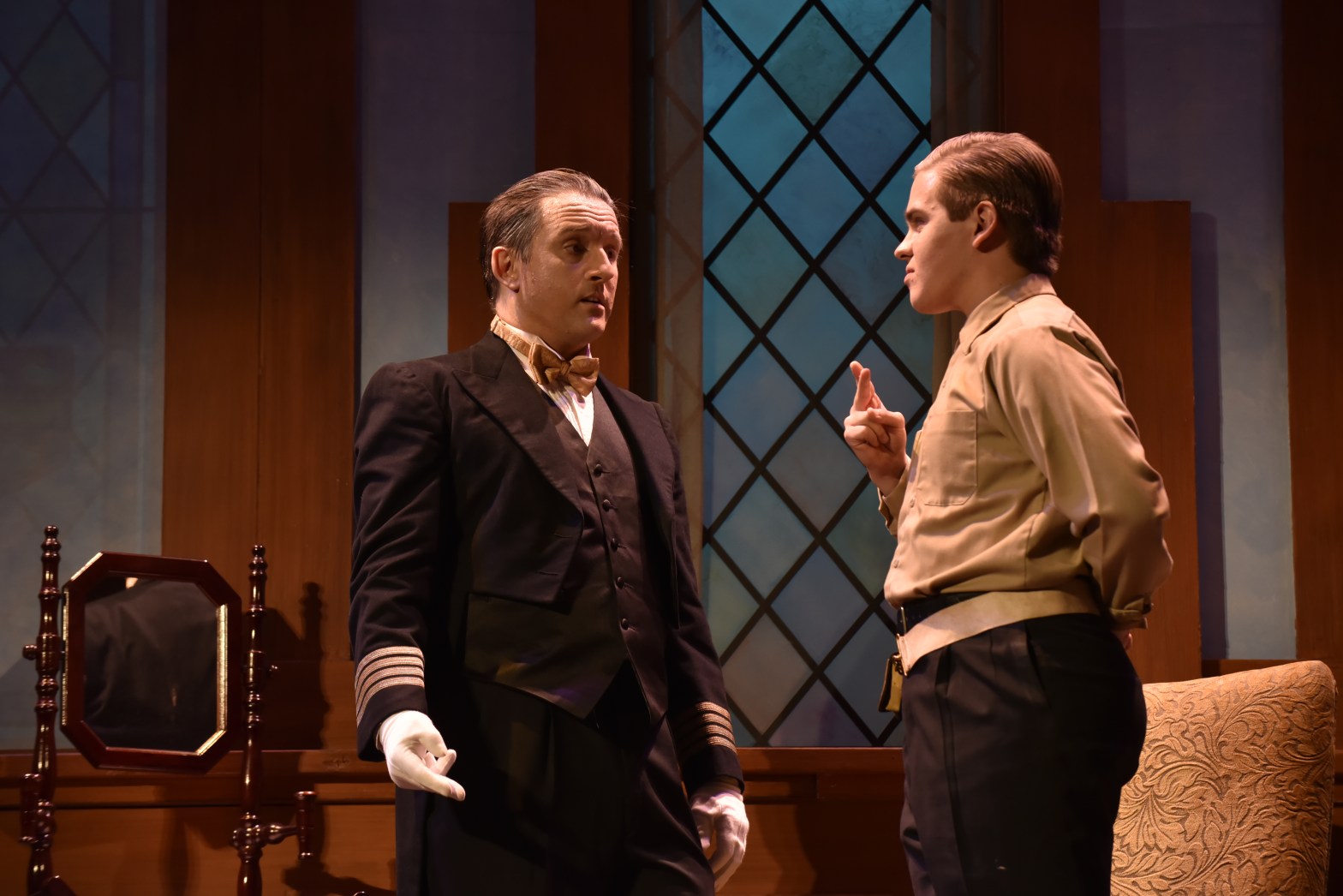
Photo Credit: James Berkley
© 2025 David Charles/ImprovDr
Game Library Expansion Pack I




 ImprovDr.com