Game Library: “Ballet”

As I consider the concept of “running towards Fear” in our improv, it struck me as more than fitting to pair this philosophy with a short-form game that embodies some of my own anxieties as a player. Ballet utilizes the role of a narrator (which I typically love taking on) and the role of dancers (which I’ll often do everything in my power to avoid), and so I’ll use this entry as an opportunity to exorcise (exercise?) some of my own improv angst.

The Basics

One team member takes on the role of a BBC-style commentator (or your national potentially pretentious artsy equivalent) with the remaining players serving as the company of ballet dancers. An inspirational title is obtained: I like getting an animal and terrain feature as a nod to Swan Lake. This also leaps you into a non-human world which encourages a different physical vocabulary than just being people doing busy work in an office building. With the heavy assistance of an improvising musician, or perhaps a fast-fingered technician with a strong stock of suitable classical musical excerpts at the ready, the company dances a balletic masterpiece. Throughout, the commentator provides story descriptions and guidance as well as potential laudatory critique and pertinent background information.

Example

Player A: (as the narrator) “…And the music swells as we return to the second act of Duck Road. The dancers have been in rare form tonight, especially Kuznetzov, and I for one am anxiously awaiting the climactic number ahead.”

The lights rise on Player B who assumes the role of the “duck” as the music shifts.

Player A: “And here is our melancholic hero, the duck, once again stuck on the wrong side of the road…”

With small wing flutters, the “duck” assumes a tragic pose, reaching forward only to be pushed back. Other team members join the fray rushing in front of the nervous animal.

Player A: “The smoky traffic whirls around and around, suffocating the duck with its dense and odorous fumes…”

Player C, as one of the vehicles, starts to physically menace and challenge the duck with sharp and angry movements. The duck retreats at first, but then starts to find some courage. The music shifts again.

Player A: “But today the duck will not lie down and take this. As the delivery truck looms once more, the duck stands its ground in a powerful pas de deux, the ‘dance of defiance…'”

The Focus

As is the case with most formats that are parodies or homages at heart, endeavor to honor the emblematic tropes of ballet – as best you understand them – giving the performance a grander than typical sense of style and passionate exaggeration. Ballet offers rich storytelling opportunities in both verbal and physical mediums so be sure not to throw away the chance to craft a dynamic arc fit for the ages.

Traps and Tips

1.) For the narrator… While there’s no reason that your narrator couldn’t assume a more “of the people” tone and approach, I like leaning into a high status (perhaps even snobby) commentator as this elevates the style of the game even further. This role can easily slide into pimping or a narrative that can feel like it’s at expense of the dancers rather than in awe of them – “…Well, that was a thoroughly mediocre dance…” Consider erring on the side of serving as a super fan, armed with a slew of interesting and random factoids that can contextualize and add value to the action. Do you know other artistic works of the composer or choreographer? Have you been following the careers of the lead dancers with great interest? A device I’ll often use is breaking up the action into various movements or “numbers.” Even if your knowledge of the field is sparse, you can name some key features to help the ensemble: “Now we watch the dance of reconciliation,” or “the dance of anguish,” or “the dance of celebration.” Such titles can quickly and clearly shift the energy and stop the scene from just meandering with generic movement. The narrator can have a tendency to lead much of the scene as they are the only player able to express themselves through language, so also make sure you are following and accepting the bold choices of the dancing improvisers and musician. Embracing longer silences during the larger dance segments helps in this regard: don’t feel the need to narrate absolutely every second of the piece.

2.) For the musician and technician… It is incredibly helpful for the flow of the scene if the musician (or technician) provides a strong variety of accompaniment rather than one continuous unbroken and consistent sound. Character entrances and exits provide a great opportunity to quickly shift the look and feel of the music and lights, especially if this is further enhanced through the narrative and with the announcement of specifically named dances or balletic features. There are so many inherent opportunities to embellish and enrich the action: individual characters can have musical motifs that weave in and out of the greater soundscape; the accompaniment can reference and reinvent familiar classical (and modern) sources; each new entrance can cause a stark shift in musical (and lighting) tone and tempo. Music truly becomes a character in these scenes and provides a vehicle for revealing the characters’ inner thoughts, moods, and turmoil. As the dancers can’t speak, the music and technical effects are critical for communicating intent and subtext.

3.) For the ballet dancers… The game Ballet loses a lot of its charm and potential when improvisers sort of dance in an apologetic fashion. Yes, it’s unlikely that many or any of your ensemble have ballet training, but treating the style and scene with a playful earnestness and seriousness of intent goes a long way. The audience is already impressed that you are willing to attempt such a feat, especially if it’s clear that this is not your strong suit, so displaying a level of commitment and conviction generally lands much better than shuffling around the stage commenting or mugging about your plight. Give the audience permission to relish your struggle. It is certainly important to know your limits – as I quickly approach another birthday milestone there are certainly moves that I shouldn’t make now which I would have gamely attempted in my twenties – and no audience reaction is worth risking injury for you or a teammate. But endeavor to move to the fullest degree of your ability and do so confidently. Even if you have a limited range of movement or physical vocabulary, keep your choices specific and intentional: Be the duck or the delivery truck. Don’t just repeat the same ineffectual physical choice again and again. These notes almost assume that you can’t dance, but if you have expertise, obviously bring it to the stage with gusto. Just be wary to pace yourself so you and the scene have somewhere to go, and not to inadvertently become focused on finesse rather than connection and story. Doing the same three moves extremely well every time you play Ballet might not really be challenging your improv chops any more than a dancer with limited ability always doing their same three moves poorly.

4.) For the story elements… All of the improvisers above should ultimately unite in the service of the greater story. The lack of dialogue promotes epic or paradigmatic characters, qualities, and tensions: ballets aren’t generally about small kitchen-sink family issues although that would certainly prove a delightful challenge. Even if you’re performing a relatively abridged scene (this game will easily expand to provide a longer offering if you have the time and stamina), Ballet invites the exploration of a grand journey. Look for powerful and interesting character combinations and get them to dance together. If you’re familiar with the terms, I’ve found that the dances are excellent places to extend the action, with characters exploring and enriching the emotional stakes and energies, while the commentator can advance the story through the narrative, shifting the action from one significant plot point to the next (or acknowledging verbally when a dancer makes the choice to do so). The simple Four Sentence Story model discussed here offers a helpful frame that readily provides structural beats to assist in this endeavor as well.

In Performance

I’ve partnered this game with a consideration of fear, and I fundamentally believe it’s critical for our growth and success as improvisers not to shy away from a challenge when we feel we might not immediately excel. On a personal level, I’ve taken some dance but I’m certainly not the most graceful of movers, yet I should be willing to happily enter the fray as needed. My stumbles may, in turn, elevate the audience’s appreciation for the excellent dancer moving beside me and there is a beautiful gift in enabling a fellow improviser’s ability to shine. Compete, if that’s innately in your nature, for the most improved award, or the most supportive award, or the best background dancer award…

I do also think it’s important to pitch to strength when we are playing in front of a paying audience and if there is an equipped dancer in our midst it just makes good sense to put them front and center in the same way that sometimes the ensemble will be best served by a strong storyteller stepping into the narrator role. As we make these choices in our improv work, however, it pays to be cognizant of what is pushing us in a certain direction and if it is a fear of not being the “best” or looking a little silly perhaps that is worthy of some self-reflection and course correction.

Cheers, David Charles.
www.improvdr.com
Join my Facebook group here.
Photo Credit: Tony Firriolo
© 2021 David Charles/ImprovDr

Connected Concept: Fear
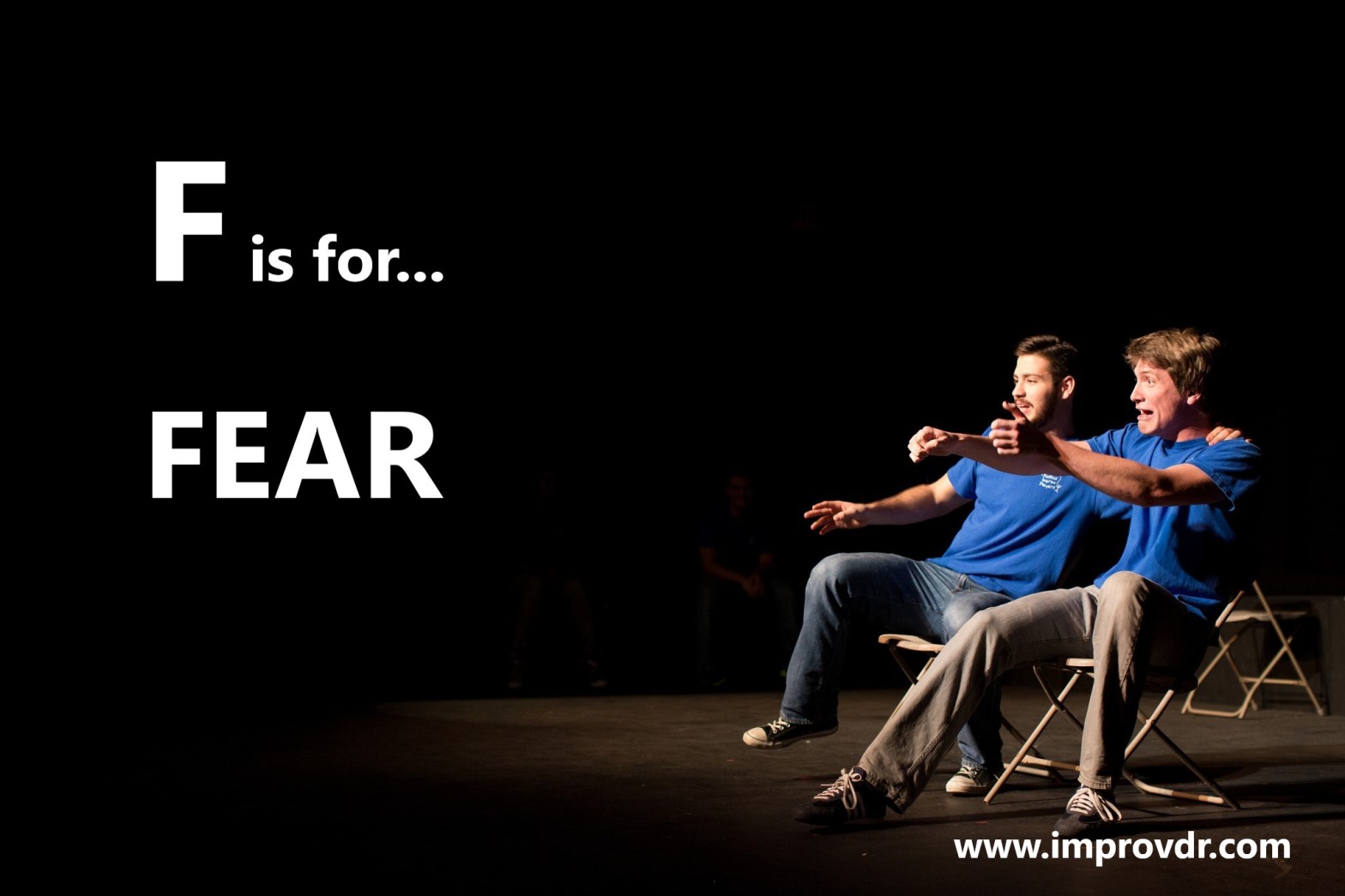
“F” is for “Fear”

A debilitating energy.

When to Run Towards Fear… and When to Apply the Brakes…

This is just a taste of this entry/concept. Go here for more information.

Related Entries: Blocking Antonyms: Abandon, Courage, Playfulness Synonyms: Inaction, Stasis

Cheers, David Charles.
www.improvdr.com
Join my Facebook group here.
© 2021 David Charles/ImprovDr

Connected Game: Ballet

Game Library: “Advance/Extend Stories”

When introduced to the concepts of advancing and Extending, many improvisers and storytellers will find these dynamics deeply familiar – even if they previously did not have names for them – as they are so ingrained in our shared narrative traditions. Advance/Extend Stories provides a low-risk opportunity to consciously explore and define these techniques so that they may be more deliberately deployed in future work.

The Basics

Players work in pairs. One player (A) serves as the first coach, while Player B acts as the first narrator. I have a deck of well-loved flashcards that I use as prompts for this game with each coach receiving a random location, occupation, and object, but you can also just provide players with a title or similar inspiration. Player B begins telling a fictitious story based on this title or one of the flashcards, striving to create an interesting and dynamic action. As the narration develops, Player A in their role as coach can offer two forms of quick verbal feedback. They can say “advance” thus signaling that as a listener they are ready for the next step in the rising action, or they can offer “extend” at which point the narrator should flesh out and provide more details about the current element. If you’re using flashcards, the coach can use these as visual prompts (revealing them one at a time as they see fit) in addition to using the two verbal nudges. The exercise continues in this fashion until the story concludes. Players then switch roles and receive a new title or set of flash cards.

Example

Player B uses “The Old House” as inspiration for their story.

Player B: “It was a particularly cold night during a winter of particularly cold nights. Just stepping out onto your porch would result in visible puffs of breath painting patterns in the air. Icicles clung precipitously off the roof eaves, and it seemed that all of nature was in hibernation…”

Player A: “Advance.”

Player B: “Amir wrapped his heavy jacket around him as he continued up the winding path. He checked his cell phone once more. It’s low battery light was blinking but it confirmed that he was heading in the right direction: up. The old house suddenly loomed on the horizon…”

Player A: “Extend on the house”

Player B: “Paint was chipping off the exterior walls and it felt at times as if the wind might knock it off its perch atop the hill…”

The Focus

Narrators should strive to craft interesting and dynamic stories that are generously shaped by their fellow player and coach. Given the freedom and encouragement to do so, storytellers explore their own styles and narrative proclivities.

Traps and Tips

1.) Coach with love. It’s important that the coaches value the success and joy of the narrator as their utmost goal. If their suggestions take on a more “gotcha” energy you will likely undermine the story and its teller. Offer the nudges of “advance” and “extend” when you honestly feel they will help the story and maintain or elevate your interest as an audience member. Avoid needless loops or diversions: sure, you could ask them to extend on every facet of the old house on the hill but after a while this will stall the action and bog down the story with minutiae. Coaches should, instead, just trust their honest instincts to help shape a story that appeals to them and maintains their attention.

2.) Explore focused extensions. While the prompt of “advance” contains a consistent message of “I’m ready for something to happen now,” an “extend” can be wielded with a little more precision and finesse. Narrators might stumble across a scenic element, prop, or character that has been left largely undefined. Offering the specific target of your “extend” in these situations proves helpful by asking “extend… on the large tree” or “…on the face in the window.” In this way you can gently shift the emphasis of the narrative and possibly unlock a new potential that the storyteller might not have otherwise polished. This is much more useful than just randomly offering “extend” without identifying any particular facet of interest: you don’t want the author to have to guess what you might have in mind.

3.) Don’t overdo it. When serving as the coach it can feel as if you have to keep providing feedback to the storyteller. If the narrator is on a roll there may be no need to do anything other than enjoy the story for large swathes of time – and that’s okay! Remember that the coach’s primary aim is to set the narrator up for success. Often players will find that merely having these terms brought to their attention encourages them to instinctively advance and extend without verbal encouragement. If the narrator is in the zone, an unexpected or unnecessary adjustment from the coach is likely to do more harm than good, so know that as is the case with all improv, sometimes your active presence and listening is the greatest gift the scene needs.

4.) Take narrative risks. This exercise can prove effective with almost any content or style of narrative so enjoy this open playing field when you rotate into the author position. Tell the type of story that you like to read or hear; create characters that represent your own experiences or passions; explore journeys that appeal to your individual sense of adventure and wonder. Don’t aim too low or simple with your narrative voice especially if you have a strong sense of the tools in play. As we investigate paradigmatic devices that often frame or structure stories as we’ve inherited them, we can simultaneously push and question these very traditions and assumptions.

In Performance

While players may have moments of struggle in terms of a few mechanics or plot stalls, I’ve found that in the vast majority of cases this exercise routinely enables energetic and enjoyable stories. The central premise of balancing action with details clearly applies to all improvisational scenic construction and raising awareness of these techniques will offer an accessible tool for quickly addressing or acknowledging missed opportunities.

Cheers, David Charles.
www.improvdr.com
Join my Facebook group here.
Photo Credit: Tony Firriolo
© 2021 David Charles/ImprovDr

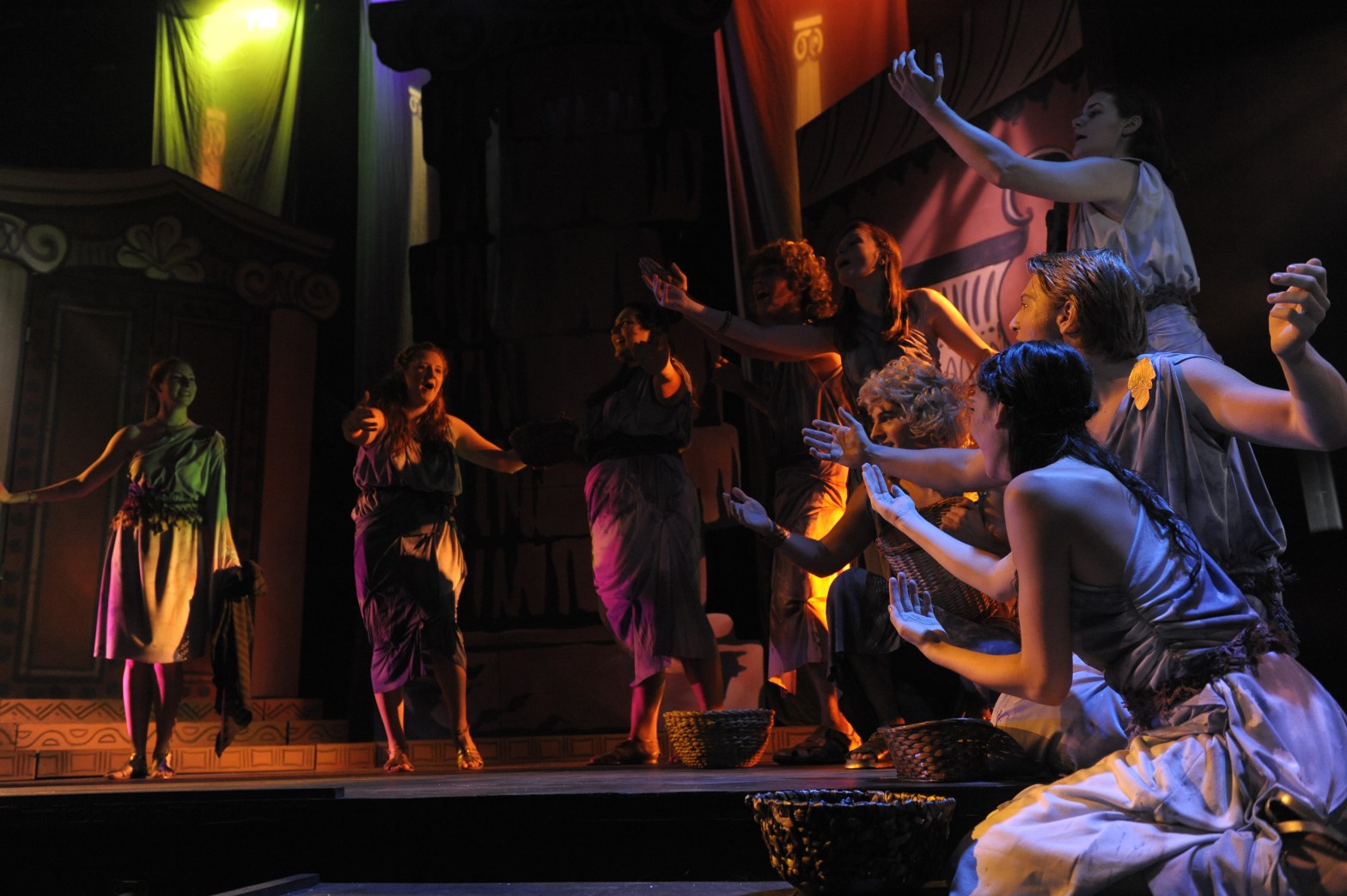
I don’t typically comment on the accompanying image but this is taken from It’s All Greek to Me, a fully improvised Greek tragedy. A standard feature of the piece was the use of odes created by a chorus of ten improvisers where, more often than not, the content heavily rested on the ability to deeply extend. This poetic and descriptive function was very much in keeping with choral odes as they have survived in the extant plays.

Connected Concept: Extending

“E” is for “Extending”

The highly effective storytelling technique of providing nuance and specificity.

Details Worthy of Your Attention

This is just a taste of this entry/concept. Go here for more information.

Related Entries: Advancing, Endowing, Heighten, Scene Painting Antonyms: Vagueness Synonyms: Details, Expanding, Specificity

Cheers, David Charles.
www.improvdr.com
Join my Facebook group here.
© 2021 David Charles/ImprovDr

Connected Game: Advance/Extend Stories

Game Library: “Naïve Expert”

In addition to providing an opportunity to work on your Expert skills, confidence and language, Naive Expert is a more seldom played endowment game (at least in my current improv circles) and so more readily retains a sense of freshness and novelty.

The Basics

One member of the team (the “expert “) leaves the space, and an area of expertise is obtained from the audience that might piece together several disparate or unexpected elements, such as Arctic submarine maintenance. Upon the expert’s return, the remaining improvisers host a talk show focusing on the guest of honor and their field of study. Through gentle clues, leading questions, and endowing, the hosts endeavor to slowly reveal to the expert the unknown ingredients. Supporting teammates may also fill in other roles such as audience members, stage management, or show staff. By the end of the scene, the guest should proudly announce their area of expertise (whether or not they “know” what it is), and the interview show concludes.

Example

While Player A is out of the space and cannot hear, the rest of the team assembles the expertise of “high school lunch nutritionist” from the audience. Players B and C assume the roles of co-anchors as Player A returns to the space while music plays, and the lights come up…

Player B: “And welcome back to Early Morning Chats!”

Player C: “We’re sooo excited to have our next guest, the formidable Dr. Moon, joining us on the couch! Let’s give them an ‘Early Morning’ welcome!”

Player A has entered and acknowledges the audience as they take a seat on the couch.

Player A: “It’s such an honor to be here with you both, Noriko and Aki! I’m excited to jump right in and dispel any of those nagging myths…”

Player B: “I imagine you are very pro-jumping in your line of work!”

Player A: “Well, yes, you know what they say: you’ve got to keep active to stay active…”

Player C: “Such timely advice, no matter where you are in life.”

Player A: “Indeed. The young, the old, teenagers…”

Player C: “Who you clearly focus on in your current line of work.”

Player B: (miming a book) “As we can see here in your new book…”

Player A: “Why, thanks for bringing that up. Yes, adolescents can experience particular challenges…”

The Focus

As is the case with most endowment games, the explicit intent is to help the “expert” determine and state the hidden subject by the end of the scene. But that being said, successfully endowing the missing information is really only one facet of the scene, and you can have a highly engaging and entertaining offering that doesn’t culminate in “victory.” Enjoy the struggle of the chase, lean into strong characters and relationships, and explore the inherent story of the expertise (or the close approximation thereof).

Traps and Tips

1.) Avoid all “buzz” words. A good rule of thumb for all endowment games is that the endowers (those with the hidden knowledge) should not explicitly say or do any of the critical elements that would reveal the hidden information. This is the equivalent of telling or using parallel actions as opposed to complementary actions that serve as the bedrock of the dynamic. Any significant piece of the puzzle should be uttered first by the endowee or the expert in this particular case. (I generally shy away from even repeating key words after they have been guessed by the expert as this can similarly puncture some of the magic of the game’s climax). In our “high school lunch nutritionist” example above those four words are immediately off limits, and I’d also avoid anything that is just one remove away, such as teenager, education, food and health. You are more likely to fall into this trap if your focus is solely on getting them to “guess” the correct answer quickly, as opposed to enjoying the potentially meandering process of interviewing the expert and crafting a playful scene. Puns and word play often (rightly) feature heavily in these games, but also be careful of anything that is so obvious there could only be one possible response.

2.) Experts, practice bravery. It’s difficult not to think of these scenes as “guessing games” and this function certainly is a part of the mix, but if they feel like “guessing games” then you might be aiming too low in terms of entertainment value. Experts need to present themselves as experts, with the requisite bravery, language, and attack. It’s important to pace your specificity so as not to paint everyone prematurely into a corner – “Hello, I’m an expert on the planet Mars and nothing else!” – but shuffling around in a sea of vagueness doesn’t help either – “I’m glad I could be here to talk about things and stuff!” Make brave assumptions and assertions. Answers that include one or two strong details provide potential doorways for your partners, so don’t be afraid to offer up the random specifics that jump to mind. Don’t think of every response as an attempt at solving the entire riddle at hand, or you’ll likely hamstring yourself. Rather, listen closely to the way the hosts phrase their remarks and react or free associate with those particular elements. If a line of answers is clearly thwarting and not assisting, also bravely move on and explore a different theme or idea.

3.) Interviewers, seek connections. There can certainly be considerable pressure on the interviewers to keep the scene moving, so I like that this frame easily houses two or more co-hosts that can share this work and thrill! Avoid buckshot questioning that just throws out one clue after another in a disparate (and possibly desperate) sense. I strongly prefer an approach that always seeks to utilize something that the expert has just said (or recently offered), hence the import that experts routinely use specific language. This approach is more skillful and nuanced, requiring flexibility to follow unexpected pathways that pop up. In the above example, “jumping” led to “active,” which led to different demographics and “teenagers,” which then, hopefully, will get us to “high school.” This is a more exciting and dangerous path than just pushing the expert with “So, I hear you have three teenagers at home.” The connection approach is also much more likely to enable a story of sorts, which adds so much to the scene. Remember to avoid using buzz words but be sure to make it very clear when the expert has discovered an important word or element: getting them to repeat it several times generally works well. Other pet peeves in this and most endowment games include a “fill in the blank” approach: “When I was seventeen, I spent most of my day in…” Similarly, a charade or “sounds like” approach feels a little unnecessarily cheap as well and degrades the talk show frame.

4.) Accept everything. It might go without saying, but just in case it doesn’t, it’s really critical in these endowment games to have an attitude of accepting everything as best you can. If the expert offers up something completely unexpected, is there a way to weave that towards your desired outcome rather than just dismissing it out of hand? If the interviewers are using leading questions that push you deeper into the unknown, embrace the risk and forge ahead, trusting that there is likely (hopefully) some method to the madness. The game revolves around determining an absurd subject, so it’s highly likely that there will be some absurd or opaque moves. If players begin to judge or assess their partners’ choices rather than reacting to them with confidence, the game will lose much of its charm.

5.) Sell the ending. I allude to this above, but ultimately, it doesn’t really matter if you get it exactly right at the end of the scene. It does matter that you build to and celebrate a bold finish. Even if the expert thinks that they have no clue as to the specifics of their field, they should celebrate and sell the little that they do know. Often, in a short-form venue, the game may be timed to add an element of danger and stakes. It can serve to fudge that time a little if the team members are in sight of the solution, but I’ve seen endowment games fizzle when a well-intended host is clearly over generous in a way that just lets the scene stumble forward relentlessly. Commit to the ending, sell it joyfully, let the audience revel in how close or far you were in your estimation, and celebrate the journey regardless of the outcome.

In Performance

Nearly all of the strategies I’ve outlined above can be relaxed a little if the action hits a wall. If the scene is limping into its final phases without any headway, committing relentlessly to opaque clues will rarely appeal to the audience nr set the players up for joy. Games of this ilk are often audience favorites; there is something innately delightful about being in the know and seeing someone else fight to figure out details that are now so obvious to you! Depending on the time available and the experience level of the players, adjust the severity of the ask-for challenge, too. Just as a truly impossible expertise might implode, a ridiculously easy target is unlikely to land well if the expert figures it out in thirty seconds.

Cheers, David Charles.
www.improvdr.com
Join my Facebook group here.
© 2021 David Charles/ImprovDr

Connected Concept: Experts

“E” is for “Experts”

Assuming the confidence and traits of an Expert can unlock new dynamic potentials and relationships.

An Expert Approach to Characterization

This is just a taste of this entry/concept. Go here for more information.

Related Entries: Character, Verbal Skills Antonyms: Fear, Interviewer

Cheers, David Charles.
www.improvdr.com
Join my Facebook group here.
© 2021 David Charles/ImprovDr

Connected Game: Naïve Expert

Game Library: “Entrances and Exits”

When played with finesse, there can be a captivating flow enabled by the short-form game Entrances and Exits as players joyfully nudge each other on and off the stage.

The Basics

Usually (and perhaps optimally) played in a team of four, there are two fundamental rules that govern the traffic patterns of this game. The first rule is that there must always be two characters on stage at any given time, and the second rule is that there can only be two characters on stage at any given time. To keep this equilibrium, all new entrances will necessitate quick and justified exits; similarly, any exiting character will require that a fellow player swiftly enters to take their place. The scene develops with players closely adhering to these conditions, shuffling through various character and relationship combinations as a result. As the stage must always be populated by two characters, the scene should also clearly begin in such a fashion so as to establish and honor the rules.

Example

The scene begins with the suggestion of “tree house.” Players A and B begin onstage while their teammates C and D clearly wait to the side.

Player A: (putting down a crayon with an elaborate gesture) “And that concludes our tree house charter!”

Player B: “You have the neatest printing. I’m glad that you wrote it down.”

Player A: “You’re going to need to refer to me by my title now that I have been officially appointed as the tree house president.”

Player B: “I thought we were going to vote on that first…”

Player A: “Well, as the charter clearly indicates, in the event of a tie, the author of the charter, which in this case was me, will get to cast the deciding vote.”

Player B: “I don’t remember us talking about that!”

Player A: “I added it when you went to the toilet. I warned you about having too many juice boxes. So, anyway, clearly voting would merely be a formality at this point…”

Player C: (calling from offstage) “Everything okay up there kids? You’ve been awfully busy!”

Player B: (squirming) “I probably shouldn’t have had that last juice box…”

Player C: (calling) “I’m coming up!”

Player B: “I’ll be back in a second…”

Player A: “You can use the escape pole!”

As Player B “slides” down the escape pole, Player C mimes climbing up a ladder and through a hatch. There are now two players on stage once more. Player C has a bag of cookies.

Player C: “I thought you and your new friend might like a snack.”

Player A: “I thought we talked about trust and personal boundaries… But I will have a cookie…”

The Focus

Be sure to give due attention to the staging practices, justifying all entrances and exits as well as providing interesting character combinations. Entrances and Exits shares many commonalities in terms of technical logistics with Key Word, which I examined here. The first three tips discussed in this companion entry also strongly apply to the current offering.

Traps and Tips

1.) Clearly be in or out. It’s important to honor the central rules of Entrances and Exits and this is difficult to achieve if “offstage” players are not unequivocally offstage. When the audience becomes confused as to who is actually in the scene, much of the charm of the game will fade. It’s okay to be an offstage voice as a third actor, but you need to be an offstage voice, remaining clearly in the wings to uphold the conceit. It’s a given that there will be fleeting moments in the transitions where the magical number of “two” is fudged for a second, but this shouldn’t become the norm. I’ve seen some companies encourage the audience to audibly indicate when the rules are broken with a grumble or boo. I’m torn about this conceit: while it increases audience engagement, these interruptions can sap the drive and nuance of the scene. I’d rather that the team members themselves quickly recognize, justify, and adjust when they notice an infraction (perhaps with a gentle nudge from a vigilant host).

2.) Craft an exact environment. There is a lot to be gained from creating and sustaining a highly detailed environment. In addition to upping the level of challenge, knowing exactly what features are located both onstage and as destinations in the wings also adds specifics to the characters’ justifications. Is there a restroom located in the stage right wing and a parking garage stage left? In the tree house example, do you always use the pole to exit the house and the ladder to ascend, or will other potentials also emerge: perhaps a makeshift window leads out onto a particularly robust tree branch or the roof of the child’s home? The scene and dynamic can feel a little flat when characters just aimlessly wander in and out of the space. Make every entrance and exit physically precise and deliberate: don’t settle for the pedestrian. It’s also great to use the surprise of the cued stage directions to add to the emotion and attack of your characters.

3.) Consider all the possibilities. While you’ll want to prioritize the story first and the gimmick of the scene second, it’s helpful to keep in mind the different potential staging possibilities and look for opportunities to deploy them. There are actually only four basic choices in terms of organizing the comings and goings of the scene: a single player can leave the scene thereby causing another character to enter; a single player can enter the scene making another leave; both players can leave which would force both offstage players to cover them; or, finally, both offstage players can simultaneously enter with the inverse effect. This seemingly sparse range of alternatives magnifies considerably when you consider the who and how. The scene thrives with different character energies and playfully exploring different physical ways of ingress and egress (climbing, crawling, running…) adds so much joy into the mix. Also, remember that you can (should) use these staging prompts to serve the greater needs of the scene and your teammates.

4.) Change up the combinations. This advice echoes a similar comment I made about Key Word, but it bears repeating here. Entrances and Exits generally involves a cast of four players, each taking on one role for the duration. A lot of the potential of the scene lies in getting different character combinations to the stage so that you can see all or most of these relationships (again, it’s not as many as you might think – it’s only six different pairings). Sticky feet, or an inability to leave the stage, can prove highly problematic in this format as it literally halves the potential character combinations if one character overstays their welcome. It’s possible that one character might emerge as central or the protagonist but always be on the lookout for excuses to yield the stage to others. If you’ve been in two or three vignettes in a row, mathematically speaking, it will nearly always be your turn to leave.

In Performance

In some ways, Entrances and Exits can feel like a condensed La Ronde with its core assumption of two-person vignettes. It can also provide a helpful strategy for moving focus in larger ensemble pieces. Be wary of diminishing these scenes into merely a staging gimmick; there is a lot of room in this format for grounded and interesting story and character work. I’ve been playing and coaching the game for nearly three decades now and am often struck by its resilience and ability to incorporate a wide variety of tones and styles.

Cheers, David Charles.
www.improvdr.com
Join my Facebook group here.
© 2021 David Charles/ImprovDr

Connected Concept: Exits

“E” is for “Exits”

A critical tool to deploy (and awareness to foster) if you don’t want your improv explorations to become cluttered and unfocused.

Should I Stay or Should I Go Now…?

This is just a taste of this entry/concept. Go here for more information.

Related Entries: Edits, Give, Stage Picture, Sticky Feet Antonyms: Entrances

Cheers, David Charles.
www.improvdr.com
Join my Facebook group here.
© 2021 David Charles/ImprovDr

Connected Game: Entrances and Exits

Game Library: “Commercial”

The short-form game Commercial can add a stylistically distinct option to your playlist. As this game generally serves as a succinct “quick hit,” I’ve paired it with the concept of Erasure as the format doesn’t have much room for improvisational waste or second guessing. The premise is relatively simple, but the execution poses worthy challenges and opportunities.

The Basics

The team obtains a product or service that may be absurd (silent smoke detectors) or offers a twist on a more well-known item (a calculator that gives compliments). Players craft an original “slice of life” commercial that shows the need for this given product.

Example

Players are challenged to create a commercial for a pair of scissors that can cut tension. Player A and B begin moodily washing dishes at the family sink.

Player A: (slightly irritated) “I just thought you said you were going to pick up dinner on the way home”

Player B: (equally irritated) “And I clearly sent you a text at lunchtime reminding you that I was picking up the laundry instead.”

Player A: “I can’t help it that my phone is old and running out of memory.”

Player B: “And I can’t help it that my husband is old and running out of memory…”

Player C enters the kitchen holding a mimed over-sized pair of scissors much to their parents’ chagrin…

Player A: “And what exactly do you think you’re going to do with those, Tyler?”

Player C: “Look, I can hear you in my room and neither of you can seem to move past this…”

Tyler mimes closing the scissors between the couple. The mood quickly dissipates…

Player C: “Now, doesn’t that feel better…?”

The Focus

I generally frame Commercial as a quick one-minute game – probably a holdover from when I first learned it during my Theatresports days. As the scene seeks compactness, there is really very little room for erasure or the clumsy utilization of others’ choices: there simply isn’t time to create details that aren’t then woven into the fabric of the story. Subsequently, I’ll stress this lens of efficiency, noting that the game demands strong listening, accepting, and justifications if you and your audience are to feel satisfied as the lights black out at the end.

Traps and Tips

1.) Hire “great actors.” I stress the “slice of life” style of this particular version of Commercial as that moves it away from a more commentator or spokesperson driven model. It can be helpful to think of these as small family or workplace dramas with familiar characters that explore a problem that only this great new product can solve. Assume that the company had gobs of money at their disposal and hired the very best talent they could find. Sliding into the “bad actor” trope will provide initial joy but often makes it needlessly difficult to build the energy and arc of the scene. In some ways, it feels like wimping or commenting rather than committing unequivocally to the fictitious world no matter how absurd it might seem. It’s a good strategy to have the product make its way onto the stage (helpful neighbors are a common and useful device), but avoid this as the first move for reasons I outline below…

2.) Follow the structure. If you’re not well versed with the Four Sentence Story structure, it’s worth reviewing here as that frame is extremely helpful for this scene. I’ll often teach both games in tandem as they support each other so well. The initial players are usually responsible for establishing the world in which the given product will appear (the balance); this will generally heighten and develop into an explicit need perhaps with the entrance of an additional player (the problem); the arrival of the product will typically herald that the scene is moving towards its climax (the solution); and the commercial may culminate with a new equilibrium or boilerplate product disclaimers and details (the resolution). If the scene meanders around or between these elements, it will often lose its sense of direction and purpose.

3.) Develop the balance. Although these scenes are characteristically short, don’t skimp on the balance. Without a clear and specific routine, the product’s arrival will often feel anticlimactic or too obvious. It can be a fun approach to start a little obtusely away from where you know the scene will eventually head. When you rush to the problem (which I’ve done a little in my example above), there can be less raw material to draw upon and reincorporate. I was keen to model how the product might make it to the stage, but if the tension scissors vignette was played out in “real time” we could probably sit in and build that tension for several more lines before the arrival of the scissors. Once the scenic problem has been solved, there often isn’t much steam left in the game, so don’t rush to this moment without specifics and finesse. If you do find yourself having quickly solved the problem, it can prove helpful to have other examples of the problem enter the scene quickly to extend the game: the parents aren’t tense now, but a sibling enters in distress having just failed an important exam…

4.) Support the action. It’s easy for a Commercial scene to become a little cluttered, so don’t rush the stage or needlessly enter, “just so you can be a part of the fun.” If you’re waiting in the wings for your moment, consider less high focus ways to contribute. Depending upon your venue’s level of technical support, you might be needed as the music, jingle, or sound effects, vocally punctuating the important moments of the scene. It’s a nice touch to close the game with a brief voice-over if the product information (name, price, where you can buy it…) can’t easily be pitched from within the scene. It’s by no means a set device of the game, but I’m also fond of using actors as props or the product itself when this feels playfully appropriate. There is something I innately enjoy about the juxtaposition of a really dramatic initial scene suddenly and awkwardly housing an improviser’s body trying to figure out the physicality of a pair of scissors!

In Performance

I’ve seen this general conceit as both a stand-alone game and also as a break away component of a larger structure – you’re creating a radio play but now there’s a pause for a word from the sponsor. Don’t be afraid of the misleading simplicity of the structure: lean into the style and story arc. There’s really no room to “shop for the best idea” – air time is expensive after all – so be sure you’re giving your all to the offers already established and in the mix.

Cheers, David Charles.
www.improvdr.com
Join my Facebook group here.
Photo Credit: Tony Firriolo
© 2021 David Charles/ImprovDr

Connected Concept: Erasure

“E” is for “Erasure”

Carelessly (or callously) dismissing or cancelling the valuable ideas that others have already established and nurtured.

If You Feel Yourself Erasing…

This is just a taste of this entry/concept. Go here for more information.

Related Entries: Blocking, Bulldozing, Shivving Antonyms: Accepting, Justification Synonyms: Cancelling, Negating

Cheers, David Charles.
www.improvdr.com
Join my Facebook group here.
© 2021 David Charles/ImprovDr

Connected Game: Commercial