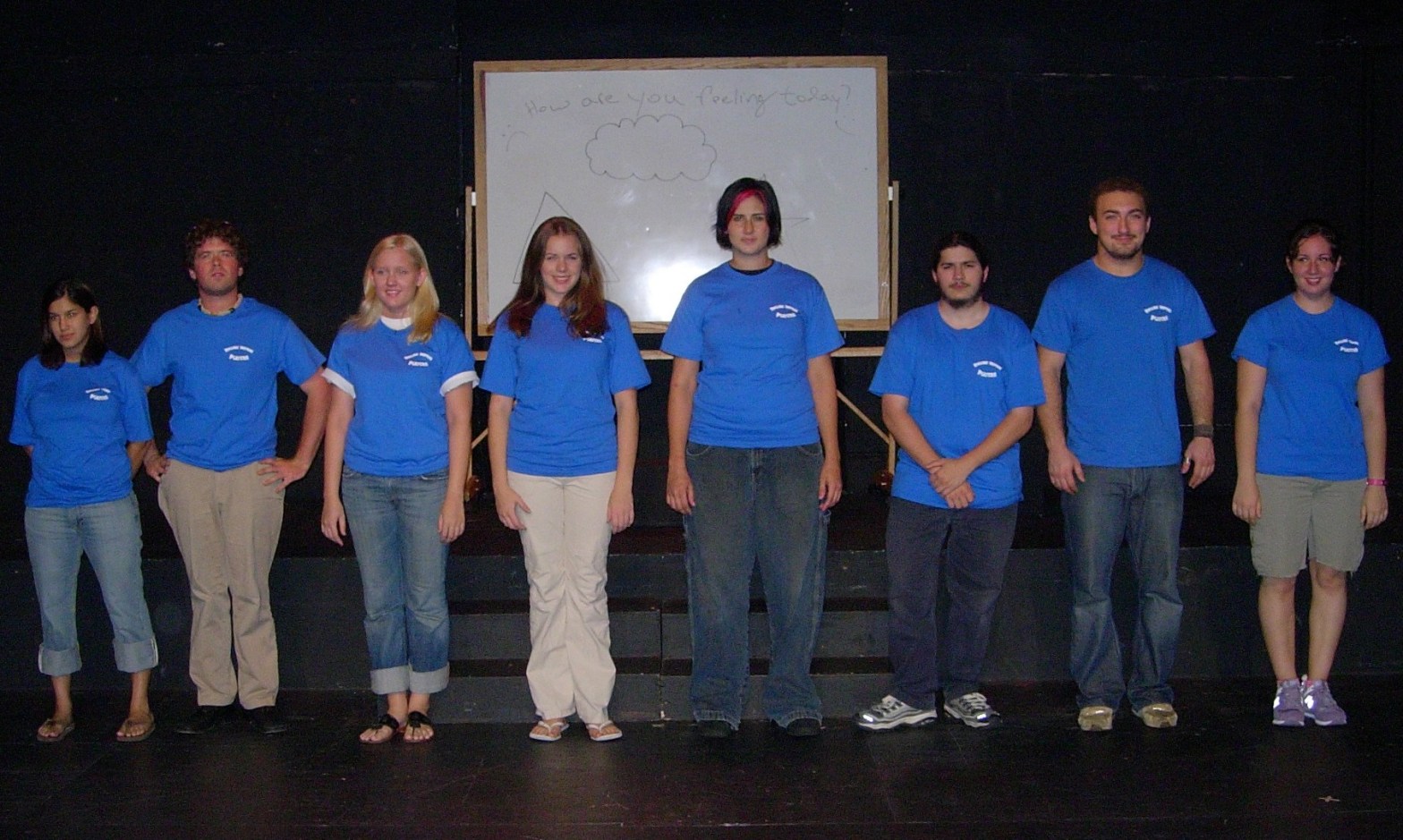
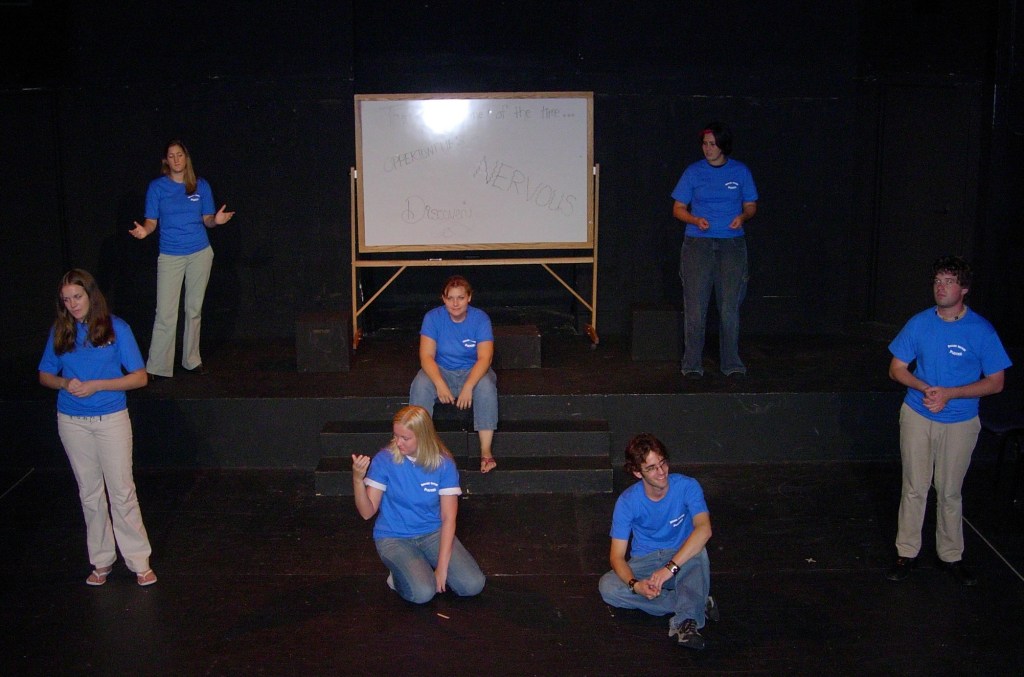
“D” is for “Dramaturgical Improv”

A useful way to describe improvisational modes of performance that privilege research, nuance, and highly wrought connections to the base materials from which they take inspiration.

Qualities of Dramaturgical Improv

This is just a taste of this entry/concept. Go here for more information.

Related Entries: Deviser, Improvisation, Long-Form, Narrative

Cheers, David Charles.
www.improvdr.com
Join my Facebook group here.
© 2021 David Charles/ImprovDr

Connected Game: Sequence Game

Game Library: “Fantasy Scene”

I’m drawing from my days at the Players Workshop of the Second City again for this frame that has a distinctly sketch-like feel. I imagine Fantasy Scene is more typically utilized for light-hearted results, but I’m offering it as a way to explore Drama as I have seen many memorable workshop performances that pursued a more grounded and sincere end.

The Basics

I teach this as a Spolin-style exercise in which players are given a brief moment to determine a basic who, what, and where prior to the performance (as opposed to a more “on-the-spot” approach where they get an ask-for from the audience and then go). Players perform in pairs. The structure is a little more specific than many short-form frames, and you will probably need to slowly walk through the beats. I generally do this before the quick planning sessions so that players understand the goals and potentials of the central dynamic. I’ve woven my traditional example through this section to provide clarity. There are five beats:

Beat One: We see Players A and Player B in the “real” world engaging in their balance. It’s helpful if the given circumstances of the relationship and location are clearly defined and explored in this beat before moving onto the next scenic segment.

Players A and B are two exhausted businesspeople collapsing at a hotel bar after a grueling series of conference presentations on new real estate best practices. They know each other well but almost exclusively from these gatherings. Any remnants of the joy that brought them into this industry are now faint memories, but they try to lift each other’s spirits over drinks.

Beat Two: Either character cues a fantasy from their character’s perspective. Once this signal occurs, the second player instantly joins this new world, assuming whatever role is needed that may or may not be a different version of their initial character from the “real” world.

Player A pointedly alludes to a suppressed dream of being a professional touring musician. Player B transforms into an adoring groupie begging for an autograph as the hotel bar temporarily “vanishes” and becomes a backstage door. Both players continue exploring this new premise.

Beat Three: When the fantasy has served its purpose, either player cues a return to the original reality, snapping back into their former point of view and energy. Both players now continue to develop the original premise in the original location, although it is likely informed by what has just happened in the first fantasy (which neither player explicitly references).

In the fantasy world, Player B has become frustrated as the groupie when their idol (A) pushes them away. Player B takes this energy and shifts their tone into that of their original real estate agent. Player A immediately drops the musician persona, and we are now back in the bar.

Beat Four: When the opportunity arises, the second player now launches their own fantasy world. Their partner, once again, enables this scenic detour, embodying the role or energy that will best equip the new journey.

Player B alludes to their abandoned pursuit of remodeling classic cars. Player A leaps into the premise, and together, they explore this alternate reality with A fawning over an array of beautifully restored automobiles.

Beat Five: The scene ends with a sharp return to the first premise. This beat may consist of just a quick exchange or can take up as much room as is needed to honor the original conceit.

Player A transforms a moment of driving in their car and an accompanying joyfully exclaimed, “I can’t believe this!” by repeating the line more ominously, thus returning to the gloomier hues of the bar. Player B is now also sitting once more on the bar stool. They finish their drinks and are resigned to their lots in life.

The Focus

The conceit and sharp execution of the fantasies are well worth the time to workshop and polish just so that this improv possibility is in your toolkit when it is needed. The format truly shines when players discover an internal logic and connection between the five potentially disparate vignettes. It may take a few more mechanical attempts and observations before this goal feels within reach.

Traps and Tips

1.) Don’t over-plan. If you don’t tend to use a more Spolin-derived brainstorming session prior to scenes, the biggest trap of this device is providing too much time to think and plan. Players should agree upon the bare minimum (“We’re two businesspeople, in a bar, escaping a conference”). If players are afforded too much time to consider their premises, they invariably start to ponder the how in addition to the who, what, and where. This tends to make the improv comparative (“Is this what we agreed upon beforehand?”) as opposed to inspirational (“This is our starting point, and it could go anywhere!”) For example, for this game, players need not have any preconceived notion as to what the fantasies will be about, or which order they will be initiated. I also encourage players to practice good improv practice in these short brainstorming sessions, too, accepting and adding to each other’s choices rather than judging and discarding them. And it can prove helpful to remind them that the audience doesn’t know what has been pre-determined, so it’s still critical to define these elements in the course of the action.

2.) Pitch clear transition cues. The requisite finesse of this structure also provides its primary challenge; namely, the transitions need to be clear and dynamic but are most successful when they are discovered in the moment. For the sake of precision, it’s more than fine to offer a clear verbal cue such as “Sometimes I just wish I’d pursued my music…” Generally, if either player thinks that a transition has been offered, they should commit to the change at 100%. Sharp distinctions between the five beats are crucial. For this reason, while setting the fantasies in this particular hotel bar could work, such a choice is more likely to confuse the audience and your fellow player as you move back and forth. Contrast (in location, mood, energy, physicality, characters…) is your best friend. Often, the transitions back into the first reality are more varied and can incorporate most edit traditions. A player might repeat a line of dialogue changing from one premise to the other (or their partner can just respond in the opposing timeline). Characters can also use their current physical position to prompt the change, justifying a pose in a new way. I like this strategy, in general, with players not just dropping prior poses but rather using them to move the companion storyline along in a novel way. The unavoidable key to these moments of transition is that one player bravely offers the shift and their partner, equally bravely, grabs it and runs without questioning their instinct. Deferring or doubting in these critical moments inevitably causes the energy of the scene to dissipate and meander.

3.) Look to fulfill your partner’s needs. This scenic dynamic can unlock a truly lovely style of play when you enter the fantasy realms. Here, the supporting player’s primary goal is to craft a world in which the featured character can go on an interesting journey. The initiating player (for example, Player A and their musician aspirations) might offer up a strong character to assume or just pitch a broader scenario. This brief intent might be all you have, so it’s important to jump confidently into the fantasy waters. Assess what dynamic might best serve your partner in real time and remember that the launching character (who remains the same in both worlds) should be the star of these scenic departures. If you decide to maintain your current character and relationship from the base scene, it’s helpful to make sure their tone or energy changes in a sharp and recognizable fashion between each beat otherwise the five sections can all tend to bleed into each other. I’d also advise that it’s preferable to parallel whatever choice was made in the first fantasy in regard to casting with the second; that is, if Player B assumes a new identity for A’s fantasy, Player A does the same for B. This structural repetition is pleasing for the audience.

4.) Explore the greater scenic connections. Once you have a sense of the mechanics (I promise it’s not as difficult to do so as it might appear at first glance) this frame comes to life when played at the top of your intelligence. The fantasies can be just that, whimsical musings divorced of all reality, but when they ultimately provide a commentary on the primary relationship or theme, the scene takes on a whole new power. Consider shaping the second fantasy so that it reflects or distorts concepts and elements explored in the first. Perhaps Player A’s dreams of fame reveal a different but equal kind of loneliness and exhaustion that Player B also explores when it becomes clear that their cars are the only relationships they have managed to maintain. While the game is entitled Fantasy Scene, the fantasies need not begin or end positively and may ultimately prove to be nightmares or revealing distortions. The more these fantastical vignettes reflect upon or complicate the foundational scene and relationship, the better. Do our protagonists ultimately find solace in recognizing that they are in the same boat and forge a deeper friendship or remain imprisoned in their own bubbles of isolation?

In Performance

The dynamic of exploring flashbacks or alternate realities is a long-form mainstay, but housed in this frame, this device provides an opportunity to enrich our characters and content. This game tends to enable sizable scenes: it’s common for six to eight minutes to zip past somewhat effortlessly. While you could add players to further support and populate the fantasy realms, there is something innately elegant about exploring the scene as a two-hander. Frankly, this is the only drawback to the game as it can be challenging to include it in a short-form playlist (or a workshop setting) if you’re trying to spread performance opportunities and time across a larger ensemble.

Looking for more games and exercises? Check out the ever-expanding Game Library here.

Cheers, David Charles.
www.improvdr.com
Join my Facebook group here.
Photo Credit: Tony Firriolo
© 2021 David Charles/ImprovDr

Connected Concept: Drama

“D” is for “Drama”

An imperfect term used to describe performance art that tends towards the darker or more complex hues of human experience.

Thoughts for Elevating the Dramatic

This is just a taste of this entry/concept. Go here for more information.

Related Entries: Emotional Truth, Showing, Stakes, Subtext Antonyms: Comedy Synonyms: Honesty, Sincerity, Vulnerability

Cheers, David Charles.
www.improvdr.com
Join my Facebook group here.
© 2021 David Charles/ImprovDr

Connected Game: Fantasy Scene

Game Library: “Obstacle Race”

I first came across an iteration of this short-form structure during my time with Chicago Comedysportz. It’s a delightfully silly and high-energy game featuring exaggerated physicality. I re-visited and re-tooled the concept a few years ago to work for a four-person Gorilla Theatre ensemble, and it nicely utilizes the concept of embodied Discovery. Welcome to Obstacle Race! On your mark, get set, go…

The Basics

Two players serve as commentators – ideally working on microphones if they’re available – with two other teammates serving as the pantomiming athletes. Three random or potentially absurd obstacles are elicited from the audience. A slow motion scene follows in which the two runners encounter and hopefully overcome the named obstacles during their race; all-the-while, the two sideline commentators provide a detailed blow by blow account of the athletes’ efforts. If you are familiar with the game Slow Motion Commentary, the primary elements are very similar.

Example

Players A and B serve as the commentators with C and D pantomiming the athletic action. The audience suggestions for obstacles include a treacle spill. As the lights rise, the two athletes are running in slow motion with the commentators positioned off to the sides of the stage.

Player A: “And welcome back from the break. For those of you just joining us, we’re in the final stages of the marathon, and the competition has been fierce!”

Player B: “That’s right, Erik! The Norwegian and Canadian runners have finally broken off from the pack and all eyes are on them.”

Players C and D slowly glance at each other with a sense of rivalry and continue the slow motion running... Player C has added a noticeable limp.

Player A: “Many of you will recall that these two runners were in a similar position last year when the Norwegian suffered an unexpected hamstring injury…”

Player B: “I’m sensing that this might still be an issue for the Norwegian today as they seem to be slowing…”

Player D now starts to run with labored steps, and C quickly follows suit while also emphasizing their established injury.

Player B: “And what’s this? It appears that their shoes are becoming stuck on the tracks.”

Player A: “A sticky situation indeed! I’ve never seen anything like this in my thirty years of commentating!”

Player D’s shoe has become stuck, and they’re fighting to peel it off the street while C dares to taste the impediment…

The Focus

This format provides an opportunity to showcase physical skills and agility. There are significantly different challenges depending on whether you assume the commentator or athlete function, so strive to rehearse in both capacities, especially if one area feels less like a performance comfort zone. Also, keep your focus on the give and take between players as this is key to the game’s success.

Traps and Tips

1.) Pay attention. If you’re not careful, this game can become a real competition between the various player factions and functions. You need to be as cognizant of others’ choices, especially when you are excited about your own. Offers can and should come from all participants so the commentators, in addition to sharing the focus between each other, should carefully observe and acknowledge the athletes’ actions. Inversely, it’s likely that the commentators will pitch ideas or contextualize physical choices that the athletes should be sure to incorporate and justify. The scene becomes truly dynamic when choices are effortlessly pitched, received, and heightened from all involved parties.

2.) Mine the specifics. The audience-elicited suggestions are great launching points for the scene, especially if they are a little (or very) out-of-the-ordinary. A helpful strategy to this end can be to obtain a more traditional task or object and then ask the audience to embellish it in an unexpected way – jumping over laundry baskets instead of hurdles, for example. Luxuriate in the physicality of these unusual moments, exploring the details that emerge and remembering all the while that the athletes are moving in slow motion. There can be a tendency to inadvertently crank up the speed as the scene progresses, which makes it more likely that specifics will be missed or approximated, so keep the tempo slow and steady. And don’t overlook the potential of the time between the three named obstacles: avoid allowing this space to become emptily repetitive but rather use it to explore character, relationship, and the ever increasing effect of the physical challenges.

3.) Utilize side support. From a live score, recorded soundtrack, well-placed Foley work or technical effects nudging the action forward, to generous Canadian Crosses from other teams and encouraged audience responses and contributions, the game is replete with potentials for interaction and embellishment. If you’re able to use tracked music, the theme song from Chariots of Fire works particularly well and adds energy and drive. More often than not, the song alone usually generates a raucous audience response!

4.) Get to the action. Especially if you are playing this game in a timed environment (but also in general), just skip the seemingly obligatory “athletes warming up on the sidelines” section of the scene. It’ll burn needlessly into your time, and there’s little that you can do here as a narrator that can’t just augment the scene when it starts in the midst of the action. Sequence the audience suggestions strategically so that the most bizarre or overwhelming obstacle assumes that third and final position to assist the scene’s build and payoff. If you’re able to make the obstacles cumulative to some degree with the athletes carrying the residue from one hurdle to the next, that’s truly the icing on the improv cake.

In Performance

Clear and generous communication is critical as, left to its own devices, the game can become a little chaotic with an avalanche of excited offers. Give each choice sufficient time to develop and land. If you’re looking for a larger all play frame, runners can easily be replaced mid-scene (or between each obstacle) by teammates in a baton-wielding relay race fashion or, depending on your stage dimensions, you could have three or more runners each in their own lane.

Cheers, David Charles.
www.improvdr.com
Join my Facebook group here.
© 2021 David Charles/ImprovDr

Connected Concept: Discovery

“D” is for “Discovery”

The last third of CAD that refers to revelations inspired by the environment or physical aspects of your theatrical world.

Discovery Considerations

This is just a taste of this entry/concept. Go here for more information.

Related Entries: Accusation, CAD, Confession, Specificity, Where Antonyms: Balance, Stasis Synonyms: Revelation

Cheers, David Charles.
www.improvdr.com
Join my Facebook group here.
© 2021 David Charles/ImprovDr

Connected Game: Obstacle Race

Game Library: “Prologue”

This resilient improv frame can serve equally well as a handle, short-form game, or as a device housed within a long-form structure. Prologue utilizes a spoken narrative introduction to set the wheels of a scene in motion while also giving a little more artistic control to the featured Deviser than may be typical in some improvisational settings.

The Basics

One player assumes the role of the prologuer or narrator. Before the action of the scene commences, they step forward and provide a detailed narrative introduction that establishes the given circumstances (or CROW) of the scenario. This narration may be inspired from an audience suggestion or derive from a personal artistic goal for the scene. Other teammates then craft a nuanced scene that fully utilizes these offered details. In the short-form tradition, the scene continues until it finds a natural ending without additional guidance or interruptions from the prologuer. In a long-form structure, the prologuer (or a different narrator) might then build on the previous scene by offering new narrative introductions or bridges.

Example

Player A volunteers to assume the role of narrating the prologue and steps forward…

Player A: “It can take a while to become accustomed to life in the country with its more leisurely pace and the increased likelihood that you’ll be recognized wherever you go. So, it shouldn’t be a surprise that teenage siblings, Grace and Greg, weren’t feeling particularly in sync with their new rural high-country surroundings. They had promised their parents that they would give this relocation a try, and in their earnest and frayed opinions they had. Or at least, that’s what they told themselves as they stood on the train platform that frosty Monday morning…”

Player A leaves the stage as Players B and C enter and stand on the platform…

Player B: “…I thought it couldn’t possibly be as bad as I had imagined, but I was wrong.”

Player C: “What were Mom and Dad even thinking?! We’re clearly city kids.”

Player B: (with slight panic) “You’ve got the tickets, Grace?”

Player C: (tapping their pocket) “It took me two months to save up for them. These are our freedom.”

A local, Player D, enters from a distance, and immediately recognizes them…

Player D: “Well, if it isn’t Greg and Grace! Shouldn’t you two be in school…?”

The Focus

A well-delivered prologue can quickly launch a scene and set it up for a dynamic journey. Players should mine the narrative for details both intended and those that may have been almost unconscious, like a unique turn of phrase. Prologue also offers a wonderful opportunity to boldly explore different styles and tones of play.

Traps and Tips

As the scenic component of this game largely demands traditional improv skills and techniques, I will focus here on the more peculiar role of the prologuer.

1.) Offer details. A strong and helpful prologue includes a fair share of nuanced detail. Providing solid CROW (Character, Relationship, Objective, and Where) elements are without question a good place to start as these facets allow the ensemble members to spring to action confidently. Every element needn’t be painted in technicolor, but it’s helpful to go beyond the basics on some level. This dynamic is predicated on the conceit that the prologuer has a particular idea in mind, so you shouldn’t apologize for offering up a few loaded choices. Embrace and savor the role of the scenic deviser! A vague or overly deferring prologuer essentially defeats the purpose and promise of the game.

2.) Provide inspiration. In addition to providing a launching pad, an effective prologue should inspire the company. It shouldn’t be exclusively prescriptive, telling the company what you want to see, but should also strive to unlock the creativity of your fellow improvisers. I liken it to an ellipsis: there is an innate sense of promise or lurking potential. A dynamic prologue, subsequently, should feel a little incomplete. Rather than instruct the players explicitly step-by-step how to proceed, it suggests an interesting way to begin trusting that your fellow improvisers will take the story ball and run with it in playful and surprising ways.

3.) Suggest mood. I’m a fan of not only establishing some strong who, what, and where ingredients but also using the prologue to offer up or model some sense of mood or style. Run-of-the-mill improv scenes don’t always afford such an opportunity to take a moment and set a tone right up front so it would seem a real waste not to fully exploit this aspect of the device. The narrator can embody or establish a strong stylistic choice or genre in their own initial delivery, or offer up some narrative guideposts for the improvisers to embellish. From the example above we could lean into a modern fable energy, an after-school special filled with hyperbolic warning, or perhaps even a Rod Stirling Twilight Zone vibe.

4.) Consider mystery. This may be a personal preference, but regardless of the overarching mood, I think a little mystery in the prologue can go a long way. Introductions that include a rich or provocative question are likely to ignite the imaginations of the players. Why did the family move into the rural highlands in the first place? Why are the siblings so determined to escape this new home? Has something just happened that was the final straw to break the camel’s back? Don’t feel the need to answer everything in the prologue: a little intentional mystery can go a long way.

In Performance

If you are a player in the scene, you can certainly gently work your way up to the prologue ingredients with them finally coalescing for the climax or resolution, but there is also an invigorating power in jumping into the scene with all (or the majority of) the named ingredients already established and in play. This allows the scenic players to get the best of both worlds: the structure and inspiration of the given circumstances, and then sufficient time for freedom and exploration to develop their own discoveries. The prologue example provided above is also on the lengthier side. You can certainly still gain great value from considerably more concise introductions, such as “Siblings Grace and Greg, wait anxiously on the train platform as they try to escape their rural lives…” I’ve used both lengthier and more concise prologue introductions to strong effect in multiple projects such as Lights Up: The Improvised Rock Opera and Variations on a Theme.

Cheers, David Charles.
www.improvdr.com
Join my Facebook group here.
Photo Credit: Tony Firriolo
© 2021 David Charles/ImprovDr

Connected Concept: Deviser

“D” is for “Deviser”

A helpful term I’ve come to use to describe an improvisational “playwright” or creator.

Faces of the Improvisational Deviser

This is just a taste of this entry/concept. Go here for more information.

Related Entries: Dramaturgical Improv Synonyms: Creator, Director, Dramaturg

Cheers, David Charles.
www.improvdr.com
Join my Facebook group here.
© 2021 David Charles/ImprovDr

Connected Game: Prologue

Game Library: “Da Doo Ron Ron”

Based on the 1960’s song of the same name made famous by The Crystals, Da Doo Ron Ron provides a worthy example of an energized Decider that I’d particularly recommend if your ensemble contains strong and confident singers.

The Basics

Players form a line on the edge of the stage or its equivalent. An audience member’s name (or really any word can suffice) is obtained that will serve as the inspiration and target rhyme for the song that follows. Ideally, a musician plays a lead in, although you could use a track or sing a cappella. Starting with the player positioned most stage right, improvisers take turns offering a new original rhyme in the rhythm of the song, with the third player providing three quick rhymes in a row during the song’s faster section. Each new verse continues the same AAAAA rhyme scheme until a player stalls, stumbles, repeats a prior offering, or doesn’t manage a rhyme at all, at which point the audience eliminates them with a game show buzzer sound or similar. After each elimination, a new name is obtained, and the process continues until a single winner (or winning team) remains.

If you’re unfamiliar with the song, you can check it out here on YouTube.

Example

Players receive the name “Pete” to inspire the song. The music starts…

Player A:

“I met him on a Monday, and his name was Pete.”

All:

“Da doo ron ron ron, da doo ron ron”

Player B:

“He was so suave he knocked me off my feet.”

All:

“Da doo ron ron ron, da doo ron ron. Yeah!”

Player C:

“He kissed so sweet.

All:

“Yeah”

Player C:

“He dressed so neat.”

All:

“Yeah!”

Player C:

“He was so discreet.”

All:

“Da doo ron ron ron, da doo ron ron.”

The song continues to the next verse…

Player D:

“Standing by Pete’s side I felt so complete…”

All:

“Da doo ron ron ron, da doo ron ron…”

The Focus

In addition to serving as a melodic decider, this game offers opportunities to hone rhyming, charm, and story-telling skills. (Some companies add a “Da do do do,” before each “Yeah,” to add to the musicality.)

Traps and Tips

1.) Clearly set the rhyme. As players (or the host) elicit new names to inspire each re-start, be sure to clearly set the rhyming expectation. In early verses, it’s fine (and perhaps advisable) to shorten a more complex name (Peter to Pete) to set players up for initial success. The first singer of the verse should clearly set this expectation with the first line of the song and end their improvised phrase with the adjusted name or nickname. As the game moves into later rounds, it can prove a playful challenge to accept multi-syllabic names, especially if you need to start eliminating players more quickly. In my current venue, we’ll often use a tough name for the penultimate round and then return to a one syllable offer for the final two players so that there’s a greater chance to get a more finessed final battle!

2.) Watch the rhythm and articulation. If you are rhythmically challenged, you’ll want to spend some time drilling the tempos and timing of the underlying song as this game will quickly go off the rails if players are inconsistent. Nervousness can tend to make you rush through your offer or push to the shared “Da Doo Ron Ron” refrains in a way that upends the rhythm: rely on those more musically inclined in your ensemble (and hopefully the musician if you have one) to clearly set and maintain these elements. If you struggle with the timing, err on the side of fewer words as attempting to cram effusive meanderings into the allotted time will usually spell disaster. Fewer words will also encourage stronger articulation, which is another key element. Punch that final rhyme word: you’ll want to make sure the audience and fellow players can hear it to enable both enjoyment and eliminations. There can be an understandable inclination to retreat into your head a little in this game as you search for an unused rhyme, so make sure you’re giving full attention to the line endings of your fellow ensemble members too.

3.) Relish the “third person” struggle. While you could certainly break up the faster section of the song into three consecutive singers, this moment of intense challenge elevates the playfulness and danger of the game. When you land in this position, enjoy that undeniable panic. The audience will love you if you make it through with some sense of grace and applaud you if you ultimately succumb after a valiant effort. As players are eliminated, strive to rotate who will land in this position in the next round. If I’m facilitating this game, I’ll tend to restart the song with the player in the line immediately after the person who just went out, but sometimes I’ll deliberately mix that up especially if someone keeps landing in this more difficult position or one team is over-featured in terms of remaining players.

4.) Honor the frame of the game. Audiences can prove reluctant to initially eliminate players, especially if they are particularly charming or playful, so you may need to encourage this from the stage. A player who deviously gets away with a slant rhyme, homonym, or repeated word can add some spice if it happens once but remember that the game is designed to eliminate players so ultimately you want to give the audience permission to do so. To this end, make sure you clearly set up the pertinent list of infractions when you introduce the game: stalling, stumbling, not rhyming, repeating a rhyme, or getting out of rhythm are my standards. If players are delightfully but frustratingly excelling, that’s when you can also add additional rules such as no slant rhymes. Accepting eliminations with great exuberance and good will also goes a long way to empowering your audience to play along.

5.) You can play this as a non-elimination game, too. I don’t see this done as often as I’d like as Da Doo Ron Ron makes a charming stand-alone musical game as well. It’s typically sung with four verses that chart how a couple in the audience met. The game is set up with a brief interview of a willing couple where you elicit both people’s names, where or how they met, and perhaps a couple of words about each of them. Their story is then retold through song. The first verse talks about the first audience member, typically using their name or nickname as the AAAAA rhyme. The second verse follows the second person and uses their name in a BBBBB rhyme. For the third verse you construct a CCCCC verse (often using their meet location or similar as the rhyme), and you end with a DDDDD verse ruminating on their future together, ideally culminating in an apropos target rhyme set up by the first singer. If you’re playing on a four-person team, you can split up that challenging position so that the fourth player takes the third rhyme in the faster section or just let the first position rotate through the team as it will.

In Performance

As players become increasingly comfortable and successful with this game you’ll want to crank up the challenge by increasing the song tempo each round (this is the down side of using a track which will make this adjustment unlikely). It also adds an exciting level of impressiveness when each rhyme also further develops a common story thread. If you’re playing this a cappella, I’d strongly recommend that you put your stronger singers at the front of the line so you can start off on a firm footing, and eliminated singers should probably continue to sing the unison sections from the wings to give the song more gusto.

Cheers, David Charles.
www.improvdr.com
Join my Facebook group here.
© 2021 David Charles/ImprovDr

Connected Concept: Decider

“D” is for “Decider”

A Decider is a typically short-form performance game that ultimately results in a “winner” for the purposes of the greater structure.

Decidedly Detailed Decider Dynamics…

This is just a taste of this entry/concept. Go here for more information.

Related Entries: Caller, Hosting, Shape of Show Synonyms: Tie-Breaker, Warm-up

Cheers, David Charles.
www.improvdr.com
Join my Facebook group here.
© 2021 David Charles/ImprovDr

Connected Game: Da Doo Ron Ron

Game Library: “Should’ve Said”

I imagine this short-form game might be in the running for the title of “Game Known by the Most Different Names.” I’ve been playing it for many years now as Should’ve Said so that’s my preferred nomenclature. It’s typically an audience favorite and provides a helpful mechanism for quickly making unfiltered choices or pitching Curve Balls under pressure.

The Basics

My standard way for introducing this game is to note that someone is going to be gifted a “bell of second chances” which enables them to briefly rewind the scene to allow players a second crack at making a new choice – wouldn’t that be lovely in real life! This function is usually taken on by the host or a caller from an opposing team. A scene is then performed punctuated by bell rings that prompt players to quickly offer an alternative to their prior line of dialogue.

Example

A scene begins in a pizza kitchen as Player A and B are hurriedly working their stations.

Player A: “Brad should have predicted this rush what with the big game tonight!”

Player B: (putting yet another pizza into the oven) “And yet, he’s conveniently not in the store tonight.”

Player A: (rolling out some more dough) “That’s soooo Brad.”

Player B: “Well, at least we don’t have him barking orders at us all night…”

The Caller rings the bell

Player B: (flirting) “Well, at least I’m here with you…”

Player A: (with an eye roll) “Alright now, we’ve talked about this…”

Player B: “I’m just saying I enjoy your company.”

Player A: “I know what you’re saying…”

The Caller rings the bell

Player A: “I recognize that look…”

The Caller rings the bell

Player A: “I know where Brad keeps his secret stash of liquor…”

The Focus

In addition to encouraging players to take risks and embrace surprise, Should’ve Said can also help push characters to action and out of bland scenic patterns or ruts.

Traps and Tips

1.) Use the bells for good. The game certainly benefits from the appearance that the caller is torturing the players with their bells, but as I’ve discussed here strive to deploy the bell device in a way that builds and elevates the scene rather than rushes it towards improv oblivion. An attuned caller can mess with the players while also serving as a sidecoach, gently and playfully nudging players away from blocking or inactivity. Bells should ultimately heighten the joy and assist in the storytelling efforts of the team. Specifically, don’t erase a strong scenic choice if you know leaving it in play will help the players in the long run.

2.) Pace the interruptions. Most games benefit from some iteration of the advice, “play the scene first and the game second.” Ringing the bell multiple times in a row right as the scene begins doesn’t really let you build the dynamic later and may undermine a sound CROW and foundation. Give the players room to establish the central premise. Not every fun offer needs a bell: I’d argue the audience can quite enjoy seeing the caller weighing the option to bell and ultimately deciding to let the choice stand. It’s likely (and preferable) that you’ll be ringing the bell more at the end of the scene than the beginning, so it’s helpful to start a little sparsely.

3.) Embrace the change. As a player within the scene, be cautious of wimping when you are cued to change your line. This often takes the form of essentially repeating your prior choice (so “I love you” becomes “I love you so much”) or paraphrasing it in such a way that the meaning doesn’t really change (so “I love you” become “You are just so perfect for me”). If I’m operating the bell, I will nearly always cue another change when I see these moves as they don’t really honor the contract of the game. Player A does this a little in the example above when they only mildly change “I know what you’re saying,” to the quite similar “I recognize that look.” Using some parallel structure, on the other hand, can prove quite appealing: “I know what you’re saying,” morphs two bells later into “I know where Brad keeps his secret stash of liquor…” Players can sometimes fall into a pattern of explicit opposites as well (“I love you” becomes “I hate you”). This honors the general spirit of the challenge but can feel uninspired or predictable if it becomes a crutch. In these instances, a curve ball may be in order!

4.) Track the live choices. As the content of the scene can change radically from moment to moment, tracking current choices stands as a unique challenge of Should’ve Said. Avoid referencing or reincorporating offers that didn’t survive the gauntlet of the caller’s bell. This may happen inadvertently and can certainly add to the fun of the game, especially if the caller plays along and bells in a correction. While there are exceptions to every rule, generally trying to deliberately pull back prior dismissed choices feels a little against the spirit of the game although I must admit I’ve seen this work on occasion when it feels like a player is joyously toying with the caller and if everyone involved is on the same playful page.

5.) Risk. Ultimately, take the risk to just blurt out the next thing that is top of mind, trusting that the caller will serve as a safety net if it’s needed. The clumsily constructed choice assembled in the furnace of the moment will often land more strongly than the carefully constructed and delayed response. Let the audience see and delight in the struggle. Offer that seemingly random curve ball that will require some clever justifying further down the road. On a related note, be cautious of appearing to “cue” a bell as a player within the scene. If it looks like you’re setting yourself up for the bell, then you’re stealing the caller’s agency in a way that undermines the inherent risk at play.

In Performance

No matter what you may call this game, there’s a reason it is such a perennial short-form favorite: the audience experiences the unfiltered joy of immediate reactivity and creation as players scramble to assemble a coherent story from a muddle of possibilities.

Consider exploring my Game Library entry on New Choice here which takes this same conceit up a level.

Cheers, David Charles.
www.improvdr.com
Join my Facebook group here.
© 2021 David Charles/ImprovDr

Connected Concept: Curve Ball