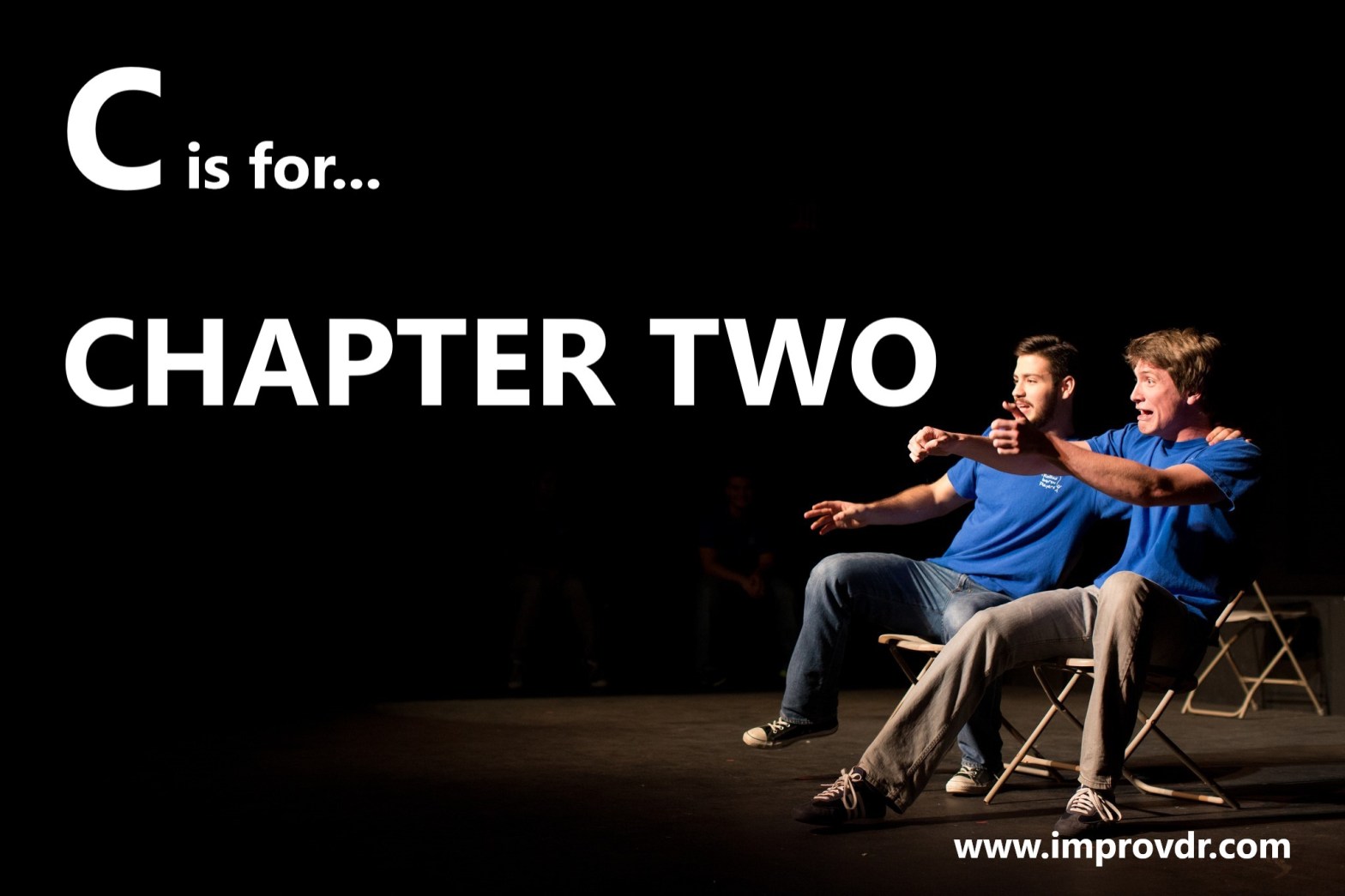
“C” is for “Caller”

A member of the improv cast that provides outside adjustments, suggestions, or challenges as the scene unfolds.

Factors to Balance as a Caller

This is just a taste of this entry/concept. Go here for more information.

Related Entries: Hosting, Shape of Show, Shivving, Sidecoaching

Cheers, David Charles.
www.improvdr.com
Join my Facebook group here.
© 2021 David Charles/ImprovDr

Connected Game: Song Cue

Search for the current stockpile of called games in the Game Library by clicking here.

Game Library: “Perspectives”

Perspectives would certainly rank amongst my favorite narrative games. If you’re familiar with Narrative Collage the premise is very similar but the mechanics are less tech dependent. This version allows players to self-edit and generally speak in an established order while Narrative Collage places this function in the hands of the technician who can raise the lights on any character at whim. The game also benefits from a slightly more luxurious pace: it can easily fill seven or eight minutes given the chance.

The Basics

A unifying event or scenario is obtained where a group of characters might congregate or share a moment of significance. Four players form a line in front of the audience, with each one stepping forward when it’s their turn. The first player (typically positioned stage right) is the first to speak and begins a narration from the point of view of a unique character of their making. After perhaps a couple of sentences they step back and the next player in the sequence continues the storytelling process, offering the beginning of a new arc from their own character’s perspective. Once all four characters have established their personae, the sequence continues through multiple rotations until eventually all four characters and stories meet in a culminating moment in time inspired by the initial suggestion.

Example

The players form a line and are inspired by the audience suggestion of “first car”.

Player A: (stepping forward) “It’d been a quiet day on the lot. Sometimes you just don’t get much interest even though these cars certainly can sell themselves given the chance! I had settled in at my desk with my newspaper and a cup of joe when I saw someone out by the new models. Here was my chance…”

Player B steps forward as “A” returns to the line.

Player B: (with a burst of energy) “Finally 16! I thought the day would never come. I’d worked all year to get my grades up ’cause (in a mocking voice) ‘that was the deal!’ The weekend couldn’t get here soon enough: the old lady was taking me car shopping!!!”

Player C has stepped forward as “B” retreats.

Player C: “I’ll be perfectly honest, I didn’t think she’d do it. Kelly has never been a particularly focused student so I thought I was safe making the deal. All our way to the car dealership I just couldn’t believe this was actually happening. My heart was racing – what had I done? But a deal is a deal…”

Player D is now downstage.

Player D: “It was a brutally hot day. And here I was, sitting out in the sun again with my siblings all around me. This wasn’t the life I was expecting, just to sit and wait and wait and wait. I longed to feel the rush of the open road.”

Player A: “This older lady was nearly hyperventilating by the newer models as I made my way causally up to my marks. It’s never a good idea to come on too strong…”

The Focus

The joy of this game is watching four very different characters and narratives develop and eventually merge at the established event or location. Active listening is particularly important, as is the ability to shelf and reuse ideas planted in the early rounds of the narrative. (Advice in my earlier callback post here is particularly on point for this particular scene so this might be worth a quick look.)

Traps and Tips

1.) Dynamic character casting choices are key. Generally players cast themselves in the moment as the game unfolds. A team member may nominate themselves to go first if they have a strong launching point in mind by placing themselves in the stage right position. It’s important to listen closely to the intent and energies of the characters as they are established so that you don’t inadvertently miss an opportunity to have a critical voice present, carelessly duplicate a character’s energy or function, or weave the characters too closely together right from the beginning. I’m a fan of taking a calculated risk in the third of fourth position once you have a sense that the fundamental roles are well covered. An unexpected, ambiguous or curveball choice here can add some interest and risk to the game – perhaps a character that has no immediately clear connection to the anticipated arc, or as modeled above, it can be fun to give voice to an inanimate object whose identity may not be instantly apparent. Once you’ve discovered the joy of this type of outlier choice, you need to be cautious that your Perspective scenes don’t become populated solely by these types of voices as it can be a challenge to move the story along in a helpful manner from only marginal or peculiar positions, hence my advice to hold off on this type of casting until later in the mix when you can assess what voice might be missing or needed. Such a patient approach also allows the clear creation of the routine or “norm” for the audience before you break it.

2.) Explore different starting points. Players should aim to have all their characters present in the same narrative moment to close the scene – from the example above, perhaps they all all speeding down the highway together with Kelly at the wheel. While it’s expected that the stories will unify and merge for the climactic event, narratives can and should start from different moments in the preceding timeline. One narrator might begin weeks before the fateful moment, while another starts earlier that morning, and a third is narrating from just minutes before everyone collides. This variety increases the likelihood that you’ll establish interesting character backstories and given circumstances that can provide color and interest for the story further down the road. To some degree you can apply this same strategy to location although you might want to be wary of having a character that starts their journey so far away that they spend the whole story arc merely justifying their travels. Thinking too much of the ending as you’re beginning the game will needlessly diffuse the risk and joy of the storytelling challenge.

3.) Vary your narrative arcs and rhythms. Depending on your given performance parameters I’ve found that the game usually thrives with five or six rotations through the team as this allows sufficient time to establish, build and connect the various characters. It’s typical to maintain the speaking order as this optimizes the flow and focus exchanges especially if you’re playing in a setting where theatre lights are unavailable to do this for you. In addition to exploring contrasting starting points and arcs as players move towards the climax, also consider dynamic rhythms in terms of your narrative lengths and styles. The game can feel a little plodding if every narration is three or four sentences apiece, and especially as the rising action builds it’s dynamic to have some quick one-liners or responses thrown into the mix. It can also become exciting to break the narrative order with deliberateness if and when an appropriate story telling opportunity arises. If everyone is speeding down the highway, for example, it’s foreseeable that the scene might culminate in a cascade of overlapping voices and screams which is very much in the spirit of the structure.

4.) Strategically utilize endowments and callbacks. As characters may exist in slightly different moments initially in each others’ timelines, players should take extra care when it comes to making and receiving endowments. There can also be fruitful tensions between how characters perceive each other as opposed to their inner perceptions, so while the mother might think she was successfully hiding her anxiousness throughout the day others could paint her as a complete nervous wreck. Or the car dealer might believe that they are suave and able to subtly manipulate potential buyers while this is not the persona they actually present to the world. It’s also helpful not to rush bringing all the characters together as this allows more leisurely shelving and reincorporating of scenic elements. It is particularly effective and rewarding when characters are able to callback little details that others established when the storylines weren’t yet connected. Does the car dealer have terrible stale coffee breath? Is the car on the lot overheating after being in the sun so long?

In Performance

While the narratives in Perspectives are generally in the past tense, it can be a fun finesse for these to shift into the present as the stories connect and culminate, giving that final moment a little more urgency and dynamism. I’ve found that most improvisers find the central conceit of this game quite accessible and enjoyable, and it’s a great way to really build and feature teamwork.

Cheers, David Charles.
www.improvdr.com
Join my Facebook group here.
Photo Credit: Tony Firriolo
© 2021 David Charles/ImprovDr

Connected Concept: Callback

“C” is for “Callback”

Reusing or recycling a story element in an effective and timely manner.

Getting the Most Out of Your Callbacks

This is just a taste of this entry/concept. Go here for more information.

Related Entries: Connections, Shelving Synonyms: Looking Backwards, Reincorporation

Cheers, David Charles.
www.improvdr.com
Join my Facebook group here.
© 2021 David Charles/ImprovDr

Connected Game: Perspectives

“C” is for “CAD”

An acronym that summarizes three highly effective forms of scenic revelations: confessions, accusations, and discoveries.

Three Forms of Revelations

This is just a taste of this entry/concept. Go here for more information.

Related Entries: Accusation, Commandment #7, Confession, Discovery Antonyms: Balance, Platform, Routine Synonyms: Breaking Routines, Ignition, Revelation, Surprise

Cheers, David Charles.
www.improvdr.com
Join my Facebook group here.
© 2021 David Charles/ImprovDr

Connected Game: CAD Bell

Game Library: “Most Scenes in a Minute”

This is a fast-paced game that is equally useful as a skill-building exercise as it is an energy-building addition to your short-form evening. It’s also another of those games where the title provides you with all the basic information you need to know! It’s called Most Scenes in a Minute.

The Basics

The time component of the game can certainly be adjusted to suit your needs or called with considerable discretion, but this is typically a one-minute game. A broad prompt is obtained (a location, theme, subject…) to inspire the scenes that will follow. Members of the team must endeavor to construct as many scenes as possible within the allotted time frame, with each scene including a clear beginning, middle, and end (buttons are of particular import). This game can also be used as a decider, with competing teams striving to perform more scenes in the minute than their rivals.

Example

“Pets” is the assigned topic. As the lights come up, Player A sits on the floor as a child, looking in their hands. Player B stands over their shoulder.

Player A: “No, I love it. It’s just not quite what I expected.”

Player B: “No one is ever too old for Lego!”

Player B smiles and turns to leave. Player A looks a the blocks and slowly starts to assemble them…

Player A: “I’m going to call you Clifford and we’re going to be best friends…”

Player B understands what they have done, and slowly leaves the stage as the lights fade.

The host calls “One.” When the lights come up, Player C is standing onstage holding a leash. Player D slowly approaches them…

Player D: “Excuse me, Celia, but are you going to pick that up?”

Player C: (Willfully oblivious while looking at their cell phone) “I’m sorry…?”

Player D points with disgust at the ground.

Player D: “I know it was your French poodle, Celia, and I’ve had it up to here with your dog relieving himself in my yard..”

The Focus

Much like a good Freeze Tag game, I like the challenge of establishing strong details as quickly as possible in these vignettes. You’ll want to present your CROW efficiently while also striving to make the brief scenes feel more robust and dynamic than merely fleeting moments. In addition to encouraging strong buttons, this game is an excellent way of honing story, character, and staging skills.

Traps and Tips

1.) Strong facilitation is critical. It’s important to have someone clearly responsible for the mechanics of the game, such as your host or another member of the ensemble. They can provide time warnings at opportune moments, tally the total number of completed scenes, and help communicate with any technical improvisers when each vignette needs a blackout. These transitions should be very short in order to help maintain the momentum of the game and if your space has the means, it can be fun for the lighting improviser just to offer up a new specific area or “look” as soon as the lights come back up. If you’re playing this as a competitive decider, the facilitator can also make any needed “calls” in terms of perceived infractions or penalties, such as if scenes are too similar or start to feel more like “moments” than true (albeit abridged) story arcs. Keep in mind that such calls are obviously all just conceits to add heat and playfulness.

2.) Rotate the starting position. A helpful tip in terms of the flow of the game is to be extremely proactive when it comes to scene starts and for players to make a concerted effort to trade into this pressure position. As prior scenes conclude, players involved in this action should endeavor to strike themselves from the stage as best as possible, or the transitions can lose any sense of clarity and finesse. Incoming players should then claim a new area of the stage for their initiation (perhaps offered by the lighting improviser as suggested above). In a delightful sense, the challenge of these transitions is made all the more difficult the fewer players you have involved. Initiating players should start strongly and clearly even if they have only the vaguest idea of what they “want” for the scene and designate any intended scene partners that may not already be present on stage.

3.) Contrast, contrast, contrast. Actively seek variety in your brief scenes. Whether it’s player combinations and numbers, staging devices, tone, or energy, the game benefits greatly from approaching the initial ask-for from multiple different angles. Look for what has already been utilized to inspire new areas of potential. If we’ve only seen human characters, a vignette from the point of view of the pets would add a new element into the mix. If the prior scenes all involved two players, a solo or group scene could break up the pattern. If scenes have all taken on a whimsical or silly tone, bringing a more poignant or sincere character to the stage will add a striking new dynamic. This format provides an opportunity to truly embrace the disposability of improv as no scene will likely last more than 10 or 20 seconds, so take full advantage of this unbridled brainstorming session.

4.) Fight the freneticism. Inevitably, this series of quick scenes becomes a little chaotic or hectic as the excitement of the challenge builds. If early scenes start with this kind of energy, it’s likely to quickly work against you and prevent you from achieving scenes with any semblance of nuance or finesse. Remember that the competition or time challenge is a gimmick, and that the audience probably has little interest in watching 60 seconds of sloppy improv in the name of “winning.” Make a concerted effort to start the first scene, in particular, with some grounded patience as this will set a tone and give you some space to let the freneticism build. If characters just run to stage and start yelling their choices at each other, the format is unlikely to elevate beyond a panicky parlor game. Admittedly, this might be exactly what your shape of show needs if you’re looking for a decider to determine a tied evening, but even under these circumstances, don’t forget to tell stories while you entertain.

5.) Consider the bigger picture. In addition to paying some extra attention to your buttons – the inspiration for this particular Game Library entry – Most Scenes in a Minute is also an excellent opportunity to explore broader ideas that might connect your scenes beyond the obvious initial ask-for. Keep an eye open for recurring motifs and themes, opportunities for characters to reappear or seemingly random scenarios to connect, or for running games or reincorporations to emerge that help to tell meta stories. As the scenes need to be concise due to the time constraints, allowing connections to organically develop is a great way of adding some skill and interest. One well-placed overarching connection can also provide the button of all buttons to end the game!

In Performance

This tends to be a high-octane game, but it can also help sharpen storytelling and staging skills. If you struggle with pitching and committing to clear buttons, the whole affair is likely to quickly devolve into a blur of indistinguishable activity. Yes, the challenge is a central and important device, but it is telling that the one performance of this game that I can still recall watching from many decades ago was when a team managed to achieve the insurmountable score of one scene. They were so enjoying their original scene (as was the audience) that they all just took their time and played it through, much to everyone’s delight. I’m not advocating this as a standard approach, but it’s good to keep in mind the standard improv wisdom that the game structure should ultimately serve the scenes and not vice versa!

Cheers, David Charles.
www.improvdr.com
Join my Facebook group here.
Photo Credit: Charlotte Brown
© 2021 David Charles/ImprovDr

Connected Concept: Button

“B” is for “Button”

The, hopefully, effective and satisfying final moment of a scene.

Thoughts on When to Pitch That Button

This is just a taste of this entry/concept. Go here for more information.

Related Entries: Edits Antonyms: Initiation, Starting Scenes Synonyms: Conclusion, Ending, Resolution

Cheers, David Charles.
www.improvdr.com
Join my Facebook group here.
© 2021 David Charles/ImprovDr

Connected Game: Most Scenes in a Minute

Game Library: “Emotions”

I know a lot of Emotional Rollercoaster variants, and this entry is of that ilk. I’ve found the way this version provides dual callers offers up a helpful mechanism to maximize the gift of the changing emotions while minimizing the risk of unfocused chaos that can often quickly ensue when you have four characters all trying to justify switches at the same time. Emotions was a standard when I played with the ensemble at Walt Disney World’s now sadly-defunct Comedy Warehouse.

The Basics

I prefer this game in a team of four with two onstage characters, each paired with an offstage emotional caller. A list of suitably varied emotions can be gathered from the audience prior to the scene (possibly with the other actors out of earshot although this doesn’t have the same payoff as other games with more of an endowment frame). Alternatively, callers can also just use a preset list or their imaginations, although the audience certainly enjoys seeing their “spoilers” hitting the stage. A typical initiating ask-for such as a relationship or location is then obtained, and the scene starts. Characters begin “neutrally” but must then assume and justify the random emotions as they are provided by their offstage companion.

Example

Players A and B serve as the onstage characters with C and D serving as their respective offstage emotion callers. The prompt provided is a job interview at a warehouse.

Player A: “Thank you so much for joining me here on the warehouse floor for the final portion of your interview.”

Player B: “No worries at all, Kalin – if it’s okay that I can you by your first name.”

Player C: (as A’s partner) “Player A: Embarrassment. Embarrassment.”

Player A: (Looking around) “I’d actually prefer that you didn’t. People might make assumptions if they know you’re a member of the boss’ family.”

Player B: “I totally understand. It won’t happen again.”

Player A: “Shall we look at the newly-installed storage system. Although I imagine that you’ve heard about it at home…”

Player D: (as B’s partner) “Player B: Arrogant. Arrogant.”

Player B: “I’m very familiar with the specifications, actually. Although I’ve heard you’ve been struggling with some basic operations… Kalin.”

Player A: “I had hoped that wasn’t common knowledge…”

Player C: (as A’s partner) “Joyful. Joyful.”

Player A: (with a sudden smile) “…but who knows if I’ll even be here in a few more weeks!”

The Focus

In addition to encouraging players to assume and explore a deeper variety of emotions alongside obvious justification challenges, this game also demands that characters are changed by the various emotional overlays. If this is not a personal or company strength, or you struggle with a bulletproof stance as a player, Emotions offers a helpful short-form tool. While it is typically played with lighter hues more likely to elicit audience laughter, the game is delightfully resilient and can work surprisingly well with more sincere or dramatic scenarios as well. I also appreciate that these scenes typically only involve two characters, so it’s incumbent upon the team to really invest in the initial relationship as this should ultimately prove to be the focus of the scenic journey.

Traps and Tips

1.) Don’t underestimate the contribution and importance of the callers. While the characters are undeniably likely to receive more of the “glory” of the scene, much of this success is typically made possible and elevated by effective and generous calling. Many of the tips I’ve included in my earlier Genre Rollercoaster post you can find here remain true in this context, although the dual caller structure offers some new potentials and pitfalls. When establishing the game, I find it helpful for callers to initially name their onstage scene partner before offering the emotional shift. Above I’ve just used Player A and Player B as stand-ins, but ideally for clarity this should be the character’s name (Kalin) or role (applicant), or perhaps the actor’s name if these are used throughout the performance and the character’s name has not yet been established. Rather than pausing the action with a “Freeze,” I prefer the device of repeating the emotion twice so that the audience and players are less likely to miss the adjustment. Generally, calls work well if they alternate somewhat predictably between the two callers so that there is time to consider what will provide the most effective or stark contrast (both with the character’s prior emotional state and their scene partner’s current climate). I also like to stage the callers on opposite sides of the stage when you can to facilitate a better view of the action and characters. If you decide to just call emotions on the fly without audience suggestions or a list, I find it a helpful little cheat to start somewhere in the alphabet and then just move your way through it for inspiration, not fretting if you skip over a letter or two on the way: “Love-struck… Mad…  Optimistic… Perturbed…”

2.) Don’t forget to leave room for each other. If this is a new technique or you’re accustomed to single caller versions, it can take a little practice to become comfortable with the rhythm of offstage calls and onstage justifications. A rookie trap is getting caught in a loop with your caller that excludes your scene partner; that is, the character gets a new emotion and they incorporate it only to be fed a new emotion which they then feel obliged to immediately use as well… The onstage characters can help a lot in this regard by offering clear pauses or moments in the scene where a new emotion might helpfully land. Similarly, if callers provide a new energy for their onstage character immediately following a line of dialogue from the other character, then their partner will be more likely to be in focus for the shift. As modeled above, it can also be effective to offer emotional changes within a character’s line, although you’ll want to have a strong connection in these moments so as to avoid talking over each other. Once the team has hopefully found a groove with the give and take, it is nice to become a little less predictable with the call placements just to keep everyone, including the audience, on their toes.

3.) Don’t disarm the caller’s choices. There are several unhelpful ways that minimize the risk of the new emotions which can tend to sneak into the scene if the players aren’t grounded or are feeling overly anxious. It is generally less successful and dynamic to slowly make your way towards the newly offered emotion. A sharp and immediate shift raises the risk and requires the justification to emerge in real time, which is inherently more dangerous and exciting for the audience and players alike. Relying solely on your words is a related trap as there can be a great deal of dynamism gained from a clearly executed but largely silent emotional response and journey (especially if you are offered a new emotion while your partner still clearly needs to finish their sentence). I’d also caution against characters naming or referencing their emotional states in their dialogue within the scene rather than fully embracing and playing them. This is good advice for all improv scenes in a showing not telling kind of way, but in Emotions, it can feel particularly wimpy to just hear a character suddenly announce “I’m joyful all of a sudden…” This gimmick ranks very highly on my list of short-form pet peeves!

4.) Don’t rely on old games in lieu of recognizing emerging ones. Again, this is great advice for pretty much every scene and particularly those that have such a strong framing handle as Emotions. It’s tempting to do “that thing” that worked so well last time, but this will invariably bear less delicious fruit than patiently watering choices that emerge spontaneously in the action. Characters may end up exploring similar or identical emotion calls, dynamic emotions may become recycled or shared, one character might experience calls at a quicker pace than their teammate, or a character might be challenged to explore subtle emotional variations that are almost synonyms. These, and so many other games, can provide delightful additions, but they rarely work well when they are needlessly imposed. Ideally, the callers are enabling cogent characterizations and deepening the featured relationship through carefully executed offers based on close observation of the scene’s needs and underlying potential. It’s important to give the top of the scene some true room to breathe for this reason so that this is a strong balance or foundation. Once this has been firmly established, playful shivving from the callers when it’s deemed appropriate is more likely to add to the fun and less likely to puncture the scenic momentum.

In Performance

A common misstep with Emotions is over-calling, especially as the scene leaves the starting gates. I enjoy this game less as a player (and from the audience frankly) when it feels like the character only gets one quick crack at each emotion before it changes. Calling in this manner also decreases exponentially the likelihood that players will be able to mine any nuance or connection from the provided state of being. This fast style of play certainly elicits a particular energized result and may aid in the construction of a dynamic climax, but don’t overlook the value of a more generously patient approach. If you’re working on removing your improv armor, a more luxurious pace will also encourage meaningful changes in your character and relationship.

Cheers, David Charles.
www.improvdr.com
Join my Facebook group here.
Photo Credit: Tony Firriolo
© 2021 David Charles/ImprovDr

Connected Concept: Bulletproof

“B” is for “Bulletproof”

If you tend to evade others’ choices and endowments, you may be falling into the trap of being a Bulletproof player.

Signs You’re Wearing Your Improv Armor

This is just a taste of this entry/concept. Go here for more information.

Related Entries: Ambiguity, Bulldozing, Commandment #5, Commandment #8 Antonyms: Change, Culpability Synonyms: Wimping

Cheers, David Charles.
www.improvdr.com
Join my Facebook group here.
© 2021 David Charles/ImprovDr

Connected Game: Emotions

Game Library: “Speak in Turn”

Speak in Turn provides a short-form game with a lot of gifts to offer, including promoting active listening, generous scene work, and nuanced communication. I’ve paired it with the concept of Bulldozing as it can also serve to address this tendency if you are working on ceding more control in your scene work.

The Basics

Players work in teams (four players seem to be optimal). Before the scene begins, players number off to establish an order. For the duration of the scene, players must speak in their assigned order: once they have contributed a sentence or idea, they cannot make another verbal choice until the sequence has completed a rotation.

Example

Players receive “a road trip” as the initiating offer and determine to speak in the order A, B, C, then D. They construct a car as the lights transition, with B occupying the driver’s seat, A beside them, and C in the backseat. D is currently offstage.

Player A: (looking anxiously out the window) “This is the third time we’ve stopped in two hours. We’re never going to make it to Sterling.”

Player B: (checking their watch) “I’m sure I can make it up on the highway.”

Player C is on their cell phone in the backseat. They throw their phone on the seat with frustration.

Player C: “The cell phone reception here is terrible.”

They all sit in an awkward silence as Player A offers Player C some chips that they have pulled out from a bag on the floor.

Player D: (yelling from offstage) “I’m 25 cents short!”

Player C sighs, looks at the others, and with a shrug, gets out of the car to go and assist.

Player A: “It’ll be a minor miracle if those two don’t kill each other before we get there.”

Player B: (shooting A a look) “You could have just said if you didn’t want to come. I know they’re my family, but…”

Player A goes back to eating chips. Player C and D eventually return to the car and get into the back seat…

The Focus

Like most games that provide a verbal restrictions, it is important to focus on the physical and emotional reality of the scene. If you just passively wait for your turn to speak again, the scene will quickly feel like it is filled with unnecessary empty air. At its core, this is a justification game where players need to craft a detailed world in which their dialogue choices (and silences) have a meaningful context.

Traps and Tips

1.) Make your dialogue count. There can be a temptation to just speak when it’s your turn in this game, but the scene usually comes to life in more interesting ways when you make sure that every line counts and feels impactful. If it’s your turn to talk but you don’t have a reason to just yet, let the tension or interest build through your physical and emotional choices. Exploring subtext and relationship specifics are the hidden gifts of the game. This also holds true if you want to talk, but it’s not your turn yet. A lot can be said with an intense look, shift in body language, or well-timed stage action. Also, be careful of naming the game: “Why isn’t anyone talking?” This will (sadly) likely get a laugh, but it’s not a particularly helpful or earnt one, especially if it is in lieu of committing to the unfolding action.

2.) Build the game patiently. It’s certainly important to model and “teach” the audience the rules of the game as the scene starts, but as is typically the case, the scene should be your primary concern, especially during those opening moments as you’re establishing the premise, relationships, and the world of the play. For example, starting the scene without the first designated speaker can be delightful if this choice is made carefully and knowingly, but it can also strand your fellow players onstage without any way of talking to each other. Generally, the game benefits from reserving innately more challenging dynamics until later in the dramatic arc, particularly if this form is relatively new to your team or ensemble. The scene will ultimately benefit from strongly established details that will contextualize and inform these later moments. There is also an important distinction between discovering these games and just rushing to the stage gimmicks that you’ve applied before. The former will typically land much better than the latter, which can tend to ignore important scenic rhythms that are building organically.

3.) A little torture goes a long way. In tension with the above suggestions, I would offer that once you’ve got a firm foundation for the scene, a little playful shivving or “torture” can add a new level to the enterprise. It’s easy to forget that the audience finds delight in a little struggle and that this is a large part of what makes improvisation so immediate and inviting as an art form. Choices such as an unexpectedly timed exit or a character who suddenly becomes reluctant or unwilling to talk can certainly add a joyful level of challenge, especially when the company has found an energized and effective momentum. Companies have varying attitudes and comfort thresholds when it comes to this kind of approach, but a little playful mischief serves well in this particular form. When the game is too seamless, it can oddly make the scene fall a little flat. It is also nearly inevitable that someone will speak out of turn (often in the opening moments of the scene), so it can be helpful to have a strategy in place if this occurs. I tend to have a host or emcee quickly note any infractions in such a way that doesn’t needlessly stall the building action.

4.) Explore different line lengths and rhythms. There isn’t a set expectation of line length in this game – you’ll note it’s not defined as each player gets “one sentence” each, for example. It’s possible, then, for a character to take their turn to offer a brief monologue, although perhaps avoid this as your stock choice if you’re working on overcoming your bulldozer tendencies. On the other end of the spectrum, characters could also elect to make their speech act an utterance, such as a grunt, moan, or gasp. You’ll just want to make sure you are providing clear “outs” to your sentences so that teammates clearly know that your intent is to pass the focus. It can also be exciting to vary the rhythms between each line of dialogue as the scene can feel stilted if you fall into a relentless pattern of predictable pauses and line lengths. A rotation of short lines in quick succession can create a wonderful juxtaposition to more measured sections. Alternatively, a character may make a style or tempo of speech part of their own individual game. I’d just echo the above warning about automatically inserting rehearsed dynamics rather than being open to finding them in the work. While the featured game is verbal in nature, don’t neglect the fact that strong physical and emotional offers can be made “out of sequence.”

In Performance

This game moves in and out of rotation in my current improv home, but I’m always happy when we re-remember it! It’s an improv handle that can also facilitate interesting and nuanced storytelling on the stage, which isn’t always a given unfortunately. If you are a voluminous or reluctant speaker, it can also help you break your own patterns as the scene really demands “equal” collaborative participation by its very design.

Cheers, David Charles.
www.improvdr.com
Join my Facebook group here.
© 2021 David Charles/ImprovDr

Connected Concept: Bulldozing

“B” is for “Bulldozing”

A player who tends to push their agenda aggressively and consistently onto their teammates.

Ways to Siphon the Fuel of Your Bulldozer

This is just a taste of this entry/concept. Go here for more information.

Related Entries: Commandment #2, Give, Waffling Antonyms: Passenger Synonyms: Steamrolling

Cheers, David Charles.
www.improvdr.com
Join my Facebook group here.
© 2020 David Charles/ImprovDr

Connected Game: Speak in Turn