“C” is for “CROW”

A handy-dandy acronym that refers to four helpful scenic building blocks (Character, Relationship, Objective, and Where) that can form a strong foundation for joyful play.

Building Your CROW Foundation

This is just a taste of this entry/concept. Go here for more information.

Related Entries: Character, Objective, Relationship, Where Antonym: Cartooning, Vagueness Synonyms: Given Circumstances, Initiation, WWW

Cheers, David Charles.
www.improvdr.com
Join my Facebook group here.
© 2021 David Charles/ImprovDr

Connected Game: Conducted Freeze Tag

Game Library: “Laugh and Go”

Laugh and Go serves as a rather metatheatrical game as the audience gets to see the increasing chaos of various players trading in and out of roles. Some level of Corpsing (or breaking) looms as almost inevitable, although a performance absent of this quality can prove quite breathtaking. I first encountered this game at Sak Comedy Lab, where it became a regular offering in our Gorilla Theatre shows.

The Basics

A suggestion that (at least seemingly) leans towards a more serious topic serves as the inspiration for the scene. The game is often playfully introduced as an exercise in dramatic acting, and the audience is notified that if any of the players should elicit a laugh during the performance they will be immediately replaced by another member of the company. The scene begins, and as promised, any significant laughter cues an actor swap with someone entering from the wings who then immediately picks up the action from exactly where it left off. As the scene continues, and the onstage cast grows, swaps may occur between onstage players as is deemed necessary and enjoyable.

Example

Inspired by “bullying,” Players A and B begin a scene as a parent and teenage child. Player A enters the family living room to begin, masking their face.

Player B: “You’re home a little late, Alex.”

Player A: (sheepishly) “I’m just going to go up to my room.”

Player B gets off the couch and approaches…

Player B: “Is there something wrong? Let me see your face…”

Player A pulls away abruptly, garnering an unanticipated laugh from the audience.

Caller: (announcing) “Alex.”

Player A leaves the stage, and their exact position is then assumed by incoming Player C.

Player C: “It’s nothing. I don’t want you to make a big deal about it…”

Player B: (insistently) “Let me see it, Alex.”

Player C slowly turns to reveal their face, and B recoils a little too dramatically in horror. The audience laughs...

Caller: (announcing) “Alex’s parent.”

Player B is quickly tagged out by Player D…

The Focus

Much of the joy of this game comes from the collective struggle of trying to hold it together: keeping track of the story details and character mannerisms, playfully honoring the seriousness of the context, knowing which player is embodying each character at any given moment, and struggling to retain personal composure in the face of it all.

Traps and Tips

1.) A caller is your best friend. My experience with this game would suggest that an attentive caller can make a world of difference in terms of how the scene builds and lands. From the stage, it can be challenging to distinguish an isolated giggle from a more pointed audience response – or perhaps identify which player was the primary source of the pertinent reaction. A dedicated caller can quickly pause or assess the action and make these decisions in real time, unequivocally naming the offending player, as in the example above. When the scene launches, the caller can also judiciously choose to ignore individual audience chuckles or insincere guffaws. The inherent stops and starts of the game may cause focus challenges, so this helpful steering hand can go a long way to maintaining a satisfying scenic trajectory. Onstage improvisers can assist in this regard too: once a call is made, it’s important to immediately honor and execute it (even if you’re inclined to throw a little shade as you slink to the side of the stage).

2.) Start with sincerity. Although it is almost a given that the sincere or serious suggestion will likely have collapsed in on itself by the scene’s completion, it shouldn’t become a fait accompli. In the opening salvos, earnestly dig into your acting reserves and strive to perform without a comedic wink or expectation. Arguably, this is how you should really play the whole scene, but it is of particular import as the scene makes its first steps as you need to establish and honor the central conceit and give the story a solid foundation for the madness that will likely follow. Invariably, the audience will laugh – typically at something minor and unexpected. Allow this first prompt to occur in its own time and way. If you look for or crave the laughter, the scene will suffer for it.

3.) Give the scene room to grow. While there will always be earnt exceptions, this game works really well when you start with two characters on stage (or one player soon joined by a second). The tight focus of one staged relationship makes it easier to establish some strong personality traits that others can pick up and mirror later and generally allows a more solid scenic foundation. Tag outs during this early phase should be crisp and clean so the audience can easily grasp the logistics involved. Once you have three or four characters on stage, this will usually necessitate players to switch with each other (as opposed to trading out with someone waiting in the wings). This dynamic is definitely bracing and exciting, but if you get there too quickly, the game of the scene may have nowhere to go.

4.) Try to hold it together. If (when) corpsing does occur, it lands more effectively if players have done everything in their power to keep their act together. Almost all the elements of this game conspire against the players maintaining their composure, between the stark contrast of material and staging, and the sudden casting changes and audience interruptions. If players become inclined or tempted to almost cue the audience’s laughter, the game’s conceit and integrity will degrade in the process. (For example, while it’s helpful to have clearly distinctive characters to make them easier to track, overly broad or gimmicky choices can unnecessarily serve as spoilers.) When the scene reaches its typically chaotic climax, you may have little ability to keep it together, but the audience will certainly relish your efforts to do so!

In Performance

If you’re working in an overtly comedic short-form tradition, the “now we’re going to perform a serious scene” construct of Laugh and Go can add a delightful new hue to the night while simultaneously garnering you some big laughs and full-throated audience involvement. The format also works equally well as a team or all-play game. Remember, don’t rush to the perceived finish line; rather, savor each silly slip and chuckle along the way.

Cheers, David Charles.
www.improvdr.com
Join my Facebook group here.
Photo Credit: Tony Firriolo
© 2021 David Charles/ImprovDr

Connected Concept: Corpsing

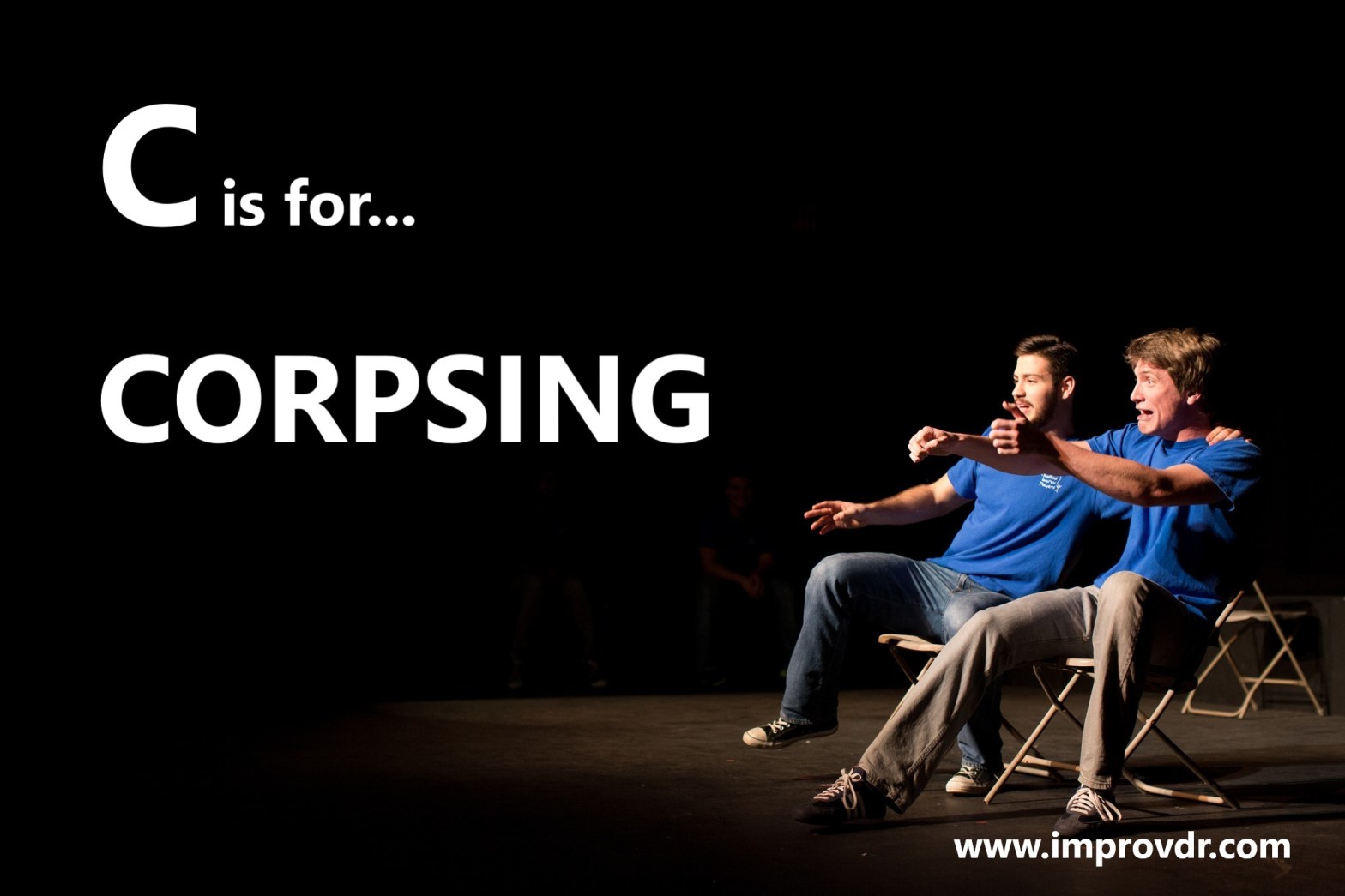
“C” is for “Corpsing”

Breaking the reality of a scene by laughing at your plight (as the player rather than as the character you’re theoretically embodying).

Keeping Life in Your Corpsing…

This is just a taste of this entry/concept. Go here for more information.

Related Entries: Commenting, Mugging Antonyms: Emotional Truth. Synonyms: Breaking

Cheers, David Charles.
www.improvdr.com
Join my Facebook group here.
© 2021 David Charles/ImprovDr

Connected Game: Laugh and Go

Game Library: “Sculptor Pairs”

If you’re familiar with Augusto Boal’s work, this exercise will strike you as familiar as it draws from his theatrical explorations. Sculptor Pairs encourages more vulnerable embodied communication and, subsequently, invites a candid consideration of personal boundaries and issues of Consent. You can use the game as a stand-alone icebreaker, ensemble builder, or as a leaping off point into more physically dynamic and emotionally connected play.

The Basics

Players, divided into pairs, select an appropriate area to serve as their workspace and nominate someone to serve as Player A and Player B respectively. The facilitator provides a prompt to spark the exploration, such as a personal relationship, emblematic location, or provocative theme. Player A serves as the first sculptor and should imagine a detailed image inspired from their own life that they would like to craft. Standing approximately three feet away from their subject (Player B) they should use gestures and hand movements to animate and adjust their partner’s position into the imagined and desired pose, all the while working in silence and without actually making physical contact. Player B should endeavor to translate these instructions as best as they can while remaining open to (silent) feedback and adjustments. Once Player A is happy with the details of the pose, they should then step into their created image and complete it with a self-selected position of their own so that the image now contains both bodies in combination. If their image requires physical contact, they should first seek verbal permission from their partner – “can I put my arm around your shoulder?” When everyone has completed their tableaux, the leader may move focus from one image to another (with players relaxing when they are not being observed) so that the ensemble has a chance to view and discuss the work of their peers. Reverse the roles and repeat.

Example

Player A and B are exploring the relationship of siblings.

Player A takes a moment to determine the essence of a relationship image and stands a few feet away from Player B. Player A gestures for B to grab a chair and sit in it and they do so. After pointing to one leg and then the other, B understands to sit cross-legged in the chair. Placing an imaginary head in their hands, Player A re-positions B’s head so that it is leaning back a little and then recommends a more joyful expression by modeling it on their own face. With an additional move, B’s arms eventually are adjusted, one sitting on their left thigh, the other holding something that the subject assumes is a drink of some kind.

Player A steps back and assesses the image and tweaks the angle of B’s head with a hand motion.

Player A: “Is it okay if I touch your hair?”

Player B nods and A now enters the image as a presumably older sibling brushing out B’s hair with an expression of care and laughter. The picture is complete.

The Focus

Concentrate on the depth and success of the silent communication, the subtle ways that sculptors are able (or unable) to craft their intent, and the process through which both players can find joy and comfort working together on something that can innately feel a little intimate or vulnerable.

Traps and Tips

1.) Contextualize the prompts. This exercise works well to plumb the depths and shades of our own lived experiences, and I would recommend setting it up with this more personal focus (rather than just making pretty pictures). Relationship prompts work well as a starting point as they tend to more readily spark our imaginations. Be sure to acknowledge that everyone in attendance may not have the same or any experience with a given prompt. In the case of siblings, for example, it would be completely in the spirit of the game to model the absence of a sibling (perhaps with the artist not entering the frame) or an image that captures the desire of what a sibling would have felt like. Similarly, if you’re tackling juicy themes, I always allow the inversion of the proffered dynamic if this is the sculptor’s instinct (so “justice” becomes “injustice”) as this attitude encourages a rich diversity of tableaux. At the end of the day, it’s highly preferable that the resulting image is personal and meaningful rather than fictive and empty.

2.) Honor the silence. There is something potentially unsettling about conducting this exercise in silence especially if you are accustomed to leaning on your verbal acuity. Embrace this way of working as it demands and unlocks for many a very new way of communicating with our scene partners. Avoid the temptation to settle at a generic approximation of your intended image and fight to realize the specific details that you view as important. This might require taking a completely different gestural approach if your initial attempts prove clumsy.

3.) Celebrate the creations. If you’re dealing with large archetypes or themes as the prompts, you’re likely to create a complex and engaging gallery of images. It’s worth taking some time to unpack the threads that emerge. Are there widely held experiences that are reflected across multiple images? Do some tableaux effectively model unexpected tensions or delightful differences? What specifics are clearly being communicated to the audience or might inspire a subsequent scene? Are there any unintended messages or physical elements that hamper the perceived artist’s intent? Discussion between rounds also affords an opportunity to assure that participants are appropriately accepting the challenges of the exercise while also feeling seen and heard.

4.) Consider a next step. I’m so often struck by the amazing variety and specificity of images crafted with this technique and how much we can communicate without uttering a single word. While there is certainly no need to move these moments into scene work, this can serve as a logical next step, especially if you’re looking for ways to craft richer scene openings that aren’t purely reliant on dialogue to get the ball rolling. Pairs can be given new individual prompts to inspire a brief sculpting session prior to beginning a more traditional scene, or after exploring a series of different prompts could elect to use a favorite to adopt as the lights come up on the action.

In Performance

While you are perhaps unlikely to incorporate the sculpting device per se into your scene work and initiations (although, why not?), hopefully the trust, specificity, and heightened physical awareness gleaned from this exercise will infuse your process. If your company struggles to represent a certain category of relationships or themes, this dynamic also affords a mechanism for slowly breaking it down in rehearsal to enable greater awareness, understanding, and comfort.

Cheers, David Charles.
www.improvdr.com
Join my Facebook group here.
Photo Credit: Scott Cook
© 2021 David Charles/ImprovDr

Connected Concept: Consent

“C” is for “Consent”

Recognizing that our choices onstage have repercussions and that our art should foster a welcoming spirit where boundaries are acknowledged and respected.

Consent Before, During, and After the Show

This is just a taste of this entry/concept. Go here for more information.

Related Entries: Commandment #1, Postmortem, Questions, Speaking Your Truth, X-Rated Antonyms: Carelessness Synonyms: Boundaries, Permission

Cheers, David Charles.
www.improvdr.com
Join my Facebook group here.
© 2021 David Charles/ImprovDr

Connected Game: Sculptor Pairs

Game Library: “Phonebank”

Does anyone remember phonebanks?! This potentially anachronistically titled game works well in both short-form settings as a stand-alone game, as well as in larger long-form productions. I’ve woven it into my Variations on a Theme and ImprOvientation pieces as a featured structural component, as is seen in the picture above. Phonebank thrives on Connections and allows characters to playfully weave together their own stories with those of fellow teammates.

The Basics

I’ve formulated a rather layered and structured approach to this game that has worked well in performance, but you can certainly just play with the general premise and allow the pace to evolve as it will. I’m considering the game in a short-form setting for this entry, so each player should elicit a different premise for their phone conversation such as who is on the other end of the phone, something emotional or unexpected that has just happened, or an urgent need or desire. When played in a long-form setting, these prompts or character motivations have usually evolved organically from prior actions and scene work. Using four players works particularly well in this form, providing sufficient material to develop the interplay without causing overwhelming focus issues.

Phase One: One at a time, the four characters gradually enter the playing field. Each improviser establishes their own phone in a phonebank (or, alternatively, brings on their personal cell phone) and begins a call to an unseen and unheard offstage partner. As each player is crafting this introduction, the next player should enter and physically establish themselves to facilitate a smooth transition so that only one player is actively talking at any given moment. In this manner, all four players should arrange themselves (typically in a straight line) and introduce their imaginary scene partner and basic premise. Once established, players continue to craft new material inspired by their backstory or prompt, working to effectively and generously give and take focus up and down the line as the need arises. This phase is marked by new disconnected material, which only serves the objectives and scenarios of each individual speaker.

Phase Two: Once all the speakers are present and their stories are sufficiently introduced, the game moves into the second phase. This tends to be about 45 seconds to a minute into the game. Characters should now seek to gently weave, echo, or connect to words, ideas, and themes that have been established by their scene partners. This ideally starts off subtly and then gradually increases in its attack as the second phase evolves. Players still maintain the integrity of their individual worlds and conversations, but look for ways that their arcs can be nudged or influenced by other content around them. Gives and takes continue “randomly” and will often increase in pace as well. This phase is the “meat” of the game and generally builds until the scenic climax.

Phase Three: When the conversations and connections have crescendoed, the game moves into its final phase, equivalent to a falling action or denouement. In the order deemed most helpful to the action, players now end their conversations by hanging up their phones and then leaving the space. These moments provide one last opportunity for characters to resolve their story thread (or potentially not resolve it, especially if future scenes await) while perhaps also reflecting on any larger theme or game that has developed. Usually, the scene will then end with one last onstage player making their final retort. I would classify this as the “typical” end of the game while noting that on occasion it can be more effective and dynamic to call the scene down at the pinnacle of phase two if something shocking, exciting, or honest lands particularly well.

The Focus

At its core, Phonebank is a focus workout as players must carefully maneuver and share their narratives. I’ve found the core concept and structure extremely accessible with new players frequently experiencing clear success and joy. This is also a helpful vehicle for exploring how connections work (and don’t work) and how to balance this instinct with other story-telling devices.

Traps and Tips

1.) Share. Phonebank is as much about not talking as it is about talking. Players will, by design, spend a lot of time waiting for their “turn,” so be sure to explore ways to remain actively present and engaged during these soft freezes. Those who enter the space later in the third or fourth positions, in particular, can sometimes get a little less stage time to craft their stories if their teammates aren’t aware. Defer to new speakers and entrances, especially if, as a character, you are “hot” with material flowing easily. Phonebank isn’t generally played in a set order with players speaking consecutively down the line, but if you are speaking every second or third time, then, mathematically, that means someone else is getting shut out. If you fear that you may be talking too much, you probably are.

2.) Focus. The second phase is certainly the most challenging, but this is also the gift of the game. Players should actively listen and engage in clear and deliberate focus gives and takes. Throwing the focus away (as opposed to directing it towards another player) or petering out as a speaker tends to undermine the central dynamic, as does excessive politeness and passively waiting for your turn. Mark the end of sentences clearly if you are intending them as “gives,” using physical or verbal gifts if you want to pitch the narrative to someone in particular. Focus takes need to be well-timed and intentional: clearly shifting your weight prior to speaking can indicate you’re next, as can verbally overlapping – perhaps with an emotional utterance rather than important words – when you sense your teammate is wrapping up their offer and is ready for an edit.

3.) Discover. In addition to the defined game, Phonebank is a great vehicle for discovering and building new dynamics within the broader frame. Perhaps there is a quick run where characters just say one or two words each, a physical game that contagiously moves from one booth to the next, or a resonant theme that starts to pull all the story threads together. In addition to seeking more obvious links, such as repeated words or backstory elements, these more nuanced connections can add exciting facets and dynamism. Once players are secure with the basic principles and the focus exchanges, an eye towards organic discovery will keep the game fresh and evolving. While it’s helpful to have a sense of where your individual story thread is heading, trajectories will and should change based on what is happening around you.

4.) Delve. One of the main reasons I have utilized this game in some long-form work is that the conceit can support an enormous variety of energies and styles, from broad physical comedy to sincere and poignant catharsis. Look for opportunities to bring this wealth of human experience to the stage, whether it is in how your frame your ask-fors or exploring both whimsical and more vulnerable takes on the material. From experience, it can be more difficult for softer hues to thrive if they are late entrances as the momentum of the game may have already become jaunty (although more sincere material needn’t be lethargic by any means). I’ve also found that a more outlandish or overtly silly choice seems to play best in the final position as this allows the audience to learn the gist of the game before upturning the apple cart. And, of course, there’s no reason that a seemingly irreverent energy can’t take a turn into something more poignant (and vice versa).

In Performance

A resilient form that can contain a broad spectrum of styles and energies, Phonebank provides a strong ensemble-based game that both polishes and requires critical improv skills. It’s one of those formats that I’ve seen, taught, and played literally hundreds of times, and yet it still intrigues and entertains me.

Cheers, David Charles.
www.improvdr.com
Join my Facebook group here.
© 2021 David Charles/ImprovDr

Connected Concept: Connections

“C” is for “Connections”

The beautiful craft of recognizing and patiently elevating patterns in our work together.

Opening Ourselves to Deeper Connections

This is just a taste of this entry/concept. Go here for more information.

Related Entries: Callback, Looking Backwards, Reincorporation, Third Thought Antonyms: Randomness, Over-Originality Synonyms: Patterns, Weaving

And check out the ImprovDr search function you can access here.

Cheers, David Charles.
www.improvdr.com
Join my Facebook group here.
© 2021 David Charles/ImprovDr

Connected Game: Phonebank

Game Library: “Alliances”

The exercise Alliances encourages nuanced strategies to get what you want in an improv scene and typically dissuades players from pursuing unproductive Conflict and arguing which, as is the case in most improv scenes and life, are largely ineffective as tactics.

The Basics

Players work in groups of four. A basic premise or scenario is provided and a clear time limit is set (typically two minutes or so works well.) A scene is performed in which players must strive to remain in the majority at all times; that is, three players existing in an alliance with the fourth clearly excluded. Players may (and should) shift alliances at will, but there must always be a clear “in” group and one outsider. When the time limit is reached, those currently in the alliance are declared victors.

Example

A middle-school playground during lunchtime is provided as the scenario. Players A, B, C and D all assume the roles of students as the scene begins.

Player A opens up their lunchbox and begins eating a sandwich while sitting on a bench.

Player B: “Oh, no. I think I forgot my lunch again…”

Players C and D both decide to join A’s activity and begin eating as well. [B is now clearly outside of the alliance.]

Player C: (to A) “I have an extra cookie if you want it.”

Player A: “Thanks! Chocolate chip is my favorite!”

Player D: “Anyone want to trade juice boxes? I don’t like grape, but my Dad always gives it to me.”

Player B has picked up a stone and started playing hop-scotch.

Player B: “Anyone wanna see if we can break our record?”

Player A: (putting their lunchbox away and running over) “Sure! I’m done with my lunch anyway!”

Player D: (quickly running over too) “And you can have my juice box since you don’t have any lunch.”

Player B: (taking the drink and jumping) “You’re such a good friend.” [C is now clearly outside the alliance.]

Player C: (still seated) “I have two more cookies if anyone wants one.”

No-one does…

The Focus

Don’t be surprised if the exercise quickly feels all-too human, especially if you use paradigmatic scenarios such as that above. Kindhearted players might try to “solve” the dynamic by bringing everyone together or working to engineer pairs, approaches that unfortunately undermine the central premise. Side-coaching might prove necessary in these instances to remind everyone that, by definition, someone must always clearly be excluded from the group. Also, while I’m a big fan of complementary characters, this exercise tends to thrive with parallel or homogeneous roles as this provides a level playing field (although it would certainly be of value to see three middle schoolers and their teacher, for example.)

Traps and Tips

1.) Embrace inclusion and exclusion. It’s human nature to fight being left out, and this instinct is central to the game’s conceit, but players should joyfully accept the swift changes in the social status quo. If you are the fourth to the party in this particular exercise, you’ve probably already lost that “round” and doggedly trying to push your way into the clique will rarely work. Enjoy your outside status and take it as an opportunity to formulate a new angle. It’s helpful for the scene and exercise to also physically model this accepted position away from the current alliance so that everyone is on the same page as to who is in and who is out.

2.) Fence sit at your own peril. The ebbs and flows of this dynamic scene tend to run swiftly, and players will quickly learn that if they procrastinate too long, others will often seize alliance opportunities before them. This discovered truth can encourage full-throttled accepting, but be cautious that it doesn’t just become an unfocused scramble. Players should still give each other sufficient room to pitch clear choices and responses as you would in any other scene. There is also no rule or expectation that existing alliances must immediately break at the first sign of pressure, especially if they are still serving the needs of their members well. You just want to make sure that you…

3.) Justify rather than block. “Bad” improv technique can easily sneak into this exercise as players compete for the safety of belonging to the group. Discourage outright blocking and wimping. It diminishes the scenic veracity, for example, if a character offers a cookie only to be met with “That isn’t a cookie.” A reply of “I’m diabetic and can’t have sugar,” on the other hand, accepts the premise while enabling the speaker to keep a distance if that’s their wish. Skillful justification makes all the difference as players look for ways to join the “in” crowd. And if you can’t compose such a rebuttal in a timely fashion, then it’s in the spirit of the game to let your partner “win” and to adjust the existing alliance accordingly. This attitude is particularly important if you’re working with younger players who might be tempted to recreate real-life cliques on the stage and harmfully stick to them.

4.) It’s about tactics. At the end of the day, Alliances is all about tactics and exploring different (often devious or mischievous) ways to get what you want from your scene partners. Sometimes, a simple choice will quickly reap dividends, such as offering up an exciting activity or opportunity; other times, it may quickly fizz without fanfare into the ether. Rarely will one repeated tactic work again and again, so players must continually look for the next potential way to win over their scene partners. Inventiveness and active listening are key. And remember that a new alliance needn’t always be instigated by the fourth outsider character: it might prove strategic to be the first to abandon the current majority group to form a new one if the former is becoming shaky, dull, or vulnerable.

In Performance

In addition to providing regular time warnings, a caller (or instructor) may need to keep an eye out for infractions such as players forming pairs, individuals not accepting outsider status, or egregious instances of blocking or wimping. And, as is always the case on the stage, players should not physically grab or push each other around to achieve their goals. While conflict sits at the center of this dynamic, overt arguing or aggression will quickly prove unsuccessful and unwatchable for any length of time. Instead, players must play at the top of their intelligence and mine more subtle and nimble ways of building and manipulating the tension. I would argue that this increased awareness is one of the more lasting gifts of the game. I’ve exclusively explored this game as an in-class exercise but I’m intrigued by the possibility of using it as a frame for an open scene (in Gorilla Theatre or similar) or perhaps even as a decider – I just haven’t quite figured out those logistics yet!

Cheers, David Charles.
www.improvdr.com
Join my Facebook group here.
Photo Credit: Tony Firriolo
© 2021 David Charles/ImprovDr

Connected Concept: Conflict

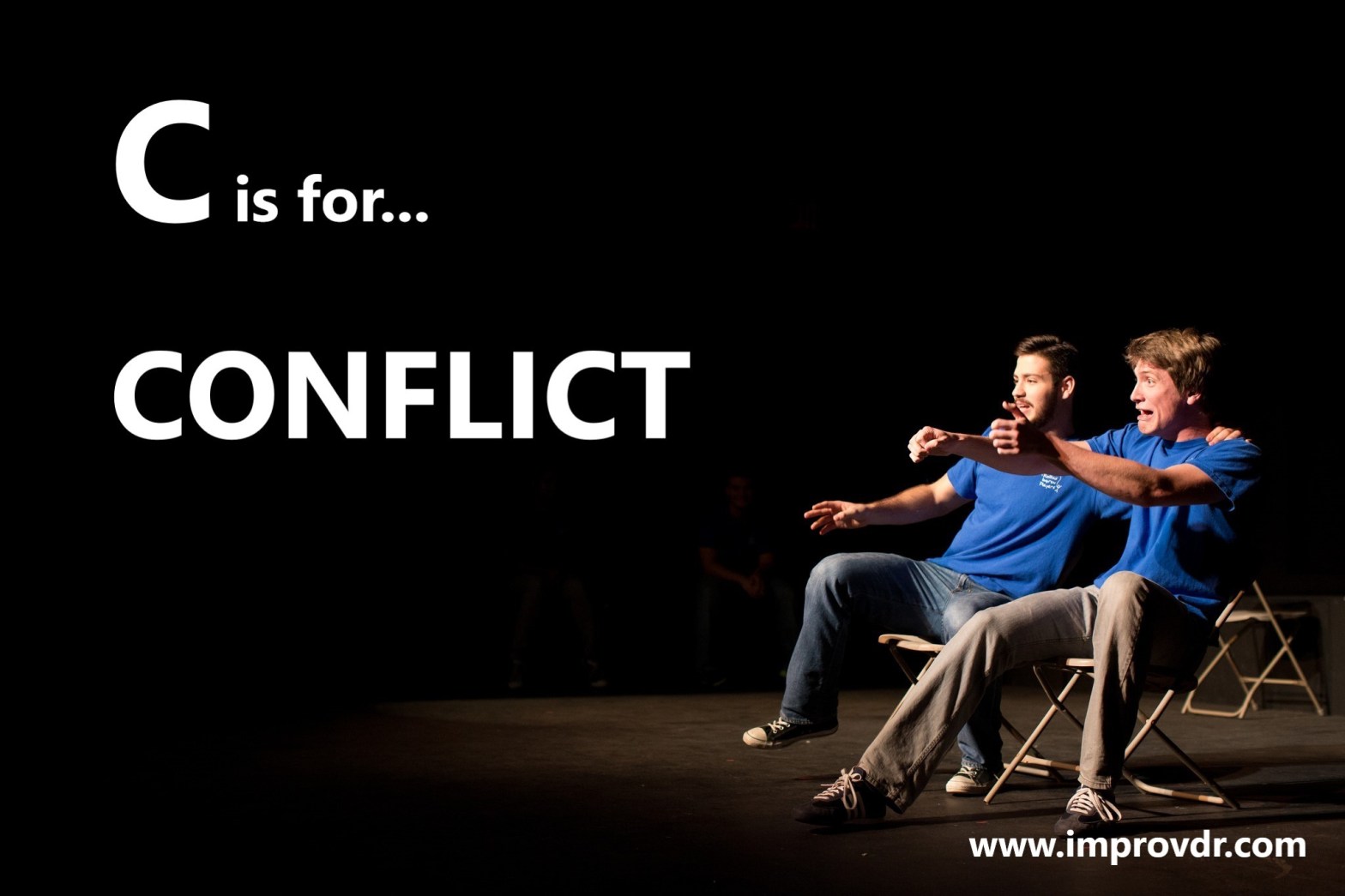
“C” is for “Conflict”

An often overused and artificial addition to improv scenes that can result in little more than onstage arguments if you’re not careful.

Underutilized Approaches to Conflict

This is just a taste of this entry/concept. Go here for more information.

Related Entries: Love, Objective, Relationship Antonyms: Agreement, Balance, Stasis. Synonyms: Obstacle, Tension

Cheers, David Charles.
www.improvdr.com
Join my Facebook group here.
© 2021 David Charles/ImprovDr

Connected Game: Alliances

Game Library: “Inner Monosong”

I love musical improv, so there should be no surprise that Inner Monosong ranks as one of my favorite games. When the scene has sufficient time to breathe, it’s also one of those short-form conceits that can start to feel a little more akin to long-form in terms of its patience and expansiveness. What’s more, Inner Monosong provides an excellent delivery system for character Confessions (and CADs in general) due to its exploration of text and subtext.

The Basics

Inner Monosong requires a strong musician, and if you have microphones available, it’s helpful to preset these on either side of the stage. A scene begins with a traditional ask-for, and characters populate the stage, establishing the basic given circumstances. When inspired, a caller announces “Inner monosong [character name]” at which point the action freezes and the nominated player steps away from the action (ideally to a stowed microphone) and sings their innermost thoughts with live accompaniment. When the musical excerpt is completed – perhaps cued once more by the caller with “Back to the scene” or similar – the featured player returns to their initial position, and the scene resumes with conventional dialogue. Several inner monosongs are prompted in this fashion until the scene finds its ending.

Example

A parent (Player A) and their child (Player B) sit in a doctor’s waiting room as a receptionist (C) works diligently behind the counter. B has just returned their paperwork as the lights come up.

Player C: “It shouldn’t be much longer now.”

Player A returns to sit beside their child.

Player A: (with concern) “Is it getting any better?”

Player B: (squirming) “My stomach still feels like it’s on fire.”

Player A: (offering a bottle of water) “Here, honey, have a little of this.”

Player B: “I’m not sure I’m able to…”

Caller: “Freeze. Inner monologue young child”

The action freezes as Player B steps to the stage’s edge, and music begins to play. They sing...

Player B:

“There ain’t an easy way to say
I just didn’t want to go to school today.
Mom brought me here to my surprise,
Now I’m digging myself deeper with all my lies…”

Caller: “And back to the scene…”

The music concludes as Player B returns to their chair.

Player A: “I’ve just never seen you this way before. You’ve got me quite worried…”

The Focus

There is a lot going on in this game technically, such as the crafting of dynamic songs and content, creating sharp contrasts between the spoken and singing portions, and implementing the sung secrets to create interest and tension. Once you have the logistics of the game under your belt, consider the interplay between what the players and audience know as opposed to what the various characters know. The songs provide an effective means for making and shelving strong choices that can enrich a seemingly simple story arc.

Traps and Tips

1.) Build the calling. When you’re calling the game, it’s typically effective to make sure every significant character on the team has one opportunity each at the inner monosong microphone, so you’ll want to pace your calls accordingly. If you sense someone has a really explosive reveal or confession brewing, it’s wise to leave that character until last so as to facilitate a climactic scenic ending. (The same is true if you have a powerhouse voice in your company as starting with this player can set the bar oppressively high for those that follow.) When I play this game in a timed setting, such as Gorilla Theatre, one verse or a verse and chorus per character are typically sufficient, especially if they are getting material out strongly and succinctly. In less constrained formats, able singers could land an entire song. There are certainly gimmicks that the caller can deploy which I am a little hesitant to include here as they typically feel disingenuous if they are jammed into the scene rather than discovered, so use these are inspirational examples rather than mandates. Playing with the length of songs can provide joy, especially once a “norm” has been set. You can also call singers out of dubious or playfully problematic target rhymes. If you have able singers in your ensemble, it can also be dynamic to culminate in an inner duo-song with two singers on opposing microphones (perhaps conducted by the caller to help with the give and take).

2.) Lay the groundwork. Knowing that songs are a-coming, scene work can tend to be a little under-developed if you’re not careful. Invest in clear initiations and endowments to get the scene moving. The most successful Inner Monosong scenes should feel as if they didn’t need the songs to create interest (although interest is certainly increased and polished by their presence). Help out the caller by making sure all onstage characters have known names or relationships as it’s more difficult to cue the songs if everyone’s identity or purpose is vague. As the songs are essentially subtext revealing moments, it’s also important that characters develop some form of mystery, backstory, or ambiguity. It is more difficult to explore subtext at the microphone if there is nothing interesting brewing already, although the music and rhyme can delightfully veer you into new and unexpected terrain.

3.) Mine the contrasts. Few games house such rich inherent potential for contrast as Inner Monosong. In terms of the staging, characters move from frozen scenic tableaux to lively sung solos: a character that might be reserved or modest in the scene could take on a very different mood in the privacy of their sung thoughts. The verbal shifts offer unique contrasts as the scene moves from dialogue to lyric: perhaps the least eloquent speaker comes alive when we hear their accompanied imagination, or characters may face playfully incongruent musical choices that reveal a whole new energy or facet. Similarly, text and subtext can form dynamic tensions: secrets and lies can add flavor and surprise to scenes as the audience (and fellow players) learn that everything may not be as it seems on the surface. While it is certainly possible for a monosong to largely reflect and uphold the known given circumstances, this is probably not the best use of these metatheatrical moments. If you find yourself walking down this improv path, I’d advise heightening the known fact to the nth degree – so rather than just loving someone in your song if this is already known, you reveal that you are completely besotted or obsessed, for example.

4.) Develop the details. This game can certainly thrive with largely independent and disconnected monosongs, but when this element operates on a higher storytelling level, the game can truly soar. Look for connections between the various subtexual elements as they unfold. If the child has lied their way into the doctor’s waiting room, can players accept this greater idea and build upon it creatively? Perhaps the parent is also there under false pretenses as they have developed a crush on the doctor and are using this insignificant illness to manufacture another encounter. Perhaps the receptionist is also lying and fabricated their resume in order to secure a much-needed job in tough times… Subtextual connections, games, and related themes add a whole new finesse. These choices may ultimately be exploded and revealed in the regular dialogue sections or remain loitering under the surface as the scene concludes.

In Performance

If you like the sound of this scenic dynamic but don’t have a musician at your ready disposal (or, perhaps, you don’t enjoy the singing challenge), Inner Monologue operates in largely the same way with a caller inviting characters to reveal their thoughts through unheard asides. It can also prove helpful to play this non-singing version first to gain a better understanding of the logistics at play. Either iteration, sung or spoken, offers a crowd-pleasing way to explore the power and playfulness of character secrets and confessions.

Cheers, David Charles.
www.improvdr.com
Join my Facebook group here.
Photo Credit: Tony Firriolo
© 2021 David Charles/ImprovDr

Connected Concept: Confession