Game Library: “Relay Entrances and Exits”

This fast-paced improv drill rehearses the basic but critical skill of entering and exiting the stage with purpose and gumption. If you, or an improviser you love, suffer from Sticky Feet, this jaunty exercise should provide the solvent you need.

The Basics

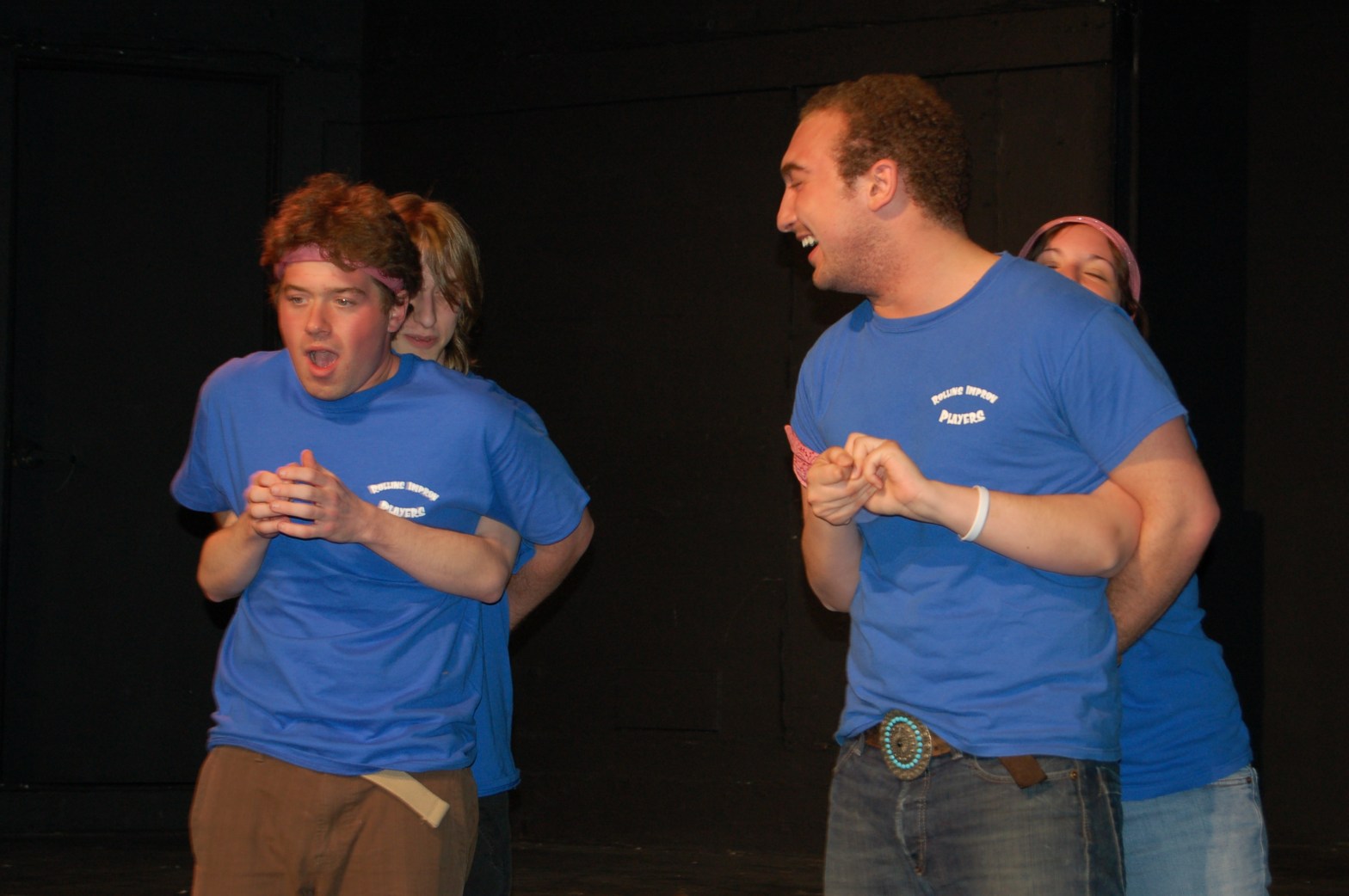
Players number off to establish a set order. (I’m using letters below just for consistency.) The first player (A) begins an activity in a provided location. After a moment, Player B makes an energized and justified entrance with an accompanying line or two of dialogue. Upon receiving this offer, Player A immediately responds with a similarly supported exit. A moment later, Player C enters with heightened vim and vigor, providing a line of their own which, in turn, cues Player B’s justified retreat. Players continue to briskly come and go until everyone has had at least one moment in the scene with Player A returning to complete the sequence alongside the last assigned improviser.

Example

Player A begins on all fours weeding the much-loved garden in their family front yard with a small trowel and bucket.

Player B: (arriving with fanfare) “I’m home early from college, mum. You’ve got me for the whole month!”

Player A: (exiting after giving her child a warm hug) “What a sight for my sore eyes! Let me get your bedroom ready!”

Player C: (entering) “I clocked your doing 45 in a 30 zone. I’m going to need some identification.”

Player B: (exiting back into the street) “My apologies, officer – I was so excited to get home. Let me get my wallet out of my car, and we can clear this matter up.”

Player D: (slinking into the yard) “So, look who’s come back to the neighborhood all these years and promises later…”

Player C: (feigning a call on the radio and walking offstage) “What was that, headquarters? A robbery in progress? I’m on the case…”

The Focus

You’re unlikely to create sharply etched and nuanced storylines with this game, but that’s not its intended purpose. Relish the challenge of making each and every arrival and departure strong, clear, and fully embodied.

Traps and Tips

1.) Breathe. The tempo of this exercise can inadvertently work against its own goals as characters hurriedly come and go. While the premise is certainly a little absurd, don’t allow your choices to fall into this category as well. Take the challenge seriously even if the content is lighthearted. You’re ultimately unlikely to get anything of much value out of the experience if it merely becomes a gag-delivery system. Don’t rush through or approximate your own choices. Give each entrance and exit its full weight and treat it as if it were the moment of the greater scene. It’s also a trap to just get louder or bigger or angrier than your predecessor: actively seek new energies and rationales (or previous tones in new ways) that feel honest and connected.

2.) Build. Each new character should seek brevity in their dialogue but don’t overlook the value of some good old-fashioned CROW. Your arrival will take on greater meaning and significance if everyone clearly knows your identity and relationship to the current onstage character. The drive and challenge decreases if the exercise morphs into actual vignettes: this would move you into La Ronde territory, which is admittedly fine territory to explore but serves another end. (You can read about this long-form here.) If you’re able to keep the larger environment alive and growing, that’s a great additional finesse. Perhaps someone trips over Player A’s trowel on their way out, for example. And don’t ignore the potential of reincorporating the evolving stage geography. Who is or could be in the house with the college-aged student’s mum? What neighborhood features have been established stage left and right? Did the police officer leave their patrol car in view on the street?

3.) Accept. The urgency of the exercise can, unfortunately, result in players slipping into old or bad habits. Waiting in the line to go on almost invites planning, and so it can be easy to push that clever idea you came up with offstage a minute ago into the narrative flow regardless of what actually just happened. So be extra wary of clumsily blocking, pimping, or erasing the reality of your scene partner. Similarly, don’t just do that thing that you hope will impress, get a laugh, or “win” (whatever that might mean to you). The game feels markedly more exciting when each new entrance truly utilizes what has gone before, so don’t neglect the improv basics in a misplaced effort to avoid the risk of truly being responsive and in the moment. Troubled waters await when players start rejecting obvious choices for fear they’re not being clever enough.

4.) Land. For an additional finesse, make sure each character truly lands in the scene. While the game can quickly feel like a series of transitory Canadian Crosses – and, in fact, this is largely the case – characters should not enter with the foreknowledge that they will then be immediately departing. Assuming this reality tends to make players approximate their choices, which can add to an overall unhelpful hectic quality. Rather, each character should arrive and ground themselves with the – albeit unfounded – expectation that they are now serving as the much-anticipated star of the scene. This small adjustment in owning the space can make a surprisingly large difference in how the game plays out.

In Performance

This whimsical drill always reminds me of the power and potential of bold entrances and exits. This critical element of our improvising play doesn’t always get the attention it needs, but little of quality can transpire without the measured and deliberate shuffling of characters on and off the stage.

Cheers, David Charles.
www.improvdr.com
Join my Facebook group here.
Photo Credit: Tony Firriolo
© 2022 David Charles/ImprovDr

Connected Concept: Sticky Feet

“S” is for “Sticky Feet”

Sticky Feet provides a vivid way of describing an improviser inclination to get stuck onstage. The joy of participation can prove so enticing that players find themselves pulled onto the stage only to discover that they are not particularly needed. And then they stay on stage… for a long time.

Warning Signs You’re About to Get Stuck

This is just a taste of this entry/concept. Go here for more information.

Related Entries: Entrances, Exits, Sharing Focus, Stage Picture Antonyms: Commitment, Energy Synonyms: Passivity

Cheers, David Charles.
www.improvdr.com
Join my Facebook group here.
© 2022 David Charles/ImprovDr

Connected Game: Relay Entrances and Exits

Game Library: “High Card”

You’ll need a traditional deck of playing cards for this experiential game that examines how Status influences our social interactions and relationships.

The Basics

The facilitator selects a large public setting or scenario, and players each privately draw a card that will determine their status: an ace representing the highest status and a two representing the lowest.

Phase One

Players should look at their own card and then stow it safely away so that no one else can see it. For the duration of the all-play scene, they should endeavor to subtly and realistically explore and exert this status when communicating with others.

Phase Two

A new setting is obtained, and the cards are shuffled and redistributed. Now players cannot look at their own card but must display it on their person in such a way that others can see this assigned status. During this second exploration, players should now endow and bestow the appropriate status configurations on those they meet, all-the-while assessing and accepting their own place in the assigned pecking order.

Example

Some chairs are scattered throughout the space to resemble the basic configuration of a high school cafeteria. Players engage in everyday activities and conversations with preassigned statuses and self-assigned characters.

The Focus

If your ensemble is unfamiliar or unpracticed when it comes to status work it may prove helpful to initially explore this dynamic in a more extreme scenario, such as a Renaissance city square complete with the highest royalty and lowest beggar. Generally, however, the process and overall experience benefit from a closer-to-home setting that allows for the examination and deployment of more subtle status moves and adjustments.

Traps and Tips

1.) Play. Keep your focus on your scene partners. As Keith Johnstone reminds us, status is something we do, so don’t strut around trying to be your status. Rather, engage in real conversations, explore honest needs, and try to achieve simple goals while letting your known or suspected status infuse your interactions. Also remember that status and social rank or class are not synonymous: the cafeteria cook may reign supreme over all their colleagues, especially if the scene takes place in their domain, or be a social outcast rejected by students and coworkers alike (or anything between these stark poles.)

2.) Assess. While you play, be sure to assess the subtle and not-so-subtle signals you are receiving from others. An “ace’ is usually easy to spot and to adjust your behavior accordingly: smaller differences between you and your fellow improvisers’ cards – an eight and nine, for example – require a much more nuanced understanding and application of the core concepts. Settled status relationships may also be thrown into turmoil with the simple act of a new character arrival or departure. Strive to maintain the social façade at all times – if you pull back the curtain and start flagrantly guessing the hierarchy or naming status maneuvers, you’ll create little of value.

3.) Apply. Particularly when playing the second iteration, take the risk of being changed by the way others are treating you. Don’t settle into a stance or belief and then coast for the remainder of the experiment. Test your theories, adjust your tactics, and then test again. Can you get away with sitting at the proverbial or literal “cool kids’ table?” If you initially failed in this pursuit, can you use a different tactic and try again? Even if your initial assessment of your spot in the pecking order was correct, this doesn’t mean your character isn’t trying to change their lot in life.

4.) Challenge. It is very easy to fall into character clichés, especially if you find yourself at one of the extreme ends of the status spectrum. High status characters needn’t be aloof, demanding, or loud-mouthed: low status personae don’t have to be servile, agreeable, or wallflowers. If you’re encountering this particular exercise again (or concept in general), raise the stakes by exploring a character whose status portrayal doesn’t neatly fall into widely held tropes or stereotypes. How is an unctuous “king” perceived or a self-assured “three”? What happens when you starkly contrast your assigned status with your character’s known role, wealth, or occupation?

5.) Debrief. At the conclusion of each phase, I instruct players to silently form a line from perceived lowest to highest status. (In the second phase, I’ll tell improvisers to remove and pocket their card thirty seconds or so before wrapping up the game in this way so it’s not just a simple matter at looking at others’ cards in the lineup.) There’s certainly delight if the ensemble is largely correct in their order, but regardless of their overall “success,” take a few minutes to discuss the experience. Why did players correctly or incorrectly place themselves where they did? What signals did they receive or send that supported this decision? How is their understanding of status enriched and deepened? Furthermore, it’s eye-opening to reflect on the distinction between asserting your status (phase one) and being completely dependent on others to know your place (phase two).

In Performance

I describe exercises as experiential when they don’t assume an audience. Subsequently, there’s no need to worry about avoiding split focus, crafting linearity, or building to a unified scenic climax. In fact, such macro improv concerns can subvert the gentler exchanges that are the bedrock of the game. When we take these skills onto a traditional or not-so-traditional stage, however, it’s important to remember that our audiences are assessing and assigning status positions based on the action just as the players did in their own private explorations. In these theatricalized situations, focus breaches and contests will very much influence how status flows and is perceived by your patrons.

The Game Library is booming with approximately 200 detailed game descriptions and performance tips. You can access it here.

Cheers, David Charles.
www.improvdr.com
Join my Facebook group here.
Photo Credit: Scott Cook
© 2022 David Charles/ImprovDr

Connected Concept: Status

“S” is for “Status”

The sometimes hidden and sometimes glaringly obvious power dynamics that inform interpersonal and societal interactions.

Some Common Status Misconceptions

This is just a taste of this entry/concept. Go here for more information.

Related Entries: Character, Relationship Antonyms: Class, Rank, Station Synonyms: Power

Cheers, David Charles.
www.improvdr.com
Join my Facebook group here.
© 2022 David Charles/ImprovDr

Connected Game: High Card

Game Library: “Escalating Scene”

As a theatricalized embodiment of the “butterfly effect,” Escalating Scene raises the Stakes to typically catastrophic levels.

The Basics

When played as a skills-building exercise I tend to have teams self-select a basic who, what, and where (Spolin style) as well as a minor action and major event that are completely unrelated – such as running out of toothpaste and a global stock market crash. In a performance setting, these last two ingredients could be gathered from the audience with the other components being discovered in the opening moments. A scene begins in which we quickly see the first smaller occurrence. Players must then construct a chain of connected events that finally (hopefully) culminates in the second monumental event. Each subsequent step in the rising action should clearly be caused by the former and elevate the overall stakes.

Example

Players are given a “hang nail” and a “statewide electrical blackout” as the two random actions. (I’m outlining several potential steps sans detailed dialogue just to give a sense of the arc, but each vignette should be fully embodied and fleshed out.)

Step one: A frazzled overworked single parent, Player A, prepares breakfast for their teenage children who quickly run out the door to school. As Player A clears away the dishes, they inadvertently give themselves a hang nail.

Step two: Too busy to tend to their wound, Player A jumps in their car and picks up their carpooling co-worker who notes how distracted Player A is this morning.

Step three: With bad traffic looming, and the hang nail pain increasing, Player A takes their eyes off the road for a second and gets into a fender bender.

Step four: An irate driver jumps out of the nudged car and Player A does the same. A heated exchange ensues as traffic builds up around them.

Step five: A’s passenger joins the fray and notices a truck hurtling towards them on the bridge, unable to stop. The quarreling duo just manages to leap aside as the truck pushes both cars over the traffic bridge and is now suspended in air with the driver in peril.

Step six: The truck continues to shift weight as the bystanders now form a human chain to rescue the driver, with Player A in the front and having to stomach the pain of their hang nail as the driver is brought to safety.

Step seven: With a thunderous explosion the truck finally falls off the overpass bridge onto a series of high voltage electrical lines. The city, and presumably then the state, is plunged into darkness. Blackout.

The Focus

Stay in the moment and polish each new contribution as it arrives. Increased energy and presence are more likely to get you to the finish line that solipsistic and fearful planning in the wings.

Traps and Tips

1.) Consider your goal. When it comes to determining your final scenic destination, natural disasters or resolutely non-human events prove problematic. Putting aside the fact that many weather catastrophes these days are likely caused by humanity’s neglect of the environment, it’s difficult to make this causal connection from the first simple action in a three- or four-minute scene. The exception to this advice would be natural events that commonly have very human ignitions, such as a forest fire or dam bursting. The final event can also be a wonderful occurrence rather than a disaster, such as performing an act of heroism or finally attaining a difficult lifelong dream.

2.) Consider your tactic. The hang nail example above ended up following one character through multiple beats of their day and resulted in them personally having a hand (finger) in the concluding tragedy. There is an advantage to such an approach in that you have one player tracking and ultimately connecting all of the dots. The major alternative consists of using a style more akin to a Pass-Off or Follow the Leaver frame. Here the focus baton tends to pass from one character to the next with no-one serving as the protagonist for a protracted period of time. So, while Player A suffered from the hang nail, their emotion or actions would then spill out onto one of their children or the ridesharing coworker who would then, in turn, similarly rile the next character in the chain. This version offers additional challenges but also potentially more finesseful rewards.

3.) Consider your steps. As the scene begins, the looming result can feel a little impossible or oppressive so it’s tempting to want to leap “there” in as few steps as possible. Lean in the opposite improvisational direction and fuel the small choice currently onstage rather than smother it by blatantly replacing it with that element that you feel needs to get into the story arc now. Player A could have plugged in a faulty appliance in their kitchen and caused the blackout in two moves, but that would be unlikely to provide an engaging journey. When I use the workshop model of this game in my class, I deliberately don’t ask to know the target choice as I’m much more interested in discovering the next steps along with the players: the final outcome doesn’t really matter, especially if the arc and stakes continued to rise in an exciting way. When your audience is expecting a particular climax, I believe this attitude still has currency as a great unforeseen ending is still a great unforeseen ending!

4.) Consider your roles. One of the many unique facets of this scenic dynamic is that it typically requires a larger than average cast of characters. Especially if you’re playing the game in a team setting, be ready to turn right back around the second you leave the stage to join the action as someone entirely new. Family members in step one above may need to immediately recycle into carpool colleagues in the next beat, or fellow gridlocked drivers a moment later. Energized story arcs also tend to scroll through multiple locations in quick succession, so you need to be ready to support these transitions as well, moving or embodying furniture and environmental forces as needed. If you’re playing in the Pass-Off style, this is particularly the case for the departing prior baton carrier who will likely need to return much sooner than they anticipate.

In Performance

Fight the manic beast that can lurk just below the surface of this game that tends to feed off the panic instilled by the knowledge of a particular desired outcome looming over the horizon. Enjoy and elevate the process, explore where the current offers can take you, and gently raise the amplitude of the stakes trusting that this energy alone will take you somewhere exciting and worthwhile.

Cheers, David Charles.
www.improvdr.com
Join my Facebook group here.
Photo Credit: James Berkley
© 2022 David Charles/ImprovDr

Connected Concept: Stakes

“S” is for “Stakes”

What our characters will gain (or lose) if they are successful (or unsuccessful).

Raising the Stakes

This is just a taste of this entry/concept. Go here for more information.

Related Entries: Drama, Objective, Urgency Antonyms: Passivity Synonyms: Heighten

Cheers, David Charles.
www.improvdr.com
Join my Facebook group here.
© 2022 David Charles/ImprovDr

Connected Game: Escalating Scene

Game Library: “They Said, They Said”

Alternatively known as Stage Directions, They Said, They Said facilitates playful physicality by separating creative duties amongst the various team members. If you struggle with creating vibrant Stage Pictures, this game provides a powerful antidote to talking heads.

The Basics

Two players (A and B) serve as the onstage characters while two offstage teammates (C and D) act as their respective directors. After each line of dialogue, the corresponding director narrates an accompanying action, usually in the form of “They said as they…” If a third character is needed and enters, an additional improviser can become their director counterpart, or this role can be assumed by one of the existing offstage players.

Example

Players A and B are siblings setting up a camp site, while their counterparts, C and D, position themselves on either side of the stage.

Player A: “This is, without question, the perfect spot!”

Player C: (from the edge of the stage) “They said as they excitedly slipped off their backpack.”

Player A joyfully removes their backpack and rests it on the ground.

Player B: “If I’m understanding the map correctly, the sun should rise towards those mountains…”

Player D: (from the edge of the stage) “They said as they gestured towards the horizon and sipped from their canteen.”

Player A: “Give me a swig of that!”

Player C: “They said as they collapsed onto a majestic rock…”

Player B: “It’s all yours!”

Player D: “They said as they tossed the canteen and felt the first drops of rain on their forearms…”

The Focus

It can take a while to learn the requisite rhythm of this game, alternating between the actors and directors. Make sure you’re leaving sufficient room for each role to fully complete its function. Played gracefully, rich offers should be plentiful from both contributing camps.

Traps and Tips

1.) Actor traps. The sequencing takes a while to master so make sure you leave time between lines of dialogue for the directors to contribute – simply taking a breath usually does the trick. It’s particularly tempting to want to talk again immediately after your assigned director has provided stage business – often in an effort to verbally justify any new information – but doing so will typically shut out your onstage scene partner. Instead, explore the offered idea physically first and trust you can add a verbal justification later if it’s warranted. Furthermore, while you don’t want to craft a performance devoid of any initial physicality, it can make the director’s job needlessly difficult if your already introduce a great deal of movement with every utterance.

2.) Director traps. Endeavor to make your stage directions forward rather than backward looking. For example, “they said angrily” adds a quality to a spoken line that’s already been seen and so doesn’t really gift new information. The same holds true for just describing an action that your character counterpart has already completed. Using the fuller phrase, “They said as they…” usually propels you into a new action or activity to augment what’s currently in play. (Immediately using a verb in gerund form also works, such as “They said climbing… or hiding… or crouching…”) It’s also easy for gun-shy directors to stall the momentum, so leap into the fray right after your assigned improviser has finished their sentence. Even if you have no clue what you’re going to say (which the audience loves to see) you’ll at least have the launching phrase “they said as they…” to buy yourself a second!

3.) Actor tips. Fully embrace offered stage directions. If you wear these choices lightly, or take on an air of commenting, the scene will rarely evolve into anything of particular interest. It’s likely that directions will become more unexpected or peculiar as the scene progresses – although this needn’t be the case. Seek to playfully justify any challenges while also retaining the integrity of your character and the scenic givens. By design, the characters are puppets to some degree, but don’t surrender your agency completely. And if you ever feel unsafe or unpleasantly uncomfortable, don’t hesitate to Speak Your Truth. You should also strive to lay a firm and grounded foundation quickly (your CROW or WWW) as it’s difficult to backfill these details elegantly once the scene has taken off.

4.) Director tips. While the game’s construction invites some degree of shivving and charting a curve of absurdity, stage directions can also more generously just serve and heighten the characters’ instincts. Don’t be afraid to elevate games already occurring in the scene rather than always inverting expectations or adding mischief. That being said, if you’re too kind or tentative you might not be fully exploiting the gift of providing significant physical or emotional actions. I advise starting small and somewhat obvious but with helpful specificity, as it’s easier to add mischief to a well-functioning scene than it is to remove the damage such moves have inflicted on a story now struggling to find its footing.

In Performance

Separating improvisational responsibilities into verbal offers (characters) and physical offers (directors) reveals the potency of each component and permits players to unapologetically focus on one area at a time. This can be quite the boon if you typically struggle to equally contribute verbally and physically at the same time. I’ve also played this game as a two player tour de force where onstage players provide their own dialogue and then their partner’s stage directions (so after Player A has spoken, Player B narrates A’s movement as an aside, and then A returns the favor after each line of B’s dialogue). While the mechanics remain the same, the challenge is rather different as now players must multitask to the nth degree, quickly offering a stage direction and then dialogue from their own character’s perspective. As much fun as this can afford, I’ve personally found separating these functions usually enables stronger storytelling and scene work.

Cheers, David Charles.
www.improvdr.com
Join my Facebook group here.
© 2022 David Charles/ImprovDr

Connected Concept: Stage Picture

“S” is for “Stage Picture”

How bodies, furniture, and props are arranged on stage to facilitate meaning and enable effective storytelling.

Picture This

This is just a taste of this entry/concept. Go here for more information.

Related Entries: Exits, Focus, Levels, Physicality, Side Support Antonyms: Split Focus, Sticky Feet, Talking Heads, Upstaging Synonyms: Blocking, Staging

Cheers, David Charles.
www.improvdr.com
Join my Facebook group here.
© 2022 David Charles/ImprovDr

Connected Game: They Said, They Said

Game Library: “Invisibility Scene”

There are several variations of Invisibility Scene, each of which creates a dynamic tension between Split Focus and more unified order.

The Basics

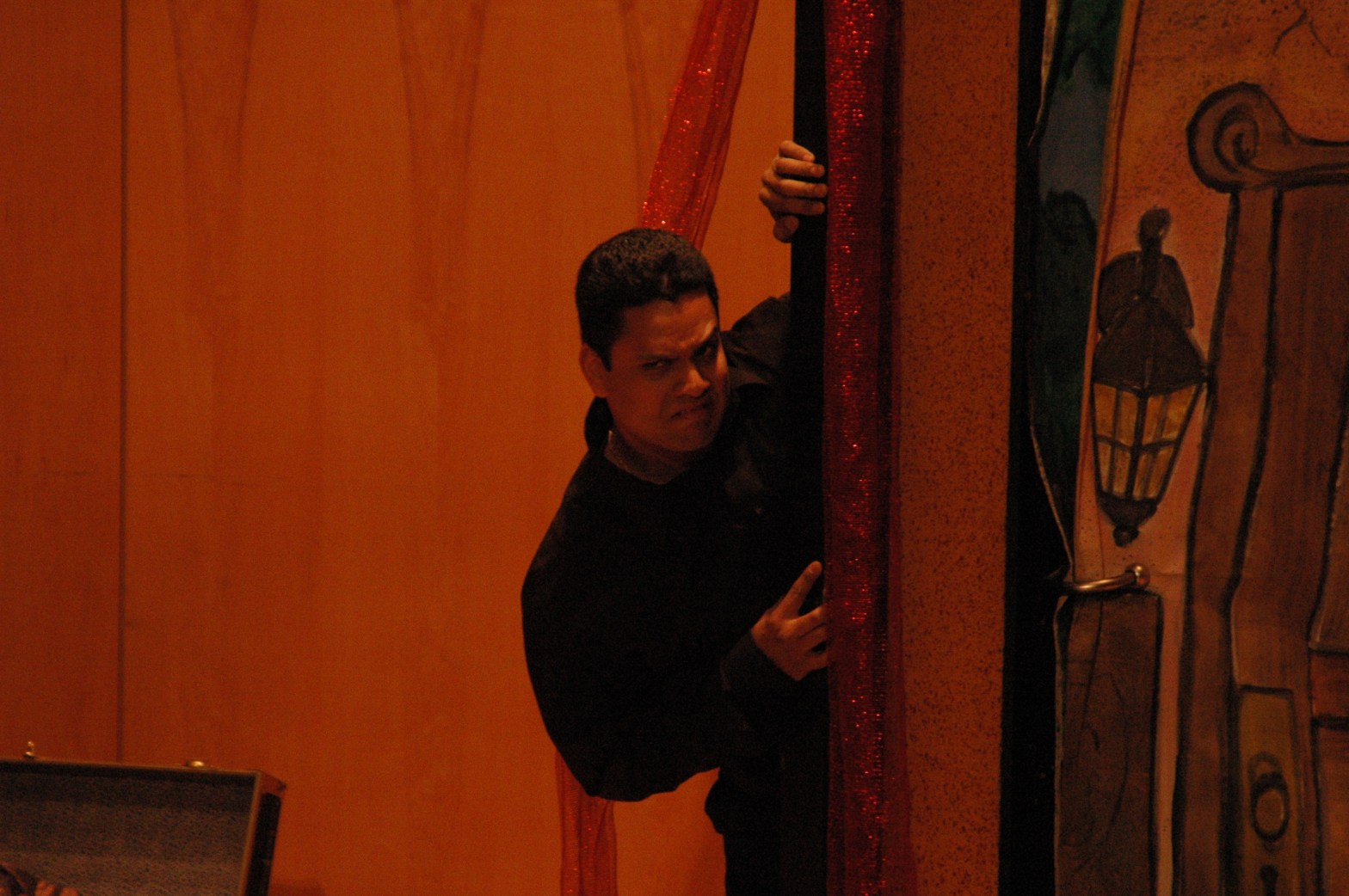
This dynamic can serve as a stand-alone short-form game or inspire scenic work within a longer piece. The conceit involves combining traditional characters with those visiting from another plane or dimension. I’m calling the latter “ghosts” throughout this entry just for clarity.

Variation One

While ghosts are fully present on the stage, only the audience can see and hear them. All the other corporeal characters are unaware of their unearthly costars, although they can notice any physical changes in the environment, such as moving objects.

Variation Two

Ghosts remain fully present but now can only be heard by one (or more) selected character. Ghosts can communicate solely to each other in a stage whisper if their intent is not to have their human scene partner perceive their choice. It’s also possible to explore this dynamic with ghosts being seen by a particular character (or even seen and heard) but I’ve found this approach is less powerful in regard to the current lens of utilizing split focus.

Variation Three

Ghosts now become disembodied voices often provided over microphones. Their physical presence and effects on the location are now fully endowed and justified by their flesh and blood onstage partners. This scene can be played with some or no dialogue being perceived by some or all of the human characters as the needs of the scene dictate. Overtalking is more likely in this iteration as invisible characters can’t gently secure focus through physical moves on stage, so be extra careful to share the verbal space.

Example

Players A and B serve as the now deceased former occupants of a countryside farmhouse and begin onstage in the living room. Players C and D are the new owners and recent newlyweds. They begin offstage.

Player A: (looking out the window) “I think this is them coming down the driveway. I’ve got a really good feeling about this couple.”

Player B: (sitting stubbornly in the comfy chair) “I’m not convinced. I like it when it’s just us…”

Player A: (turning with affection) “We’ve talked about this, Eli. Someone has to keep up the farmhouse now that we’re…”

Player B: “I shouldn’t have to sleep in the guest room in my own house, Mary.”

They react at hearing a key unlock the front door.

Player A: “You’ve promised, Eli, that you’re going to join me in being a good host…”

Players C and D, a young – very much in love – couple burst into the room. A and B go silent and watch, adjusting their own positions as needed.

Player C: (with pure joy) “I can’t believe this is all finally ours! I thought we’d never cut through all that red tape!”

Player D: (replacing A at the window) “It really is a picture-perfect postcard view!”

Player C: “You’re positive you want to get rid of all this furniture? It seems a shame.”

Player B shoots Player A a concerned look. Player D crosses to the “comfy” chair that D manages to vacate just in time.

Player D: “Well, everything except this beauty. It has a certain rustic charm about it…”

The Focus

As all the improvisers must coexist in the same location at the same time, the potential for clumsy split focus is high. Playfully exploring and solving this inherent tension provides much of the value of these pieces. Players should display extra care in sharing focus both with any scene partner who occupies the same temporal plane but also with those across the supernatural divide.

Traps and Tips

1.) Select your approach. Unless you’re workshopping each of the variants in a classroom setting (which I strongly advise) an opportunity for an Invisibility Scene might emerge without substantial time to discuss your preferred approach. Each of the above options has a slightly unique flavor even though they come from the same improv sweet store, but one variation might serve the needs of your scenic premise a little better than the others. Endeavor to get your team on the same page as quickly as possible even if this needs to occur onstage in real time while the scene starts up. It only takes one careless misstep to scuttle the dynamic before it’s had a chance to take hold: “What are you two doing in the house we just purchased…?”

2.) Establish your rules. There’s probably little value in meticulously explaining to an audience the complex rules of the paranormal universe you intend to bring to the stage. On the contrary, there is often a powerful payoff when you don’t establish too clear an expectation as part of the fun stems from the audience figuring out the rules for themselves. But it is important to unequivocally establish said rules early in the piece as part of the routine. As in the example above, it’s helpful to start with one reality or the other, especially if the ghosts can’t talk freely in the presence of the humans. Once the basic rules are set – primarily who can and can’t see and hear whom and why – then the stage is set to test and bend these guiding principles. Be particularly careful that those who can’t see the ghosts don’t accidentally do so.

3.) Pace your progression. Our farmhouse example assumes a variation one or two approach (number three wouldn’t have the older couple in material form). Now that both realities are coexisting onstage, the game will likely heat up. Players A and B haven’t yet spoken in front of the new owners. If they do so without any perceivable reaction, then we’ve committed to the first variation where interaction primarily takes the form of object manipulation. If C or D (or both) can hear or see the ghostly occupants, then we’re in variation two territory. The complementary camps should actively strive to help each other and the overarching story arc. In addition to generous focus gives and takes, this can also take the form of consciously shaking up improviser combinations so that both worlds have the creative space they need to contribute. An overcrowded stage is still an overcrowded stage even if two of your players are playing ghosts!

4.) Earn your breaches. Once the rules have been set and modeled for the audience (and the players) and you’ve gently ramped up the central dynamic, then be cautious that you don’t needlessly break your own patterns. Disrupting the established routine usually resembles the curse of naming or revealing the game thereby ending the premise prematurely and heralding a mercy button. Strategic breaches, on the other hand (leg?) are a different matter entirely. Perhaps we’ve all been working under the assumption of a version one world where humans are unable to see or hear their ghostly partners, only to learn later in the scene that Player C has heard everything but was hiding the truth from their spouse for fear of being thought mad. Breaking the rules in this deliberate way really equates with a scenic evolution rather than a clumsy rug pull.

In Performance

There’s a fourth variation on this same theme that I hesitated to include above as it belies the title a little and has a markedly unique energy. Here the ghostly characters are fully seen and heard by everyone, so their different-ness is much more conceptual and much less (more?) “invisible.”

Supernatural visitors are a strong stylistic choice and so won’t be equally welcome in every scene or genre. But the games and potentials of these personae are uniquely intriguing and inspiring, and well worth a look.

Cheers, David Charles.
www.improvdr.com
Join my Facebook group here.
© 2022 David Charles/ImprovDr

Connected Concept: Split Focus

“S” is for “Split Focus”

Split Focus refers to a company’s inability to quickly address moments of competing efforts to gain and hold the audience’s attention. If the company can’t decide where the action is most cogent, it follows that the audience won’t figure it out either.

Splitting the Difference

This is just a taste of this entry/concept. Go here for more information.

Related Entries: Commandment #2, Give, Take Antonyms: Focus, Sharing Focus Synonyms: Chaos

Cheers, David Charles.
www.improvdr.com
Join my Facebook group here.
© 2022 David Charles/ImprovDr

Connected Game: Invisibility Scene