Game Library: “Escalating Scene”

As a theatricalized embodiment of the “butterfly effect,” Escalating Scene raises the Stakes to typically catastrophic levels.

The Basics

When played as a skills-building exercise, I tend to have teams self-select a basic who, what, and where (Spolin style) as well as a minor action and major event that are completely unrelated – such as running out of toothpaste and a global stock market crash. In a performance setting, these last two ingredients could be gathered from the audience with the other components being discovered in the opening moments. A scene begins in which we quickly see the first smaller occurrence. Players must then construct a chain of connected events that finally (hopefully) culminates in the second monumental event. Each subsequent step in the rising action should clearly be caused by the former and elevate the overall stakes.

Example

Players are given a “hang nail” and a “statewide electrical blackout” as the two random actions. (I’m outlining several potential steps sans detailed dialogue just to give a sense of the arc, but each vignette should be fully embodied and fleshed out.)

Step one: A frazzled overworked single parent, Player A, prepares breakfast for their teenage children who quickly run out the door to school. As Player A clears away the dishes, they inadvertently give themselves a hang nail.

Step two: Too busy to tend to their wound, Player A jumps in their car and picks up their carpooling co-worker who notes how distracted Player A is this morning.

Step three: With bad traffic looming, and the hang nail pain increasing, Player A takes their eyes off the road for a second and gets into a fender bender.

Step four: An irate driver jumps out of the nudged car and Player A does the same. A heated exchange ensues as traffic builds up around them.

Step five: A’s passenger joins the fray and notices a truck hurtling towards them on the bridge, unable to stop. The quarreling duo just manages to leap aside as the truck pushes both cars over the traffic bridge and is now suspended in air with the driver in peril.

Step six: The truck continues to shift weight as the bystanders now form a human chain to rescue the driver, with Player A in the front and having to stomach the pain of their hang nail as the driver is brought to safety.

Step seven: With a thunderous explosion the truck finally falls off the overpass bridge onto a series of high voltage electrical lines. The city, and presumably then the state, is plunged into darkness. Blackout.

The Focus

Stay in the moment and polish each new contribution as it arrives. Increased energy and presence are more likely to get you to the finish line that solipsistic and fearful planning in the wings.

Traps and Tips

1.) Consider your goal. When it comes to determining your final scenic destination, natural disasters or resolutely non-human events prove problematic. Putting aside the fact that many weather catastrophes these days are likely caused by humanity’s neglect of the environment, it’s difficult to make this causal connection from the first simple action in a three- or four-minute scene. The exception to this advice would be natural events that commonly have very human ignitions, such as a forest fire or dam bursting. The final event can also be a wonderful occurrence rather than a disaster, such as performing an act of heroism or finally attaining a difficult lifelong dream.

2.) Consider your tactic. The hang nail example above ended up following one character through multiple beats of their day and resulted in them personally having a hand (finger) in the concluding tragedy. There is an advantage to such an approach in that you have one player tracking and ultimately connecting all of the dots. The major alternative consists of using a style more akin to a Pass-Off or Follow the Leaver frame (see here). Here the focus baton tends to pass from one character to the next with no-one serving as the protagonist for a protracted period of time. So, while Player A suffered from the hang nail, their emotion or actions would then spill out onto one of their children or the ridesharing coworker who would then, in turn, similarly rile the next character in the chain. This version offers additional challenges but also potentially more finesseful rewards.

3.) Consider your steps. As the scene begins, the looming result can feel a little impossible or oppressive so it’s tempting to want to leap “there” in as few steps as possible. Lean in the opposite improvisational direction and fuel the small choice currently onstage rather than smothering it by blatantly replacing it with that element that you feel needs to get into the story arc now. Player A could have plugged in a faulty appliance in their kitchen and caused the blackout in two moves, but that would be unlikely to provide an engaging journey. When I use the workshop model of this game in my class, I deliberately don’t ask to know the target choice as I’m much more interested in discovering the next steps along with the players: the final outcome doesn’t really matter, especially if the arc and stakes continued to rise in an exciting way. When your audience is expecting a particular climax, I believe this attitude still has currency as a great unforeseen ending is still a great unforeseen ending!

4.) Consider your roles. One of the many unique facets of this scenic dynamic is that it typically requires a larger than average cast of characters. Especially if you’re playing the game in a team setting, be ready to turn right back around the second you leave the stage to join the action as someone entirely new. Family members in step one above may need to immediately recycle into carpool colleagues in the next beat, or fellow gridlocked drivers a moment later. Energized story arcs also tend to scroll through multiple locations in quick succession, so you need to be ready to support these transitions as well, moving or embodying furniture and environmental forces as needed. If you’re playing in the Pass-Off style, this is particularly the case for the departing prior baton carrier who will likely need to return much sooner than they anticipate.

In Performance

Fight the manic beast that can lurk just below the surface of this game that tends to feed off the panic instilled by the knowledge of a particular desired outcome looming over the horizon. Enjoy and elevate the process, explore where the current offers can take you, and gently raise the amplitude of the stakes trusting that this energy alone will take you somewhere exciting and worthwhile.

Cheers, David Charles.
www.improvdr.com
Join my Facebook group here.
Photo Credit: James Berkley
© 2022 David Charles/ImprovDr

Connected Concept: Stakes

“S” is for “Stakes”

What our characters will gain (or lose) if they are successful (or unsuccessful).

Raising the Stakes

This is just a taste of this entry/concept. Go here for more information.

Related Entries: Drama, Objective, Urgency Antonyms: Passivity Synonyms: Heighten

Cheers, David Charles.
www.improvdr.com
Join my Facebook group here.
© 2022 David Charles/ImprovDr

Connected Game: Escalating Scene

Game Library: “They Said, They Said”

Alternatively known as Stage Directions, They Said, They Said facilitates playful physicality by separating creative duties amongst the various team members. If you struggle with creating vibrant Stage Pictures, this game provides a powerful antidote to talking heads.

The Basics

Two players (A and B) serve as the onstage characters while two offstage teammates (C and D) act as their respective directors. After each line of dialogue, the corresponding director narrates an accompanying action, usually in the form of “They said as they…” If a third character is needed and enters, an additional improviser can become their director counterpart, or this role can be assumed by one of the existing offstage players.

Example

Players A and B are siblings setting up a camp site, while their counterparts, C and D, position themselves on either side of the stage.

Player A: “This is, without question, the perfect spot!”

Player C: (from the edge of the stage) “They said as they excitedly slipped off their backpack.”

Player A joyfully removes their backpack and rests it on the ground.

Player B: “If I’m understanding the map correctly, the sun should rise towards those mountains…”

Player D: (from the edge of the stage) “They said as they gestured towards the horizon and sipped from their canteen.”

Player A: “Give me a swig of that!”

Player C: “They said as they collapsed onto a majestic rock…”

Player B: “It’s all yours!”

Player D: “They said as they tossed the canteen and felt the first drops of rain on their forearms…”

The Focus

It can take a while to learn the requisite rhythm of this game, alternating between the actors and directors. Make sure you’re leaving sufficient room for each role to fully complete its function. Played gracefully, rich offers should be plentiful from both contributing camps.

Traps and Tips

1.) Actor traps. The sequencing takes a while to master so make sure you leave time between lines of dialogue for the directors to contribute – simply taking a breath usually does the trick. It’s particularly tempting to want to talk again immediately after your assigned director has provided stage business – often in an effort to verbally justify any new information – but doing so will typically shut out your onstage scene partner. Instead, explore the offered idea physically first and trust you can add a verbal justification later if it’s warranted. Furthermore, while you don’t want to craft a performance devoid of any initial physicality, it can make the director’s job needlessly difficult if your already introduce a great deal of movement with every utterance.

2.) Director traps. Endeavor to make your stage directions forward rather than backward looking. For example, “they said angrily” adds a quality to a spoken line that’s already been seen and so doesn’t really gift new information. The same holds true for just describing an action that your character counterpart has already completed. Using the fuller phrase, “They said as they…” usually propels you into a new action or activity to augment what’s currently in play. (Immediately using a verb in gerund form also works, such as “They said climbing… or hiding… or crouching…”) It’s also easy for gun-shy directors to stall the momentum, so leap into the fray right after your assigned improviser has finished their sentence. Even if you have no clue what you’re going to say (which the audience loves to see) you’ll at least have the launching phrase “they said as they…” to buy yourself a second!

3.) Actor tips. Fully embrace offered stage directions. If you wear these choices lightly, or take on an air of commenting, the scene will rarely evolve into anything of particular interest. It’s likely that directions will become more unexpected or peculiar as the scene progresses – although this needn’t be the case. Seek to playfully justify any challenges while also retaining the integrity of your character and the scenic givens. By design, the characters are puppets to some degree, but don’t surrender your agency completely. And if you ever feel unsafe or unpleasantly uncomfortable, don’t hesitate to Speak Your Truth. You should also strive to lay a firm and grounded foundation quickly (your CROW or WWW) as it’s difficult to backfill these details elegantly once the scene has taken off.

4.) Director tips. While the game’s construction invites some degree of shivving and charting a curve of absurdity, stage directions can also more generously just serve and heighten the characters’ instincts. Don’t be afraid to elevate games already occurring in the scene rather than always inverting expectations or adding mischief. That being said, if you’re too kind or tentative you might not be fully exploiting the gift of providing significant physical or emotional actions. I advise starting small and somewhat obvious but with helpful specificity, as it’s easier to add mischief to a well-functioning scene than it is to remove the damage such moves have inflicted on a story now struggling to find its footing.

In Performance

Separating improvisational responsibilities into verbal offers (characters) and physical offers (directors) reveals the potency of each component and permits players to unapologetically focus on one area at a time. This can be quite the boon if you typically struggle to equally contribute verbally and physically at the same time. I’ve also played this game as a two player tour de force where onstage players provide their own dialogue and then their partner’s stage directions (so after Player A has spoken, Player B narrates A’s movement as an aside, and then A returns the favor after each line of B’s dialogue). While the mechanics remain the same, the challenge is rather different as now players must multitask to the nth degree, quickly offering a stage direction and then dialogue from their own character’s perspective. As much fun as this can afford, I’ve personally found separating these functions usually enables stronger storytelling and scene work.

Cheers, David Charles.
www.improvdr.com
Join my Facebook group here.
© 2022 David Charles/ImprovDr

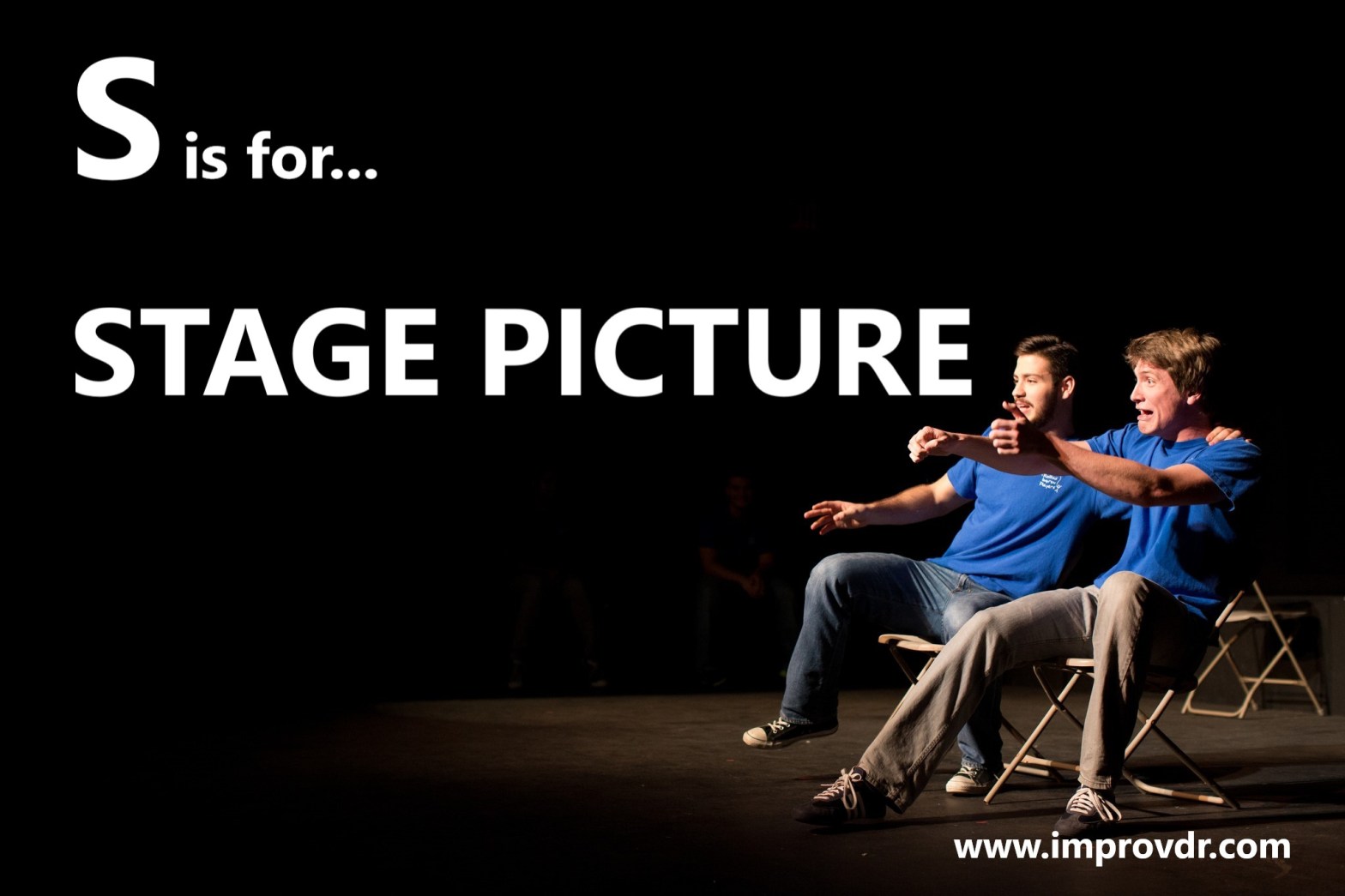
Connected Concept: Stage Picture

“S” is for “Stage Picture”

How bodies, furniture, and props are arranged on stage to facilitate meaning and enable effective storytelling.

Picture This

This is just a taste of this entry/concept. Go here for more information.

Related Entries: Exits, Focus, Levels, Physicality, Side Support Antonyms: Split Focus, Sticky Feet, Talking Heads, Upstaging Synonyms: Blocking, Staging

Cheers, David Charles.
www.improvdr.com
Join my Facebook group here.
© 2022 David Charles/ImprovDr

Connected Game: They Said, They Said

Game Library: “Invisibility Scene”

There are several variations of Invisibility Scene, each of which creates a dynamic tension between Split Focus and more unified order.

The Basics

This dynamic can serve as a stand-alone short-form game or inspire scenic work within a longer piece. The conceit involves combining traditional characters with those visiting from another plane or dimension. I’m calling the latter “ghosts” throughout this entry just for clarity.

Variation One

While ghosts are fully present on the stage, only the audience can see and hear them. All the other corporeal characters are unaware of their unearthly costars, although they can notice any physical changes in the environment, such as moving objects.

Variation Two

Ghosts remain fully present but now can only be heard by one (or more) selected character. Ghosts can communicate solely to each other in a stage whisper if their intent is not to have their human scene partner perceive their choice. It’s also possible to explore this dynamic with ghosts being seen by a particular character (or even seen and heard) but I’ve found this approach is less powerful in regard to the current lens of utilizing split focus.

Variation Three

Ghosts now become disembodied voices often provided over microphones. Their physical presence and effects on the location are now fully endowed and justified by their flesh and blood onstage partners. This scene can be played with some or no dialogue being perceived by some or all of the human characters as the needs of the scene dictate. Overtalking is more likely in this iteration as invisible characters can’t gently secure focus through physical moves on stage, so be extra careful to share the verbal space.

Example

Players A and B serve as the now deceased former occupants of a countryside farmhouse and begin onstage in the living room. Players C and D are the new owners and recent newlyweds. They begin offstage.

Player A: (looking out the window) “I think this is them coming down the driveway. I’ve got a really good feeling about this couple.”

Player B: (sitting stubbornly in the comfy chair) “I’m not convinced. I like it when it’s just us…”

Player A: (turning with affection) “We’ve talked about this, Eli. Someone has to keep up the farmhouse now that we’re…”

Player B: “I shouldn’t have to sleep in the guest room in my own house, Mary.”

They react at hearing a key unlock the front door.

Player A: “You’ve promised, Eli, that you’re going to join me in being a good host…”

Players C and D, a young – very much in love – couple burst into the room. A and B go silent and watch, adjusting their own positions as needed.

Player C: (with pure joy) “I can’t believe this is all finally ours! I thought we’d never cut through all that red tape!”

Player D: (replacing A at the window) “It really is a picture-perfect postcard view!”

Player C: “You’re positive you want to get rid of all this furniture? It seems a shame.”

Player B shoots Player A a concerned look. Player D crosses to the “comfy” chair that D manages to vacate just in time.

Player D: “Well, everything except this beauty. It has a certain rustic charm about it…”

The Focus

As all the improvisers must coexist in the same location at the same time, the potential for clumsy split focus is high. Playfully exploring and solving this inherent tension provides much of the value of these pieces. Players should display extra care in sharing focus both with any scene partner who occupies the same temporal plane but also with those across the supernatural divide.

Traps and Tips

1.) Select your approach. Unless you’re workshopping each of the variants in a classroom setting (which I strongly advise) an opportunity for an Invisibility Scene might emerge without substantial time to discuss your preferred approach. Each of the above options has a slightly unique flavor even though they come from the same improv sweet store, but one variation might serve the needs of your scenic premise a little better than the others. Endeavor to get your team on the same page as quickly as possible even if this needs to occur onstage in real time while the scene starts up. It only takes one careless misstep to scuttle the dynamic before it’s had a chance to take hold: “What are you two doing in the house we just purchased…?”

2.) Establish your rules. There’s probably little value in meticulously explaining to an audience the complex rules of the paranormal universe you intend to bring to the stage. On the contrary, there is often a powerful payoff when you don’t establish too clear an expectation as part of the fun stems from the audience figuring out the rules for themselves. But it is important to unequivocally establish said rules early in the piece as part of the routine. As in the example above, it’s helpful to start with one reality or the other, especially if the ghosts can’t talk freely in the presence of the humans. Once the basic rules are set – primarily who can and can’t see and hear whom and why – then the stage is set to test and bend these guiding principles. Be particularly careful that those who can’t see the ghosts don’t accidentally do so.

3.) Pace your progression. Our farmhouse example assumes a variation one or two approach (number three wouldn’t have the older couple in material form). Now that both realities are coexisting onstage, the game will likely heat up. Players A and B haven’t yet spoken in front of the new owners. If they do so without any perceivable reaction, then we’ve committed to the first variation where interaction primarily takes the form of object manipulation. If C or D (or both) can hear or see the ghostly occupants, then we’re in variation two territory. The complementary camps should actively strive to help each other and the overarching story arc. In addition to generous focus gives and takes, this can also take the form of consciously shaking up improviser combinations so that both worlds have the creative space they need to contribute. An overcrowded stage is still an overcrowded stage even if two of your players are playing ghosts!

4.) Earn your breaches. Once the rules have been set and modeled for the audience (and the players) and you’ve gently ramped up the central dynamic, then be cautious that you don’t needlessly break your own patterns. Disrupting the established routine usually resembles the curse of naming or revealing the game thereby ending the premise prematurely and heralding a mercy button. Strategic breaches, on the other hand (leg?) are a different matter entirely. Perhaps we’ve all been working under the assumption of a version one world where humans are unable to see or hear their ghostly partners, only to learn later in the scene that Player C has heard everything but was hiding the truth from their spouse for fear of being thought mad. Breaking the rules in this deliberate way really equates with a scenic evolution rather than a clumsy rug pull.

In Performance

There’s a fourth variation on this same theme that I hesitated to include above as it belies the title a little and has a markedly unique energy. Here the ghostly characters are fully seen and heard by everyone, so their different-ness is much more conceptual and much less (more?) “invisible.”

Supernatural visitors are a strong stylistic choice and so won’t be equally welcome in every scene or genre. But the games and potentials of these personae are uniquely intriguing and inspiring, and well worth a look.

Cheers, David Charles.
www.improvdr.com
Join my Facebook group here.
© 2022 David Charles/ImprovDr

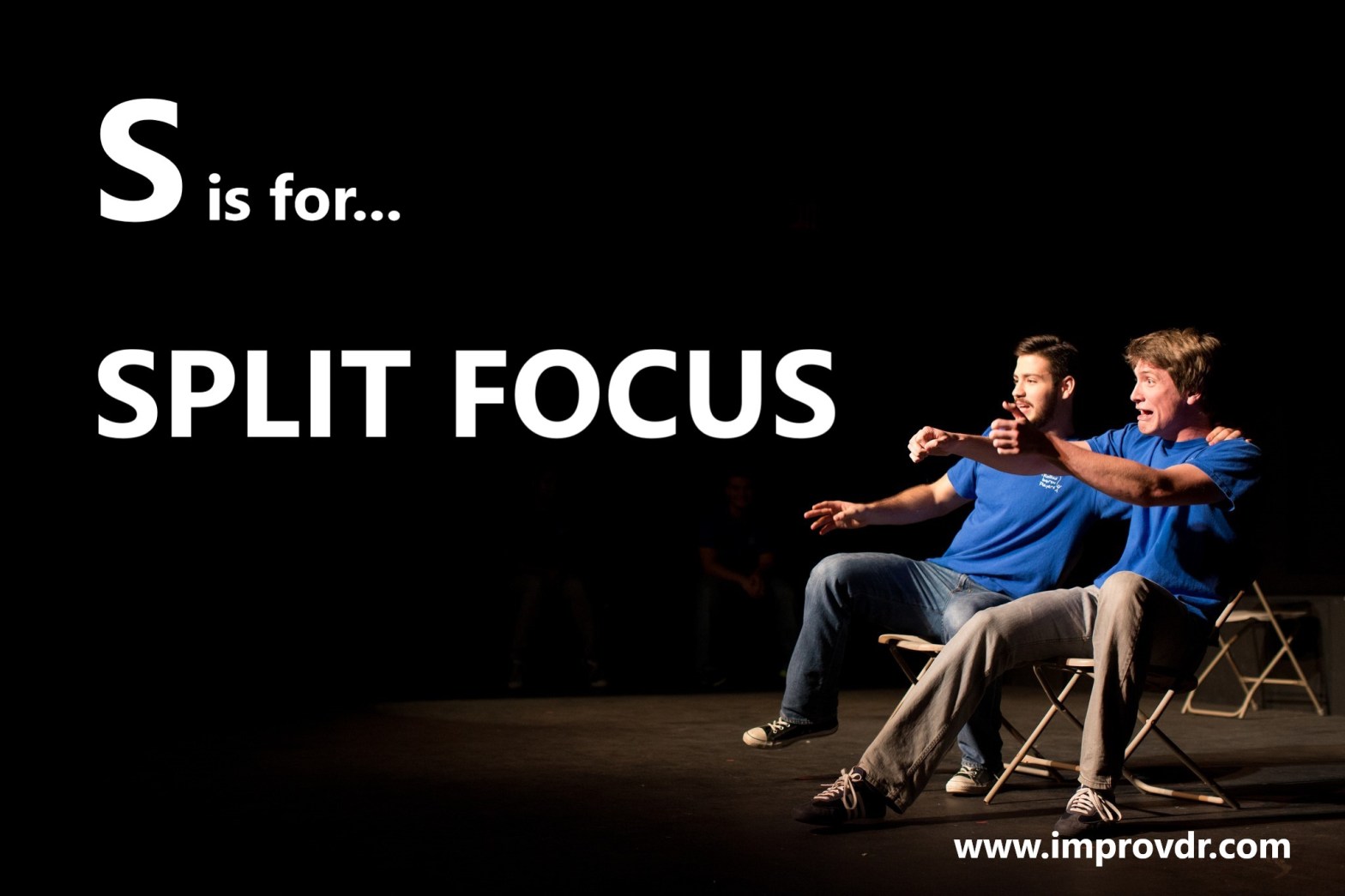
Connected Concept: Split Focus

“S” is for “Split Focus”

Split Focus refers to a company’s inability to quickly address moments of competing efforts to gain and hold the audience’s attention. If the company can’t decide where the action is most cogent, it follows that the audience won’t figure it out either.

Splitting the Difference

This is just a taste of this entry/concept. Go here for more information.

Related Entries: Commandment #2, Give, Take Antonyms: Focus, Sharing Focus Synonyms: Chaos

Cheers, David Charles.
www.improvdr.com
Join my Facebook group here.
© 2022 David Charles/ImprovDr

Connected Game: Invisibility Scene

Game Library: “Crime Endowment”

A common closer in my current home venue, Crime Endowment centers on an in-the-dark suspect confessing to a ludicrous crime that they must piece together in real time. Without a healthy respect for Specificity and calculated risk taking, the task-at-hand can easily fall flat.

The Basics

One player volunteers to serve as the endowee or “criminal” and leaves the space. While they are absent, an absurd crime is cobbled together from typically avowedly non-criminal elements, such as a common weekend activity, harmless object in your attic, recognizable landmark or destination, and the name of a celebrity. I don’t think we’re unique asking a random audience member to share their initials for this last component and then brainstorming a famous personality or fictitious character inspired by this pair of letters. These offers combine to form the “crime,” and when the endowee returns, their teammates must use leading questions to make the suspect confess (usually in a set amount of time). Crime features are usually endowed in the order they were obtained.

Example

The assembled crime consists of brewing coffee with a unicorn at the pyramids of Giza with Jacinda Ardern. Player A (the suspect) returns to the stage as two teammates pace in the interrogation room.

Player B: “Alright, take a seat. I’m required to tell you we’re recording this interview.”

Player A: “Look, I’m just happy to clear up this misunderstanding. I honestly didn’t even think it was a crime to park outside the library overnight.”

Player B: “You get that, Joe?”

Player C: “Sure did, boss. You must have had a real late night last night.”

Player A: “I don’t mind admitting I did enjoy a few glasses of red at the local wine bar…”

Player B: “And yet you look fresh as a daisy this morning… right, Joe?”

Player C: “Fresh as a daisy, and completely alert, boss, talking to us all sweet and low like that…”

The Focus

Close collaboration, active listening, and playful – often punny – volleys provide the necessary foundation of this endowment tour-de-force.

Traps and Tips

1.) Filter through character. Are you an over-confessor accidentally spilling the (coffee) beans at the slightest provocation, a hardened criminal who’s defiant and proud of your activities, or a self-proclaimed mastermind toying with your interrogators? Regardless of your persona, you’ll want to make sure you bravely offer up specifics even if you’re feigning a more withholding stance. Quickly establishing a strong point of view as the suspect can gloriously ignite the scenic fire. The same holds true for the interrogators: are they brusque, pleasant, or desperate? Played without finesse, the game will closely approximate a transaction scene; imbued with memorable characters, it will soon become much much more.

2.) Confess, don’t guess. All endowment scenes are essentially guessing games, but these mundane mechanics should be hidden from the casual observer. Even if your suspect persona clearly wants to please, each attempt should have the certitude of a confession rather than the hesitancy of a guess. (On a simple level, beware of a questioning inflection.) When you respond to the interrogators, offer something specific even if you’re confident that you’re a hundred percent wrong. Even when you are wrong – and you will be often, especially during the opening moves of the scene – being strongly and specifically wrong is more likely to provide a new line of questioning for your teammates. Although I’d add one proviso, if the scene is getting truly stuck, take the risk of being wrong in a detailed new way rather than circling endlessly around the same worn-out idea.

3.) Compel, don’t tell. All the major components of the randomly assembled crime should be uttered first by the suspect. Ideally, even after a criminal element has been successfully named, it’s good form for teammates to still avoid saying it so that the final confession still has some punch when all the pieces are finally put together and said aloud. Good endowing etiquette applies with players seeking to steer the suspect by unlocking potential clues in the endowee’s dialogue rather than playing charades or providing a series of “fill in the blanks.” While the suspect needs to bravely offer up detailed raw material, the endowers should lean into word play and leading or loaded questions. The more skillful and subtle your strategies, the more miraculous the results will appear.

4.) Recreate the tale. One of my favorite features of this game is the opportunity for the final grand confession – whether or not it ultimately ends up being “correct.” In addition to ticking off the various components on your mental list, enjoy the chance to weave them together into a climactic narrative that fills in any missing blanks or justifications. To help set up this climatic moment, it’s wise not to say the final puzzle piece when you think you have it but rather send a clue back of your own that hints at your solution for the interrogators to confirm. This inclination to find the story serves the game well as a whole, linking together established character traits, unique games discovered in the moment, and perhaps even some of the discarded specifics that were seemingly dead ends. The audience appreciates a closing recap even of the most rudimentary nature, but when the suspect owns this closing moment and paints a vivid picture of their misdeeds and motivations, the results can prove breathtaking.

In Performance

The mechanics of Crime Endowment closely resemble those of Naive Expert examined here, which offers further insights into skillful endowing and communication techniques. Both endowment games are crowd pleasers, but the potential for a dramatic final confession makes the current offering more clearly suited for that coveted closing spot on a short-form playlist.

Looking for an additional overlay? Boris adds an invisible interrogator (of the same name) that can be called upon by the interrogators to roughhouse the stubborn criminal, causing the stubborn criminal to react to the unseen actions with a series of athletic reactions. (This requires a particularly adept criminal and a careful framing as you want to make sure the “torture” remains silly and playful, or you’ll quickly enter the realm of the ick.) Over Confessor tweaks the central dynamic of the suspect, eschewing any sense of resistance and replacing it with an eagerness to confess to anything and everything with glee just to get the crime off their chest. (Here the trap is for the criminal to truly overload the scene with random offers and not let the interrogators get a word in edgewise).

And for our second R&D Show outing, we expanded this conceit into an entire first act, with insanely multifaceted crime elements and partial reenactments to add to the fun. This remains one of our most audience-pleasing performances to date.

Cheers, David Charles.
www.improvdr.com
Join my Facebook group here.
Photo Credit: Tony Firriolo
© 2022 David Charles/ImprovDr

Connected Concept: Specificity

“S” is for “Specificity”

Going beyond the ill-defined mundane to create particulars and nuance.

Questions to Unlock the Details

This is just a taste of this entry/concept. Go here for more information.

Related Entries: Ambiguity, Discovery, Extending, Offer Antonyms: Generalities, Vagueness Synonyms: Details, Nuance

Cheers, David Charles.
www.improvdr.com
Join my Facebook group here.
© 2022 David Charles/ImprovDr

Connected Game: Crime Endowment

Game Library: “Narrator”

Narrator (also known as Dimestore Detective) places one player at the center of the action and empowers them to comment on the events and their own character’s feelings through the sporadic use of asides. Typically, these shared thoughts express the fictional point of view of the character, but they can also be used to directly communicate needs and choices to fellow players. Subsequently, the mechanics of the game provide a simple means for rehearsing Speaking Your Truth onstage.

The Basics

One player serves as the internal narrator which may take on a detective function or pursue a more “everyday” persona as is the case with classic series such as Malcolm in the Middle, Everybody Hates Chris, or Clarissa Explains It All. This character periodically utilizes first-person narration through asides to contextualize the action. The remainder of the scene plays out in the traditional fashion through dialogue and action.

Example

Player A, the narrator, starts the scene by miming a downstage high-school bank of lockers. As they unload their school bag for the start of the day, they talk directly to the audience.

Player A: “It’s been three days since the mysterious unsigned Valentine’s Day card showed up in my locker. Now I’m certainly well liked at this high school, Mount Cooks, but I’ve been wrestling all weekend while working on my debate speech as to the unknown author. I was lost in a bit of a daydream when I heard their familiar voice from the other side of the locker door.”

Player B has entered and started using the locker beside the narrator.

Player B: “I hope you had a good weekend! Or were you thinking about that card the whole time?”

Player A slams their locker shut to talk directly to their friend.

Player A: “It was a little bit of both! Nicole, I’m just at a loss as to who it could be…”

Player A leans against their locker clinging to an oversized mathematics textbook, forlorn.

Player B: “You are the smartest person in this high school – smarter than half the teachers! You’re the captain of the debate team, after all! If anyone can figure this out…”

Player A: (narrating to the audience) “Nicole is my best friend, and she’s usually right, especially when it comes to assessments of my intelligence. I have Ms. Rosendahl’s pre-calculus first period, so we had to walk and talk…”

They both start down the hallway.

Player B: “And you know my theory anyway. That transfer student seems to be oddly interested in everything you do…”

As soon as this new character is mentioned, Player C assumes their identity and leans on the classroom door.

Player C: “I wondered if you were going to break your perfect attendance record…”

The Focus

The requisite skills for Narrator draw liberally from the canon of other well-loved short-form games. Make sure your featured character both shapes and enables the play of others. It’s a frightening part to explore if there’s any sense that your teammates expect you to make all the significant offers.

Traps and Tips

1.) Think Prologue. Much like the short-form game Prologue, the narrator function provides a great opportunity to establish the mood or style of the scene that can, in turn, set up the team for considerable success. It’s by no means necessary for this character to hit the stage first in order to provide such a preamble, although the game will feel a little odd if they don’t arrive on the scene reasonably quickly. As an omniscient character, it’s typical for this character to be privy to most, if not all, significant events. The narrator has the unique option of utilizing overt storytelling techniques, so don’t overlook this chance to really craft a playful stylistic landscape that the team can then reflect and populate.

2.) Think Typewriter. In Typewriter, the author usually sits at the side of the stage; Narrator brings this presence (and all their tools) into the action proper. While there may not be time to deploy all of the typist’s “tricks,” look for chances to provide backstory details, add environmental influences, or embellish the location through descriptive scene painting. By telling the audience your history with a featured character, intensifying the mood with weather features, or strategically placing a pertinent prop within arm’s reach, you can do much to raise the stakes and interest of the scene. And you also have the power to facilitate quick shifts in time or location as they’re needed just by announcing them: “An hour later, I was sitting in the cafeteria…”

3.) Think They Said, They Said. The role of the narrator also shares some of the staging devices that are central to They Said, They Said. It’s important that fellow players retain agency and are not treated merely as empty-headed puppets, but gentle adjustments or options can also be pitched from the narrator position. These may be purely dramatic in nature, seeking to reinforce current traits and games, or can take on a little bit more of a diagnostic vibe. In the first category, the narrator could encourage a character to double down on their own choice that may have inadvertently fallen by the wayside: “Nicole is the most relentlessly positive person I know.” In the second, the narrator can gently address staging problems such as a crowded stage, uninspired stage pictures, or cajole activity in a scene that has devolved into talking heads: “She waked over to the chalkboard and started to diagram the possibilities.”

4.) Think Asides. The physical gimmick of the game draws very much from the theatrical tradition (and improv game of the same name) Asides. The narrator should quickly establish the rules of this game that help the audience and fellow players discern when they are taking a private moment with their thoughts as opposed to engaging in public dialogue. Often, a simple but clear change in stature and tonality will suffice: turning flat to the audience and assuming a slightly more confidential air. Other players should continue gentle activity and avoid eye contact with the narrator in these moments, and although the improvisers should very much hear, process, and apply any offers from the aside, it’s important that their characters don’t gag by commenting on this theatrical conceit or it’ll lose its agency: “Who were you just talking to…?”

5.) Think Conscience. And just as the game Conscience plays with the concept of text and subtext, so too can the narrator on multiple levels. Contrasts and contradictions provide rich gifts on the improv stage, and the narrator is uniquely situated to endow and reveal lies and tensions. In their own dialogue, they can share their truth before or after providing its antithesis in the dialogue: “Ms. Rosendahl isn’t just going to let me leave class early, so Nicole and I came up with a ruse.” Similarly, narrators can contextualize another character’s words by elucidating juicy prior actions or motivations that they have discovered. If your scene partner is treating you with treacle-like affection, noting to the audience that they always do this when they want something will encourage new games and tactics from your fellow player.

In Performance

The intersections this game shares with so many others reveal the numerous potentials and challenges that await the improviser who assumes the central role. While they might have more tools at their disposal than their scene partners, there is little that these tools can do without exciting and rich materials. Non-narrating players should enter bravely and with purpose, trusting in their own instincts and the narrator’s ability to adjust the direction as needed. Speaking Your Truth informs each of the above strategies as it is through an honest exchange of needs that the narration and narrator can best serve the scene.

If you’re not familiar with some of the referenced games above, you can track them down in the Game Library index here.

Cheers, David Charles.
www.improvdr.com
Join my Facebook group here.
Photo Credit: Tony Firriolo
© 2022 David Charles/ImprovDr

Connected Concept: Speaking Your Truth

“S” is for “Speaking Your Truth”

Speaking Your Truth is a safety valve mechanism committed to maintaining the beauty and inclusiveness of our collaborative storytelling. The concept is synonymous with “calling it onstage” and I tend to use both terms interchangeably. To speak your truth is to momentarily conflate character and player (if this is not already your stylistic norm) so as to provide timely feedback to your teammates.

How to Fully Accept a Fellow Player Speaking Their Truth

This is just a taste of this entry/concept. Go here for more information.

Related Entries: Commenting, Consent, Mugging, Postmortem, Trust Antonyms: Obfuscating, Suffering Synonyms: Calling It Onstage

Cheers, David Charles.
www.improvdr.com
Join my Facebook group here.
© 2022 David Charles/ImprovDr

Connected Game: Narrator