Game Library: “Press Conference Endowments”

Here’s a press conference with a twist; namely, the featured celebrity has no idea what they are announcing (or even who they are, for that matter)!

The Basics

One player leaves the auditorium, and their teammates obtain a famous personality as well as a typically unrelated announcement or cause. The endowing players then scatter into the house before the absent improviser is ushered back into the space where they are greeted by the excitable press corps (the actors in the audience) who pepper the famous personality with leading questions.

Example

Player A leaves and is assigned “Brad Pitt,” who is unveiling a new line of diesel-scented fragrances called “Slick.” When the supporting actors are in place, Player A enters with camera flashes, exclamations, and great fanfare.

Player A: (with a broad and brave smile to their adoring public) “Thank you all for joining me here today for such an exciting event. I’ll do my best to get to all your questions.”

Player B: (standing with a mimed recording device) “Conner Chaumley with the Hollywood Gazette. Before we begin, are there any rules about what we can and can’t talk about during this press conference…?”

Player A: “As I always say, I’m an open book…”

Player B: “Well, you may say that, but I wouldn’t want a fight to break out…”

More Fight Club clues (and similar) are offered until the speaker proudly identifies himself. The press begins to unravel the diesel element…

The Focus

The staging inside the theatre at large opens up new potentials for audience interplay and involvement (alongside the central delight of an endowment game). Don’t overlook this aspect of the game.

Traps and Tips

1.) Dive. As the unknown celebrity, make brave choices that the press corps can nudge, shape, and “correct.” You’ll want to be careful of just listing random facts – if you merely name a stream of different celebrities, then we’re in the land of a guessing game rather than an endowments scene (and when it comes to your identity, in particular, it’s odd to claim multiple different identities before stumbling into the right persona). However, remember that it’s imperative to provide a specific “and” to each of your “yeses,” especially when you’ve no idea what your teammates might be fishing for. You’ll move the ball further down the field (swimming pool) with specificity rather than stalling. And if you think you’re on the cusp of an answer, you can confirm your instinct by offering up a clue of your own and then seeing how it’s received. “I have a whole ocean of friends, and ten of them are waiting offstage to help with my announcement…”

2.) Wade. As members of the press corps, endeavor to gently lead the endowee towards the finish line with directed calmness. Provide helpful context, especially if a component is unusual or oblique. When the first reporter defines themselves as representing a Hollywood outlet, for example, this sets some initial parameters without giving away the whole shebang – there are a lot of movie stats, after all. More subtle clues that will initially fly over the celebrity’s head frequently tickle the audience who is in the know, so don’t fall into the trap of jumping to the end result in one move when a more leisurely paddle will prove more enjoyable for everyone.  As I’ve noted in other endowment entries, “fill in the blank” strategies and their ilk should be a last resort, not a first salvo. Don’t rob the audience of the fun of watching the celebrity making some wildly off the mark assumptions.

3.) Explore one lane. The unique staging adds a lovely way of breaking up an evening of similar looking scenes and invites a little playful chaos as reporters (and perhaps even some keen audience members) jockey for attention and focus. Some scattershot endowing is both likely and desirable; however, if the guesser routinely becomes overwhelmed, try to focus your hints on one lane at a time. It’s common practice to work on a single aspect of the ask-for before moving onto the next – usually in the order they were gathered from the audience. So, if one player is working on “Brad Pitt,” then others should follow suit. (It’s also common to start with the celebrity’s identity as this gives Player A a lens through which to play.) In a similar fashion, if one improviser is pulling on a particular thread (perhaps the Fight Club angle in our framing example), then it can be useful to join that specific game before segueing onto an entirely different tactic or element.

In performance

Naive Expert (here) was my first endowment game addition to this library, so it contains some good boiler plate advice for this sub-genre as a whole. This current variant particularly thrives on some punny word play and a host of silly reporter characters.

Cheers, David Charles.
www.improvdr.com
Join my Facebook group here.
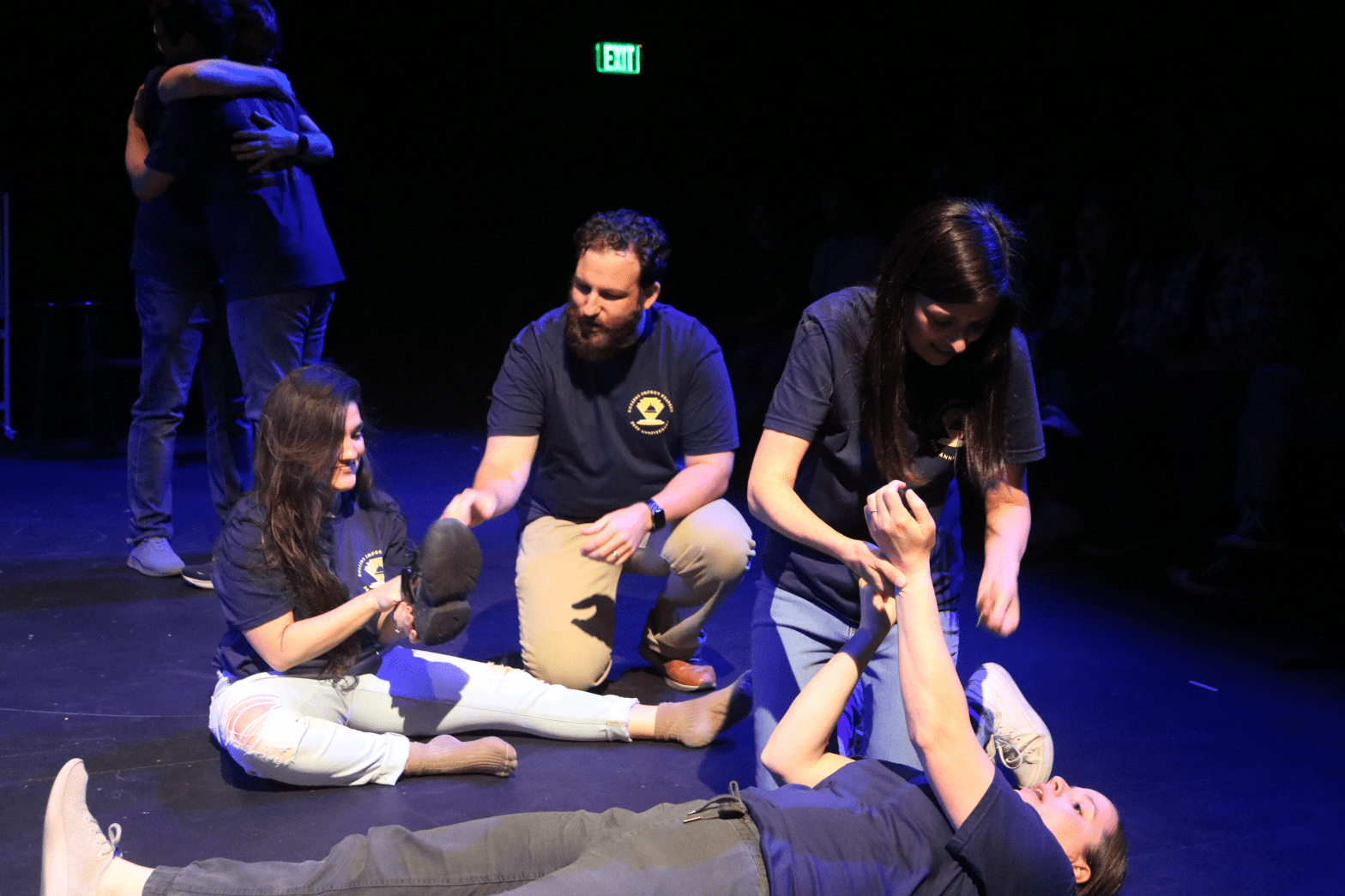
Photo Credit: James Berkley
© 2025 David Charles/ImprovDr

Game Library Expansion Pack I
Game Library: “Poet’s Corner”

Here’s a lovely frame for the language lovers amongst us.

The Basics

The host or an assigned player facilitates a groovy poetry jam in which a series of guest improvisers perform original (need I say, improvised) poems and works of art. Each piece can be inspired by one unifying suggestion that spans the whole set, or use a unique ask-for or contextualizing pitch from the facilitator (or a random title drawn from a hat, or image projected onto a screen, or a piece of music, or start from nothing more than the poet’s first impetus…) If you’re so inclined, each poetic offering can culminate in a rousing round of finger snaps or similar. (Some find this conceit less joyful than others.)

Example

Suitably artistic lighting and cool music set the stage as Player A assumes the role of the jam host (perhaps providing a piece of their own later in the event).

Player A: “Welcome cool cats and dogs to our evening of electric emotions and sensuous stories…”

The audience is encouraged to snap their fingers, or clap, or howl like dogs…

Player A: “And here’s our first fearless phonetic freedom fighter with a little piece inspired by… earthworms.”

Player B takes the stage as Player A encourages a warm welcome.

Player B:

“Beneath our feet
Releasing heat
With motions so discreet, they remain unheard
Unheeded
Unheralded
Save for the hungry bird
Whose greed would have it feed on your soul
Swallow you whole
As you wriggle, writhe, and roll,
Without a thought or care
For all you’ve done without a word
Of thanks…”

The Focus

Enjoy the ability to savor the poetry – in whatever form it may take – and to create stories and material within this unique dynamic.

Traps and Tips

1.) Play with style. This is such a gentle conceit that can easily be retooled to host all manner of artistic musings, so be sure to define poetry loosely and inclusively. Much like the vaguely similar musical frame In the Studio (read about it here), you shouldn’t feel guilty pitching and playing to strength, perhaps placing any “ringer” in your ensemble in the final slot. Slam poetry, jazzy freestyling with musical underscoring, Shakespearean sonnets, pithy haiku poems, and the like can all have a place. And also like In the Studio, this is similarly a great device for pushing yourself and each other into trying styles and techniques that you don’t know you can do yet. Throwing in a song can also work, although too much music might lead you into Forgotten Songs territory, which is fine but really another handle altogether.

2.) Play with content. Regardless of your chosen form, lean into the typically untapped potentials of heightened language. If your words are too causal or every day, there may be little poetry ultimately in your corner! Play with rhythm, repetition, and rhyme. While every poem might not feature each of these ingredients in equal measure, most unapologetically play with the musicality of the word. Throw in some alliteration, assonance, and parallelism while you’re at it to add even more challenge and finesse. Poetry can also explore tough subject material from a helpful distance, so don’t be afraid to consider complicated themes with equally complicated language. While it certainly can be fun to throw a Dr. Seuss ditty into the mix, every poem needn’t become a jingle, and it’s nice to offer your audience a rollercoaster of offerings with surprising tonal twists and turns.

3.) Play with character. If poetry isn’t your “bag” (and even if it is), don’t underestimate the gift of character. Whether you’re performing as a thinly veiled version of yourself or leaning into a persona that is a bit more of a stretch, Poet’s Corner thrives equally on the what (or content) as the how (or performance style) and who (who). As always, a strong and smart point of view will guide you if and when the poetry escapes through your fingertips. At the same time, be wary of sliding into problematic stereotypes, especially if you’re simultaneously claiming a performance mode that hasn’t historically been the domain of your ancestors and kin. If you are straying far afield – as the game invites – I’d recommend clearly basing your character in yourself and exaggerating an emotional quality or motivation rather than potentially tastelessly approximating the perceived speech qualities or physical traits of an “other.” Or, in other words…

4.) Play with integrity. While this game invites a parodic approach that examines and mirrors poetic tropes and practices, a little earnest love and effort will go a long way. Celebrate the styles you bring to the stage; seek to elevate your own efforts as you craft your literary homage; risk leaning into the great emotional storehouse that is the spoken word. Don’t lose sight of the fun – some able target rhyming or punny word play will serve when applied judiciously. But be careful of viewing the game as no more than these delightful gimmicks. Poetry taps into deeper truths, both lightly comedic and deeply vulnerable. Allow your audience the gift of experiencing this whole gamut of emotions.

In performance

I hadn’t played this game for a while and was reminded of it in 2024 during a gig in Pittsburgh. There, the players all riffed on the suggestion “cactus,” and my contribution consisted of a song with Ryan Goodwin on the keys. We crafted a breakup ballad, likening the dead relationship to a prickly cactus. It ended with a lyric bemoaning how the protagonist was still drawn to the object of their affection even if the attraction always ended with them being hurt and made to bleed. There were certainly some chuckles along the way, but a more sincere tone pervaded that really served the game and audience. That experience has made me want to explore this frame even more.

Cheers, David Charles.
www.improvdr.com
Join my Facebook group here.
Photo Credit: Tony Firriolo
© 2025 David Charles/ImprovDr

Game Library Expansion Pack I

Game Library: “Piano Torture”

Your company musician is placed front and center as they paint the stage with various melodies and soundscapes in Piano Torture.

The Basics

For the duration of the scene, the improvising musician can start and stop their accompaniment at their pleasure. When music is playing, all onstage dialogue becomes sung. When the music stops, players must immediately return to everyday spoken word.

Example

Players A and B begin a traditional scene in the fruit department of an upscale grocery store, with A pushing their shipping cart around the immaculate displays.

Player A: “I don’t think I’ve ever seen so many options…”

Player B: (a little overwhelmed) “So many expensive options.”

Player A: (gently) “It’s a special occasion, Kevin. It’s not every day I get a promotion.”

Player B: “I know. I know.”

Player A: (picking up a beautiful cantaloupe) “How can you…”

The musician suddenly begins a sultry tango and A begins singing…

Player A:

“…complain about such a ripe sight?
Every melon and guava make me want to swipe right…”

The music stops as quickly as it began.

Player A: (now talking again) “…just pick out something you like. Don’t give a second thought about the price tag…”

The Focus

Enjoy the surprises and tonal shifts provided by the accompaniment.

Traps and Tips

1.) Musician wisdoms. As the musician also functions as a caller, they should keep in mind good etiquette for this role; namely, balancing some challenging torture with moments that set the players up for success or helpful discoveries. (Ideally, every musical switch does a bit of helping and hindering.) Unless you’re building to a culminating climax, you don’t want to think of the musical moments as songs so much as dynamic excerpts or snippets. By all means, throw in a variety of musical styles – as many as are comfortably in your repertoire – but keep in mind that players will need to sing to these accompaniments and do so quickly.

2.) Transition wisdoms. Much can be gained or lost in the moments where players move from dialogue to song and back again. For the musicians, as best you’re able, avoid long play-ins or complex embellishments as these can force the singer to needlessly stall and wait until they have enough musical information to confidently sing. If you’re opting for a stylistic surprise (which is where much of the fun lies), aim to front load the most crucial information – likely the key and general rhythm or feel. For the performers, as best you can, just start singing as soon as you hear the musician play. You’re likely to hit some clumsy notes as you find how your voice best works with the soundtrack, but this fearlessness will serve you and the scene much better than tepid transitions where the energy of the scene dips. (Seek to snap out of the sung sections just as quickly as these stark transitions are pure improv gold.)

3.) Actor wisdoms. Just as caller pointers apply to the musician, actors should heed the general lessons of called games, too. Pay particular attention to focus gives and takes, especially when the music stops and starts. If your character is currently talking, it follows that you should now be singing. It can be tempting to just start crooning when you hear the music, regardless of your current function in the action, but a sudden wall of song will rarely serve. Look to share the hot seat around and exploit the heightened stakes and rhyming mischief that musical improv invites. Overcrowding can easily hamper this fun as well – the more characters on stage, the more challenging it can be to elegantly move focus.

In Performance

If your company is blessed with strong musicians, this structure can make for a nice addition that lets music collaborators lead the charge. It tends to play a little more frenziedly than other short-form singing games like Song Cue and Scene Song (though arguably by design). That being said, it provides a dynamic alternative if you’re looking to shake up your playlist a little.

Cheers, David Charles.
www.improvdr.com
Join my Facebook group here.
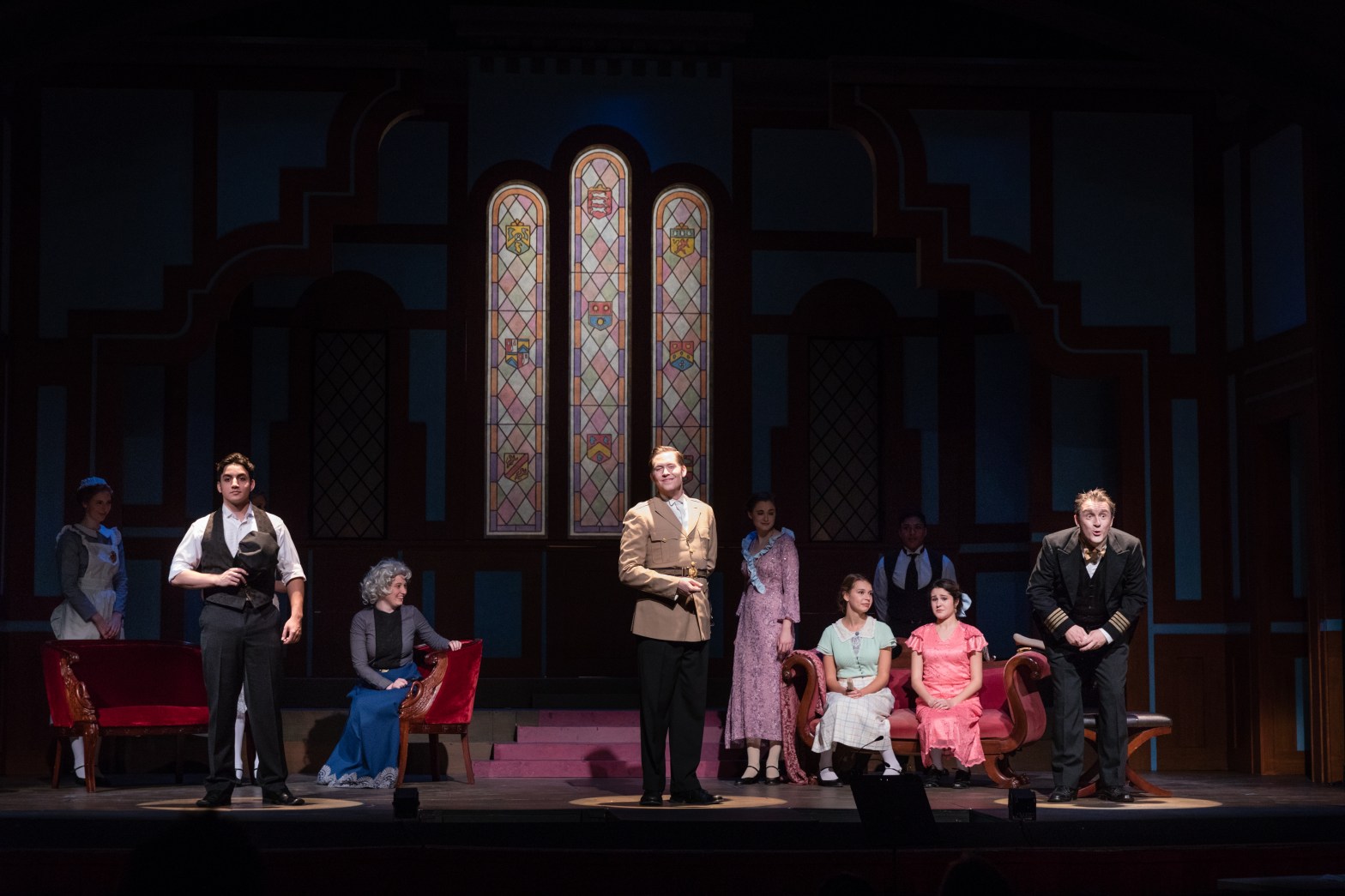
Photo Credit: Gontran Durocher
© 2025 David Charles/ImprovDr

Game Library Expansion Pack I
Game Library: “Physical Thermometer”

Broad characters are the norm in this highly physical short-form game.

The Basics

Before the scene, players form a line, and the host (or another facilitating performer) slowly raises and lowers their hand beside each actor until a designated audience member calls stop. The corresponding body part determined by this process becomes the source of each character’s driving energy or mood (their “body lead”). After each player has been subjected to the “physical thermometer,” a scene is played in which this random assortment of characters interact. Depending on your venue, company demographic, and comfort levels, you can exclude “swimwear zones” from the selection process. In fact, that’s generally a wise strategy in general so as to avoid unnecessary icks in an otherwise silly mechanic.

Example

The physical thermometer randomly assigns A their chin and B their knees as character leads (along with other body parts for C and D). The scene begins at a gas station with A and B pulling up halfway through a long cross-country drive.

Player A: (rolling their neck from the driver’s seat) “Let’s not have a repeat of our last stop, please. We can just get our gas, and go…”

Player B: (already opening their door and starting to stretch out) “I’m not built for this like you. I can only spend so many hours folded up into your tiny car.”

Player A: “I’m not paying for a rental when I have a perfectly good mini…”

Player B now exits the vehicle and explores the forecourt with a very knee-centric walk.

Player A: (irritated) “Don’t go too far, Clara.”

A unfolds from the car and starts to examine the various prices and grades of fuel with a chinny look…

The Focus

Let the inexplicable physical aspects of the scene guide you into new territory and dynamics.

Traps and Tips

1.) Play. Some body leads will feel innately more manageable and richer than others, and so it can be easy to get into your head about using an alien or peculiar physicality in the “right way.” Relieve yourself from that pressure and just try different things while using the filter of your given lead. There’s no one correct way of moving with aggressive knees or an inquisitive chin, so take the risk of just doing something – anything – and then finding its logic and purpose. Often, broad character inspirations become riddles that it will take the whole scene to even partially “solve,” so throw yourself into the murky waters with abandon and fearlessness. As I’ve demonstrated, it can be helpful to add a quality to your assigned lead if you’re feeling a bit lost: aggressive knees will play differently than flirting or cautious knees, for example. (This is also the gimmick of the closely related game, Emotional Body Parts.)

2.) Discover. Similarly, avoid the temptation to front load justifications for your inexplicable energy and movement choices. If you’re a bit of a thinking improviser, this tendency can deflate the risk of exploratory movement. Player B’s “need to stretch” could potentially fall into this category if this choice was offered to explain away the odd walking that would follow. When this is the primary motivating factor, anything fun and unexpected that has already been framed in such a way won’t likely open any new doors for the action. Yes, there is certainly a degree of justification that will occur within the scene but avoid totalizing your character’s deal in a flippant verbal comment. This not only “names the game” but also reduces the wonderful accidental patterns that tend to present themselves when players start doing first and seeking meaning second.

3.) Reuse. Character leads provide a great tool for finding and heightening helpful behaviors, so be sure to look back on what you’ve done and seek to find ways to keep those energies vibrant and growing. It’s foreseeable that you might strategically throw away or minimize some movement-based ideas that felt clumsy or inorganic – and that’s okay. But look to mine offers that are encouraging risk-taking alongside atypical staging and energies. The audience will enjoy watching your character evolve and deepen, and patterns of behavior are particularly effective when it comes to isolating our “deals” as players. So, as always, if you don’t know what to do next, consider the things that you’ve already done and enjoyed, and do some more of that in a slightly new way!

4.) Build. This falls a little under the heading of my “stock advice” for games with an internal focus: while you’re getting your own character vibe going, make sure you’re truly connecting to and playing with others. It’s easy to start residing in your head as you search for the next move or physical choice, but in doing so, you’ll miss the opportunities your teammates are both deliberately and accidentally pitching. The character lead is a fun embellishment designed to push you out of old norms and habits. A host of disconnected movement and personae, however, will only be so much fun for so long, so don’t lose sight of building the scene and story together. Every choice needn’t be chinny or knee-y to the nth-y degree-y.

In performance

If your characters are becoming flat or dull, Physical Thermometer (and other essence or movement-based handles) are a great way to shock everyone out of the everyday. Played at a “10,” you’ll get wildly bizarre and comedic caricatures which can provide a boost in energy and presence to your playlist. Played at a “1” or “2,” you might find yourself crafting quite nuanced relationships with a hint of the unexpected that can add freshness to old stale tropes and scenarios.

Cheers, David Charles.
www.improvdr.com
Join my Facebook group here.
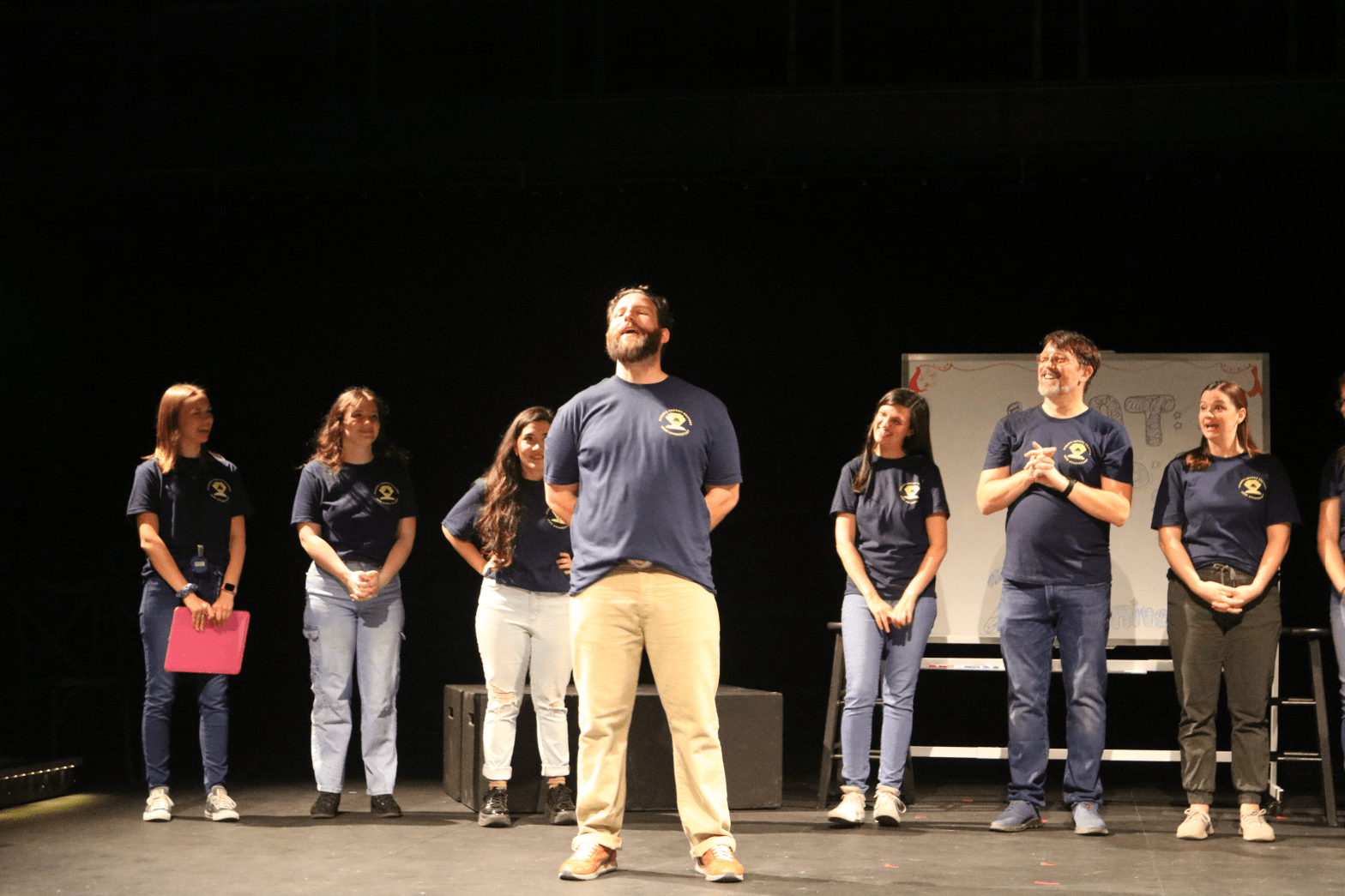
Photo Credit: Tony Firriolo
© 2025 David Charles/ImprovDr

Game Library Expansion Pack I
Game Library: “Pecking Order”

The rules governing Pecking Order are relatively simple but will nonetheless provide rich opportunities for exploring relationships and status in a whole new way.

The Basics

This scene works well with four actors who form a line at the lip of the stage prior to the action beginning. Players are assigned a status order (from 1 as the highest to 4 as the lowest), so Player A might be assigned 1, B a 2, C a 3, and D a 4 at the bottom of the pecking order. For the following scene, players may only talk to characters who hold status positions immediately above or below their own. In this way, Player A can only talk to B, while B can talk to A or C but not D… The action unfolds honoring these preset patterns and conditions.

Example

Status is assigned as described above with A holding the highest 1, and D the lowest 4. A movie star and their entourage serve as the inspiring impetus, and B and C volunteer to start. They create a luxurious dressing room and continue their preparations for their boss’ arrival.

Player B: (arranging an oversized bouquet on the star’s makeup table) “I’m just saying that he isn’t happy. Something clearly didn’t go as planned last night.”

Player C: (nervously fluffing the pillows on the star’s couch) “Did he say something to you? Something about me? I did everything on the list you gave me…”

Player B: (candidly but without cruelty) “I’m not even sure he knows your name. It’s my job to make it so he doesn’t have to worry about the insignificant details…”

Player C: “I’m just really enjoying this job and working for you both. I always wanted to work in the entertainment industry, and this is a dream come…”

Player A enters in a grumpy mood. C stops mid-sentence, honoring the rule that they can’t talk to A (or overtly in A’s presence). A goes to their makeup table.

Player A: (simply, to B) “I prefer orchids.”

Player B shoots a look to C as an explanation of sorts.

Player B: “Yes, sorry. I thought I’d made that clear. But these are quite lovely.”

Player A: “I can see why you might feel that way…”

Player B considers assigning the task to C but doesn’t want to risk another flower-related fiasco.

Player B: “Let me personally fix this oversight for you. You deserve nothing but the very best.”

B exits leaving A at their mirror and C fussing with the couch. These two characters cannot talk to each other…

The Focus

Obey the scenic rules and enjoy the resulting status discoveries and games.

Traps and Tips

1.) Status thoughts. Consider the basic rules of status (you can review them more fully here). High status needn’t become belligerent or mean; low status doesn’t have to be bumbling or incompetent. Extreme status contrasts will prove entertaining, but there is also something bracing about watching characters who are just slightly above or below each other on the status ladder. These subtler distinctions will likely encourage subtler moves and choices as well. If B was A’s best friend before A made it big, this relationship should become more nuanced and believable (as opposed to B being some hapless pleb).

2.) Casting thoughts. If you’re playing this game for the first time, it can be helpful to line up a character’s social role or rank with their pecking order assignment – in this way, our “number one” becomes the star with lower positions becoming their manager, assistant, driver and the like. Different (and frankly, often more interesting) dynamics await when the company doesn’t conflate rank or function with status. If Player D, for example, becomes A’s director, now there is a new and interesting tension to unpack (especially as the rules don’t allow A and D to talk directly to each other!) Another variant, Family Status (coming soonish to the Game Library) takes this idea up a few extra notches.

3.) Staging thoughts. Aim to thoughtfully rotate through the available characters in helpful (and then, ideally, less helpful) combinations. Don’t avoid staging the “gap” relationships – A and C above – and yet don’t rush to these more challenging vignettes before a firm scenic foundation has been laid. And if the scene is struggling rather than soaring due to the silence, be ready to provide a connecting entrance. When there are multiple characters on stage, pay particular attention to speaking rights and norms. The guiding rules are a little less cut and dry here, but if C is talking to B in the presence of A, then they are probably doing so very discreetly (perhaps almost as an aside) and they certainly wouldn’t interrupt A to speak. As with all status games, top dogs need to be extra generous with their presence and exits so that the other cats and mice can play.

4.) Justification thoughts. There can be a tendency to want to explain all the communication patterns in the scene: Player D messed up really badly with their boss, A, and is now avoiding them so as not to risk being fired… Some of this behavior is certainly warranted and will add to the greater tapestry of emotions and motivations. However, don’t neglect the wonderful power of subtext as well. If every line of dialogue is used to explain who is talking to whom and why, then there may not be much time left to construct a compelling scene, and too much talking about the talking essentially drags the whole affair into “naming the game” territory.

In performance

Played thoughtfully, focus will move between the players in new and exciting patterns. If you are a bit of an over-talker by default, challenge yourself to play in the middle or lower end of the pack as this should necessitate moving more of your choices into your physicality and actions.

Don’t forget you can keyword search the always expanding Game Library to find other games and exercises of a similar or contrasting ilk here. And you can find out how to get a copy of my companion book, The Improv Dictionary, which digs into core performance skills and strategies like status and relationship by following this link.

Cheers, David Charles.
www.improvdr.com
Join my Facebook group here.
Photo Credit: Tony Firriolo
© 2024 David Charles/ImprovDr

Game Library Expansion Pack I

Game Library: “Pass-Off Scene”

I first encountered this long-form structure during my undergraduate days in Chicago from a fellow ComedySportz player, Tony Alcantar. It’s also known as Follow the Leaver, and it offers an elegant though perhaps unexpected device for creating a longer narrative piece.

The Basics

A broad location is obtained (ideally one with multiple smaller sub-locations for reasons that will become clear). Several players begin a traditional improv scene in the given environment. This continues until a character organically discovers a reason for leaving. As they clearly initiate their exit, the action now follows them with any characters remaining in the original location stealthily striking themselves (and any furniture they were using) from the stage. The audience now follows this exiting character in motion, watching then change locations until they interact with a new scene partner or partners in another facet of the greater location (or in a transitory location like a hallway or sidewalk). When new characters are introduced, this interaction becomes the next dramatic focus (and may require the quick arrangement of new furnishings to define the given setting). Scenes continue at will until another exit is prompted (possibly by the same “traveling” character or, more frequently, by a new improviser), and the audience now follows the next journey. In this way, focus is “passed off” much like a baton in a relay race between an array of personae and possibly back again (depending on the length of the party and the size of your cast and location).

Example

Players A and B begin a scene in an apartment, handwashing their dishes as their landlord still hasn’t fixed the dishwasher. After some gentle complaining, A believes they hear something in the common hallway and volunteers to investigate.

The scene follows A through their front door and into the hallway of the apartment complex. Several (literal) steps later, Player C establishes themselves as a maintenance worker changing a blown light bulb.

Players A and C now create a scene in which C remarks they never received a work order for A’s dishwasher and that they’re overworked and understaffed but will try to get to it later today. C observes they’ll need to head to the basement to get their toolbelt, thus becoming the next focus carrier.

The scene now follows C (while it’s assumed that A will head back to their apartment). C winds down the hallway and then down a flight of imaginary steps before encountering Player D, the teenage child of a resident, who is smoking in the stairwell.

Players C and D improvise a scene. Until D states they want to finish their cigarette in the stairwell without listening to their parents arguing. C observes they’re heading to the basement.

The scene continues to follow C. When they make it to the basement, they’re met by Players E and F sorting through their storage locker…

The Focus

This is a great mechanism for meeting a whole host of interesting characters who interact within one multifaceted location.

Traps and Tips

1.) Casting. This is a rare form that can house a robust number of players (comfortably ten or more, in my experience). It’s advisable to generally think of this as a “one character each” structure. This allows each player to really sink their teeth into their characterization, and so much fun emerges from seeing known personae in new or odd combinations. Player B, from the kitchen, will hopefully reappear later in the mix, as should D, the secretively smoking teenager (perhaps together). Once you’ve mastered the potentially tricky transitions, it’s helpful to craft them so that you’re maximizing these casting permutations in your favor.

2.) Motivating. The game is made richer by strong character deals, motivations, and secrets. Without anything pushing the characters into action (and motion, frankly), the exits will quickly start to feel clumsy and inorganic. Avoid the temptation to solve problems quickly or easily, as this tendency can tend to write you out of the longer story arc. Similarly, entering as the referenced or named character immediately can compress rather than expand the long-term possibilities. Meeting the technician rather than the landlord next feels connected, for example, but also leaves some wiggle room to establish other story elements. This game works best as an ensemble piece, so you don’t want every early move to be about the broken dishwasher. Strive to load up those content shelves with diverse story threads and potentials.

3.) Staging. Be ready to move quickly between various destinations! It’s helpful to have chairs and blocks within reach, but know that, by design, the action is unlikely to remain in any one place for a protracted period of time. So be strategic with your furniture placement as everything will need to be set and then struck and then probably set again swiftly. It can take some practice to become accustomed to the convention of watching character’s travel as this action is more typically edited. But these transitory spaces serve multiple functions, allowing time for set adjustments, staging variety, and typically public spaces where characters can easily bump into each other or reconnect. So don’t rush through these moments that can easily become entertaining and fully fleshed scenes in their own right.

4.) Exiting. And then there are the ever- important exits themselves. Traditional etiquette denotes that the action will follow the first character to announce their departure or begin to leave. In most improv frames, exits are used as decluttering devices to rid the stage of bodies that have become superfluous, so it can be engrained to leave when you feel you are done as the improviser and therefore no longer needed. Here, such kindhearted moves will bring the focus with the “finished” character rather than throwing the focus back to the players who are in the thick of a climactic exchange. So be careful. The side-supporting pizza delivery person will grab the story if they leave immediately after their delivery has been completed. Some accidental focus grabs are delightful – I still remember watching players forced to create a scene in a crowded closet when this was the natural next location. If you’re hoping to craft a longer and more nuanced offering, however, you’ll want to favor thoughtful focus tags. A helpful reminder is that if you don’t think you’ll serve the story by becoming the next link in the rising action chain, then you should default to staying in your current location so that someone else can become the protagonist.

5.) Containing. For your greater setting, consider helpfully compartmentalized locations where you might meet a fun variety of personalities and types. On a simple level, doors help as these give you clear transition moments between one vignette and the next. (It’s a fun finesse to set these entry points in different places around your stage and then to reuse these markers later to anchor established areas and furniture configurations.) Large, largely homogeneous spaces can become unhelpfully repetitive and limiting; exploring a food court and primarily moving between one cluster of tables to another won’t likely inspire as much playful creativity as using the greater mall where the food court is just one feature. While anything is possible and can possibly work, leaving the chosen environment will quickly pose potentially daunting obstacles. If our maintenance worker above goes to a bus stop and then takes a bus to their home on the other side of town, they’ve likely just edited out a host of characters in a problematic fashion. If in doubt, bring that needed character into the frame of the location so that they can then play with the family of characters we’ve already met.

In performance

It can take a little time for the players and audience to learn and appreciate the resulting traffic patterns and staging “rules” but this approach to story and world building can result in pleasantly atypical results as your characters can now reap the benefits of a more dynamic and changing set. In addition to using this device as is, I’ve also woven it into longer long-form pieces, most recently and notably Upton Abbey: An Improvised Comedy of English Manors. Here, actors alternated leading the audience and each other through pre-designed rooms and hallways in an early twentieth century English estate (with considerable assistance from a set crew and improvising technicians and stage management). I know some less improv-savvy audience members didn’t immediately understand the conceit – especially as characters circled around a central staircase to facilitate changing floors – but it was a helpful solution for meeting a sizeable cast while also introducing key settings.

Cheers, David Charles.
www.improvdr.com
Join my Facebook group here.
Photo Credit: Tony Firriolo
© 2025 David Charles/ImprovDr

Game Library Expansion Pack I

Game Library: “Party Quirks”

While most endowment games walk on the sillier side of the improv path, Party Quirks dances merrily down this road with unabashedly absurd characters and unfiltered foolishness.

The Basics

A host of a party is joined by (usually) three guests who each embody a quirk, trait, or persona that was solicited from the audience while the host was absent. During the resulting party, each guest engages with the previously absent character in the hopes that they will eventually recognize and be able to explicitly name their peculiar foibles.

Example

Player A volunteers to serve as the host and during their absence, B, C, and D acquire “leopard on the prowl,” “painfully shy teenager,” and “panicked soccer mom who’s lost her kid at the game” respectively. A returns and starts their party prep as B is the first to arrive.

Player A: “So glad you could make it, Brenton. I wasn’t sure you would when you responded, ‘maybe…'”

Player B: (salaciously examining the snack table) “I like to keep my options open.” (With disappointment) “You’ve put out a lot of… vegetables.”

Player A: “I’ve got chicken wings in the oven. You’re actually a little early, which is fine…”

Player B: “Well, that’s a start, and as they say, the early bird catches the…”

Player A: “Worm?”

Player B: “Or something like that. Oh dear, I seem to have spilled a little something on myself…”

A few beats later, the pair realizes that Player C has quietly entered the living room and is hiding against the wall…

The Focus

I tend to view this game as fundamentally an exercise in large, brave characterization as the bizarre prompts demand equally bold physical, emotional, and verbal manifestations.

Traps and Tips

1.) Focus on your deal. For the guests, strive to break down your ask-for into bite-sized pieces. If you’re given an animal or other non-human source of inspiration (or perhaps even the identity of a celebrity), it’s standard practice for your character to believe they are the named identity rather than embodying the actual thing itself. (So, Player B doesn’t drop to all fours to be a leopard but rather takes on the animal’s essence and intensity.) Unless time is no longer on your side, avoid monologuing or becoming a soloist as the traditional give and take of the scene remains crucial for watchability. (Entrances are, perhaps, an exception to this rule and invite strong and owned moments of arrival to get your individual game going.) For the host, it’s helpful to have a strong scenic deal too (other than merely correctly guessing your guests’ peculiarities). This can be as simple and obvious as wanting to host the best party of the season, or a little more guarded such as finally confessing your love to that one special coworker.

2.) Focus on your host. Endowments more commonly seek to change the qualities of a designated scene partner who isn’t in the know. This game plays and feels a little differently in that guests will often (at least initially) focus on layering attributes onto themselves. Player B is the leopard, after all, not Player A, so B will likely move with a predatory and disturbing gait. Subsequently, it can be easy to neglect or forget the host, who is structurally the key to the scene. Make sure each big choice or move is seen and processed by the host and that they, in turn, have a chance to respond and share what they’re receiving. Strong and playful choices that the host can’t see won’t push the scene forward; Player C lurking on the back wall will likely be joyful for the audience, for example, who will eventually decipher the choice, but A will eventually need to experience that energy in order to be able to successfully incorporate it. In general, then, avoid prolonged side-games and scenes in which the host isn’t directly involved and engaged.

3.) Focus on your fellow guests. Paced entrances are predictably a must in a game ripe with split focus potentials. This also allows the host some uninterrupted one-on-one time with each arrival to truly savor their choices. Generally, the host should name the deal of each guest when they’re somewhat certain of the underlying ask-for. (The audience should be cued to “oooh” and “ahhh” and “applaud” throughout to let the party host know when they’re close or on the money.) Correctly identified players can then leave the party or fade into the background until needed. Especially if the scene is running out of steam or time, players shouldn’t forget that they can also help create the conditions for their teammates to more clearly portray and explore their quirks. Subsequently, if Player A isn’t picking up on B’s feline hunger, they might more ably recognize the behavior if B menacingly starts to follow C across the room.

4.) Focus on your prompts. For first-time players, it’s smart for everyone to have some sense of what types or categories of quirks might be gathered from the audience. If the host is looking for a celebrity, they’re unlikely to understand that they have a great cat in their living room. To this end, players might need to deploy leading language to guide the investigation if the ask-fors deliberately or accidentally strayed from any venue expectations: “This party is really wild,” “It’s a real zoo in here….” As with all endowment games, avoid explicitly saying any of the key elements as these should first be heard from the endowee. Once your company becomes comfortable with the premise (and routinely finds “success”), it can add to the fun to include at least one unexpected ingredient into the mix to keep everyone on their toes. Such a choice also usually necessitates that everyone lends a hand in identifying the final guest, which provides a nice energy boost and climax.

In Performance

The short-form game Psychiatrist explores this same conceit only relocated to a therapist’s office where patients are “cured” when the doctor successfully names their delusion (who or what they believe themselves to be). If you’re put off by the potential vibe of making light of mental illness, Party Quirks explores the same dynamic without that ick.

You can explore other endowment games by using the Game Library search engine found here. And check out The Improv Dictionary here for helpful pointers on endowing and building bold characterizations.

Cheers, David Charles.
www.improvdr.com
Join my Facebook group here.
Photo Credit: Leesa Brown
© 2024 David Charles/ImprovDr

Game Library Expansion Pack I

Game Library: “Parallel Universe”

At its core, Parallel Universe is really a Freeze Tag variation (albeit on steroids) with a more substantial scenic arc. It works particularly well with a smaller cast or team and is actually quite exciting and effective even with just a duo, although expect a bit of a workout!

The Basics

Two contrasting and unrelated scenarios (or universes) are obtained that will house two equally different scenes. To begin, a caller nominates which universe will be seen first, and the game begins. At a suitably dynamic moment, the caller rings a bell (or perhaps announces “switch”). All onstage players must freeze in their current positions before then justifying their poses in the context of the second scenario. This new scene develops until the caller repeats the signal, thereby freezing and returning the improvisers to the original premise. Multiple bells then move the players back and forth between the two universes, with each transition being led by the prior frozen tableau.

Example

“Classroom” and “Deep Sea Oil Rig” serve as the inspiring suggestions. The caller selects the classroom to begin, and Players A and B take the stage.

Player A: (assuming the role of a struggling teacher) “Alright, Audrey, why don’t you join me at the whiteboard, and we’ll work through the steps together.”

Player B: (with equal parts reluctance and petulance) “I’m a lost cause. My mind just doesn’t work this way. I’m never going to pass calculus.”

Player A: (handing Audrey a marker) “Attitude is half the battle. Now, let’s start at the beginning.”

Player B reaches to take the marker, only to be interrupted by the caller’s bell. The improvisers now find themselves in their parallel universe, perhaps with a lighting and underscoring change to help sell the transition. Shortly thereafter, B transforms the marker into a length of breathing tube.

Player B: “Something hit one of our support pylons, and I’d feel a lot better knowing how much damage it caused.”

Player A: (accepting the piping before checking their heavy driving suit) “And I’d feel a lot better if you were joining me down there.”

Player B: “I’ll be watching your every move up here on the short circuit camera.”

A is suitably unimpressed but begins to inch backwards just as the bell sounds again, returning the action to the classroom. Their movement takes on an astonished quality as they examine the whiteboard.

Player A: “I’ve never seen anything quite like it. Audrey.  You’ve discovered a whole new way to solve the equation…”

The Focus

Endeavor to fully accept and embrace offers coming from all quarters but most specifically from the poses that carry over with each belled transition.

Traps and Tips

1.) Plant. The model above moves quickly to illustrate the mechanics, but you’ll generally want to allow a reasonable amount of time in each world before jumping back and forth and complicating matters. Without a clear CROW for each scene, it’ll be difficult to develop a story of any consequence. If you’re playing with a larger team, this is particularly important as it’s no fun to watch players move from one scene to another without knowing who anyone is or what they’re doing.

2.) Move. This is standard advice for most Freeze Tag games as there’s little risk or interest if players are just shifting from one talking heads premise to another. My preference is to find the movement organically rather than engaging in clearly unmotivated gymnastics! Usually, remaining open to the types of activities that might occur in the two worlds is enough to nudge players into dynamic actions. If you’re serving as the caller, try to reward brave physicality with your bells as strong poses will invite stronger actions and stories, too. Except perhaps when both premises are robustly established and up and running near the culmination of the game, you’ll also want to see every character justify their stance before shifting back.

3.) Support. When players exclusively concentrate on their own deals and justifications, the game can take on an unhelpfully competitive tone, especially if the scenes contain multiple excited players vying for space. Make sure everyone gets a window to make sense of their changing world (usually starting with the improviser currently in focus or in the most delightfully awkward or difficult to maintain pose). It’s odd to switch universes if someone still hasn’t clearly joined the new reality. It can be generous to assist other players with their justifications, but make sure this doesn’t inadvertently become a means for bulldozing as it’s more fun for everyone to see how each performer uniquely puts the disparate pieces together than to just have one overeager improviser announce a solution. And remember that every justification needn’t be verbal in nature – clear physical, emotional, or psychological adjustments add great variety to the mix.

4.) Leap. The first couple of transitions may tend to be stumpers as everyone tries to identify the foundational elements of each scene, but as the game finds its footing, be sure to confidently leap from one world to the next as the structure almost demands an increased tempo of calls. If every transition becomes tepid or apologetic, it’ll be hard to gather steam to reach dual (and perhaps dueling) scenic climaxes. To utilize a second meaning of “leap,” it’s also fine and often helpful to let scenes move forward in time between each reappearance. Our oil rig diver might be deep underwater when we see them next (possibly with their partner becoming the pylon), or resurfacing after their dive, or recovering in the medical bay… While players should retain their original roles – it’ll be confusing if Player B suddenly embodies the math teacher and A takes on the student – you might find yourself needing to take on a new character or function as the stories advance, especially if you’re playing in a duo.

In performance

The more contrast you frontload with your audience suggestions the more challenge and fun awaits. (Even something as simple as asking for an indoor and then outdoor location can be enough to make sure the worlds aren’t unhelpfully similar in tone or activity.) As you become more comfortable with the conceit, you can also look for gentle connections or thoughtful contrasts between the two vignettes. In this way, you can unlock a greater uniting theme or topic that sheds additional light on both premises in a pleasing fashion.

The Game Library contains numerous Freeze Tag structures that can serve as great training resources for this current undertaking. You can find them by using the search engine here.

Cheers, David Charles.
www.improvdr.com
Join my Facebook group here.
Photo Credit: James Berkley
© 2024 David Charles/ImprovDr

Game Library Expansion Pack I

Game Library: “Papers”

Random lines of dialogue recorded on slips of Papers punctuate this twisting and turning improv scene.

The Basics

An assortment of lines is recorded on pieces of paper and appropriately distributed (as described below). During the scene, improvisers pick up or unfurl a random offering and then use the contents as their next spoken contribution. Each random line is then justified and (hopefully) woven into the greater story and scene.

Example

Audience elicited movie and song quotes (and the like) have been strewn across the stage in preparation for the scene while the players were out of earshot. They field an inspirational suggestion, “dermatologist,” and the lights transition for the scene to begin. Players A and B begin by sitting on the stage and playing with their toes in the imaginary sand.

Player A: (luxuriating) “It’s so nice to finally be out of the office. I’ve been counting down the days until this conference!”

Player B: (liberally applying suntan lotion) “Aruba is everything I imagined and more. It was nice of you to invite me, doctor.”

Player A: “You deserve it. It’s been a bumper year, and that’s thanks in no small part to you… And the organizers are paying for the both of us.”

Player B: “Are they expecting me to attend all the panels…? I’m not sure if I could look at another photo of a mole.”

Player A: “No one goes to all the panels, Morgen.”

A picks up a piece of paper before reading it aloud.

Player A: “Make my day.” (Player A takes a second to determine what that might mean.) “It would really make my day for you to just kick back and enjoy yourself. You’ve earned it.”

Player B: “I don’t know what I’ve done to deserve such a kind boss!”

B grabs a stowed line and reads…

Player B: “There’s no place like home…”

The Focus

Enjoy the many random detours the papers will invariably provide while working to make some sense out of the resulting madness.

Traps and Tips

1.) Options for eliciting the papers. I’ve used three different strategies in this regard, and they all can work well depending on your greater goals and venue configuration. On campus, largely for time reasons (but also a little to safeguard content), I’ll generate suitable quotes and have them printed, cut, and ready to go. If the short-form show is themed, this might also influence the pre-planned options. Alternatively, you can have audience members create slips prior to the show or during intermission, perhaps with a simple prompt or content guidelines. (It will prove helpful to have someone quickly proof the resulting creations to avoid numerous repeats or language that doesn’t align with your venue norms.) This adds the not-to-be-minimized joy of audience members recognizing their contributions when they make it into the scene. Lastly, if time isn’t an issue, you can send the playing team out of the space and collect and record the quotes right before the action, which puts the whole audience “in the know.” You’ll want to have some helpful prompts at the ready, such as second favorite movie quotes, lyrics from popular songs, and bumper stickers you’ve seen on the road. On a purely technical level, you’ll need players other than those about to act writing down the suggestions just to keep things moving (and have pre-cut papers and good pens available, too).

2.) Options for distributing the papers. I’ve utilized two different methods in this regard. Less commonly, you can hand every player a bunch of quotes that they can store in a pocket until the right scenic moment presents itself for a reveal. If your company includes improvisers with mobility concerns or limitations, this can spare them the discomfort of bending down over and over again to secure their next random line. This also avoids the problem of not having any slips of paper within reach at that perfect scenic moment – although there can be fun mined from justifying that sudden cross to the other side of the stage when a paper opportunity beckons. More commonly, the prepared papers are scattered across the performance area. In this version, players draw slips as they’re needed, which has the added advantage of (hopefully) shifting focus to the improviser in question just as they’re about to make a verbal offer. There’s also something delightful about actually seeing the supply of papers steadily becoming depleted. While you needn’t promise the audience that every paper will be used before the scene ends, if you like the added risk of this contract, the pocketed option won’t generally sell as well.

3.) Options for setting up the papers. The papers will generally provide silly and unexpected flights of fancy. If the scene begins silly, you might find yourself sinking in troubled waters. Start grounded, with clear given circumstances, and (a personal preference) maybe even a little on the serious side so that the story has some stakes built in. Don’t expect the random papers to do this important foundational work for you. It’s okay to wait 20 or 30 seconds before introducing the core conceit. When you do start using the papers, pace them carefully, remembering that the audience’s attention will naturally flow to the improviser who has just picked one up (or retrieved one visibly from their pocket). Let each written quote land and become justified before someone reaches for the next one, or else the scene will start to feel like an odd series of punchlines without any framing setups. If focus is becoming murky or cluttered, work to set up others – consider even procuring and handing them an unread quote – so that there’s no mistaking where the next big move will be coming from. Characters who are appropriately marginal or out of focus should think twice before grabbing papers from the stage, for that very act will put them in the middle of things and might scuttle the dominant action. Lastly, be careful of building up to your next paper with such a specific incomplete sentence that the written dialogue will invariably butcher in terms of syntax: “What you really need is a cup of… [insert phrase that 100% won’t be a liquid here].”

4.) Options for delivering the papers. Jittery players can tend to defuse the risk of the randomness by pre-ambling quotes – “My mother always said… [insert unexpected line here.]” Avoid this when you can as it minimizes the likelihood that the offer will change you or your scene partners. Also, make sure what’s written on the paper is the very next thing that you say: there should be no confusion as to what was written and what is now your improvised justification. (Though I wouldn’t advise reading the line flatly and without any subtext – still commit as an actor even though you’re not sure what to make of the choice yet.) A little nervous pause between the written and improvised dialogue will go a long way in making this distinction. Or, at least, let the audience see you read the paper aloud in real time rather than glancing at the contents, memorizing them, and then weaving them into a readymade and anticlimactic solution. I’m also a fan of screwing up the spent slip of paper and either throwing it away or stowing it in your pocket. (If you do the former, be sure you help clean up the theatre space after the game!) You don’t want used slips accidentally becoming mixed back into the pool and recycled. (That can be funny once!) There is also something exciting about papers becoming central plot points and moves in the scenic game rather than unimportant sidebars, so do your best to be changed and effected by the unexpected revelations.

In Performance

This game requires many of the same skills and strategies as other verbal justification handles, such as Columns and Hesitation Speech if this is new terrain for you. At Sak, this game goes by Lines From the Audience, but I prefer Papers just as it includes all the possible variants listed above. (Lines From Your Pocket is a lesser used title as well.)

I tend to improvise without my glasses on, but if you’re of a certain age (like me) or struggle to read under stage lighting, you’ll want to plan to have your spectacles within reach!

Cheers, David Charles.
www.improvdr.com
Join my Facebook group here.
Photo Credit: Olivia Skvarenina
© 2024 David Charles/ImprovDr

Game Library Expansion Pack I

Game Library: “Out From Under”

Audience members are placed front and center in this scenic game that shares the fun and rewards of performance.

The Basics

Team members each select an audience volunteer who will serve as their double for the following scene: a three-person team and subsequent three-person group of volunteers works particularly well. Based on a suggestion, the three resident improvisers begin the action. When an offstage caller rings a bell, the scene pauses, and the awaiting audience members tag out their assigned improviser before taking on their exact poses. The story continues with the volunteers striving to pick up from precisely where the initial improvisers left off in terms of physicality, dialogue, and plot. After each entering performer has contributed and justified their positions, the caller rings the bell again, heralding the original improvisers back to claim their suspended roles. Once the volunteers have cleared the playing field, the story continues again. Several actor switches occur, marked by clear freezes and exchanges, until the scene reaches a natural conclusion. Unlike conventional Freeze Tag games, the characters and action are continuous and consistent pausing only for the pertinent cast shuffles.

Example

Players A, B, and C select audience volunteers X, Y, and Z and they are brought up to the stage for instructions. Before the scene begins, the volunteers are gently ushered to the side of the stage (where hopefully another unused improviser can tend to and guide them). The premise of “backstage after a rock concert” is offered, and the lights transition as Players A and B assume positions.

Player A: (with a high-pitched excitement) “The concert was amazing, Dad. I can’t believe you got us tickets and backstage passes to meet Hailee. She’s my favorite! You’re my favorite!”

Player B: (cautiously) “Now I can’t guarantee that she’ll spend any time with us, sweetie. These rockstars aren’t often as friendly in real life as they are on social media.”

Player A: “No one calls it ‘social media’ Dad. You’re not going to embarrass me, are you?”

Player B: “I think that is actually very likely, but it won’t be my intention…”

There is a flurry of movement and noise as Player C enters as the singer. She assumes a highly theatrical pose and is just about to speak when the caller rings the bell, causing the action to halt. The audience volunteers, X, Y, and Z rush on and assume A, B, and C’s positions before the latter move to the sides of the stage.

After a beat…

Player X: (mirroring A’s exuberance and unfreezing) “I can’t believe it’s you!”

Player Z: (smiling politely as the superstar with over-the-top generosity) “I always have time for my fans.”

Player X: “Can I have you autograph, Hailee. Hand me my t-shirt, Dad…”

The singer’s attention moves to the dad and there is a glimmer of recognition.

Player Y: “It’s nice to see you again, Hailee. I wasn’t sure if you’d know me after all this time.”

He hands his daughter the shirt just as the caller freezes the action again.

The Focus

The audience members will do what they’ll do, in spite of any instructions beforehand, so the onus is on the resident improvisers to really embrace every choice and happy accident in an effort to craft an engaging story.

Traps and Tips

1.) Audience selection. We’ll often instruct the actors to find their “doubles” in the audience as a playful conceit for acquiring the needed volunteers. This may result in some fun matches or, more typically, wildly unlikely choices that add even more to the fun of the whole event. Usual warnings in regard to volunteer elicitation apply; namely, avoid overly eager or evasive audience members, or those who are too inebriated to engage in controlled and appropriate behavior onstage. And make sure they understand that they will be replacing a specific actor (and character) each for the duration of the scene. Deploying a “handler” – someone assigned to assist and encourage the volunteers from the edge of the stage – helps a great deal, especially during the moments of transition.

2.) Improviser first moves. Start the scene with your company members so that there’s a better chance (at least theoretically) that the core CROW ingredients will quickly make it to the stage. It’s helpful to give each character a rather obvious deal, energy, physicality, voice, or objective in the opening salvos – such as the young girl’s excitement, dad’s self-deprecation, or singer’s flamboyance – so that the incoming replacements have something to hang their hats on. If everyone has just sort of been “standing around” without any discernable qualities or functions, you’re not setting up the volunteers for success. Similarly, while you don’t have to have every character onstage for every moment of transition, it can make audience members anxious if they’re missing from large sections of the scene. Hence my advice to keep the base number of characters small.

3.) Improviser later moves. I’ve played this game when the doubles have absolutely crackled and, frankly, added more to the story than their “professional” counterparts. Contrarily, I also seen and played it when the doppelgangers have struggled to make any moves of note or consequence (perhaps due to unhelpful choices on the part of the home team as well to be fair). You generally won’t know what type of guests you’re going to have until they’re up on stage and the action is underway. Regardless, however, of the volunteers’ actions, the resident players should work diligently to accept and utilize everything whether or not it was intended. Justify sudden and unexpected changes in a character’s energy or qualities. Explore where the accidental response or choice can lead. Mine your double’s dialogue and vocal qualities for all they’re worth. Obviously, you should be accepting the choices of your fellow castmates as well, but it’s particularly important that ideas emanating from the volunteers are viewed as critical. Anything less will make the guests look and feel like impediments rather than geniuses.

4.) Improviser final moves. There’s no reliable formula for the inner beats or climax of the scene, but the rule of threes will often prove helpful, and so you’ll want to start moving towards an ending before the third entrance of the volunteer doubles (especially if everyone has been involved in every transition). I’d gently recommend that players look to engineer the “out” for when the audience members are at the wheel for several reasons: this encourages the resident players to look for strong and active moments for the caller to use as the transitions, makes sure the guests are being empowered to craft powerful and meaningful choices, and offers up the accolades of the final button to the “underdogs.” If the scene becomes messy rather than resolute in these closing moments, a quick switch back to the players will hopefully afford an opportunity to succinctly land the missed ending as a last resort if it’s needed.

In performance

I have a standard caution for this game when it comes up as a possibility in the greenroom at Sak Comedy lab. We’re fortunate enough to have our performers use body microphones, so it can be jarring to move from amplified to unamplified voices and back again as you switch between company and audience members. Some colleagues aren’t as bothered by this as I am (which, frankly, might also be a sign of my increasing years and decreasing hearing…). Either way, if you’re playing in a particularly large venue (or a theatre with poor acoustics) you might want to think twice before slating this format.

Cheers, David Charles.
www.improvdr.com
Join my Facebook group here.
Photo Credit: Sara Carroll
© 2024 David Charles/ImprovDr

Game Library Expansion Pack I