Game Library: “Asides”

It’s tempting to relegate the device of Asides to style-based scenes or formats as it is a less common practice in contemporary (Western) scripted theatre, but this conceit can be deployed to dynamically break the fourth wall in a host of different performance situations. In addition to developing narrative, subtext, and staging skills, this performance overlay also playfully connects improvisers to the audience in interesting ways. Furthermore, if you struggle with Mugging, this technique can redirect an inclination to step out of the action to a more productive and aesthetically pleasing end.

The Basics

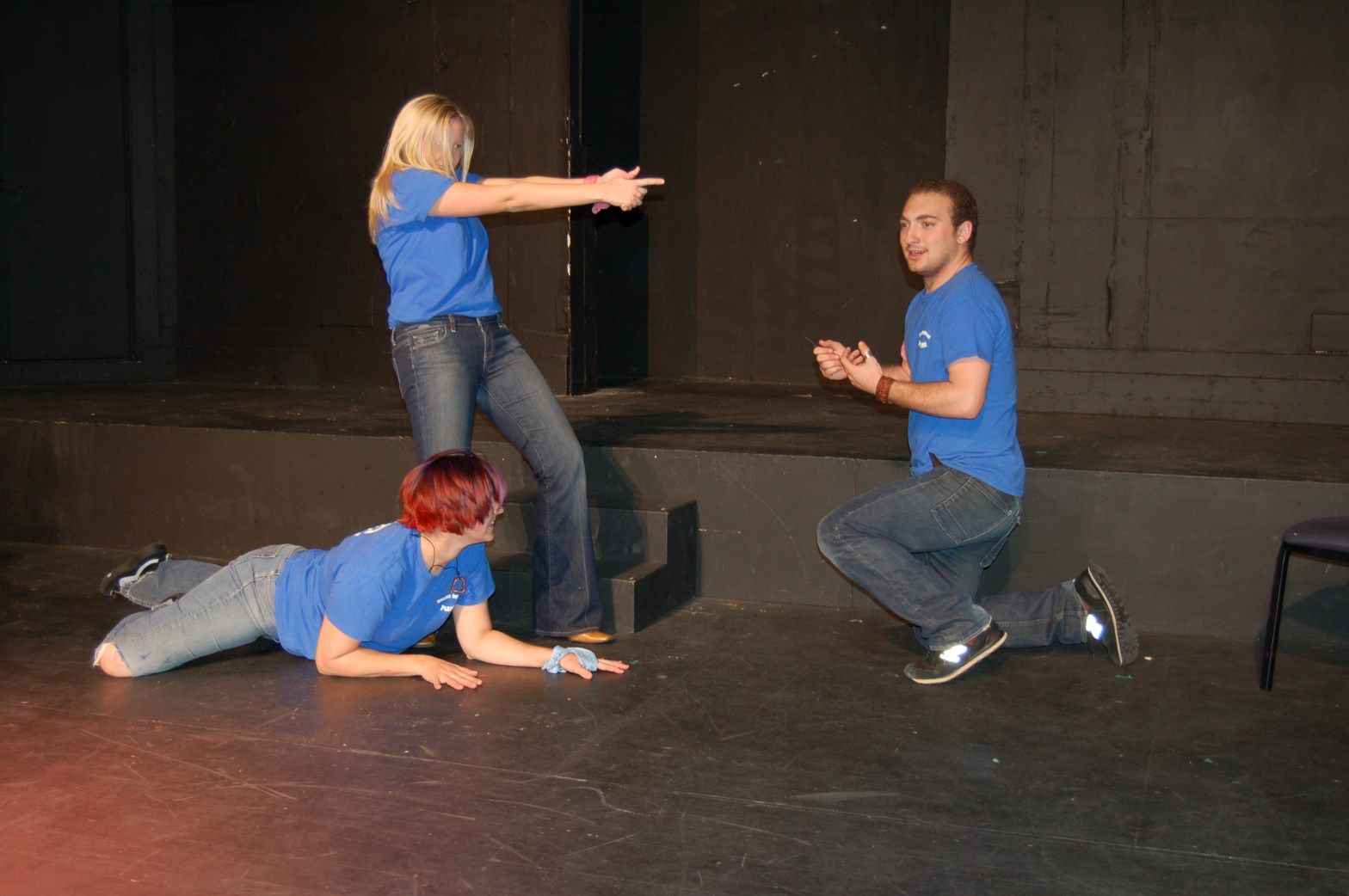
Improvisers construct a scene in which one or more players can momentarily pause the action to share their character’s inner thoughts with the audience through the use of an aside. Players may cue this device by either distinctly turning their head away from the action or stepping to the forestage and conversing with the audience directly before returning to the scene. A story develops punctuated and informed by a series of these theatrical interruptions.

Example

High school reunion attendees (Player A and B) are sipping punch in their old gymnasium as angsty music plays in the background. It is several – painful – hours into the event...

Player A: “…And that was when I broke up with my third spouse…”

Player B: (kindly, though only just) “You certainly have lived quite the life since graduating twenty years ago.”

Player A: “Nearly graduating – there was that mix-up with my credits, remember? I’ve always meant to go back and fix that…”

Player B: “It’s never too late…!”

Player A: “Tell that to my second husband!”

Player B: (taking a step downstage as A gets a refill: an aside) “Well, I’ve done my part and made the rounds. It looks like Nandeeta didn’t come anyway.”

Player B steps back into the scene and continues…

Player B: “It’s getting late, I really should be heading back to my hotel…”

Player A: (handing B another drink) “You’re not going to make me drink alone! These events are always just one drink away from depressing…”

Player B: “Okay, just this last one.”

Player A: (raising their glass) “To the good old days…”

Player B holds their glass aloft as Player A steps downstage for an aside…

Player A: (aside) “Those really were the best years of my life, even if I don’t have a diploma to show for it…”

The Focus

Enjoy using the asides to deepen and expand upon the characters’ lives, feelings, and objectives. While there are gimmicks that you can fold into the asides, this device can also work well at face value without commenting on its presence. Leaning into the gimmicks will incline the scene towards a broader comedy: prioritizing the subtextual undercurrents and potentials will move you towards more dramatic hues. Obviously, both approaches have their merits and place.

Traps and Tips

1.) Establish and maintain a clear aside conceit. It’s helpful to adopt and maintain a particular asides approach within any one performance. A more subtle turn and talk to the audience (perhaps with a hand gesture signifying privacy) can support sincere or contemporary scenarios, while a grandiose step to the proverbial footlights evokes more Shakespearean or commedia dell’arte hues. That being said, inverting these norms can also work extremely well and provide an effective juxtaposition. The key is that performers make a clear signal when they move from the scenic world through the fourth wall and back again so that their fellow players and the audience understand their intent. It’s a well-worn gag to mistake a character’s aside as dialogue (and not one I’m particularly fond of) but if this continues to happen in earnest then it’s likely that players aren’t sharply creating this important distinction and that would be a waste of the game’s inherent promise.

2.) Use deliberate staging to support others’ asides. There are simple and helpful ways to assist players during their aside moments that further add to the clarity and theatricality of the scene. It’s generally good form not to look directly at a character as they engage in these transitions and verbal commentaries (or even in their general direction) This broken eye contact reinforces the notion that these stolen moments are private. Depending on your stylistic preferences, the background scene could essentially freeze as well, although in most cases I’ve found a softer freeze – where characters quietly continue minor stage business – provides a nice sense that the scene has remained active all the while. In both cases, there is fun to be had from players snapping back into prior scenic activities or emotional energies. Player A could step out and back into their toast, for example, with an accompanying shift in tone. If you elect to have asides delivered on the forestage, it can prove effective to not use this area as a part of your primary location as well.

3.) Give asides purpose and oomph. Asides provide a great opportunity for mischievousness and general silliness but I’d caution against only using them as a way of exercising your wit and whimsy. These private moments are uniquely able to unlock dynamic elements of the scene, adding urgency and stakes to otherwise run-of-the-mill situations. Consider using this device to explore character backstory, secrets, or CADs (confessions, accusations, and discoveries). Asides offer a rare tool for jumpstarting games, heightening tensions, and establishing rich given circumstances. The power of these choices can quickly become punctured if strong asides are cheekily echoed or diffused. In this way, while Player B could immediately mention Nandeeta from A’s aside, by patiently shelving this hidden offer, its potency and import will likely build. Asides, after all, are pitched as secrets rather than everyday dialogue, and improv secrets tend to have more dynamic pay-offs when they are earnt.

4.) Pay extra attention to gives and takes. If you’re using a single character as your aside provider (as might be the case in a film noir detective piece, or a Malcolm in the Middle parody), issues of focus tend to be a little simpler as this player will likely emerge as the protagonist and subsequently serve as the default focus in the scene. When asides can come from any quarter (such as is the convention in the cutaway moments in Modern Family or a Moliere comedy), players need to display extra diligence so as not to step on each other. Generally, it’s helpful not to try to “sneak in” an aside in these cases but rather wait until your character clearly holds the attention of your scene partners and the audience. It’s also helpful for characters to telescope a little their intent to grab an aside so that others can let them take the needed room to do so. But even better, when characters start to consciously give each other windows for these moments as opposed to hurriedly trying to take them from each other, the scene benefits greatly.

5.) And why not explore a variety of genres and styles. In my introduction I note that Asides shouldn’t only be considered as a way of infusing bold styles into our work: undoubtedly I would love to see this tool deployed more often in everyday contemporary scenes and situations. But the use of asides can also serve as a gateway into a myriad of stylistic options, from dime store novels, to high-school dramedies (think Saved By the Bell), to mockumentaries and a wide array of period-specific theatre parodies. I particularly enjoy this scenic game as it can easily house all of these genres and more, so don’t feel that this tool can only support one type of scene or period. The same holds true in terms of tone.

In Performance

As a stand-alone short-form game, or as a device woven into the fabric of a long-form homage, Asides provides a dynamic and malleable tool for getting into the minds and motivations of our characters. Not to mention, it’s also a theatrical way to establish, intensify, and explode powerful secrets.

Cheers, David Charles.
www.improvdr.com
Join my Facebook group here.
Photo Credit: Tony Firriolo
© 2022 David Charles/ImprovDr

Connected Concept: Mugging

“M” is for “Mugging”

The amateurish tendency to break character and look out into the audience (often for approval).

When Is a Mug Not a Mug…?

This is just a taste of this entry/concept. Go here for more information.

Related Entries: Approval, Commenting, Corpsing, Gagging, Speaking Your Truth, Wearing Your Character Lightly Antonyms: Cheating Out Synonyms: Breaking

Cheers, David Charles.
www.improvdr.com
Join my Facebook group here.
© 2022 David Charles/ImprovDr

Connected Game: Asides (or you can just review the Game Library in general by going here.)

Game Library: “Word Association”

If you’ve taken a few improv classes, I would imagine you have already come across some version of Word Association. This perennial exercise provides helpful insights into the creative process and how we can generate new Material from an open and reactive process.

The Basics

I’m including three versions of this warmup that I use often (and one that’s a newer addition to my lexicon) as they all have a little something different to offer. The basic premise remains largely the same: one player begins by providing a random word and offering it to another who must then quickly respond with the next unfiltered word that comes to mind. This new word then becomes the impetus for the next player’s contribution. Working at a quick pace, players create a sequence of associated words conjured in this manner.

Version One – The Classic: Players form one large circle and someone volunteers as the first contributor: this improviser then provides the first offer for the exercise. The sequence moves in a set direction (generally clockwise) with players turning and giving their new word to the next player. Words travel around the circle for multiple rotations, and you can reverse the direction just to shake it up a little. If you are working with a larger group, it can be helpful to model the exercise and then break into a couple of smaller circles to decrease the lag time between offers. Waiting for too long between contributions almost invariably invites players to retreat back into their heads unfortunately.

Version Two – Word Ball: Players work in a circle once again but now the word and focus no longer move in a steady and predictable pattern. The first volunteer pitches their random word across the circle with an energized gesture to a specific player who responds by sending their own associated word to a new random person. In this manner, the sequence darts quickly between players thereby keeping everyone a little more “on their toes.” If you use the classic model often as a warmup, this iteration provides a freshness and further prevents players from planning or getting ahead of the chain as they no longer know where they will fall in the sequence. As this variation introduces the possibility that some players may become under-featured, be sure to encourage an awareness of involving everyone equally in the game. (Sound Ball, discussed here, can provide a nice prequel to this offering.)

Version Three – Word in the Middle: This variation has become a standard warm-up for some of my theme-based long-forms. In addition to exercising spontaneity, this approach also serves as a brainstorming session of sorts. The director or a member of the ensemble offers up a concept or theme word such as “power,” “support,” or “sincerity,” and this word is proverbially placed in the “center of the circle.” One player initiates the game Word Ball style (sending the focus randomly around the circle) with the chosen theme serving as the first offer. Players now associate with the word immediately offered, the predetermined theme word, or (more commonly) an organic combination of them both. Players can return to the chosen word if they are momentarily stumped, want to pull the group focus back to the central idea, or feel that the exercise has served its function. In the latter instance, we’ll usually wrap up the warmup when four or five players have all opted to say the given theme word in a row. Admittedly, this version refocuses the dynamic of the base Word Association a little, and contributions can become a little headier if players are not careful. Ideally, however, the process retains the playful abandon of the original.

Version Four – The Third Thought: This is another iteration that shifts the foundational focus a little, although you reap a powerful device for finding new angles into old material. You can move in sequence around the circle or play randomly Word Ball style (I prefer the latter). Now when a new word is passed the responding player actively skips an association, responding instead with their third thought. So, if Player A passes Player B “Chicken,” Player B hears “Chicken” (first thought) then associates “Drumstick” (second thought) and then makes one more connection before passing “Drum kit” (third thought). Again, I’d caution that this invites a more intellectual experience which can work against the intended immediacy of the original exercise, so still encourage bravery and attack. If you’re looking for ways to jumpstart new ideas from old suggestions though, this warm-up can squarely fit the bill: an audience suggestion of dentist could now inspire a scene on a deep-sea oil rig rather than in a dentist’s chair when the initiating player associates from dentist to drill to derrick before beginning the action!

Example

Players form a circle to play the first version. Starting with Player A, they pass words around the circle: “Mountain… Summit… Peak… Spy… Magnifying Glass… Insect…”

The Focus

Players should strive for immediacy, reactivity, and silencing any internal judges that might be influencing their word choices. A steady and jaunty tempo often indicates that the group is working well in these areas of focus.

Traps and Tips

1.) Keep an eye out for… invented rules. The central premise of Word Association is beautifully simple: listen to the prior player’s word and then offer up the next word that leaps to mind. I’ve found that players will often self-impose additional rules that are not part of the contract. It’s fine to say a word that’s already been said or even to repeat the word that was just said if this is your honest and immediate response. It’s equally fine to have your reaction resemble onomatopoeia in that it is part word and part guttural reaction. Or you might find yourself responding with two words, or a word in another language, or a short phrase, all of which are more than okay too. There is no expectation that contributions are breathtakingly unique; in fact, the expectation is the very opposite. Players should allow themselves to just let their instincts play. There really isn’t a “wrong” in word association in terms of your response, although there are some habits or “cheats” in terms of your technique that might inhibit the risk of spontaneity. I address some of these pitfalls below.

2.) Keep an eye out for… judgment. It’s difficult to take the risk and leap into the corners of your subconscious if you feel yourself playing in a judgmental environment. On some occasions this may be coming from the director or fellow players; more commonly, however, the judging tends to come from the players’ own inner voice. Encourage bravery and ownership of each new word association. When words are offered with a questioning or apologetic tone – “I really don’t like this word but it’s all I can think of…” – the exercise quickly loses its generative energy and joy. It’s good practice for us to pitch our contributions with passion and conviction, and this can start with a seemingly simple little game like this one. As a coach you can assist with this atmosphere by focusing feedback on the way the group is playing and riffing rather than highlighting specific content whenever possible. Establishing content parameters, which may feel necessary in some academic environments in particular, can prove a little tricky in this game as when you actively discourage risqué material you may actually end up increasing the likelihood of its appearance, although I hope it goes without saying that the game should not be used as a tool to deliberately offend or divide the ensemble.

3.) Keep an eye out for… thinking three steps ahead. The human mind can prove quite remarkable in its efforts to avoid looking unprepared! I’ve found that patterns can often emerge (especially in the first version of the game) where players are subconsciously pre-selecting their words several players before it’s their turn. If the sequence has been “Purple… Red… Blue… Bird… Bath… Green,” it’s highly possible that the “Green” player may be inadvertently continuing the “list of colors game” rather than responding openly to the word “Bath.” (It’s also possible that they might just have a green bath at home!) I use the image of a blank piece of paper and invite players to imagine that they only “see” the word immediately prior to their own so as to avoid the potential trap of listing. While there is something comfortable about just adding another item to that long list that’s already going, this approach doesn’t fully embrace the creative gifts of the game. On rarer occasions, players may also start forming or continuing sentences rather than associating random words. This is another great exercise in its own right (you can find it here) but is a bit of a cheat as well when it’s done in lieu of taking the risk of adding something more personal.

4.) Keep an eye out for… over-originality. A related trap anxious players can fall into is deciding their contribution well in advance and inserting it into the flow regardless of what has come before. As opposed to perhaps holding onto a list category as described above, this approach tends to reveal itself in disjointed offerings that are extremely peculiar or are pitched with a clear intent to amuse or surprise – “just wait until I keep saying pineapple every time it’s my turn to play…” Again, it’s probably futile and ultimately unhelpful to dwell on these moments as one player’s obvious might be another player’s bizarre, but generally it helps to emphasize the import of making simple and honest reactions without feeling the pressure to appear clever. No-one can win at Word Association – it’s about connecting to the group and allowing yourself to be fully present, engaged, and changed. Which, lastly, brings me to…

5.) Keep an eye out for… poor eye contact. This might seem like a small consideration, but it is often telling of more systemic issues when players only passively pass the words. They may avoid eye contact with their initiator and receiver, looking skyward or to the ground instead, or in the randomized versions send the focus without clear intent or direction across the circle. This may occur due to anxiousness or a fear that their words aren’t “good” enough, or just a general inability to commit to the task at hand. It’s important to really connect to your fellow players in the circle, and to accept and offer the associations with conviction and deliberateness. Overly casual passes and physicality are often accompanied by overly casual articulation, and this exercise lives and dies based on whether or not you can hear and comprehend the words that are being pitched. And it’s a good habit, after all, to make sure that your intended partner has truly received your improv gift. In the event that you didn’t quite catch the prior word (or it is in a language you don’t know) my strong preference is to associate with the energy or feel of what you did hear rather than pause the game to repeat the missed offer.

In Performance

When I’m utilizing these exercises for the first time with a group, I’ll often just ask what was happening when the game was on a roll? What did this feel and look like and what were players experiencing individually and as a group? Generally, players are adept at knowing when they were fully present (the words just kept flowing at a brisk tempo) or when they were struggling (their eyes floated to the ceiling each time they were offered a new word as they sifted through several possibilities). The stakes of this game are so wonderfully low, and yet it can quickly reveal habits and hesitancies that, left unattended, will not serve players well as they move into more complex and nuanced scenes and stories. These exercises also provide a palpable and important reminder that material can emerge with surprising ease when we just listen and react in the moment.

Cheers, David Charles.
www.improvdr.com
Join my Facebook group here.
Photo Credit: Charlotte Brown
© 2022 David Charles/ImprovDr

Connected Concept: Material

“M” is for “Material”

The content that inspires creativity.

Sources of Material Inspiration

This is just a taste of this entry/concept. Go here for more information.

Related Entries: Obvious, Speaking Your Truth, You Antonyms: Cleverness, Over-Originality Synonyms: Content

Cheers, David Charles.
www.improvdr.com
Join my Facebook group here.
© 2022 David Charles/ImprovDr

Connected Game: Word Association

Game Library: “Mantras”

Utilizing Mantras onstage provides a powerful tool for infusing potentially combative scenes or relationships with greater complexity and Love. This technique is related to the concept of subtext, although one static mantra can effectively inform a whole scene while (effective) subtext tends to change from line to line.

The Basics

I like to explore this dynamic in paired scenes as this allows players to really sink their teeth into a complex relationship. I’ll provide both players with a basic but charged premise to inspire their work. After the launching point is clear, each player is then assigned a personal mantra privately (it’s fine for those observing to know but have scene partners step out of the space or cover their ears and sing!) Players now explore the given circumstances while silently repeating their given mantras.

Example

Players A and B are cast as an adult child (A) and their incarcerated parent (B). B has just recently breached the conditions of their parole; A has bounced around from relative to relative due to B’s legal misfortunes. Player A has been given the mantra “I love you;” Player B has been given the mantra “I love you.” The scene begins with Player A arriving.

Player A: (Sitting and thinking their mantra) “I’m not sure why I came…”

Player B: (Thinking their mantra) “I didn’t think you would. Thank you.”

Player A: “We didn’t really get to say goodbye… again.”

Player B: “I’m really sorry about that. This isn’t how I wanted things to work out.”

Player A: “You had a choice…”

Player B: “It doesn’t feel like I ever really have a choice…”

The Focus

Mantras shouldn’t become gimmicks but rather serve an anchors to a grounded reality and truth. This exercise is particularly well-suited to dramatic or emotionally complex material. It’s difficult to know where improvisational material will go, so it’s wise to give players the opportunity to pass on a scenario without explanation if it doesn’t feel like a good fit. I once assigned what I thought was a completely unlikely dramatic scenario just to find out after a really tense scene that it was extremely close to home for a player: I’ve explicitly included an apology-free “new scenario please” policy ever since. Similarly, it’s helpful to note that observers are welcome to quietly leave the space if they need a moment if this isn’t already a standard workshop practice.

Traps and Tips

1.) Assign simple mantras. A scenic mantra tends to lose its effectiveness if it’s needlessly unwieldy or verbose as players will struggle to actively keep it front of mind. I’ve come to use three variants almost exclusively when I coach this game: “I love you,” “I need you,” and “I hate you.” (I also lean heavily into the first option as well as this tends to create the most fulfilling fireworks.) There is something innately helpful about assigning the least convenient mantra given the scenic relationship. In the above example, it would be understandable for the child to feel anger or resentment (and these colors will still likely appear) so “I love you” makes them look for what pulls them towards their wayward parent rather than encouraging them to push further away.

2.) Feel don’t say the mantras. Depending on the predominant tone of your ensemble this exercise may feel like a significant departure from your typical energy. It’s important that the mantras aren’t reduced to platitudes or casually spoken aloud. Rather, avoid saying these words all together as uttering them will invariably rob them of their power. (It’s been a rare occasion when I’ve heard a player say their mantra and it hasn’t felt anticlimactic or cliched.) Focus on the deeper feelings that these mantras unearth and work diligently to nurture the resulting tensions. What does it mean to love someone during a moment of great disappointment? What does this love look like? Why did you decide to visit (or receive this visitor) in the first place?

3.) Savor (don’t resolve) oppositional energies. Relish the delightful messiness that these scenes unlock. An inclination to solve the central tension or dynamic will often puncture the most riveting elements of the relationship. While it’s possible that our parent and child might find some modicum of peace in this meeting, there is also probably a great deal of pain, blame, and disappointment that will remain. Sit in these oppositional forces and allow the characters to experience the resulting emotional ebbs and flows. Mantras often prove especially effective when they tap into inner conflicts or turmoil. It is human nature to want to find a resolution; but, it’s innately more dramatic to add fuel to these fires rather than water. And perhaps one small but honest step forward is the best that characters can hope for in particularly complicated moments – pushing for more than this will often read as insincere or magical wish fulfillment.

4.) Embrace the silent exchanges. Players who privilege their verbal skills should be particularly wary not to waffle or feel the need to articulate every thought or feeling exclusively through dialogue. Trust that fully embraced mantras will also add depth and interest to the silences, simple gestures, and stage business. Over-talking increases the risk of explaining complex emotions rather than activating and experiencing them. The former approach can move the scene towards a commenting energy, while the latter will typically increase vulnerability and emotional commitment. Sometimes, the most effective communication of the mantras resides in the subtle look or otherwise inconsequential movement.

In Performance

At the conclusion of each scene I’ll usually ask the players what mantra they were receiving from their partner. Developing this emotional awareness of others’ climates is an equally useful improv (and life) skill. As the exercise moves through various vignettes, players will often feel more confident in their assessments and ideally will start to also incorporate this knowledge into their characters’ tactics. In this way, Player B might exploit (not necessarily maliciously) the love that they feel coming from their child, or Player A might feel and appreciate B’s love even if it hasn’t been shown in a way that they need or want. There is a beauty in building these messages in the unspoken subtext and trusting that our partners and audience don’t need every choice spelled out in order for them to prove poignant and clear.

I really look forward to playing with this dynamic when it’s slated for my classes. If it’s a new exercise for you I wish you similar joy and excitement!

Cheers, David Charles.
www.improvdr.com
Join my Facebook group here.
Photo Credit: Tony Firriolo
© 2022 David Charles/ImprovDr

Connected Concept: Love

“L” is for “Love”

Enriching the vibrancy of your play by prioritizing and deepening what brings the characters together.

Spreading the Love Around

This is just a taste of this entry/concept. Go here for more information.

Related Entries: Consent, Emotional Truth, Freshness, Kindness Antonyms: Conflict Synonyms: Empathy, Joy, Passion

Cheers, David Charles.
www.improvdr.com
Join my Facebook group here.
© 2022 David Charles/ImprovDr

Connected Game: Mantras

Game Library: “One-Downing”

I personally prefer the dynamic of One-Downing from its kin, One-Upping, as the former feels less braggadocious and overtly competitive. (This might be due to my New Zealand upbringing where there is generally little patience for “tall poppies” or blatant self-aggrandizement.) Played gently and generously – as it should be – either version of the game affords great opportunities to make your partners feel and look good. It’s also a fun crowd-pleaser as it trades in interpersonal energies that are all-too-familiar.

The Basics

Two or more players improvise a scene in which they strive to be “less than” their partner in terms of status, value, or esteem. Players can experience this dynamic in unobserved explorations, or in scenes in front of the group (it’s often helpful to do the former then the latter if time permits.) Team scenes can also incorporate this central dynamic with all the players joining the fray or one or two augmenting the scene as supporting characters who tend to the story and given circumstances rather than explicitly engaging in the game conceit.

Example

Three nervous students (Players A, B, and C) sit in the principal’s waiting room, having been summoned over the high school loud speaker system. Player D assumes the role of the principal’s secretary and sits to one side of the room at their desk, busying themselves with typing and paperwork. There is a moment of tension while the students sit and contemplate their fates. Player A eventually stands and starts to pace…

Player A: “I can’t afford to get into trouble again…”

Player B: “I hear you. I’m still grounded from my last ‘incident.'”

Player A: “I wish I had parents like yours! A grounding is nothing.”

Player B: “Well, it wasn’t just a grounding. I’ve not had the use of my cellphone for a month…”

Player A: “I’m still trying to persuade my mother to let me have one at all.”

Player B: “Your mother is a pushover. You just have to give her time.”

Player A: “Which is hard to measure without a cell phone, just saying.” (To Player C) “Do you have the time, Mikey?”

Player C: “Sorry, my Dad has banned me from all technology.”

Player B: “That must make doing your homework rough!”

Player C: “I get the worst writing cramps in my hand… Look, I’m so sorry. This is all my fault…”

The Focus

Players should play with an eye to gradually becoming more and more hopeless (or whatever “capital” has been pitched). The scene has an unavoidable aura of competitiveness, but the action feels more real and playful when the focus is on playing the game as opposed to winning the game. Part of the charm of the conceit resides in acknowledging and enjoying the finesses of your scene partners.

Traps and Tips

1.) Explore one game or direction at a time. One-downing can include a wide array of different dynamics or value systems. Characters could be working to be seen as the most pitiful, the most under-appreciated, the most incompetent… It’s well within the realm of possibility that several dynamics might appear in the one scene but this can often make the game feel cluttered or unfocussed, especially if multiple choices inelegantly compete rather than emerge and develop with collaborative care and grace. Endeavor to pull on the same scenic thread as your teammates at any given time. The nervous students are initially riffing on the severity of their prior punishments – enjoy where this energy goes before shifting gears to a radically new facet. One-downing scenes tend to have “waves” with a series of (perhaps loosely) related issues or focal points. The work quickly becomes more laborious if characters dart randomly between multiple ideas that never have a chance to grow or mature. This is not to say a thread can’t be benched after a successful run and then reincorporated or referenced later, but strive to follow one flight of fancy at a time.

2.) Leave room for your partners’ choices and successes. If you find yourself monologuing in a One-Downing scene, you may be accidentally inhibiting your scene partners from utilizing your story elements. I find it helpful to consciously contain speech acts so that there’s always enough room for the next player’s addition. Providing fully-formed backstory or justifications can have a tendency to “end” games rather than initiate or prolong them, and may indicate that the speaker is working a little too hard to “win.” Making smaller moves that have an almost incomplete quality, on the other hand, invites teammates into the fray. If your partner says “I’m sad,” offering “I’m having a really bad day too” is more likely to keep the game going than “I’ve been put on so many medications that I haven’t even experienced a real emotion in over a decade now…” Don’t leap to the end. It can also prove helpful to rotate which character starts each new rally so that others have a chance to undermine the original thought (although, there can be a pleasure in repeating the speaking order with similar one-downing results each time as well if this pattern has emerged organically).

3.) Consider qualitative as opposed to quantitative moves. The inverse tendency serves as a minor personal pet peeve, but I think it’s worth mentioning because avoiding this trap encourages players to unlock less expected responses. Number games quickly feel inelegant. If Player A observes that they lost their cat this morning before coming to school, and Player B remarks that they lost two cats this morning (and then Player C lost three…) you’re certainly engaging in a form of one-downing, but there isn’t much nuance or subtlety here. When players fall into numeric or quantitative battles, I tend to lose interest rather quickly as an audience member. If you think qualitatively, thematically, or magnify an unexpected part of the offer, the results are more creative and revealing. In this way A’s lost cat might result in Player B having always wanted a cat but never being allowed one, or having an imaginary cat (perhaps that they lost!) or losing a sibling that morning when they left the front door open…

4.) Tend to your physical world. As a game that leans into verbal choices and exchanges, it’s easy for One-Downing to become a sit and chat affair if the participants aren’t extra careful. Status and relationships can certainly benefit from physical choices as well: do the three students adjust their seating order or positions as their various woes are ranked, or gradually slump off their chairs and onto the floor as they become increasingly overwhelmed? Crafting a rich environment with staging possibilities and props certainly helps as well (as is the case with all our improv scenes). Tending to the location also opens up new performance choices as not every line or move needs to immediately add to the current one-downing dynamic. If you’re playing the game with a larger team, supporting players can add a lot of value by fleshing out the location with activities and staging. For example, it’s possible Player D may remain largely silent as the secretary in the office, throwing knowing looks at the students now and again. Or they could punctuate the action with foreboding high-focus crosses to the principal’s door to see if their boss is now ready to receive the children for judgment.

5.) Maintain the veneer. Lastly, my preference is not to explode or point at the game unless this disruption is cueing the end of the scene. There is something wonderfully effective about characters “casually” playing the game while upholding a social facsde. Appearing supportive of fellow characters while also gently working to subtly gain footing provides a dynamic tension that is, unfortunately, quite recognizable as all-too-human. Friends often play these kinds of games in real life: who got the least amount of sleep last night; who has the tallest mountain of looming homework (or grading!) or who experienced the worst dating horror story? It’s also important to remember that by design you can one-down yourself by one-upping or elevating your partner, especially if you don’t have a next step readily in your pocket: “It’s so great that your parents are still taking an interest in you…” This also has the delightful effect of appearing generous when you are, in fact, still serving your greater subversive goal of becoming the bottom of the pecking order.

In Performance

All of these techniques apply equally to One-Upping scenes, and I generally teach these both back-to-back. Students will nearly always have an innate preference, but there’s great value in exploring both sides of the status coin. (High status players tend to prefer One-Upping, for example.) In addition to a great game in its own right, this tool also provides a joyful character quality that can enrich pretty much any improv (or scripted) scene.

For a similar dynamic used to a very different end, check out my earlier post describing the game Nicer Than You here.

Cheers, David Charles.
www.improvdr.com
Join my Facebook group here.
© 2022 David Charles/ImprovDr

Connected Concept: Looking Good

“L” is for “Looking Good”

Taking into earnest consideration the experience of your fellow players on the improv stage and making sure they are having a joyful experience. Making your teammates look and feel good.

Implementing the Golden Rule

This is just a taste of this entry/concept. Go here for more information.

Related Entries: Commandment #3, Ensemble, Hosting, Postmortem, You Antonyms: Shining, Winning Synonyms: Balance, Inclusiveness

Cheers, David Charles.
www.improvdr.com
Join my Facebook group here.
© 2022 David Charles/ImprovDr

Connected Game: One-Downing

Game Library: “Word at a Time Story”

A mainstay narrative and team-building exercise, Word at a Time Story reinforces many important improv lessons about ceding control, accepting others’ offers, and trusting small obvious steps. In addition to the traditional version which serves as a great rehearsal warmup in its own right, I’ve included a variant that I use to reinforce the importance of Looking Backwards and the intentional use of reincorporation when it comes to story construction.

The Basics

While I might initially model this exercise with the whole class or ensemble in one circle, I’ve found that it generally works best in smaller groups of six to eight players so that there isn’t too long a wait between each player’s contribution. One player in each circle volunteers to speak first and the narrative generally moves around the group quickly in a clockwise direction. Each player provides one word each in this established order to construct complete sentences that tell a story. Stories may be inspired from a title or prompt (less experienced groups tend to find this helpful) or, alternatively, just start from glorious “nothing.” Players can indicate end punctuation with a pointing gesture and suitable “Boop” sound effect – it’s advisable to let the “next” person in the sequence make this call in case they intend to keep a sentence growing. Such punctuations also do not count as a player’s “word.” A series of sentences are made in this fashion until the story reaches its conclusion.

Phase One – Traditional: Players initially create stories with no language restrictions (other than exercising good taste!) Emphasis should be placed on achieving a steady and jaunty tempo and allowing the narrative to evolve according to the whims of the group, as opposed to the agenda of any individual.

Phase Two – No Repeats: In this second version players are now instructed that they are no longer allowed to repeat or reference any previously established elements or characters. This restriction includes alluding to former ingredients in a generic sense, so if the first sentence is “Susan… walked… down… the… street… on… a… sunny… day…,” future sentences can’t use “she” or “they” to allude to Susan, or “it” to bring back the street (or reuse the walking, sun, or fact that the story takes place during the daytime).

Phase Three – Traditional: Upon experiencing the second variant it can prove liberating to at least briefly return to the original iteration.

The Focus

Both versions of the game provide opportunities to reflect on how stories are successfully engineered. The first (and third) iterations are challenging but can allow for simple and elegant narratives when teams embrace the organic flow. The second iteration shows via negativa the importance of looking backwards and reusing previously established offers. When this tactic is restricted, the narrative quickly starts to resemble a poetic stream of consciousness or collaged image (perhaps beautiful in its own way) rather than a cohesive story.

Traps and Tips

1.) Contribute rather than direct. If you’re not diligent, there can be a tendency to stop the emerging narrative in order to discuss challenges, consider fumbles, or brainstorm possibilities for others’ contributions. While such pauses are nearly always well-intended, they will invariably grind the story to a halt. Weave missteps into the narrative and avoid the temptation to direct the story or the verbal offers of your teammates. There will nearly always be moments of irregular grammar or syntax: let them go and do the best that you can to right the ship while it’s in motion. Once the story has made it to the finish line, it’s appropriate to quickly discuss any technical issues, but critiquing the process as it’s unfolding or creating an energy of judgment (as opposed to playful acceptance) is unlikely to do anyone any good. I’d only amend this approach slightly when playing the second phase if players continue to reference previously used items as this undermines the experiment.

2.) Consider narrative style and voice. Third person narratives tend to work best in this format (“Eroni opened up the box…” instead of “I opened up the box…”) as this gives a clearer focus and prevents the protagonist’s identifiers changing from speaker to speaker. It can prove wise to establish some broad content parameters as well so that stories don’t become needlessly “adult” – most improvisers find it easier to add racier content if it’s suited to the venue than they do to make content more family-appropriate when it’s required if they have rarely exercised these “PG” creative muscles. To this end, I’ll often offer that the stories are being told to a young relative or similar just to encourage an inclusive tone. Players should also strive to set and maintain a brisk tempo as this helps the flow of the story while simultaneously discourages individuals from escaping into their heads to find the “best” or most “original” word. Technically, it can also prove helpful for players to take their breath one or two words before it’s their turn so that every offer isn’t preceded by a delaying pause.

3.) Surrender your individual. Whether it emerges as a well-intended director voice guiding others to get it “right,” as a “helpful” but ultimately stubborn contributor trying to pull the story in a preferred direction, or as an unhappy critic rolling their eyes when the story moves into unexpected terrain, the more you try to control a Word at a Time Story, the more likely you are to ultimately undermine it. I write about this inability to cede control when I previously briefly discussed this exercise here. Not every contribution will always feel the most blazingly radical, but the story needs players who are willing to provide the pedestrian but structurally critical words (“the,” “an,” “there…”) The group also needs players to step up when it comes time to name that object, advance to the next plot point, or offer up a specific discovery. The randomness of the word-at-a-time dynamic means that you will quickly move back and forth between these extremes as the needs of the story dictate. Serve the story; serve the team.

In Performance

The second version of this exercise is undeniably frustrating but for a helpful purpose (so if you’re the exercise leader, don’t rush through this one). Removing the ability to use prior story threads and elements clearly reinforces just how crucial it is for storytelling to recycle what has already been established. When we become too focused on what might happen next, we can lose track of all the possibilities at our fingertips that have already been created and are just waiting to find a new purpose or moment to shine.

Cheers, David Charles.
www.improvdr.com
Join my Facebook group here.
Photo Credit: Tony Firriolo
© 2022 David Charles/ImprovDr

Connected Concept: Looking Backwards

“L” is for “Looking Backwards”

Looking Backwards extols an improv ethos of finding your next move from what has gone before.

Reverse Psychology…

This is just a taste of this entry/concept. Go here for more information.

Related Entries: Advancing, Callback, Reincorporation, Shelving Antonyms: Over-Originality Synonyms: Content, Material, Offer

Cheers, David Charles.
www.improvdr.com
Join my Facebook group here.
© 2022 David Charles/ImprovDr

Connected Game: Word at a Time Story