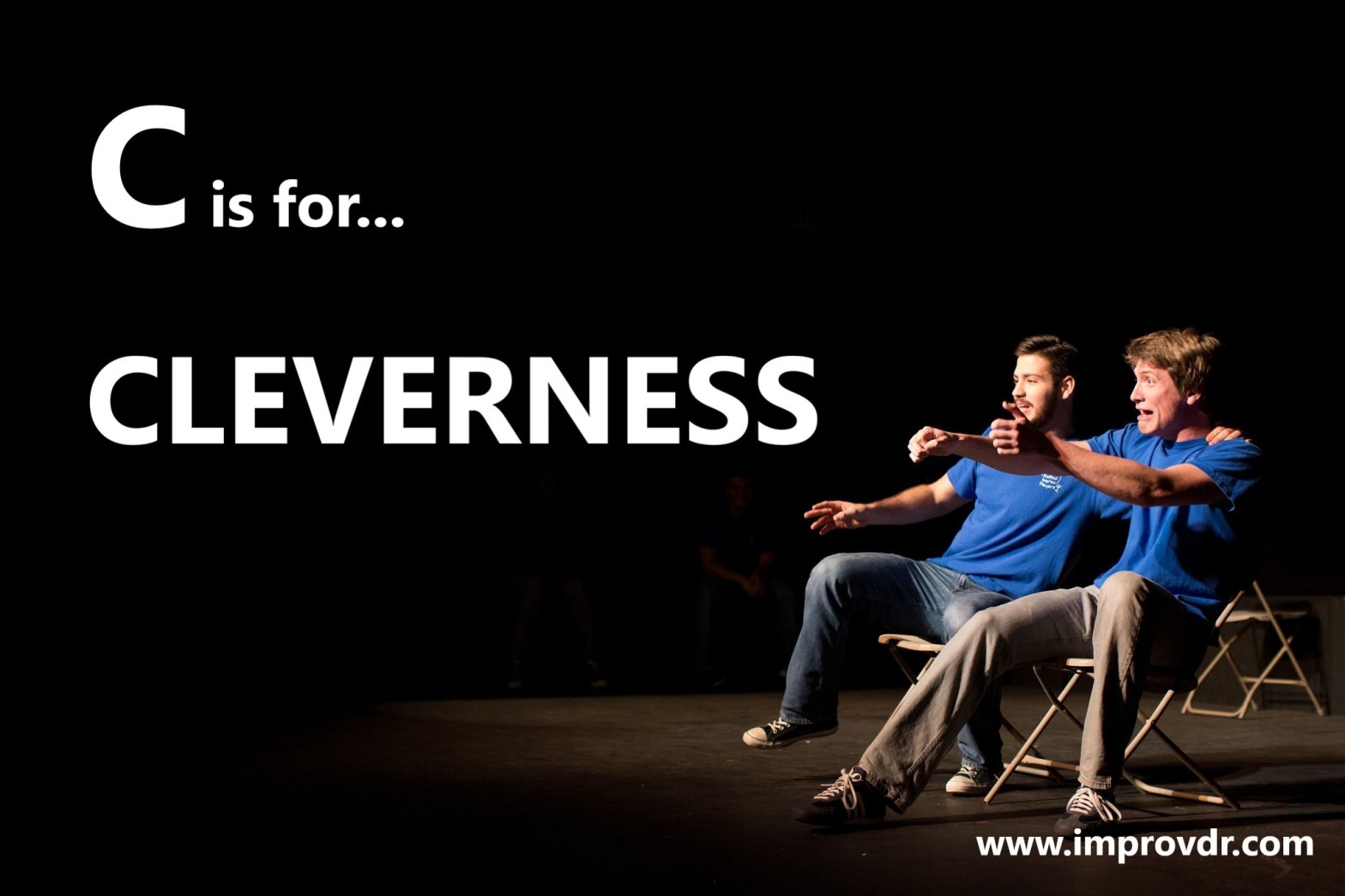
“C” is for “Character”

Part of CROW, Character refers to the details players bring to their improvised personae.

Digging Deeper into Character…

This is just a taste of this entry/concept. Go here for more information.

Related Entries: Archetypes, Commandment #9, CROW, Experts, Objective, Physicality, Relationship, Where Antonyms: Wearing Your Character Lightly Synonyms: Who

Cheers, David Charles.
www.improvdr.com
Join my Facebook group here.
© 2021 David Charles/ImprovDr

Connected Game: Character Walk

Game Library: “Shared Story”

There are few short-form games that are simpler or more elegant than Shared Story. It’s a story-telling game stripped of most gimmicks and excess, so there is very little room to hide in this structure; therefore, players must work closely together to literally and metaphorically stay on the same page. I’ve diagnostically paired the game with the concept of Chapter Two-ing (leaping over small steps into the future) as this tendency will quickly undermine the performance’s narrative flow and pay-off.

The Basics

A team of players (four or five works well) forms a line in front of the audience, and a title for an original story is obtained. Each player holds a mimed copy of the proffered storybook. One at a time, generally starting with the player most stage right and moving in order across the stage, players step forward and read (that is, improvise) the next small passage of the story. When their contribution is complete, they step back into the line, and the next player in sequence picks up exactly where their predecessor left off. The story continues moving swiftly from reader to reader until a natural conclusion is reached.

Example

Players receive “The Persistent Parrot” as their story prompt and form a line.

Player A: (stepping forward and reading from their copy of the “book”) “It was a humid afternoon in the tropical rain forest. A thunderous storm had just swept through the dense canopy, drenching the forest with its powerful might.”

Player B: (stepping forward and reading from their book) “The once-frightened creatures slowly made their way out of hiding, assessing the damage of the unwelcome but all-too-frequent visitor. Soon the air was filled with the sound of wildlife once more.”

Player C: (stepping forward and reading) “Atop one of the tallest trees that stood proudly in the center of the forest, a particularly colorful parrot perched, looking studiously at the scene below.”

Player D: (stepping forward and reading) “He called out with a piercing cry, his eyes darting anxiously from tree branch to tree branch, all the while looking…

Player A: (stepping forward) “…for the young chick that had once shared his nest. He cried out into the wind again, but with no avail…”

The Focus

In a nutshell, the focus of the game is strong and collaborative storytelling. Players should seek to craft one unified story with small and logical steps, avoiding unnecessary leaps by generously utilizing the specific choices and ideas offered up by their teammates. Consider the emerging tone and style of the piece as well – the format can function as a simple whimsical children’s story, a more robustly poetic Gothic tragedy, and anything in between; but it requires players to carefully listen to each other and reflect back these tonalities.

Traps and Tips

1.) Confidence is key. Make sure you truly sell your contribution each time you step forward to add to the story. One of the fun aspects of the central conceit that everyone is reading from the same story book is that players are not really “responsible” for any weirdness that ensues: those choices were just in the book after all! A simple story told with energy, excitement, and conviction will nearly always land well, while a more complex piece can struggle if the players’ anxiousness is clearly evident. Exuding confidence is good advice for all improv, but it is particularly the case for such a gimmick-free game as this.

2.) Prioritize the story. Don’t avoid the fact that the story is the priority for this game. Players can tend to insert unearned gags or schtick in an effort to evade the challenge at hand, so be wary of such choices eclipsing the narrative arc. While it’s certainly appropriate for a player to end their offer in an ellipsis, for example (as Player D does above), such choices should set up your scene partners for success and joy. When these moments become wimps – deferring the responsibility of making a detailed offer – they can quickly diminish the momentum of the story, especially if this then becomes a recurring gag. Pass offs such as “And then something completely unexpected happened…” or “And that’s when she solved everything with one simple sentence…” may work well when utilized sparingly by teams with high levels of trust and bravery but are more likely to scuttle the story if the team is struggling or just starting to find its stride.

3.) Contributions come in all shapes and sizes. There is ample room within this game to explore and honor a wide range of narrative gifts and inclinations. Not all excerpts need to be the same length; in fact, it can provide a great energy shift to dynamically move from several sentences to a few carefully chosen words and back again. The ideal length of any given contribution is whatever is needed to make the current choice rich and helpful. Players can utilize their moment to largely extend on and enrich a detail or moment offered by a fellow teammate or opt to advance the story with a dynamic next step. Or, obviously, they may do a little of both. Encourage and nurture this variety and individuality as each story unfolds.

4.) Commit to the physicality. The physical components of Shared Story are minimal but important and will add a great deal to the polish and flow of the story. Make sure players step forward and backward with energy and conviction if they’re able. Sluggish movement during these moments will quickly allow the momentum and interest to dissipate, resulting in a narrative that never really seems to build steam. I also like the device of everyone committing to holding their own copies of the mimed book as this also gives a nice physical presence. Occasionally I’ve seen players pass along one copy up and down the line, but this inevitably results in lulls and stalls as players fumble with the logistics of a mimed prop, especially when Player D needs to get it back to Player A at the end of each round. A fun finesse (that is a little gimmicky I’ll confess) is that players can all turn the story book pages at appropriate moments to punctuate important actions, although be careful of overusing this motion or it quickly becomes distracting.

5.) Explore story structure. This game is a great receptacle for polishing other storytelling and construction skills. I’ll often pair it with the exercise Four Sentence Story (here) noting that we may now spend several sentences honoring a singular story component: in the above example, the first three narratives could all be considered part of the “introduction” function, with a “problem” not clearly emerging until the fourth and fifth additions. Shared Stories tend to succeed when they err on the shorter side, perhaps two to four minutes in length, so this also necessitates that they do not become needlessly meandering nor expansive. I’ve found that stories that don’t have a very clear here and now or struggle to focus on the path of one particular protagonist can quickly become unwieldy and ultimately unsatisfying. Small, connected steps are critical as there is rarely time to successfully build beyond the current “chapter”; leaps in the narrative to a Chapter Two rarely reap rewards as, by definition, they tend to erase the utility of earlier choices and demand a new array of story elements and specifics.

In Performance

I will confess that I don’t program this game in my short-form shows as much as I’d like to as players and audience members alike don’t always fully appreciate the substantial skill required to make such an unadorned narrative structure shine. Compared to “flashier” games, it can feel a little naked. But this is a much-loved standard in my classes and workshops as it is a great way to sharpen narrative skills and quickly diagnose tendencies that might be tripping up players as they strive to build effective stories together.

Cheers, David Charles.
www.improvdr.com
Join my Facebook group here.
Photo Credit: Scott Cook
© 2021 David Charles/ImprovDr

Connected Concept: Chapter Two

“C” is for “Chapter Two”

Leaping forward in the story in a lurching or inelegant fashion that tends to erase the current scenic elements already in play.

How to Keep Your Story on the Same Page

This is just a taste of this entry/concept. Go here for more information.

Related Entries: Advancing, Erasure, Over-Originality Antonyms: Small Steps

Cheers, David Charles.
www.improvdr.com
Join my Facebook group here.
© 2021 David Charles/ImprovDr

Connected Game: Shared Story

Game Library: “Status Swap”

Most of the status games in my stock derive one way or another from Keith Johnstone’s critical work and writings on the topic, and Status Swap is certainly no exception. As we seek Change and dynamism in our scene work, this type of exercise can provide a helpful and motivating template. You can also easily adapt the central conceit to explore other forms of “swaps” such as emotions, animal essences, or physicalities.

The Basics

Generally played in pairs (perhaps with some additional players on standby to support as needed), one player is assigned as the “high status” character in the scene (holding the most “power” or sway), while the other assumes the role of the “low status” character (holding little such social capital). By the conclusion of the scene, players must have facilitated an exchange in the status configuration so that now the high status character holds the lower status and vice versa.

Example

Player A has assumed the role of a high-powered CEO and “high status” while Player B is the new company intern and “low status.” It is apparently company policy for the CEO to meet all new hires, and so Player A has been joined in their impressive office by a seemingly anxious Player B…

Player A: (pointing out the window) “…and that new wing should be completed in just a few more weeks.”

Player B: “You’ve really created an astounding company here.”

Player A: “But just twenty years ago, I was in a similar position as you right now…”

Player B: “Oh, I don’t think I could ever accomplish anything quite like this.”

Player A: “Software development is an ever-evolving field. You never know where the next million – or billion – dollar idea might come from.”

Player B: “You’ve certainly made the most out of your breakthrough all those years ago. You don’t worry that all of this might be made obsolete by the next great idea…?”

Player A: (a little thrown off) “Well, that’s why I hire the best and brightest, such as you!”

Player B: “I was just a little surprised on the tour to see that you’re still heavily investing in traditional manufacturing procedures. Everything we were exploring in my doctoral program points to quantum computing as the way forward…”

Player A: “Quantum computing…?”

The Focus

There are many ways that the status or power exchange can occur (as discussed below), but make sure this challenge remains at the center of the scene. You can also be strategic when assigning initial roles and statuses. Players who typically resist change or ceding the high ground may find giving up their power in the scene particularly disconcerting, and so might benefit from at least initially experiencing the game from this orientation. While players who prefer assuming low status might find some discomfort in the high status role, I find that they are generally more willing to allow their status to change as the scene demands.

Traps and Tips

1.) Don’t conflate rank and status. I consider this idea more fully my expanded Status entry (now housed in The Improv Dictionary) but be wary of assuming that social rank and status are necessarily one and the same. As this exercise explores, status is in reality quite fluid, and while the CEO is likely to normally hold the higher status position, particularly when they are ensconced in their high rise office, their occupational rank may stand in contrast with their relational capital. This scenic dynamic can benefit from beginning in the “traditional” status configuration (the boss is high, the intern is low) as this allows a more dynamic and potentially unexpected adjustment, but there is certainly also great value in starting with less expected configurations and watching the CEO find their way back to the top of the pecking order.

2.) Explore different initial status gaps. A CEO with an intern innately offers a pretty substantial starting status divide, but this distance is another fruitful area of exploration. You could begin with a relationship that would suggest a stark status contrast and then adjust this in the backstory or given circumstances right from the top of the scene. Perhaps the intern is the CEO’s child or parent, or both characters have long been best friends, or are currently head-over-heels in love spouses. On the other end of the spectrum, it’s also exciting to explore initial starting points that instinctively suggest a closer status distinction, such as a CEO and CFO, or an intern and their peer who has been with the company for just a few months. Such configurations invite gentler scenic work and subtler “swaps” that open up a new level of playful discovery.

3.) Pursue different swapping rhythms and dynamics. As players explore various scenarios and journeys, also be on the lookout for different ways in which the status can effectively switch. I’d caution against discussing these possibilities prior to getting on your feet and playing the game in favor of recognizing this variety and celebrating it as it organically emerges. There is a marked difference, for example, if the status swap occurs swiftly and suddenly in essentially one large move or choice, as opposed to a more measured and patient approach where the exchange is gradual and incremental. Similarly, the scene will feel rather different if there is a status inversion in the closing moments as a “rug pull” as opposed to as the result of a bold choice in the opening dialogue. There is no one right strategy to pursue but rather a multitude of approaches that can unlock powerfully diverse potentials.

4.) Embrace and justify the switch. Just in case this doesn’t go without saying, make sure you are consciously and actively embracing the status switch as it emerges (even if the character is seemingly resisting it). The first step in this journey might be unintended or small, so it’s important that players are mining the scene with an attitude that the process of changing status could be triggered by almost anything. In fact, I’d offer that the more riveting scenes tend to be those where the players don’t aggressively offer tilts but rather recognize their potential from the organic flow of the action. It will also prove less satisfying if the ultimate status inversion is not appropriately justified: sure, someone could just flip their status at the end of the scene, but as is the case with all improv, it’s more about the process than just leaping to an intended outcome. (To this end, it’s also innately less powerful if players enter the scene with a pre-determined mechanism for switching their status that they work towards regardless of what other fruitful potentials emerge.)

In Performance

I’ve presented this dynamic as a training exercise, but it is certainly stage worthy either as a declared frame or as a more subtly discovered game. It tends to work best if you focus on one central relationship, but other players can certainly support the action with strategic and generous side support. In long-form modalities, status inversions (and possibly recoveries) can also dynamically and successfully span and shape the dominant dramatic arc given care and finesse. One could easily argue that this type of journey is often central to the scripted realm as well – just think of King Lear or Oedipus Rex or Medea or Tartuffe or Stop Kiss

Cheers, David Charles.
www.improvdr.com
Join my Facebook group here.
Photo Credit: Tony Firriolo
© 2021 David Charles/ImprovDr

Connected Concept: Change

“C” is for “Change”

The powerful device of seeking variety and growth in your characters and their journeys.

Changing Up Your Characters

This is just a taste of this entry/concept. Go here for more information.

Related Entries: Commandment #5 Antonyms: Bulletproof, Commenting Synonyms: Breaking Routines, Tilt

Cheers, David Charles.
www.improvdr.com
Join my Facebook group here.
© 2021 David Charles/ImprovDr

Connected Game: Status Swap

Game Library: “Stop! Think!”

If your improv is starting to feel one dimensional you may be suffering from a lack of detailed subtext. As text and subtext conflate and essentially become the same thing, our choices (no matter how exciting or promising they might appear) can start to feel like Cartooning — merely stating our ideas rather than executing them with nuance and emotion. Stop! Think! is a dynamic exercise that can help strengthen our subtext muscles and quickly reveal when our scene work and characters are losing that delightful complexity that tends to mark the human condition.

The Basics

Players obtain a central premise and may work in smaller groups, all performing simultaneously, or one group at-a-time in front of the workshop or class. The scene begins “normally” with players establishing the basics of the scene and communicating through everyday dialogue. At an opportune moment, the instructor or caller announces “Stop! Think!” and all on-stage characters must now start monologuing their inner subtext. These streams of consciousness continue until the caller announces “Continue” and the scene returns to traditional action and dialogue exchanges. The scene develops with multiple subtextual interruptions until an organic ending is reached.

Example

Players are inspired by the choice of “Stepsiblings.” The scene begins with both players lying on their beds in their now-shared bedroom.

Player A: (breaking a silence) “I really like your posters. You have great taste in music.”

Player B: (a little cool, rolling over to read their book) “Thanks.”

Player A: (after a moment) “I was thinking of trying out for the basketball team. Do you like it?”

Player B: “Yeah, I’ve made some good friends there.”

Player A: “Maybe you could introduce me to them…?”

An awkward moment of silence.

Player A: “…if that’s not asking too much.”

Player B: “No, I can do that…”

Caller: “Stop! Think!”

Player A: “I think I’m coming on too strong. I just don’t really know anyone in town yet, and if my own stepbrother doesn’t like me, this is going to be rough. Maybe I should just let this go and let him read? It’s kind of nice having someone to talk to, though. I’ve always been an only child with a room all to myself. And now I have a big brother to look up to…”

Player B: (overlapping and at the same time) “I know I shouldn’t be so grumpy. It’s not his fault our parents hooked up. He seems to be taking it much better than I am. This house is going to be so different without Mom in it. Dad just doesn’t get me, and I don’t know what to think of this ‘new woman’. He couldn’t have waited until after my senior year of high school…?”

Caller: “Continue”

Player B: “Look, I just want to read my book, if that’s okay with you…”

Player A: “Yeah, sure.” (after a moment) “Can I just ask you one more question…?”

The Focus

It quickly becomes apparent in this game if there isn’t anything happening in the scene at the subtextual level, and it’s likely that players might initially struggle with the central dynamic if this skill isn’t already part of their improv tool belt. It is certainly foreseeable that there will be some trial and error, so it can be kind to allow an unobserved attempt prior to bringing the exercise before the group. Be vigilant that players are striving towards active subtext and using this time to craft dynamic points of view and backstory elements. While some choices may remain as “secrets,” ideally, these internal monologues should also be reflected in the ebbs and flows of the textual (“normal”) relationship and scenic choices.

Traps and Tips

1.) Subtext moments shouldn’t become empty placeholders. Initially, the “thinking” portions of the scene can feel a little overwhelming, especially if you don’t feel you have narrowed in on a deal as your character. The caller should strive to set players up for success in this endeavor, allowing sufficient time for something to land before offering up the first subtextual challenge. Be on the lookout for empty “thinking” – players circling unhelpfully around one narrow idea or filling time with nondescript language such as “I don’t know, I just don’t know…” If you see this happening, some side-coaching is probably in order to re-establish the focus and intent of the exercise. Perhaps offer up some over-arching questions such as “How do you feel about sharing this room,” “What just happened before the scene started,” or “What do you really want from your scene partner?”

2.) Explore different subtextual energies and dynamics. Subtext tends to initially incline to one end of the spectrum or the other and will often seem very snarky or bitter (“I hate everything about you and this situation”) or, sadly less often, full of unconditional love and adoration (“You are perfect in every way”). Look for all the beautiful variance and potential between these two positions. Subtext can be uni-directional, essentially in agreement with the stated text but felt at a deeper level of significance, or vari-directional, working in contrast or opposition to the text (think saccharine but insincere “Southern hospitality”). Sarcasm would certainly serve as a strong example of this latter approach, but this energy can quickly dominate the scene in a way that diminishes the potential for finding nuanced details. (I would actually recommend encouraging actors away from a sarcastic approach in general.) Subtextual moments are also excellent opportunities for shelving new details, exploding CADs, and launching the occasional curve ball if these devices are familiar.

3.) Don’t be polite when thinking. Trained improvisers can also struggle with the wall of sound that is deliberately encouraged when the subtext is cued and may try to kindly give and take focus in these moments with others onstage. Especially when you are in the workshopping phase of this exercise, avoid such politeness as best you can. While the dynamic certainly isn’t about yelling over your scene partners, it is, by design, intended to be a little selfish. This is a moment for you to focus on your own deal and given circumstances without prioritizing what your partner may be brewing. It should feel and function like a monologue (or, perhaps, soliloquy if we want to be a little more precise). For the audience, the connections and disparities that develop from the characters attacking these moments are certainly a large part of the fun. Also, while you clearly want to apply any discoveries made during your thinking rants, merely repeating these feelings verbatim as spoken dialogue when the scene recommences isn’t really honoring the gift the game.

4.) Start small. The more characters that are present for the scene, the more complex the subtextual rants and ramifications become. The scene tends to have a better chance of profundity and success when it has a more contained focus. For this reason, a dynamic relationship between two players tends to work well as an initial starting point. If you are playing with a larger “team,” look to carefully pace your entrances so as to allow smaller combinations to share the stage whenever possible. Generous exits will help in this regard as well. Similarly, when calling the game, there is a fine line between challenging the players with sufficient time to develop dynamic energies and needlessly torturing them with voluminous subtextual opportunities.

5.) Develop your active listening. If players have found comfort with this technique and are generally crafting interesting choices that are then informing and enriching the textual components of the scene, encourage deeper listening during the subtext cacophony. Yes, players should continue to exert the selfishness encouraged above, but it is also possible to look for themes, tensions, and offers within your partners’ “unheard” monologues, too. Players should avoid “hearing” such moments as the characters, but as improvisers should look for ways to subtly heighten and explore any gifts contained therein. Player B mentioned missing his Mom and wanting a more typical senior year of high school. These ideas might open new doors for Player A in the spoken scene that follows, although I’d caution that instantly grabbing something from your partner’s subtext can feel a little easy or cheap as opposed to shelving it and looking for a moment later in the action where it might serve a greater end.

In Performance

There is a bit of an intentional clutter at the center of this game when all the onstage characters start to speak in an unorchestrated cacophony. As a result, I tend to use this game as an exercise or steppingstone to other subtext-focused frames that are a little more audience-friendly, such as Text/Subtext, Conscience, or Inner Monosong. That being said, the foundational dynamic is certainly playful and dynamic and with some close attention to not overcrowding the stage (and perhaps having characters find gentle ways to share focus) the game certainly has clear promise.

Cheers, David Charles.
www.improvdr.com
Join my Facebook group here.
Photo Credit: Tony Firriolo
© 2021 David Charles/ImprovDr

Connected Concept: Cartooning

“C” is for “Cartooning”

Cartooning refers to a two-dimensional style of play that lacks nuance and depth.

Bringing That Third Dimension to Your Scene Work

This is just a taste of this entry/concept. Go here for more information.

Related Entries: Commenting Antonyms: Showing, Truth, Vulnerability Synonyms: Telling

Cheers, David Charles.
www.improvdr.com
Join my Facebook group here.
© 2021 David Charles/ImprovDr

Connected Game: Stop! Think!

Game Library: “Environmental Freeze Tag”

Freeze Tag games are a mainstay of most short-form workshops and performances, and while they are certainly excellent warm-ups and skill building exercises you can get a little performer fatigue if you’re playing the same versions again and again. Environmental Freeze Tag is a quick-paced variation that I don’t see played nearly as often as its relatives, and it has the added advantage of modeling some of the central techniques behind effective Canadian Crosses. If you struggle to create locations rich with details and potentials, this game will certainly help you in that regard, too.

The Basics

One player will serve as a caller and elicit a list of contrasting environments. These options can be compiled prior to beginning the game, or the caller can gather new suggestions during each transition. A first environment is offered, and players, one-at-a-time, enter the performance space and start to create characters, objects, or dynamics that can define this location. Players should think in terms of Canadian Crosses and physical choices as opposed to characters engaging in sustained dialogue. Improvisers can enter and exit at will and should strive to keep an interesting and balanced stage picture. Once we have seen a relatively full array of choices, the caller announces “Freeze,” and those who are currently onstage do just that. The caller may then streamline the image by releasing some players by saying their names, which cues an exit. A new location is then offered, which serves as the inspiration for the next round of choices. Those currently “frozen” should justify their current poses in this different context and are then joined by others in the wings to flesh out the new world. The process continues at the caller’s discretion through multiple contrasting locations.

Example

“Circus” is offered as the first environment. After a blackout, players start to enter…

Player A: (assuming the role of a barker, walking across the stage) “Step up, step up, and experience the world’s largest hallway of mirrors? Will you find or lose yourself in the ever-changing corridors…?”

Players B and C enter. C offers B a handful of balls that they proceed to throw at an imaginary target in the hopes of winning a prize.

Player D enters and stands near B and C, assuming the stance of a large spinning prize wheel with their arms outstretched.

Player E enters and sits, looking scared, downstage right. They assume the stance of a lost child holding an over-sized stick of candy floss (cotton candy).

Player F stands to one side as an off-the-clock clown reaching for a cigarette. Player G enters after a few moments as a fellow performer.

Player G: (to Player F) “Can you believe these kids? I don’t know how much longer I can take this.”

Players H and I, holding hands, stroll across the stage as teenagers lost in each other’s company. They stop and look at various signs and attractions.

Player A, no longer a barker, has returned as a giraffe in a cage interacting with the crossing teenagers…

Caller: “Freeze.” (The players do so.) “Let’s have Player C, E, G, and H leave the scene.” (The caller elicits a new location and offers it back to the stage…) “Let’s move to a construction site…”

Those remaining on stage take turns justifying their old physicalities in new ways… perhaps A now becomes a crane, B assumes the role of a foreperson, F and I start carefully walking across a high beam…

The Focus

At its core, this is a freeze tag game, which means that the concept of justification is critical in its implementation. There are also give and take challenges due to the unavoidably cluttered nature of the vignettes that need to be tended to judiciously. In addition to crafting rich and dynamic locations, players should endeavor to explore the full range of their physicality in order to enable stark and playful shifts and opportunities for recontextualization.

Traps and Tips

1.) Helpful caller strategies. Unlike many freeze games, the caller is an active and important contributor. Pace the new locations carefully: you want to give sufficient time for each location to be fully embodied and developed, but don’t want the attack to drop or the stage picture to lose dynamism and interest before announcing the “Freeze.” If the size of your ensemble allows, aim to provide space for everyone to make at least a little gift before shifting gears as a general rule. When culling the stage picture between environments, strive to keep the most challenging or interesting elements in play. It can be fun to have one player in the hot seat for several shifts in a row especially if they’re in an unusual position and are doing well with each subsequent justification, but also try to spread the wealth amongst the company as best you can: players can become disheartened if they are always sent to the side during the transitional moments. Keep an eye out for sightlines — if an area of the stage has become cluttered, these are good places to release some players before announcing the new impetus. Furthermore, seek contrast between locations. This goal can be assisted by your ask-for phrasing if you’re getting locations within the game. “That was an outdoor location. What’s an indoor place where you’ve worked?” “We were just in nature. What’s a location that is very modern or urban?”

2.) Helpful player strategies. It can be useful to approach this game as a brainstorming exercise as opposed to a scenic exploration. As each location is provided, consider what characters, animals, relationships, props, or set pieces would likely be featured in this world. What are the unique facets of the location that make it quickly recognizable to an audience? These choices needn’t connect in a story sense, although it can be helpful to think about how they might relate spatially. In the circus example above, were the clowns in a “backstage area” as opposed to the carnival games and lost child who were in the circus grounds? Finding and maintaining a staging logic adds a new delightful level to the exploration. Don’t fall into the trap of having mini scenes with nuanced dialogue exchanges. A line or two is fine, especially if it is establishing or justifying your presence, but once you’ve had your moment in focus it’s generally wise to assume softer focus while other elements come to the stage. If there is a lot happening and your choice is no longer needed or pertinent, don’t be afraid to take the exit so that there’s room for others to join. Canadian Crosses are extremely helpful in this format. As the location takes shape, keep an eye out for trends that you can address. If everyone is a character (which tends to happen when players are first introduced to the game), then it’s great to take on an inanimate aspect. As you scroll through multiple worlds, some very strategic callbacks or character reincorporations can prove highly successful, especially as the game approaches its conclusion, but don’t rush to this conceit or the environments may become poorly illustrated.

3.) Helpful “freeze” strategies. There is some helpful etiquette when it comes to the location transitions. It’s good form to prioritize those onstage when new locations are introduced so that they have strong focus while they justify their old position in a new way — hence the device of the caller cleaning up the image between these pivotal moments. The basic rules for other freeze games apply here: don’t fudge or release your pose as you make your new choice but rather mine the potentials of its smallest details; defer to players holding difficult positions so that they have right of way if they need it; and maintain an awareness of others in the space so that focus can be deliberately moved from one justification to the next. Offstage players should endeavor to allow sufficient time for all the captured players to unfreeze before re-joining the action. This prevents sudden clutter reforming and also gives the frozen players a little right of way in terms of grabbing the most obvious scenic elements as part of their justifications. Obviously if the frozen players are clearly struggling in a non-joyful way an offstage player should certainly enter with a choice so as to buy others some time (or possibly pitch an endowment to a fellow player who is “stuck” both physically and creatively).

In Performance

While this game is clearly related to its other Freeze Tag kin and many of those games’ strategies will assist in its execution, the mechanics and scale of this iteration will feel decidedly different at least initially. The clutter is both the blessing and the curse of the game. You need players to enter (and exit) with abandon and create multi-faceted environments, but especially when it comes to the freeze transitions, players must display patience and great care with focus give and takes or else it can quickly become chaotic and largely unwatchable. The pacing of new entrances is critical in this regard, and it’s particularly important for offstage players to remain present and focused so that they can clearly communicate to each other their intent to join the fray.

Cheers, David Charles.
www.improvdr.com
Join my Facebook group here.
Photo Credit: Tony Firriolo
© 2021 David Charles/ImprovDr

Connected Concept: Canadian Cross

“C” is for “Canadian Cross”

The art of briefly entering a scene in progress to make a concise and useful offer.

Moments Ripe for a Canadian Cross

This is just a taste of this entry/concept. Go here for more information.

Related Entries: Complementary Action, Give, Parallel Action, Side Support

Cheers, David Charles.
www.improvdr.com
Join my Facebook group here.
© 2021 David Charles/ImprovDr

Connected Game: Environmental Freeze Tag

Game Library: “Song Cue”

If you play musical improv scenes it’s likely that some version of this game is already in your repertoire. If it’s not, then it certainly should be! Song Cue is a classic “called” short-form game that challenges improvisers to craft originally titled numbers on the spot. For some general Caller tips, be sure to check out my earlier entry here.

The Basics

Players construct a scene based on an audience suggestion. As the action unfolds, a caller can identify a previously spoken line of dialogue by saying, “Freeze, that sounds like a song…” and then repeating the pertinent portion of the phrase. Players construct an improvised song inspired by (and typically featuring) the nominated title. At the conclusion of the song, players return to spoken dialogue until a new song title is “recognized” and called.

Example

The scene is inspired by “canoe”. Two players begin the scene gently rowing on a river as the lights come up.

Player A: “You truly picked the perfect day for this. It couldn’t be more stunning out here.”

Player B: “You’ve just be so stressed sweetie, and you always get so recharged in nature…”

Player A: (laughing with self-recognition) “You know me so well!”

Player B: (looking in the canoe) “Oh, I thought I packed some water. I can’t seem to find it…”

Player A: (lovingly) “No worries. Everything I need is in this canoe.”

Caller: “Freeze, that sounds like a lovely country ballad: ‘Everything I need is in this canoe…'”

The improvising musician provides some appropriate country music and Player A begins to sing...

Player A:

“The scenery is beautiful, that’s clearly true
But I’ve no interest in this astounding view
‘Cause you always seem to know just what to do
That’s why everything I need is in this canoe…”

The Focus

While the caller device certainly adds some challenge to the game (and perhaps a little well-intentioned “torture”), I’ve found that Song Cue is a wonderfully resilient frame that can support a wide range of styles and energies: from nuanced relationship scenes all the way to whimsical or fanciful improv romps. The game will struggle without crafting successful songs that enrich the themes and subtext, so this is certainly a skill set to polish and bring to the format.

Traps and Tips

1.) Some game-specific caller advice. Often the best song titles are those that have spontaneously slipped out (rather than those players have more deliberately or knowingly pitched) so look for these as the scene evolves. While a meandering line of dialogue as a title will certainly get a laugh, improvisers can struggle to remember and successfully use these more voluminous suggestions: it’s more than appropriate to edit a longer line of dialogue into its essential core. Some venues prefer to just provide the unadorned title to allow the musician and singer the freedom to find the style or mood, but I quite like adding a little overlay to help give the songs some variety. If you opt for this approach, be sure to name your offered style as early in the call as possible to give the musician an opportunity to adjust accordingly, and it’s wise to have a sense of what styles may be beyond your technical parameters (heavy metal without a guitar, for example, can be extremely challenging on a keyboard or piano). Regardless of which approach to style you utilize, be mindful of facilitating different moods and energies in your calls and sharing the opportunities amongst the various team members.

2.) Some song mechanics thoughts. The ins and outs of the songs offer unique challenges and opportunities. The caller should endeavor to grab song titles of interest confidently and quickly so as not to needlessly stall or interrupt the story arc. Almost without exception the scene benefits from three musical moments that represent the beginning, middle, and end or climax of the scene, the last of which is typically a show-stopping or up-tempo number. Occasionally it can be dynamic to throw in a fourth quick hit that might feature a particularly silly line or if players are clearly struggling to land a song and would appreciate a fast edit. It’s a good default position to assume that the interrupted speaker who provided the title will serve as the featured singer (at least initially) and it can be helpful for the caller to also distinctly mark musical numbers as solos, duets, or ensemble pieces especially if your company tends to fall into patterns of performance. I like making sure at least one number is a solo or ballad just to provide some variety. In terms of song endings, these can be determined by the singing players in conjunction with the musician, or you can deploy the caller to offer buttons by ringing a bell or noting “…and back to the scene.” Often a verse with a chorus feels sufficient unless everyone is on a roll, but it can be helpful to utilize the caller as a failsafe measure.

3.) Some transition guidance. When the caller announces the “Freeze” to insert the song title suggestion, I’d generally recommend onstage players assume a soft freeze, gently continuing activity as they closely listen to the new information. There will often be a few “empty” moments as the musician prepares based on the potentials of the title and starts the musical introduction. Characters can use these moments to then re-start the scene, finish any interrupted dialogue or pre-song banter, and robustly position the designated singer to take the focus. There are several approaches you can take once the songs are up and running. Unlike some other musical games where non-singing characters remain frozen as singers croon their subtext or unheard thoughts, the scenic action typically continues in Song Cue. Depending on the feel of the scene or style of the song, action can retain a “slice of life” or realistic feel, or you might assume a more “theatrical” energy with slightly largely than life movement or choreography. It often proves helpful not to preset this choice but rather to allow the given circumstances to dictate the approach for this particular scene.

4.) Some song content musings. The musical moments of this scene will invariably create energy spikes in the scene, especially if everyone is working together well to craft dynamic transitions and launches. The resulting songs can certainly exist on charm alone, but I’d also encourage using these moments to deepen and enrich the content of the scene. It’s a mistake or wasted opportunity to let the musical moments become filler or inconsequential pauses in the action. You can use the songs to extend: in the example above, we have a chance for Player A to flesh out their views on the relationship, providing backstory, subtext, or emotional veracity. They could also paint more details about the greater environment on the river or add nuance and particulars to the activity of canoeing. Similarly, you can use the songs to advance: perhaps Player A’s song builds to a proposal (welcome or not), or their level of distraction causes the canoe to hit a rock and breach, or the couple finds themselves lost in an aquatic labyrinth. When the songs are used as critical elements of the storytelling (as they would be in a musical) rather than accompanied departures of little consequence, the game takes on a whole other level of finesse. Songs are also a great time to drop a CAD.

In Performance

Musical games played well (and frankly not-so-well) are clearly audience pleasers so it’s definitely worth the time to build up the requisite skills that enable this type of scene. Remember to balance the storyline and game components, allowing the scene to develop before potentially overwhelming it with calls. It can be a trap to expect the songs to do all the heavy lifting of the scene especially if the unsung dialogue isn’t providing rich and connected context and justifications.

Cheers, David Charles.
www.improvdr.com
Join my Facebook group here.
© 2021 David Charles/ImprovDr

Connected Concept: Caller