Game Library: “On the Back Word Endowments”

Secrets are at the core of this spirited endowment game that requires players to simultaneously wear the hats of endowers and endowees.

The Basics

While players are sent out of the playing space so they can’t hear, an array of words are obtained from the audience, one for each of the team members. These words are written clearly on sheets of paper, cardboard, or similar. When the team returns, they face the back wall, and other improvisers tape one word onto the back of each player as the game title would suggest. It’s important that these are fastened in such a way that players are unable to see their own word. During the following scene – inspired by a new ask-for that is typically unconnected to the elicited words – players strive to learn and say their assigned words while, at the same time, providing clues as to the hidden words of their teammates. The scene ends when everyone has been successful in this charge, or a time limit or clear story resolution has been reached.

Example

While outside the theatre, players are assigned four random words from the audience, “fortune,” “insensitive,” “skyscraper,” and “philanthropy.” When the players return, these words are taped to their backs, Player A receiving “fortune” and so on down the line. An end of the year teacher’s party serves as the premise. As the scene begins, players mull around a snack table clearly eyeing and reacting to each other’s words. Player A, taking on the part of the principal, approaches Player B.

Player A: “It’s hard to imagine this school without you next year. 44 years in the profession! That’s remarkable.”

Player B: “I’m looking forward to seeing what the next chapter of my life holds.”

Player A: “Look, I feel the need to apologize again. I really should have made a bigger deal of your retirement.”

Player B: “You’re new to the principal’s office. I know it wasn’t personal.”

Player C, who has been listening, chimes in…

Player C: “We should have made a bigger deal of you, Isabella. 44 years is quite the accomplishment.” (pointedly to A) “And heavens know none of us do this for the money.”

Player A: “I know, I know. I should have been more thoughtful. You can say whatever you want about me. I won’t disagree…”

The Focus

Alongside the fun visual component of characters moving through the action with paper on their backs and straining to see each other’s target words, this scene is just an amped up endowment game, albeit a more complex one than average with clues moving in multiple directions at once. General endowment best practices apply as a result, such as not saying others’ “on the back” words, and attempting to lead players to the “correct” answer through subtle inference (at least initially) rather than a “fill in the blank” or charades mentality.

Traps and Tips

1.) Remember the logistical needs. As is often the case with endowment formats, there are some unique intricacies when it comes to setting the game up. On a purely material level, you’ll need to preset appropriate paper or cardboard stock, thick markers, and reliable tape that will stick to the clothing of your players for the duration of the scene. The game loses some charm if the audience is unable to also see the words throughout the action, so write accordingly, especially if you’re in a larger performance space. A team of three or four works well; more than that and the resulting scene can tend to become epic, perhaps painfully so. It’s helpful to elicit a variety of words in terms of type, length, and challenge. Technically, they need to be legibly written on the papers, so anything too long will cause issue. Artistically, it’s nice to have a word (or two) in the mix that is reasonably attainable so that there is the likelihood of a victory in the early stages of the scene.

2.) Remember, you’re an endower. As players explore the scene, all the while searching for clues as to their own hidden word, it’s easy to forget that you should also be actively providing help to your teammates. Part of the fun of the first phase of the game is watching players jostling to read each other’s words, so make sure you have at least one word front of mind that you can work towards. Focus is particularly important: your intended partner needs to know that you’re offering them assistance (as opposed to just launching clues into the ether). I’ve found it a useful strategy to muster the team’s resources towards one word and player at a time, even if this shifts multiple times from player to player as characters come and go or if the current line of inquiry proves unsuccessful. If you find yourself needing to break down an unfamiliar or multisyllabic word into smaller constituent parts, this tactic is particularly critical. There is entertainment value in an initial scattershot approach with everyone working at cross purposes, but this rarely holds interest or utility in the long run.

3.) Remember, you’re an endowee. And the opposite holds true as well – don’t lose sight of the fact that teammates are trying to endow your hidden word. Remain attentive for unexpected or peculiar phrasing or vernacular that is likely nudging you towards your intended destination. As is the case with all endowment frames, avoid a “guessing” mentality and language: “is my word ‘fortune?'” Make sure you’re responding through the lens of your character: “I really do have great fortune when it comes to friends.” And be wary of letting the uncertainty of your goal infect every choice you make or line you utter; as always, make big choices unimpeded by the fear of being “wrong.” A predictable but effective scenic button can consist of everyone confidently utilizing their assigned word in back-to-back sentences in quick succession regardless of whether or not they are all actually known.

4.) Remember, you’re in a scene. A playful panic can pulse just under the surface of this format if you’re not mindful, and that usually isn’t a great energy from which to construct grounded scene work. Take the time to set up strong CROW elements – every line needn’t be a clue or response to one, especially initially. Make sure characters are going on an interesting journey separate (but perhaps connected) to the game conceit. Dynamic and clear relationships also help steer the focus around the stage, as does a central action or dramatic goal. Excited overtalking can easily emerge, so avoid crowding the stage or find ways to fade into the background when you’re not actively needed. Particularly if you’ve already determined your assigned word, it’s generous to cede the stage to others still engaged in the struggle for knowledge unless you’re sitting on the next needed move or piece of information. Well-timed exits and entrances will serve just as in any other scenic exploration.

In Performance

If endowment games are a newer addition to your repertoire, review my earlier Game Library post on the format Naive Expert here for additional thoughts and pointers. I’m not sure if I’d recommend this current offering unless your company already has a strong sense of the foundational skills involved as it demands a lot of shifting focus and multitasking that in adept hands creates enthralling controlled chaos, but for the less able just results in chaos of the everyday nontheatrical variety!

Cheers, David Charles.
www.improvdr.com
Join my Facebook group here.
© 2022 David Charles/ImprovDr

Connected Concept: Secrets

“S” is for “Secrets”

Hidden or unvoiced information that adds to the stakes and energy of a performance.

Secrets Secrets are So Fun

This is just a taste of this entry/concept. Go here for more information.

Related Entries: CAD, Character, Commandment #1, Dramaturgical Improv, Objective Antonyms: Cartooning, Truth Synonyms: Lies

Cheers, David Charles.
www.improvdr.com
Join my Facebook group here.
© 2022 David Charles/ImprovDr

Connected Game: On the Back Word Endowments

Game Library: “Typewriter”

If you enjoy narrative and language-centric structures you’re probably already familiar with Typewriter. It’s another classic Theatresports game that I encountered in my youth that still serves as a mainstay in my classroom.

The Basics

The basic version of the game sees one player serving as the typist and setting themselves to the side of the playing area where they can easily observe the action. As the typist starts writing aloud – usually pantomiming the mechanics of a typewriter or computer all the while – the characters in their imagination come to life and are embodied by their fellow teammates. The scene alternates seamlessly between the typist’s narration and the embodied dialogue and action of the onstage characters.

Example

The title “When It Rains” serves as the initial prompt and Player A sits to the side of the stage to assume the role of the typist. As the lights transition, they roll a fresh page of paper into their imaginary typewriter and begin typing and talking…

Player A: “When It Rains. A gritty crime novel by A. Nonymous. Chapter One. As the clock struck midnight, the tired city streets cried once more. Law abiding citizens had long since escaped into the comparative safety of their claustrophobic apartments. Except for an elderly man clinging to the soggy embers of a gasping cigarette, who stood restlessly on his stoop…”

Player B, when the first character is mentioned, assumes this persona and enters the stage, bundled in an overcoat playing with the offered cigarette in their hand. They peer into the darkness.

Player B: (softly, almost painfully) “I know you’re out there.”

A second figure, Player C, slowly steps into the light.

Player C: “You shouldn’t be surprised. I warned you this would happen…”

Player A: (narrating) “The huddled man nervously reached into his pocket. An alley cat screeched in the distance…”

Player C: “Move slowly old man. Is all the money there?”

Player B: (fumbling with an envelope) “And my son?”

Player C takes the money and ruminates.

Player A: (typing) “Streams of perspiration blended with the relentless rain dripping down the man’s face as the heavy silence hung in the humid air.”

Player C: “Well, that all depends on what you do next…”

The Focus

For fulfilling stories pay particular attention to the give and take as well as the unique ways the various roles can contribute to the action. There are a lot of gimmicks that tend to get passed down with this game but none of the “bits” are needed to craft a successful scene if everyone focuses on just creating a rich tale.

Traps and Tips

1.) Share the spotlight. A lot of the initial heavy lifting can sit on the shoulders of the typist and, in most cases, I believe it’s kind to actually give this player a little room to find their voice and perspective. I advocate for an empty stage to start the game for this reason so that the author has a few moments to establish a mood or idea. Once the story is up and running, however, it’s good form to make sure characters aren’t merely puppets enacting exactly what their writer has described. Look to exchange the reins of the scene often. It’s helpful for the typist to offer clear throws to their fellow players so that they have room to explore without every move being framed or commented upon. Likewise, if the players performing characters dash forward with no regard for the author, the scene will start to feel like any other, so it’s also important to leave windows open in which the author can play.

2.) Typist best practices. One of the richer potentials of this format is that you can dig into scenic components through the narrative that are not always easily staged or embodied. At the top of the scene, it’s helpful to favor tone, style, and good old-fashioned scene painting to provide a tantalizing balance (status quo). As the scene continues, in addition to keeping these elements alive and engaging, you can also provide provocative backstory, hidden motivations, or elucidate a character’s subtext or psychological state. The characters primarily provide dialogue and stage action, so while the author can offer choices in these areas too, it makes sense to focus more squarely on other features that are more difficult to physically create. Don’t forget that in addition to their narrative function that the typist is a character too, so explore a unique point of view and voice when you’re in the author’s chair.

3.) Character best practices. A confident author can be both a blessing and a curse as it can incline other players to defer too much to this more singular vision. It’s generous to allow the author enough room to start something but, just as you would in any other scene, make sure you are “yes, anding…” Honor what’s been pitched and then swing for the fences. If you become tepid in your own contributions, you may actually be demanding that the typist remains firmly in the driver’s seat. When dialogue naturally enters the narrative flow, use your words deliberately and with conviction, avoiding the standard gag of merely repeating verbatim what might have been offered from the typewriter. And make sure you’re “yes, anding…” any physical realities too. Don’t just stand passively onstage awaiting further orders.

4.) Discover games rather than recycle bits. I’ve alluded to this above, but I’ve seen many a promising Typewriter overwhelmed by a misplaced commitment to “funny bits” rather than imaginative storytelling. Sure, you can rip out your current page and start again, erase a prior choice and type in a new replacement, or leap the action forward multiple chapters. Each of these gimmicks, at one time or another, was undoubtedly an honest discovery and reaction to the needs of the moment. Perhaps the story got off to a jumbled start, or the language was becoming a little too racy for your target demographic, or the action had stalled, and everyone was talking about a future event that really needed to be seen rather than endlessly discussed. But without clear and scene-specific motivations, such moves will more often than not feel like filler and hamper anything more organic from emerging.

5.) Not all typewriters are created equal. And here are four variations of this basic model. The first, Double Typewriter, can provide a gentler entry into the basic model discussed above. Here, two players now share the typist duties as co-writers sitting beside each other for the duration of the novel. Tag Typewriter raises the narrative challenge by having teammates occasionally tag out the current author and picking up the mayhem where it left off. Characters are usually embodied by the same player and don’t rotate so there can be some fun logistics involved in making sure most players get at least a brief chance to type while also retaining the needed character combinations for the stage. If you’re looking to increase physical, emotional, and subtextual work, Gibberish Typewriter incorporates characters who can only speak in this invented language while the author continues to use their native tongue. Characters need to exude extra attack and confidence to playfully share the work and not allow empty “whawhawhas” to dominate. Lastly, Blind (or Absent if you prefer) Typewriter places the typist offstage and out-of-sight where they can no longer see or hear the work of their imagined personae. (They’re usually on a microphone so the audience and players can easily hear them.) This final version upends some of the more graceful narrative potentials in favor of an avowedly “fish out of water” dynamic where the onstage players must work overtime to justify the steady stream of clashing incongruities.

In Performance

The mechanics of this game are strong and can happily house a wide array of different novelistic styles and author energies, from teen adventures, to Bronte romances, to futuristic fantasies. It’s a shame not to fully exploit this range when you take your turn in the typist chair.

Cheers, David Charles.
www.improvdr.com
Join my Facebook group here.
Photo Credit: Tony Firriolo
© 2022 David Charles/ImprovDr

Connected Concept: Scene Painting

“S” is for “Scene Painting”

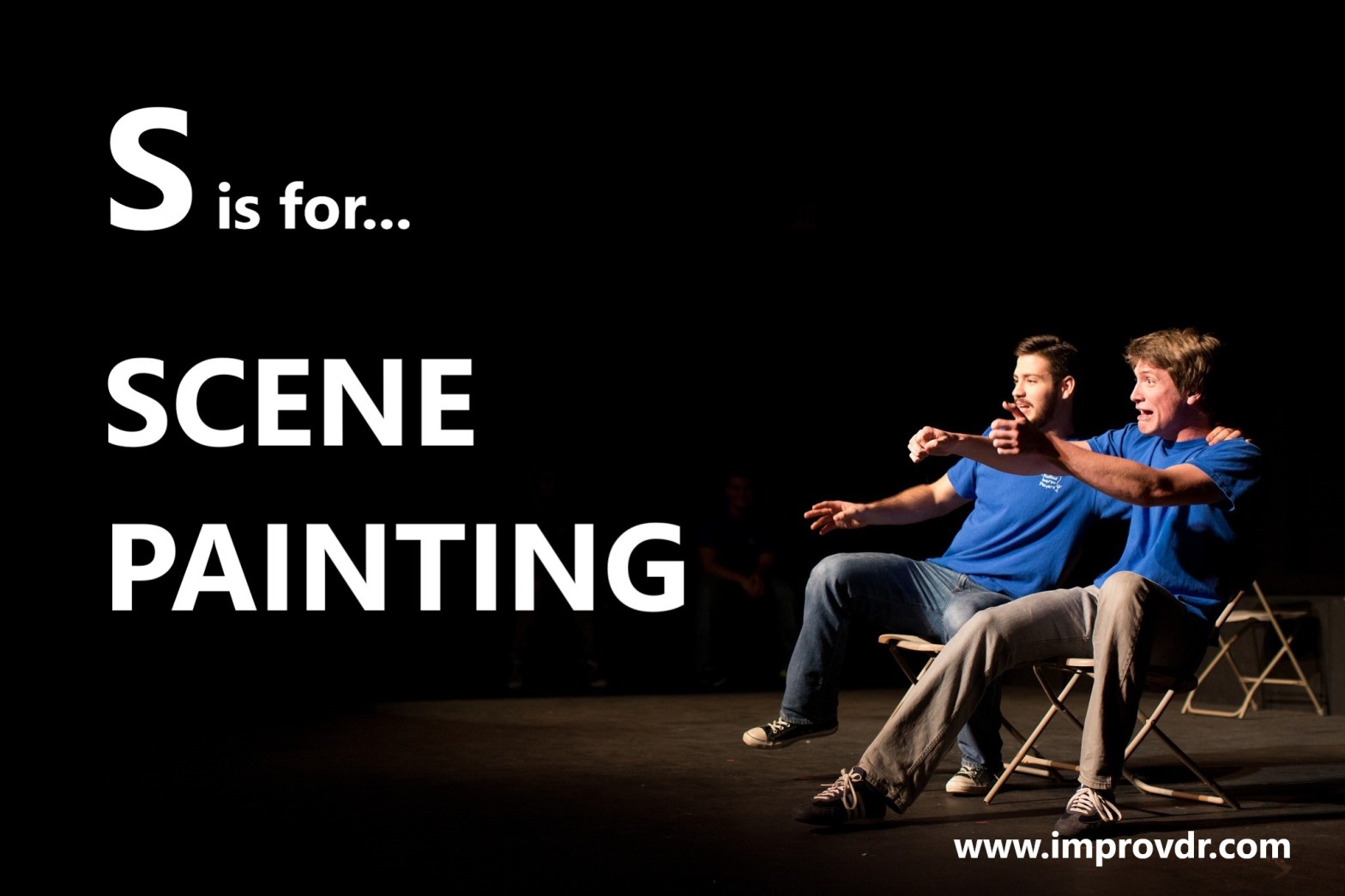
Scene Painting literally allows anything to manifest on stage through the illustrative narrative efforts of the company (as opposed to an initially mimetic “space object” creative approach).

Pigments of Your Imagination

This is just a taste of this entry/concept. Go here for more information.

Related Entries: CROW, Extending, Narrative, Physicality, Space Objects, Verbal Skills, Where Antonyms: Emptiness, Talking Heads, Undefined Space

Cheers, David Charles.
www.improvdr.com
Join my Facebook group here.
© 2022 David Charles/ImprovDr

Connected Game: Typewriter

Game Library: “Rhyme Fire-Line”

Rhyme Fire-Line provides a low-pressure exercise to develop your Rhyming chops. I’ll also use it as a quick warm-up to dust off improv cobwebs before attempting more challenging musical or verse-based work.

The Basics

This exercise works well in groups of four or five so divide your company into teams accordingly. Each player has a turn in the “hot seat” by facing a small line formed by their remaining teammates. A steady rhythm is established by the hot seat player – “A” in this case. The bank of other players offers up words within the set tempo according to the specific guidelines below. After each new word, Player A responds on the next beat with their own corresponding offer. (For the first round this would look like Player B, Player A, Player C, Player A, Player D, Player A, Player E, Player A and then back to Player B.) Player A remains in the hot seat improvising quick responses to their teammates’ prompts for several rotations. Players then shuffle positions, with Player B now stepping before the line, and the process repeats until everyone has had their turn facing the fire-line.

Phase One: This round is optional especially if your ensemble is familiar with the basic version of the game (Word Association Fire-Line), but it can prove helpful to return to this classic to firmly establish the underlying mechanics. In this original iteration, players in the lineup provide random words and Player A must respond with their own instinctive word associations. It’s helpful for the lineup improvisers not to then word associate with the featured player but rather attempt to truly provide fresh inspirations. So rather than a chain that might go something along the lines of “B: Cat; A: Dog; C: Bone; A: Yard; D: Stick…” you would be more likely to brainstorm “B: Cat; A: Dog; C: Power; A: Electricity; D: Scary…”

Phase Two: Instead of word associating, the featured player is now instructed to provide rhymes for each new offer provided by their fellow teammates in the line. As is the case with the above example, players in the feeding positions should strive to be as random as possible rather than lean into obvious patterns or circle around the same series of sounds. In particular, it can become tricky if lineup improvisers inadvertently start to rhyme with Player A’s responses thereby necessitating that Player A rhymes yet another new word with the common ending. So instead of “B: Sap; A: Cap; C: Nap; A: Slap; D: Chap…” a more helpful selection would be “B: Sap; A: Cap; C: Dish; A: Wish; D: Sprinkle…”

Phase Three: This version will look very similar to the above iteration but the small adjustment in intent flexes a different and extremely helpful rhyming muscle. Now feeding players still offer up a rapid-fire succession of random words but they strive to get the featured improviser to say a particular word of their choosing. To make that less opaque, Player B might think the word “sprinkle” but rather than say this word they offer up a rhyme (“twinkle,” “tinkle,” “sink hole…”) in the hopes that Player A will now respond with their original choice “sprinkle.” I find this attitude shift a helpful low stakes interim step towards more intentional target rhyming (the focus of the next iteration) and it also encourages consciously pitching words with accessible rhyming options. There’s no need to stop or comment if the rhyming player offers something unintended as this will disrupt the tempo.

Phase Four: Finally, players explore the concept of more focused target rhyming. Here the caller or facilitator provides a broad category – such as colors, fruit and vegetables, or articles of clothing. For this round, players in the line now pitch words that (hopefully) lead the hot seat player to a rhyme within the given category. So, if the group is exploring colors the exchange might look something like this: “B: Clue; A: Blue; C: Snack; A: Black; D: Scary Sprinkle…” If you’re playing with a jaunty tempo – which is the goal – this can place a lot of pressure on the feeder line so players should offer something with no expectation that every set up will land firmly in the provided category.

The Focus

There will be a hit/miss ratio in this exercise and players should release any expectations of perfection as these will invariably lead to frustration and anxiety. Regardless of what position you are filling, throw out something on the rhythm and then just move on. In addition to sharpening rhyme skills, played with fearlessness Rhyme Fire-Line serves as a palpable reminder that success and failure are innately related in the improvisational pursuit.

Traps and Tips

1.) Rhythm is your friend. This game will quickly descend into chaos if you don’t establish and maintain a clear and consistent rhythm. The tempo should initially be set by the featured improviser so that they can offer a speed that suits their own learning curve and comfort level. Once this is going, however, fellow teammates will probably need to work to keep it consistent as the rhyming player can have a tendency to slow or distort the pace to buy themselves a few seconds when they need it. (Frankly, this happens with the feeder improvisers too!) If you have several groups all playing simultaneously in the same space, clapping to keep tempo can become acoustically problematic and will make it difficult for players to hear each other. I’ll tend to either use gentle finger snaps or even a gestural wrist flip to visually create and sustain the rhythm in these cases. Also be mindful that players don’t crank up the speed accidentally out of misplaced excitement (although this is certainly a fine choice if everyone is on their game and is ready to up the challenge).

2.) Saying something is your friend. I mention this in my focus notes above, but wimping will quickly make the game collapse. There is no denying that this dynamic can prove quite nerve-racking – and equally invigorating when you’ve made it through the gauntlet! Rhyming puts us all in our heads a little, especially when it’s the stated focus of the game. There will be (many) moments when the “perfect” rhyme or set up comes to you two seconds after you needed it, and that’s okay. It’s a healthy spontaneous workout to just leap into a word when the rhythm lands on you. If you don’t rhyme or utter something nonsensical, that’s okay too. When you’re a word feeder, it’s particularly important that you don’t grind the dynamic to a halt as the responding improviser benefits greatly from the pressure and predictability of the steady rhythm. So just say something. More often than not your instinctual utterance will prove better than you had feared. It’s also more helpful to say something simply and clearly than to fumble with a more complex thought that is less likely to be heard or understood.

3.) Be kind to your friends. It’s important that players set each other up for success. Yes, there will be slips, but players in the lineup shouldn’t consciously pitch words that they know are real stumpers or just plain impossible. Everyone is on the same team. If the featured player is struggling, by all means slow the tempo down until they find a sweet spot that is a little challenging but feels manageable. If they’re struggling with multisyllabic offers, simplify and throw out something more basic. Any air of judgment or competition can quickly degrade the experience, so make sure the process is marked by boundless support. As new players rotate into the hot seat, it’s important that the team resets and allows the fresh blood a chance to find their own pathway to learning and success. And when you’re in the hot seat also remember that it’s no small feat offering up new words on cue and, in fact, I’d offer this really does become at least as challenging as the rhyming position in the later rounds.

In Performance

This sequence of games often results in some rather boisterous energy and laughter as players dance on a proverbial language tightrope. It’s healthy and helpful to joyously acknowledge the beautiful fumbles alongside the flashes of rhyming brilliance as players will surely experience both! This is a lesson that most of us can benefit from relearning on occasion as we pursue our craft.

If you’ve stumbled into this entry without seeing the accompanying “R” is for “Rhyme,” this earlier post linked below includes some helpful basic strategies as well.

Periwinkle.

Cheers, David Charles.
www.improvdr.com
Join my Facebook group here.
© 2022 David Charles/ImprovDr

Connected Concept: Rhyme

“R” is for “Rhyme”

A surprisingly useful skill that can enhance your style work, inspire delightful surprises, and connect you more deeply with your teammates.

Climbing the Rhyming Mountain

This is just a taste of this entry/concept. Go here for more information.

Related Entries: Verbal Skills Antonyms: Not Rhyming! Prose Synonyms: Poetry, Verse

Cheers, David Charles.
www.improvdr.com
Join my Facebook group here.
© 2022 David Charles/ImprovDr

Connected Game: Rhyme Fire-Line

Game Library: “Here Comes the Bus”

Structurally similar to the more ubiquitous La Ronde (discussed here), Here Comes the Bus is a called long-form game or exercise that prioritizes the examination of Relationships between an array of characters living and working in a small town or city.

The Basics

A simple bus stop is constructed with a few chairs or similar that can serve as a bench. Improvisers are generally preassigned an order although it can also work well with actors entering at will. In either case, characters are not predetermined but merely who will enter the space next. The scene begins with Player A onstage waiting for the bus. They are soon joined by Player B and a vignette occurs that explores how these two characters know each other and what is happening in their worlds on this particular day. When an outside caller feels that sufficient time has been given to establish a clear dynamic, they announce “Here comes the bus,” at which point the character that has been on stage the longest – in this case, Player A – boards the bus and leaves the stage. The remaining character portrayed by Player B is shortly joined by a new actor, Player C, enabling a new relationship to be explored. Each subsequent vignette is edited by the same device of the arriving bus until all players have had an opportunity to wait at the bus stop. As is the case with La Ronde games, the pattern typically ends with Player A returning – perhaps on the bus – and having their second (and the final) scene with the last remaining player.

Example

Player A sits on the bus bench meticulously shelling and eating a bag of pistachios. After several beats, Player B, with a bookbag thrown over their shoulder, arrives at the bus stop and lurks nearby gently nodding to the tempo of the song playing through their ear buds. Another moment passes until B looks over and recognizes A…

Player B: “Mr. Sadeh? You don’t usually take this bus!”

Player A: (a little out of sorts) “Good morning, Johnny. My car’s in the shop.”

Player B looks away for a moment considering their next tact.

Player B: “I really will get you that paper before the weekend. I’ve had some stuff happening at home.”

Player A: (he’s heard that before) “Well, the deadline was last Friday, so there will be a grade deduction…”

Player B: “I was really hoping that you could do me a solid on that…”

Player A: “Johnny, as you know It’s my policy to treat all my students…”

Player B: “I wouldn’t usually ask for special treatment. It’s my grandma…”

Eventually the caller announces the arrival of the bus and Mr. Sadeh gets on board while a recalcitrant Johnny remains. A few moments later, Player C enters…

The Focus

While La Ronde might jump around in time and location, Here Comes the Bus is a little more contained and tends to function in “real” time; that is, the time on the players’ watches matches that on the watches of the audience. Stories that incorporate numerous characters will typically emerge without much coaxing so don’t overly manipulate connections but rather trust that they will present themselves when the time is right. Lean into character and relationship as this will benefit both the greater arc and the individual players in the short-term.

Traps and Tips

1.) Think small town. Here Comes the Bus works well when it feels like we are meeting an interconnected village of characters that bump into each other with some regularity. The scene doesn’t need to be set in a small town per se, but if you opt for a larger metropolis, it’s worth considering focusing on a neighborhood or community gathering point. The bus stop might sit beside the local mall, or outside a sprawling apartment complex, for example. If players have to spend too much of their precious scenic time justifying why they are there in the first place you might find that the bus keeps arriving before much of value has been established and explored.

2.) Think established relationships. Similarly, players should avoid having to spend too much time figuring out how they know (or could know) their scene partner. As is the case with the related form, La Ronde, strangers are particularly problematic and tend to sap the potential of the vignettes. Players save themselves a lot of needless stress when they launch the scenes with a strong and unapologetic endowment freed from the concerns of being “wrong.” Player A may not have intended to be a teacher or Player B’s teacher more specifically, but once this has been offered the scene now has sufficient raw fuel to find some heat.

3.) Think contrasting relationships. One of the built-in delights of this format is that you get to see characters (with the exception of Player A) in two back-to-back scenes. This configuration inherently invites some fun use of contrasts that can complicate characters in unique ways. Player B is first seen at a status disadvantage with his teacher. It can prove insightful to adjust this arrangement with his subsequent scene partner whether that is heightening it further (C is a domineering parent), inverting it (C is a subordinate peer), or equalizing it (C arrives as a best friend.) It can feel like a missed opportunity when we only get to see one facet or energy from a character in both of their scenes, so keep this in mind as new characters enter the fray.

4.) Think engaging energies. A built-in trap of this game is the rather static titular location that essentially invites characters to just sit on the bus bench and chat. Be mindful not to just fall into this obvious orientation but rather explore a variety of staging and relationship dynamics. Entering mindfully with a prop, activity, or strong emotion can bring promise to a scene that might otherwise remain tepid. If more gentle hues are dominating in a way that is flatlining the story arc, take the risk of embodying a character that is having the worst (or best) day of their life. Even with a generous caller, scenes won’t often have enough time to slowly build up to something of “interest” from absolute stasis so enter ready to play with a gift in your pocket.

In Performance

A thought for the caller or facilitator: while it’s nice to give each vignette roughly equal time, be on the lookout for opportunities to pleasantly surprise the players and audience. If you’re scrolling through a larger group, in particular, it can start to feel a little predictably ponderous if scenes remain too uniform in length and it’s nice to give a scene with dynamite attack a quicker out before it fades or allow a riveting tension a little extra room to boil. You can also easily replace the caller’s announcement with an appropriate sound effect if you’re looking for a more polished edit mechanism.

Many of my thoughts regarding La Ronde squarely apply to this game as well so take a glance at that entry here for further insights especially in terms of how to handle plot, generate apt material, and expand the device into a longer format.

Cheers, David Charles.
www.improvdr.com
Join my Facebook group here.
Photo Credit: Tony Firriolo
© 2022 David Charles/ImprovDr

Connected Concept: Relationship

“R” is for “Relationship”

The second pillar of CROW, Relationship, closely interacts with and enriches the earlier concept of Character. With the exception of solo pieces (and even then, there are often implied or absent scene partners) an audience typically understands our characters based on how they engage with others in their environment.

Making the Most Out of Your Onstage Relationships

This is just a taste of this entry/concept. Go here for more information.

Related Entries: Bulletproof, Character, CROW, Objective, Where Antonyms: Strangers Synonyms: Who

Cheers, David Charles.
www.improvdr.com
Join my Facebook group here.
© 2022 David Charles/ImprovDr

Connected Game: Here Comes the Bus

Game Library: “Word Association Reincorporation Story”

I encountered this narrative exercise during my Theatresports days and so it likely traces back to the teachings and writings of Keith Johnstone. The rather clumsy name I jotted down, Word Association Reincorporation Story, essentially defines the constituent elements. This is a great workout of your memory, along with your shelving and Reincorporation muscles.

The Basics

Players work in pairs with one serving as the brainstormer (A) and the other as the first narrator (B). Player A is given approximately thirty seconds to free associate a random collection of phrases and images. Player B must then construct a narrative that reincorporates as many of these story fragments as they can recall. Upon the completion of the first story, Players A and B exchange roles and the process repeats.

Example

Player A: “A dripping ice cream cone. The smell of dried roses. A small shoe box. A couple laughing at a restaurant table. A dog sprinting across a lawn. A rusty key turning in a lock…”

The caller or instructor signals that 30 seconds has finished.

Player B: “It was the kind of summer day that you always hope for. The sun was high in the cloudless sky, dogs – freed from their leashes – were joyously sprinting away from their humans, and Raj and Sarla soaked in the sights from their quaint outdoors restaurant table. In simpler times they had frequented this bistro often, but it had been a year full of challenges and obligations, and this beautiful day was the first time their schedules had aligned and brought them back to their favorite haunt. They shared another laugh as the waitstaff refilled their cups…”

The Focus

The narrator should strive to weave Player A’s ideas into an interesting and coherent story finding opportune moments to include shelved elements and then incorporate (and reincorporate) them into the mix.

Traps and Tips

1.) Randomness generally helps. As Player A crafts their list of elements, it can become challenging not to have them all center around a common theme or energy. As best you can, aim to include some randomness and disparateness as this will more likely inspire and challenge the storyteller. To aid in this regard it can be helpful to deploy the concept of the third thought or skipping a step. If the ice cream cone makes me then think of the summer heat I can “skip” this image and move onto the dried roses (a result of too much heat). Although perhaps avoid going out of your way to needlessly include glaringly anachronistic or stylistically incompatible choices – a laced corset, a spaceship’s tractor beam, the first bricks of an ancient Egyptian pyramid… The exercise has enough innate challenges as it is!

2.) Think images rather than just words. As modeled in the example, images will generally inspire more dynamic adventures than just a list of simple words – dog, coffee, flowers. This is a less common approach to word associating but it is worth practicing as it provides choices with richer details and potentials. It’s also helpful if your image associations don’t all belong to the same category: if everything is a different feature of the landscape, or a new character, or a detailed hand prop, then you are listing in a way that could hamper the resulting narrative. If this happens organically then so be it, but if you have the wherewithal to spot the trend as it’s unfolding, then perhaps jolt yourself onto a new thought pathway.

3.) Use what stands out to you. It can feel as if the contract of the exercise is that the storyteller must use all of the first player’s thoughts. While this is certainly an admirable ability, at least initially narrators should feel empowered to focus on the specific choices that intrigued or inspired them most. If narrators rush through the list in the hopes of checking everything off, it’s possible that rich offers won’t get enough time to develop and bloom. It’s more than okay to loiter around a few choices that feel dynamic and worthy of your time as the storyteller, especially when you’re setting up the foundation of your narrative. Even at my computer I felt a pressure to move past the laughing couple so as to get to something else, but they are likely to emerge as the story’s protagonists, so it’s helpful to give them sufficient time “on stage.”

4.) There are many ways to make the images important. While I caution against a “quick hit” mentality of just mentioning an associated image and then moving on, there are many different ways to make each offered detail significant. For example, while it’s possible that the leash-less dog will make a return (perhaps they knocked over a child holding the ice cream cone) their initial appearance did a lot in terms of setting the mood and tone of the story. Don’t feel obliged to use each offer with the same storytelling brush stroke. That being said, as I’ve partnered this exercise with the concept of reincorporation, do remain open to strategic reappearances when they present themselves. Especially if you’re searching for the next step, it’s a tried and tested narrative tool to reach back onto the improv shelf to repurpose a dormant detail.

In Performance

It can prove helpful for pairs to have a short debrief after each experience perhaps with a guiding question such as “what was a particularly successful or memorable use of an associated element?” Much like its similar counterpart, Advance/Extend Stories here, this exercise typically results in joyful and rich stories that remind us as players to simply use what we’ve been given! If you use a random word or image generator, this is also a good solo improvising exercise that can sharpen your story skills and confidence.

Cheers, David Charles.
www.improvdr.com
Join my Facebook group here.
© 2022 David Charles/ImprovDr

Connected Concept: Reincorporation

“R” is for “Reincorporation”

Taking something that has already been said, created, or referenced, and using it again.

Repeat After Me…

This is just a taste of this entry/concept. Go here for more information.

Related Entries: Accepting, Callback, Connections, Looking Backwards, Names Antonyms: Shelving Synonyms: Recycling, Repeating, Reusing

Cheers, David Charles.
www.improvdr.com
Join my Facebook group here.
© 2022 David Charles/ImprovDr

Connected Game: Word Association Reincorporation Story