When we’re improvising, it’s critical that we are attuned to all the aspects of our scene partners’ choices. We often refer to this heightened sense of attentiveness as Active Listening, and this exercise is a great way to sharpen this skill while encouraging players to make rich and detailed offers. Beneath the Line truly requires players to scrutinize the hidden meanings contained in the first moments of a scene.
The Basics
Players work in pairs. This can be done with all pairs working simultaneously, but I prefer to do it one pair at a time in front of the group if time and logistics allow as there is a lot to be gained from observing. A line of dialogue is obtained or assigned. Player A sits in a chair and is the receiver of the exercise. Player B enters the space and, generally in silent action, establishes a dynamic and detailed context for the scene and relationship. As this culminates, Player B says the pre-determined line of dialogue.
Example
The line “I love you” is provided.
Player A sits “neutrally” in a chair.
Player B enters holding pantomimed keys in their hand. They slowly make their way around the “car,” with a heaviness in their gait and avoiding eye contact. Eventually, they arrive at B’s side of the “car,” and they open the door. With a gentle sigh and almost unconscious head shake, they utter, “I love you…”
The Focus
It is incumbent upon Player B to enter the space with a reasonably fleshed out sense of the given circumstances, while Player A should be studiously looking for clues and offers. The scene can draw to a close after the one line has been delivered, and then Player A (and possibly the rest of the group that is observing) can articulate what they experienced and assumed. Player B may then have an opportunity to add any missed or “misinterpreted” details. This exercise also allows that rare improvisational do-over if Player A’s perception of events is wildly different than intended. As players become more confident and adept, scenes could launch from this first moment and then continue onward.
Variation
Generally, the one inspirational line is provided, and this same dialogue may be used for multiple scenes in a row. In terms of the context, players may either self-select their own given circumstances before entering (as described above), or a detailed CROW could beprovided privately from a list. Both approaches have pluses and minuses. While the first method allows greater freedom of choice for Player B, this freedom can feel too infinite at times, and players can be tempted to smudge their intent towards what was successfully communicated or only make vague assumptions prior to entering. The second method provides a more consistent target but certainly involves considerable preparation. When I use this second variation, I like to use random slips of paper so that players get to try scenarios regardless of any preconceived notions of “type.”
Traps and Tips
1.) Be patient in the chair. While Player A typically begins the scene in a somewhat neutral state, they should still strive to be a receptive and helpful scene partner. They can be invited to move or participate in the activity of the scene while layering in emotional details and specific staging as they start to piece together the puzzle. However, they should also be patient and allow their partner sufficient room to establish some ideas before making large assumptions. For some, this might feel like a new way of beginning a scene, with one player more definitively taking the lead, so it might take some practice to feel the corresponding scenic rhythms.
2.) Emphasize the experience rather than being correct. A common adage of improv is that there are no mistakes, but this exercise does have an element of trying to solve a riddle with a particular answer. It is more than likely that players will misinterpret offers from their partner; in fact, this is part of the lesson and the fun of the game. As mis-readings occur, emphasize the factors at play that could invite deeper listening and clearer initiations. Why was the relationship misconstrued? Did Player B make some unintended choices that influenced Player A’s perception? Were offers made in view of the audience but not in Player A’s line of sight? In retrospect, were there any missed opportunities for clearer communication?
3.) Make the silence count. The provided line, in the above example “I love you,” could occur anywhere in the scene, but it tends to work well as the button to the initial offers. It’s helpful to use the conceit that while the players could choose to talk at any given moment, there is an emotional tension or rich backstory that at least initially prevents the characters from doing so. Extending the opening silence can be a true gift of this exercise, promoting greater patience and specificity in the initial moments of our scene work, so don’t needlessly rush through this silent action. Other utterances are fine, such as sighs, groans, exhalations, and the like, but avoid putting any additional dialogue prior to the provided one line. A key goal of the game is to really make that one line count as much as possible.
4.) The more specific the intent, the better.In the above example, I was picturing an over-worked single parent who had just picked up their teenager from the police station again after being called away from an important business meeting at their law firm. Especially in written form, it’s unlikely that all of that was communicated in my description of the stage action, but this level of specificity gives the performer so much more to play with than just a parent picking up their child after school. Enjoy the opportunity to front load a dynamic premise while also accepting that the likelihood of communicating every small element successfully in the silence might be unlikely.
5.) Don’t feel the need to describe all your prior choices if you continue the scene. If you move the exercise into fuller scenes, it can be tempting to describe all the subtle gifts rather than just accepting them and allowing them to play out at their own pace. Yes, it can certainly be helpful to define key elements, to let your partner know that you also see them as the parental figure, or that you are outside your family home, but let these details emerge organically rather than in a monologue. If you are in the Player A position, you shouldn’t be afraid of making assumptions (ultimately what you perceived is your reality after all), but if a major element feels opaque, it can be in the spirit of this exercise to allow your partner a little extra space to send you some more information. If you are in the Player B position and a choice is made that doesn’t gel with your intent, make sure you fully embrace this new direction. The discussion after the scene will give you a chance to explore any missed opportunities for stronger communication.
In Performance
Beneath the line can really encourage a slower and more detailed style of play that embodies generosity, patience, and attentiveness. There is no reason this approach to starting a scene couldn’t be added to your general improviser utility belt if it’s not there already as it can provide dynamic and rich openings. I also like that it makes that first line really count as the players have worked their way up to it with great deliberateness.
This is a short-form game that has sadly fallen out of rotation in my current companies. I believe it was one of the standard Theatresports formats we explored during my high school days, but I don’t think I had an appreciation for its tone and inherent gift during that youthful time. It’s less “showy” and “gimmicky” than a lot of other games in the mix, but when it comes to challenging your Acting chops, Scene Ending in I Love You fits the bill perfectly.
The Basics
The core requirements of this game all reside in the title. A premise for a scene is obtained, and by the end of the scene, one character must say to another the titular phrase “I love you” as the final line. You can add a time challenge (this was often the case in the classic Theatresports model I first encountered), but it will likely provide richer possibilities if you give the game a little room to breathe.
Example
The scene is based on audience suggestion of a couple that has recently broken up. As the lights come up, Player A mimes holding a large box and awkwardly knocks on a door. They wait, in a clear state ofdiscomfort, until Player B finally opens the door and stands in the frame.
Player B: (tersely) “I wasn’t expecting you today.”
Player A: “Yeah, I know. I just thought it’d be better if we got this over with.”
Player B: (impatiently) “Well…?”
Player A: (gesturing towards the box) “I thought you might like some of your things back. Can I come in and put this down?”
Player B: “I’d rather you didn’t. We can just do this here.”
Player A: (taken aback) “Oh, okay.” (Looks for a place to put the box down) “I did my best to sort through our music collection…”
The Focus
This scene is a great vessel for patiently exploring a relationship and all the complex emotions and subtextual ebbs and flows bubbling beneath the surface. Don’t rush the journey. Let each moment have sufficient time to land, and endeavor to keep your attention firmly on the here and now.
Traps and Tips
1.) Start away from love. As the scene is about getting to this statement of love in a sincere and meaningful way, it generally helps to start as far away from this known destination as possible. There will always be earnt exceptions to the rule (a clearly in-love couple struggling to say this phrase for the first time to each other, for example) but starting with a moment of rupture or tension raises the stakes of the scene exponentially. I personally love the challenge of acquiring a relationship or scenario in which this outcome seems almost impossible to achieve. Fight the instinct of trying to solve the “problem” of the scene too early by dropping breadcrumbs or foreboding what we all know is coming anyway. Rather, play the truth of the moment and just let the scene launch and follow its organic trajectory. Trust that you’ll find an honest tilt in the scene that you haven’t had to superimpose or clumsily manufacture. To this end, it can also be dynamic to avoid the “easy” confession. In the example above, Player A seems to have more residual affection than Player B at least at face value, so it could be interesting to explore how “B” might get to this moment.
2.) Don’t throw away the last line. Sure, it’s possible to have the neighborhood paper deliverer just walk in at the end of the scene and proclaim their love, but this really misses the point of the exercise. If you’re accepting the true challenge of the game, “I love you” should have become the most emotionally real and dynamic choice possible when it is finally uttered as everyone knows that this is, by design, the climax and button of the scene. The last line might contain elements of humor, pathos, whimsy, sincerity, or any other of an endless array of qualities, but I’d caution against thinking of this moment in a gimmicky way. Don’t throw away the opportunity to explore some emotional vulnerability. The conditions under which the line is uttered are truly wide open: Player A could make it a last ditch attempt on one knee to win Player B back, or after Player B leaves, “A” might look through the box and use the line to reveal their real feelings. Also, remember that while “I love you” is the last line of dialogue, it is not necessarily the last moment of the scene, and there may be one last significant silent action or beat.
3.) Prioritize the relationship and connection. I think of this game as primarily an exercise in exploring and developing relationships. My teenage self, who first learned this game, was probably much more comfortable with the thought of disarming the statement by declaring my love to a lasagna rather than another person. Obviously improv games can be packaged and retooled to serve any of a thousand agendas, but I think it’s a mistake to deprioritize a focus on the energy between the characters in favor of ultimately setting up a gag or joke. (There are plenty of other short-form games that can facilitate this desire.) You’re more likely to have the space to develop a dynamic relationship if your scene isn’t overcrowded but rather focuses on one central pair of characters. It can be helpful to acquire this relationship as the initiating ask-for and just commit to sending these characters on the journey. Remember that while there is likely some mystery as to the exact specifics, everyone knows the gist of the scene’s outcome right as it starts: someone is going to say the emblematic phrase. It follows, then, that the scene is not so much about what happens rather than how it happens.
In Performance
As I become a little more seasoned (and grey), I have developed a greater appreciation for improv games that consist of a simpler premise and, therefore, are more open to complex explorations and interpretations. Scene Ending in I Love You certainly meets this description. The mechanics of the game couldn’t be more basic and elegant, but they also provide a beautifully blank slate and stirring invitation for us to really stretch our acting muscles.
Just as scripted performance can benefit from the tenets of improv, so too can spontaneous work become elevated through embracing “traditional” Acting strategies.
Scripted Theatre Techniques Worthy of Emulation…
This is just a taste of this entry/concept. Go here for more information.
The next addition to the ImprovDr “Game Library” is connected to this week’s concept of Accusations. I first encountered this talk-show inspired game called Point/Counterpointduring my time at Walt Disney World’s Comedy Warehouse.
The Basics
This game features three players. One assumes the role of the host and adjudicator, while the other two are pundits appearing on the show. Prior to the scene, the host (or perhaps your emcee or another company member) gathers a list of five random objects or topics – the more benign and less overtly political the better. The host then introduces the scene and their two guests, each taking a moment to quickly identify themselves and establish a general point of view or leaning on the political scale. One at a time, the host introduces the audience-elicited topics, and the pundits each take a turn at strongly arguing their “pro” or “con” stance. This typically continues until all five ask-fors have been utilized and the show is wrapped up.
Example
Host: “And welcome back to Point/Counterpoint where we take on the hot button issues that are on everyone’s mind. I’m excited to have two very special guests joining me on the show tonight. Please take a moment to introduce yourselves.”
Player A: “It’s my pleasure to be here again! I’m Hank Rightman, author of Looking for the Rightman for the Job, and amateur dog-walker.”
Player B: “Thanks for having me on the show. I’m Dr. Connie Spiracy, and I haven’t drank out of a plastic bottle since I was eight.”
Host: “So glad to have you both here. Let’s get right to the issues of the day… (reading from the audience list of suggestions) Cucumbers. Everybody is talking about them.”
Player A: “Oooh, don’t get me started on Cucumbers. They are clearly a waste of space better used for development. So few calories, so little taste, and yet I’m sure your other guest will insist they need a slice for their water.”
Player B: “Look, I’m clearly pro-cucumber and have made my stance abundantly clear. We need to stop chasing ‘new’ foods that leave huge carbon footprints and, instead, embrace the great foods that are local – after all, nothing is cooler than a cucumber. And yes, I’d love a slice of cucumber for my water if you’re offering…”
The Focus
I’ve partnered this game with the concept of Accusations as playful attacks between the guests over trivial content is much of the fun of the game and intensifies the underlying satire. Strong points of view on the parts of the debaters are critical as they provide a frame through which the various random subjects can be filtered appropriately. The host serves essentially as a referee, although they should strive to heighten the energy rather than quell it. This role is certainly a great place to explore character too but remember that attention should primarily reside on the two competing experts.
Traps and Tips
1.) Trivial topics help. The political frame of the piece is deliberate and dynamic, but the game can quickly start to feel icky or too “on the nose” if truly divisive issues are offered up. The sillier the prompts, the better. To this end, it can be helpful for the host or player facilitating the elicitation of these ask-fors to request items for uncontroversial categories, such as articles of clothing, childhood toys, states, or pastimes. It may be advisable to elicit this list before even defining the pending game for the audience so as to keep the field of possible topics as open as possible. It’s also helpful for the host to quickly “rank” the answers, leaving the item with the most comedic or dynamic payoff for the final topic of conversation.
2.) Assume a clear “pro” or “con” stance. The guests need not always speak in the same order (it’s typically better to allow whoever has an angle brewing to go first), but it is generally helpful for players to clearly establish whether they are “pro” or “con” the subject. Often the game may evolve so that the same guest always falls on the same side regardless of the issue, but you can also change it up if that’s where the most promising material resides. As is the case with all patterns, there can be great joy in strategically breaking the routine, and I’ve seen the game successfully end with the guests unexpectedly finding consensus, usually for the last item. Just let the arc develop organically.
3.) Characterization is a great gateway to content. This format can tend to privilege quick wit and word play which may not be your innate strength as a player. Having a strong energy and point of view as a guest goes a long way to help in this regard as you can always lean on your character if a clever angle isn’t quickly coming to mind. Some good-natured sparring between guests can help build energy as well. And if the muse isn’t visiting either guest, the host can elect to quickly move over an item: there’s no need for each topic to receive equal treatment and it’s fine not to get to all five topics if you’re finding fun fireworks with just a handful.
4.) Embrace the style and satire.This game is a great vehicle for satirizing the echo chamber of talk shows and pundits who can and will disagree on anything. Typically, the guests will take on positions that clearly reflect exaggerated “right” and “left” personalities. It may take a while to find an appropriately whimsical tone in rehearsals as the game can feel a bit mean-spirited if it becomes one-sided or tackles current issues in unnuanced ways. It seems to play best when improvisers fully embrace the tropes of political discourse while keeping their content firmly in the land of the trivial, allowing the audience to make their own connections and judgments.
In Performance
This game requires a little practice and finesse and can feel a little like jumping into the deep end of the swimming pool as an improviser if it’s a new addition to your repertory. An attentive and generous host goes a long way to help steer the debate from topic to topic in a timely fashion, and I’d reiterate my advice to unapologetically discard any topics that might not set the guests up for playfulness. There’s enough ugly politicking in the world without us needlessly recreating it on the stage.
This dynamic served as the second installment of the ImprovDr “Game Library” where I initially matched up exercises with a concept of the week. Accepting is such a critical and pervasive underlying improv concept that I actually had a hard time narrowing down my choice for this entry. I decided to offer up a game that almost consists of nothing but accepting at its most immediate and unbridled. It’s time to explore That’s Right Experts.
The Basics
Two or more players, often (but not necessarily) seated, obtain a simple factual statement from the audience before the scene begins. As the expert scene starts, one player offers up this factoid, and then in quick succession, each “expert” accepts and extends upon the prior choice of their teammates. Players continue to “Yes, and” each other as they discuss and extrapolate on the fact at hand, generally pursuing a curve of absurdity until their expertise arrives at an unexpected, but wholly justified, conclusion.
Example
The “experts” obtain the suggestion that modern opera began in Ancient Greece.
Player A: “Well, we all know what we’re here to discuss today, because frankly it’s been all over the news: you guessed it, folks are talking about how modern opera got its start in Ancient Greece.”
Player B: “That’s right, Melanie! It was over 2500 years ago that the Greeks gathered in their huge outdoor theatres to hear the stories of the day.”
Player A: “You’re so right. These amphitheaters were so large that the actors really had to project in order to be heard all the way in the back.”
Player B: “That’s right, cause even the poor Grecians in the cheap seats needed to be able to hear all that poetry, or they’d get restless and threaten to riot.”
Player A: “You couldn’t be more right because these Grecian operas were actually designed to lull the masses into peaceful oblivion.”
Player B: “You’re right there, and that’s why the Grecians were known for bringing pillows and their night clothes to the performances…”
The Focus
There is not a lot of room to evade in this scene as an improviser, and even as I just improvised the snippet above, I had to remind myself to fully accept the prior offer before adding a new element or tangent. A gentle curve of absurdity is key. You don’t want to leap from opera in Ancient Greece to smashing guitars in rock and roll solos in a few steps, although this might be a lovely place to end up by the end of the game. The fun is the journey. Avoid trying to force a particular outcome rather than allowing it to unfold for the players and audience simultaneously.
Traps and Tips
1.) Use and enjoy the titular refrain. While it certainly doesn’t need to be verbatim (as I’ve modeled above), there is a simple delight in echoing some version of “That’s Right” during the build of the expert scene. On a simple level, it can buy you a few seconds to process what your partner has just said, while more generally this refrain adds a playful energy to the rising action if the agreement and accepting heighten and become more and more passionate with each exchange. Don’t under-estimate the true joy of just watching fellow improvisers revel in the process with each other.
2.) Small steps are key. I know of few performance games that so inherently demand small and related steps. If you start to race to a perceived ending or desired conclusion, you’ve almost lost the battle before it has begun. The game really requires you to stay firmly in the moment, connected to your partners, while you look for some simple potential in their prior offer. I’ve explored Reiterate/Repeat in another entry, and this approach can certainly be helpful as well to make sure that you have fully embraced the previous choice by paraphrasing some element of it before adding your own obviously unique twist or addition.
3.) Use what you know and sell what you don’t know. Especially in the first expert exchanges, it can be helpful to lay down some basic “facts” that are as close to the truth as your personal knowledge base can afford! In many ways, this provides the balance or routine before the unexpected connections and departures ensue. Remember that even if you’re way off in an early assertion, the audience loves it when we’re brave and take the risk to say something specific. This is also a key element of selling the expert frame of the format. If you equivocate too much with stalling vagueness, you’re also not providing your partner with details that they can recycle and re-frame.
4.) Pairs or trios work well.While you could certainly have a larger panel of experts, or perhaps deploy an additional teammate to facilitate as a host, there is something about the rhythm and danger of just having two or three experts alternating lines back and forth that is bracing and exciting. Obviously, adjust the game to suit your needs, but if you’re looking to increase the panel it might be wise to at least establish a default speaking order so that the ball doesn’t get dropped after each offer. This is part of the particularly risky dynamism of just having two experts: there is no doubt where the focus is at any given moment.
5.) Remain physically engaged. I’ve mainly experienced this game with the experts seated beside each other, but I don’t think that it has to occur in this particular staging, although keeping the focus contained certainly assists the players in maintaining their connection and pace. While the dialogue is key, look for opportunities to engage strong points of view, character mannerisms, and relationship foibles. Similarly, even if the scene starts in chairs, there’s no reason that the crescendo of “That’s right” needs to keep you in those chairs as the scene draws to a close. And throwing in a little activity probably isn’t a bad idea either!
In Performance
I’ll confess that this game, for all the right reasons, still scares me a little, and while it’s been in my improv repertory for decades, it’s definitely not a format I see or play with great frequency. This brings me back to my earlier comment that this is really an elegant exercise with few bells or whistles to hide behind. If you’re not accepting fully and with abandon, and listening deeply to your partners, it can be hard for the narrative to unfold with ease. Give it a try and let me know how it goes!
A small addendum after a recent workshop: I think this works really well in threes (and standing), especially using the default order advice above (while allowing and encouraging inspired players to break that pattern when it suits). A third player gives everyone a little breathing room and can also add energy to the chorus of “that’s right” as the scene builds.
As I noted in my previous entry here discussing the opera-improv-script hybrid that is (Your) Opera in a Trunk, this format was primarily designed with the assumption that the company might have rather sparse improv experience as they began the rehearsal process. For this reason, early rehearsals covered the greatest hits of improv, introducing core concepts such as accepting, wimping, and endowments. By design, the show was a small cast of characters embodied by the soprano, tenor, mezzo, and bass respectively, with the high voices typically assuming the more heroic or virtuous roles and the lower voices taking on the function of confidant(e)s and villains, very much in keeping with classical archetypal tropes inherent in much of the genre. Subsequently, the improv portions of the show were very relationship based, and the casting of dynamic characters was key to the arc and success of the performance. Each time a new character emerged, the audience was given the opportunity to vote from three cast-provided options, and so it was important to strengthen the skill of providing suitable archetype and relationship possibilities.
A game called Justify Circle was helpful in this regard, offering an embodied exercise to explore how characters might connect in ways that complicate, enrich, and add playfulness to the unfolding world of the opera.
Here’s a peek inside at how the exercise works:
The Basics
Players form a circle. One player volunteers to step into the middle of the group and assumes a dynamic (but frozen) pose suggestive of a character, activity, or energy. Once this image has been formed, any other player from the circle can enter and, using their own body, assume a related pose that “makes sense” of the first image, providing context, relationship, or added detail. Once this companion pose has been established, the first player says, “Thank you” and returns to the edge of the circle. The group is now left with a new incomplete image that inspires another player to enter and physically justify the remaining pose in a different way.
The Details
As the title of the exercise suggests, this game explores the concept of justification: providing a context, frame, or rationale for an incomplete or nascent choice. It’s important to stress that this justification need only make sense to the entering player, although they should strive to communicate the intent or inspiration behind their choice as clearly as possible. There is a joy in the abandon and freedom the exercise can unlock.
Within the context of (Your) Opera I typically also stress the difference between parallel choices (those that essentially mirror the idea of your scene partner) and complementary choices (those that offer a cause-and-effect dynamic, or a more complex relationship or power dynamic). In this game, parallel choices tend to collapse in on themselves after a while as they limit the emergence of new ideas, while complementary choices tend to open up new, perhaps unexpected, directions and possibilities. With only four characters to cast in this particular format, it was particularly critical to train an eye for the latter. I write about this at greater length in my consideration of the seventh commandment of Theatresports which you can find here.
Example
The first player enters the circle and assumes a pose crouching on the ground with their hands covering their head.
A second player enters, and mimes lovingly placing a shawl or covering over the first player who they have viewed as a child in need of comfort. The image sits for a moment, and then the first player says, “Thank you” and returns to the edge of the group.
A third player enters and assumes the stance of a charging bull with a ferocious look in their eye. The caring gesture is now re-framed as a cowering bullfighter who is about to be attacked. After a moment, the second player says, “Thank you” and moves aside…
Traps and Tips
1.) Encourage momentum. This exercise promotes bravery and trusting your first instinct, so encourage players to leap before they look. If using random entrances doesn’t accommodate full participation (especially if you have a larger group) you can move around the circle in order or split the group up and play it in smaller circles or even pairs. The two-person variant of this exercise is extremely bracing and dynamic as there’s nowhere to hide as you immediately have to return to craft a new tableau once you have left! Once a group is familiar with the conceit, playing in pairs is a great way to raise the stakes.
2.) Note parallel chains if they emerge. I’ll often use this game to introduce the concepts of parallel and complementary action, and I think it’s helpful to at least acknowledge if the ensemble is falling into a pattern of mirroring the prior choice rather than justifying it with a new frame or energy. There are exceptions to all improv rules, but I’ll often use the phrase “what does this character need in their world” to try to unlock potentials. There are certainly times when this “need” might in fact be a parallel – a boxer generally needs another boxer – but in most instances there are also interesting complements lurking as well – a boxer can also need a manager, a referee, an announcer, a coach, a worried parent, a fan, a doctor…
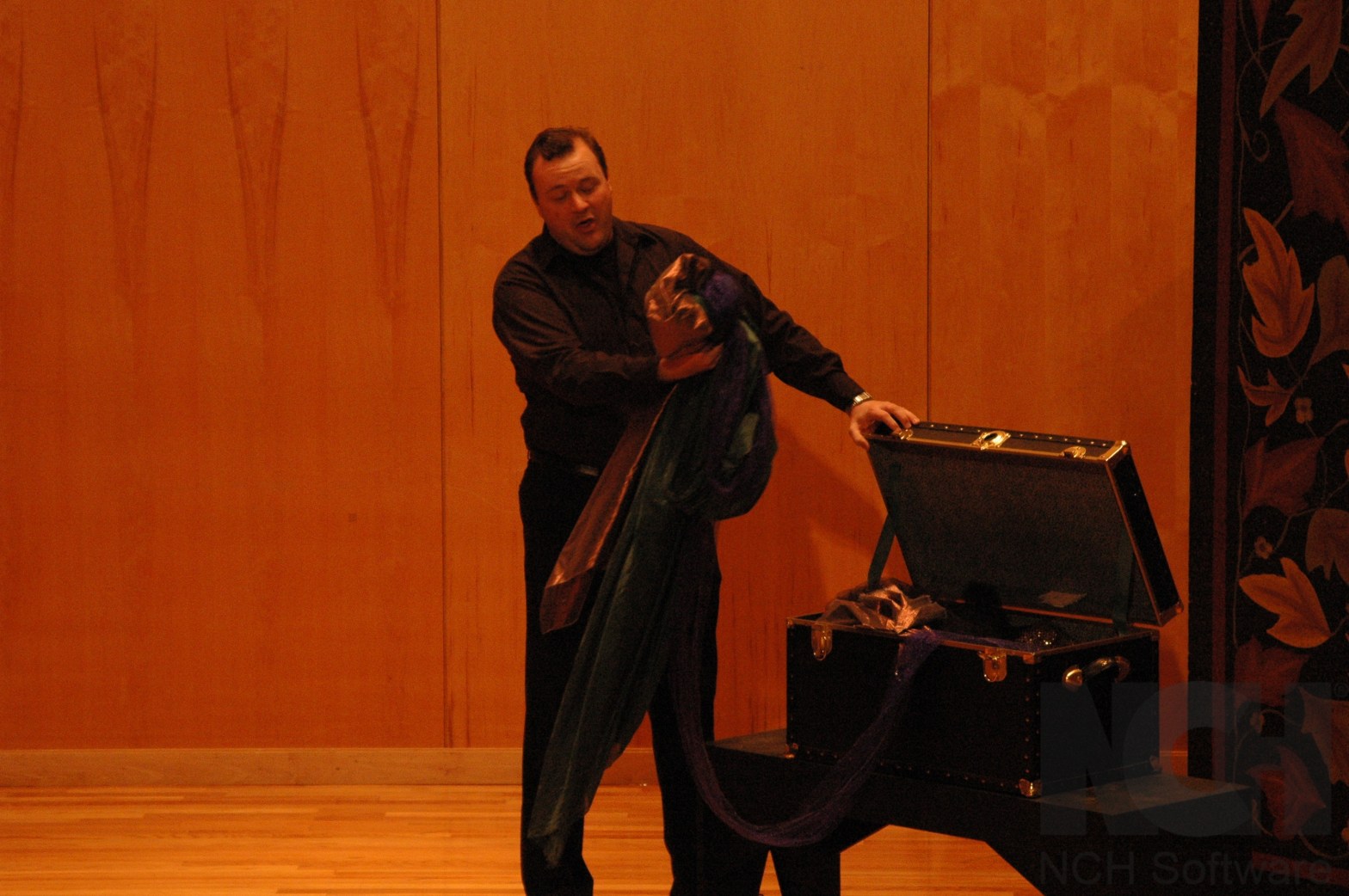
Members of the (Your) Opera in a Trunk company provide costumes and character possibilities for the awaiting Bass.
3.) Embrace the “Thank you.“I’ll often joke that the game teaches manners as well as improv, but the “Thank you” really does serve an important function. It provides a rhythm to the exercise and discourages players from jettisoning until they are confident the entering player has fully embodied their new offer. It also punctuates the beat between each completed tableau and acknowledges that a gift has just been given (even if the leaving player doesn’t fully understand the specifics in the moment). If you play the two-person version, the “Thank you” is even more critical for maintaining the integrity of the sequence.
4.) Embrace the silence.As I note below, there are certainly ways to use this frame to jump start scenes or explore dialogue, but the foundational exercise is intended to encourage physical communication. Players can have a tendency to only halfheartedly commit to the poses especially if they can “explain” their choice rather than fully embody it. Similarly, look out for players performing an activity rather than committing to a static pose rich with emotion and dynamism. When the exercise is operating on all cylinders, tableaux should explore a wide variety of compelling stage pictures and levels.
Final Thoughts
Justify Circle is one of those lovely foundational exercises that is readily adapted to multiple contexts and needs. As the company members became more comfortable and proficient with making dynamic relationship choices, I’d add new elements to the basic game structure. We might use a tableau as the first moment of a scene and then allow it to continue for a few sung or spoken lines. As (Your) Opera involved company members providing character possibilities for audience votes (see the image above) we would also sometimes explore multiple complementary roles for a tableau: if our soprano is an ice cream parlor owner, then who might our tenor, mezzo, and bass become to help populate this world with allies and obstacles? So much of the success of this format was directly attributable to the increasing playfulness with which the company would concoct whimsical character combinations and connections, and this exercise helped establish that creative mindset.
And that’s your peek inside the rehearsal process of (Your) Opera in a Trunk, my first successful “scripted” improv show that debuted at Pensacola Opera.
I encountered the Ten Commandments of Theatresportswhen I was first introduced to improvisation in New Zealand during the 1980s. These helpful “rules” provide a launching point to consider many of the fundamental principles that serve as the bedrock of most modern improvisational practices. There is some debate as to whether or not rules are necessarily helpful or may, rather, encourage players to think too much while creating onstage. Overall, however, I think there is sage wisdom to be mined, and I used these ten guidelines to inspire one of my first ImprovDr.com blog series.
Below you’ll find a summary of the commandments. Each entry is also connected to a game or exercise that explores the concept.







 ImprovDr.com